


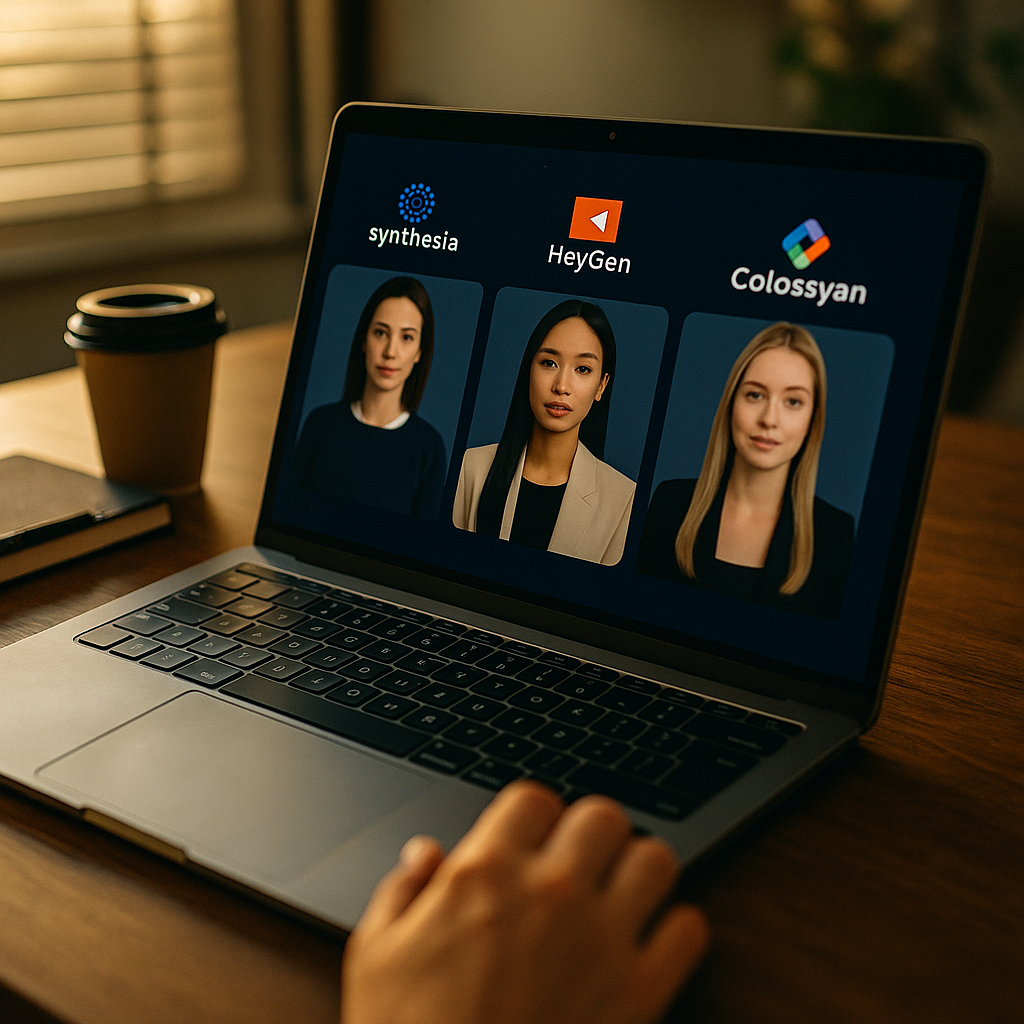
Gartner estimates that by the end of this year, over 30% of enterprise marketing videos will include at least one AI-generated avatar segment. That’s not a novelty stat anymore — it’s a procurement problem. Choosing between Synthesia, HeyGen, and Colossyan now hinges less on avatar realism and more on brand safety controls, localization depth, and how well each platform survives a legal review.
This isn’t another feature checklist. It’s a buyer’s breakdown for teams who have to answer to compliance, legal, and a CFO who wants to know why video production costs are suddenly a line item in the martech budget.
Why Brand Safety Became the Deciding Factor, Not an Afterthought
Two years ago, enterprise buyers picked AI avatar tools based on lip-sync quality and voice cloning realism. That calculus has flipped. Now the first questions in vendor evaluations are about consent chains, watermarking, and whether a disgruntled employee can generate an off-brand video using a shared workspace login.
Regulators aren’t waiting around either. The FTC has signaled increased scrutiny of synthetic media disclosures, and platforms like TikTok are already enforcing C2PA-style labeling requirements on AI content, a shift covered in detail in our breakdown of TikTok’s C2PA rollout. If your avatar vendor can’t help you meet provenance standards, you’re inheriting risk that lands on legal’s desk, not marketing’s.
The real cost of an AI avatar platform isn’t the seat license — it’s the incident response plan you’ll need if governance controls fail.
Synthesia: Enterprise Guardrails Built for Regulated Industries
Synthesia has leaned hard into the enterprise compliance narrative, and it shows. Its admin console lets brand teams lock avatar usage to approved templates, restrict script content through moderation filters, and enforce SSO with granular role permissions. For a pharma or financial services brand, that’s not a nice-to-have — it’s table stakes.
Synthesia’s content moderation engine flags scripts containing prohibited claims before rendering, which matters enormously for regulated verticals where a single unapproved health claim can trigger a compliance review. The platform also maintains detailed audit logs, tracking who generated what, when, and from which template. If you’ve ever had to reconstruct a content trail for a legal team, you know how valuable that is.
Where Synthesia pulls ahead specifically on brand safety: its custom avatar approval workflow requires internal sign-off before a personal avatar (built from an employee’s likeness) goes live. That extra friction is exactly what risk-averse enterprises want.
HeyGen: Fast-Moving, Localization-Heavy, Slightly Looser Controls
HeyGen has built its reputation on speed and localization breadth — it supports dubbing and lip-sync across roughly 40+ languages, and its translation quality has improved enough that some agencies use it purely as a localization engine, avatar aside. For global campaigns running simultaneous launches across APAC, LATAM, and EMEA, that’s a genuine advantage.
But HeyGen’s brand safety tooling, while improving, still trails Synthesia’s enterprise console in granularity. Team management exists, and there are workspace-level permissions, but the moderation layer feels more reactive than preventive. Content gets flagged after generation more often than blocked before it. For a brand running low-stakes social content, that’s tolerable. For a bank sending onboarding videos to customers, it’s a gap worth interrogating during procurement.
HeyGen’s strength is real-time avatar generation speed, which matters when a campaign turnaround is measured in hours, not weeks. Just don’t assume speed and governance are the same thing.
Colossyan: The Compliance-First Choice for Internal Comms
Colossyan has quietly positioned itself as the platform of choice for internal training, HR communications, and compliance-heavy content rather than public-facing brand marketing. That focus shows in its feature set: built-in accessibility compliance (WCAG-aligned captions), interactive quiz layers for training videos, and strong version control for iterative script edits.
Its localization tooling covers fewer languages than HeyGen but integrates tightly with translation memory systems, which matters if your brand already has established terminology glossaries from a global localization vendor. Colossyan won’t win a beauty contest against Synthesia’s photorealistic avatars, but for internal-facing content where the message matters more than the polish, it’s arguably the safer bet.
One underrated Colossyan feature: content expiration and archiving policies that automatically flag outdated compliance training videos for review. That’s the kind of operational efficiency that saves a compliance team real hours every quarter.
Localization Depth: Where the Real Differentiation Lives
Avatar realism has become table stakes across all three platforms — the differentiation now lives in how well each handles localization at scale. Ask these questions before you sign a contract:
- Does the platform support lip-sync adaptation, or just audio dubbing? HeyGen leads here, with visible mouth-movement adjustment across dubbed languages.
- Can you manage terminology consistency across markets? Colossyan’s translation memory integration wins for brands with existing localization workflows.
- Does the vendor support right-to-left languages and non-Latin scripts reliably? This is where all three platforms still show inconsistency, and it’s worth demanding a live demo in your target languages before committing budget.
Localization failures aren’t just embarrassing — they’re expensive. A mistranslated product claim in a regulated market can trigger the same compliance headaches as a fabricated AI claim. Treat localization QA with the same rigor you’d apply to emerging market ad spend forecasts: assume nothing, verify everything.
The Governance Question Nobody Asks Until It’s Too Late
Here’s the uncomfortable truth: most brand teams evaluate AI avatar vendors on output quality and skip the governance conversation entirely. Then six months in, someone in legal asks who has admin access, whether departed employees still have avatar generation rights, and what happens if a video gets flagged for a false claim.
This isn’t hypothetical. It mirrors the same governance gaps showing up across the broader martech stack — the kind detailed in our governance framework for no-code AI tools. AI avatar platforms deserve the same scrutiny you’d apply to any system generating content under your brand name.
If your AI avatar vendor can’t answer “who approved this” within five minutes, you don’t have a video tool — you have an unmanaged liability.
Ask vendors directly: What’s the data retention policy for uploaded voice and likeness data? Can you delete an employee’s avatar entirely, not just deactivate it? Is there a documented process for third-party audits? Synthesia currently offers the clearest answers here, largely because it’s chased SOC 2 and enterprise certifications more aggressively than competitors.
Cost-Per-Output Still Matters — Don’t Skip This Step
Brand safety features mean nothing if the platform doesn’t fit your production volume economics. Enterprise pricing across all three vendors scales with minutes generated, seat count, and custom avatar builds. If you’re running a high-volume content operation, it’s worth benchmarking against our AI video cost-per-output guide before finalizing vendor selection, since per-minute pricing can swing dramatically once you factor in localization add-ons.
Also worth noting: none of these platforms operate in isolation from your broader martech stack. If you’re feeding AI-generated video into automated campaigns, check whether your CRM or CDP can actually track performance attribution accurately — a problem explored in our piece on martech readiness for agentic AI tools.
Which Platform Should Enterprise Buyers Actually Choose?
If you’re in a regulated industry — finance, healthcare, insurance — Synthesia’s compliance tooling and audit trail depth make it the safer default. If your priority is rapid multilingual campaign deployment across dozens of markets, HeyGen’s localization engine is hard to beat, provided you build in an additional internal review layer to compensate for its lighter governance controls. If your use case is internal training, HR, or compliance communication rather than external brand marketing, Colossyan’s accessibility and version control features solve problems the other two don’t even address.
None of these platforms is a universal winner. The right choice depends entirely on where your risk actually lives — external brand reputation, internal compliance documentation, or global campaign velocity. For a deeper technical breakdown of avatar safety architecture across these same three vendors, see our companion analysis, Synthesia vs HeyGen vs Colossyan on avatar safety.
Run a pilot with real legal and compliance stakeholders in the room, not just creative. That’s the only way to know which platform actually survives your organization’s risk tolerance, not just its style guide.
Visible FAQ Section
Which AI avatar platform is safest for regulated industries?
Synthesia currently offers the strongest brand safety controls for regulated industries, including pre-generation content moderation, granular admin permissions, and detailed audit logs that satisfy most compliance review requirements.
Does HeyGen support enough languages for global enterprise campaigns?
Yes. HeyGen supports dubbing and lip-sync adaptation across more than 40 languages, making it a strong choice for brands running simultaneous multilingual launches, though it requires additional internal review to compensate for lighter governance tooling.
Is Colossyan suitable for external brand marketing?
Colossyan is better suited to internal communications, HR training, and compliance content than external brand marketing. Its accessibility features and version control are strong, but its avatar realism trails Synthesia and HeyGen.
What should brands ask vendors about data retention and consent?
Ask whether uploaded voice and likeness data can be permanently deleted (not just deactivated), whether the vendor holds SOC 2 or equivalent certification, and whether there’s a documented process for third-party security audits.
How does AI avatar video relate to synthetic media disclosure rules?
Platforms and regulators are increasingly requiring labeling of AI-generated content, similar to TikTok’s C2PA rollout. Brands should confirm their avatar vendor supports provenance metadata and disclosure-ready exports before launch.
Top Influencer Marketing Agencies
The leading agencies shaping influencer marketing in 2026
Agencies ranked by campaign performance, client diversity, platform expertise, proven ROI, industry recognition, and client satisfaction. Assessed through verified case studies, reviews, and industry consultations.
Moburst

-
2

The Shelf
Boutique Beauty & Lifestyle Influencer AgencyA data-driven boutique agency specializing exclusively in beauty, wellness, and lifestyle influencer campaigns on Instagram and TikTok. Best for brands already focused on the beauty/personal care space that need curated, aesthetic-driven content.Clients: Pepsi, The Honest Company, Hims, Elf Cosmetics, Pure LeafVisit The Shelf → -
3

Audiencly
Niche Gaming & Esports Influencer AgencyA specialized agency focused exclusively on gaming and esports creators on YouTube, Twitch, and TikTok. Ideal if your campaign is 100% gaming-focused — from game launches to hardware and esports events.Clients: Epic Games, NordVPN, Ubisoft, Wargaming, Tencent GamesVisit Audiencly → -
4

Viral Nation
Global Influencer Marketing & Talent AgencyA dual talent management and marketing agency with proprietary brand safety tools and a global creator network spanning nano-influencers to celebrities across all major platforms.Clients: Meta, Activision Blizzard, Energizer, Aston Martin, WalmartVisit Viral Nation → -
5

The Influencer Marketing Factory
TikTok, Instagram & YouTube CampaignsA full-service agency with strong TikTok expertise, offering end-to-end campaign management from influencer discovery through performance reporting with a focus on platform-native content.Clients: Google, Snapchat, Universal Music, Bumble, YelpVisit TIMF → -
6

NeoReach
Enterprise Analytics & Influencer CampaignsAn enterprise-focused agency combining managed campaigns with a powerful self-service data platform for influencer search, audience analytics, and attribution modeling.Clients: Amazon, Airbnb, Netflix, Honda, The New York TimesVisit NeoReach → -
7

Ubiquitous
Creator-First Marketing PlatformA tech-driven platform combining self-service tools with managed campaign options, emphasizing speed and scalability for brands managing multiple influencer relationships.Clients: Lyft, Disney, Target, American Eagle, NetflixVisit Ubiquitous → -
8

Obviously
Scalable Enterprise Influencer CampaignsA tech-enabled agency built for high-volume campaigns, coordinating hundreds of creators simultaneously with end-to-end logistics, content rights management, and product seeding.Clients: Google, Ulta Beauty, Converse, AmazonVisit Obviously →