


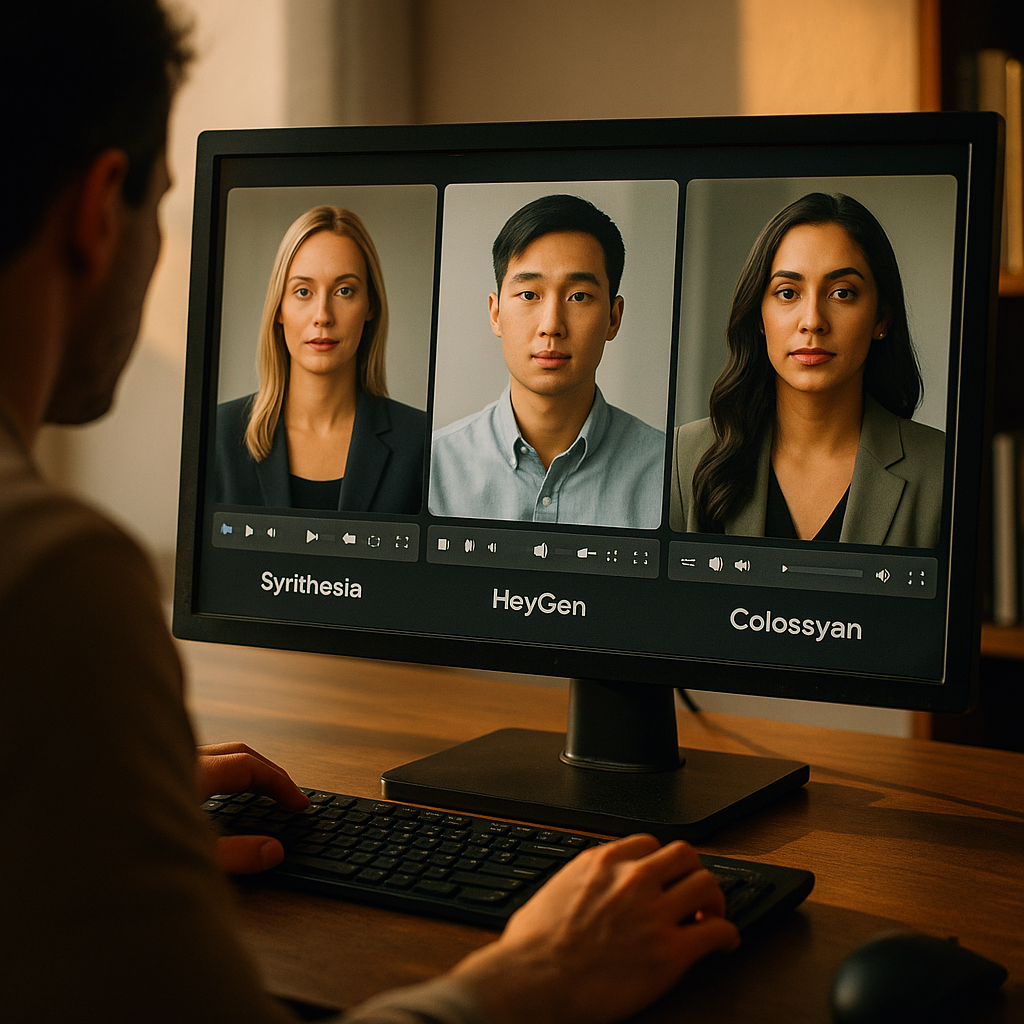
Enterprise buyers now generate more video minutes with AI avatars than with human presenters in some training and comms functions. That shift raises an uncomfortable question: which AI avatar video platform actually protects your brand when a synthetic spokesperson misrepresents your product in Portuguese, or gets flagged by a works council for deepfake-adjacent risk? Synthesia, HeyGen, and Colossyan all claim enterprise readiness. Their brand safety and localization architectures differ enough to matter for procurement.
Why This Comparison Matters More Than the Demo Reel
Every AI avatar vendor demo looks the same: a polished spokesperson, a script typed into a box, and a video rendered in ninety seconds. That’s the easy part. The hard part is what happens after legal, compliance, and localization teams get involved — because at enterprise scale, you’re not making one video. You’re making three hundred, in fourteen languages, across regions with different disclosure laws and different tolerances for synthetic media.
Marketing and L&D leaders picking a platform in 2026 aren’t just buying a video generator. They’re buying a governance layer for synthetic content. That distinction changes the evaluation criteria entirely.
The vendor with the best avatar realism isn’t automatically the safest choice — brand safety in AI video is decided by consent chains, moderation pipelines, and audit trails, not render quality.
Synthesia: The Compliance-First Enterprise Default
Synthesia has leaned hardest into enterprise trust signals, and it shows in the feature set. The platform offers custom avatar creation with documented consent workflows — real employees or paid actors sign releases, and Synthesia retains verification records. That matters if a regulator or a journalist ever asks “did this person agree to be your synthetic spokesperson?”
Synthesia also publishes content moderation policies that block specific use cases outright: political content, adult material, and anything designed to impersonate a real person without authorization. For brands worried about a rogue team member generating something reputationally toxic, that guardrail is the point, not a limitation.
- Localization depth: Synthesia supports well over 100 languages and accents, with AI-driven lip-sync adjustment per language — a detail that matters because poor lip-sync is the fastest way to make a corporate video look cheap or, worse, uncanny.
- Enterprise controls: SSO, role-based permissions, brand kits, and workspace-level content approval flows are standard on enterprise tiers.
- Data handling: Synthesia holds SOC 2 Type II certification and offers data residency options for regulated industries, which procurement teams in finance and healthcare will ask about immediately.
The tradeoff is flexibility. Synthesia’s guardrails are strict by design, which is exactly what a risk-averse enterprise wants — until a marketing team needs a slightly edgier tone for a campaign and finds the platform pushes back.
HeyGen: Fastest Iteration, Thinner Governance Layer
HeyGen built its reputation on speed and avatar realism, particularly with its instant avatar feature that lets a user clone their own likeness from a short video clip. That’s a genuinely useful capability for personalized sales outreach or executive comms at scale. It’s also where the brand safety conversation gets complicated.
Instant avatar creation lowers the barrier to synthetic media misuse inside an organization. If any employee can clone a colleague’s likeness in minutes, your governance problem isn’t the vendor’s content policy — it’s your internal access controls. HeyGen does require consent verification for likeness cloning, but the enterprise admin tooling to monitor and restrict this at scale has historically lagged behind Synthesia’s.
Where HeyGen pulls ahead: localization speed and translation quality for high-volume, short-form content. Marketing teams repurposing a single explainer into fifteen regional variants for paid social often find HeyGen’s turnaround faster, which matters if your team is already thinking about cost-per-output for AI video across a growing content calendar.
- Localization depth: Strong translation and dubbing across 40+ languages, with voice cloning that preserves tone better than most competitors in short-form content.
- Enterprise controls: SSO and team workspaces exist, but granular content approval workflows are less mature than Synthesia’s — a gap enterprise buyers should press on during procurement calls.
- Data handling: HeyGen has expanded SOC 2 coverage, but data residency options remain narrower, which can be a blocker for EU or APAC deployments under strict data sovereignty rules.
HeyGen is the platform marketing teams reach for when speed wins. It’s not necessarily the platform legal signs off on without added internal controls.
Colossyan: Built for Regulated Training, Not Campaign Volume
Colossyan occupies a narrower lane, and that’s arguably its strength. It’s positioned squarely at corporate learning and development, safety training, and compliance communications — use cases where getting the message technically and legally correct matters more than cinematic polish.
That focus shows up in features competitors don’t prioritize: built-in accessibility tools (closed captions, screen-reader-friendly exports), interactive branching scenarios for training simulations, and a simpler avatar library that reduces the temptation to over-customize into something unrecognizable as corporate content.
Colossyan’s localization tooling is solid but not exhaustive — it supports fewer languages than Synthesia’s full library, though it covers the major European and Asian business languages enterprise L&D teams actually need. For a global rollout of a code-of-conduct training video, that’s usually sufficient. For a marketing campaign needing hyperlocal dialect accuracy in twenty markets, it may fall short.
If your use case is regulatory training rather than brand marketing, Colossyan’s narrower feature set is a deliberate tradeoff, not a shortcoming — it optimizes for compliance clarity over creative range.
Where Colossyan Wins on Governance
- Version control for compliance content: Track changes across training video revisions, useful when policy updates require re-issuing certified training with an audit trail.
- Simpler consent model: Because avatar customization is more restricted, there’s less surface area for misuse, which HR and legal teams tend to appreciate.
- Lower learning curve: Non-technical L&D staff can build compliant training content without a creative team, reducing dependency on agencies.
The Localization Comparison Nobody Puts in a Feature Table
Vendor comparison pages list language counts like trophies. What they don’t tell you: language support and localization quality are not the same thing. A platform supporting 120 languages might handle Spanish and French beautifully and butcher Vietnamese tonal accuracy. Before signing an enterprise contract, request localized sample outputs in your actual target markets — not the vendor’s showcase languages.
Three questions worth asking every vendor during procurement:
- Does lip-sync adjust per language, or is it a generic overlay? Generic lip-sync in non-Latin-script languages often looks noticeably off, which undermines brand credibility fast.
- Are regional compliance disclosures (AI-generated content labels) built in, or manual? The EU AI Act and various state-level U.S. rules increasingly require disclosure when synthetic media is used in advertising or communications — a pattern showing up across other platforms too, as seen in TikTok’s labeling requirements for synthetic content.
- Can regional teams self-serve localized versions, or does everything route through a central creative team? Bottlenecks here kill the ROI case for AI avatar video entirely.
Brand Safety Is a Workflow Problem, Not Just a Vendor Feature
Even the most locked-down platform can’t stop a brand safety incident caused by bad internal process. The real risk mitigation happens in how you structure access, approval, and monitoring around whichever tool you choose.
Enterprise teams adopting AI avatar video should borrow governance patterns already emerging for other AI marketing tools — role-based access, mandatory human review before publish, and drift monitoring for AI-generated output that starts to stray from approved messaging. This isn’t hypothetical; the same governance logic outlined in no-code AI agent governance frameworks applies directly to avatar video pipelines, and teams running marketing observability tooling to catch AI drift are increasingly extending that monitoring to video content, not just copy and campaigns.
Procurement checklist for any of these three vendors:
- Require documented consent chains for every custom avatar, not just the vendor’s assurance that “consent was collected.”
- Mandate legal review of AI disclosure requirements in every target market — the FTC’s guidance on AI-generated endorsements and the UK’s ICO data protection guidance both apply depending on where content runs.
- Set internal policy on who can create or clone avatars — this is the single biggest brand safety lever, and it’s entirely on the buyer, not the vendor.
- Pilot with actual regional content before scaling budget, since eMarketer’s research on AI content adoption consistently shows quality gaps emerge only at production scale, not in pilot tests.
Which One Should You Actually Buy?
Choose Synthesia if compliance, consent documentation, and broad language coverage outrank speed and cost. Choose HeyGen if your priority is fast-turnaround, high-volume social and sales content and you’re willing to build stronger internal governance around avatar cloning yourself. Choose Colossyan if your primary use case is regulated training and internal comms rather than external brand marketing — its narrower scope is a feature, not a gap.
None of the three is universally “safer.” Safety is a function of how tightly you configure permissions, review workflows, and disclosure practices around whichever tool sits in your stack.
Frequently Asked Questions
Is AI avatar video legally required to be labeled as synthetic?
Requirements vary by jurisdiction and use case. The EU AI Act includes transparency obligations for synthetic media, and several U.S. states have enacted disclosure rules for AI-generated political or commercial content. Enterprise legal teams should confirm requirements per target market before launch.
Can HeyGen, Synthesia, or Colossyan clone a real employee’s voice and likeness without consent?
All three platforms require some form of consent verification for custom or cloned avatars, but enforcement and documentation rigor differ. Synthesia has the most formalized consent-tracking process; HeyGen’s instant avatar feature requires stronger internal access controls to prevent misuse; Colossyan limits customization enough that unauthorized cloning is less of a practical risk.
Which platform is best for localizing training content across many languages?
Synthesia offers the broadest language library with per-language lip-sync adjustment, making it the strongest choice for wide-scale global localization. Colossyan covers major business languages well but has a narrower range, sufficient for most compliance training rollouts.
Do these platforms integrate with existing martech or LMS systems?
Synthesia and Colossyan both offer LMS-friendly export formats and API access for enterprise integration. HeyGen focuses more on marketing and sales tool integrations, including CRM and social publishing workflows.
What’s the biggest brand safety risk with AI avatar video?
The biggest risk usually isn’t the vendor’s technology — it’s internal governance gaps, such as unrestricted avatar creation access, missing approval workflows, or lack of regional legal review before publishing synthetic content.
The right platform pick matters less than the governance wrapped around it: lock down who can create avatars, require regional legal sign-off before launch, and pilot with real localized content before committing enterprise-wide budget.
Top Influencer Marketing Agencies
The leading agencies shaping influencer marketing in 2026
Agencies ranked by campaign performance, client diversity, platform expertise, proven ROI, industry recognition, and client satisfaction. Assessed through verified case studies, reviews, and industry consultations.
Moburst

-
2

The Shelf
Boutique Beauty & Lifestyle Influencer AgencyA data-driven boutique agency specializing exclusively in beauty, wellness, and lifestyle influencer campaigns on Instagram and TikTok. Best for brands already focused on the beauty/personal care space that need curated, aesthetic-driven content.Clients: Pepsi, The Honest Company, Hims, Elf Cosmetics, Pure LeafVisit The Shelf → -
3

Audiencly
Niche Gaming & Esports Influencer AgencyA specialized agency focused exclusively on gaming and esports creators on YouTube, Twitch, and TikTok. Ideal if your campaign is 100% gaming-focused — from game launches to hardware and esports events.Clients: Epic Games, NordVPN, Ubisoft, Wargaming, Tencent GamesVisit Audiencly → -
4

Viral Nation
Global Influencer Marketing & Talent AgencyA dual talent management and marketing agency with proprietary brand safety tools and a global creator network spanning nano-influencers to celebrities across all major platforms.Clients: Meta, Activision Blizzard, Energizer, Aston Martin, WalmartVisit Viral Nation → -
5

The Influencer Marketing Factory
TikTok, Instagram & YouTube CampaignsA full-service agency with strong TikTok expertise, offering end-to-end campaign management from influencer discovery through performance reporting with a focus on platform-native content.Clients: Google, Snapchat, Universal Music, Bumble, YelpVisit TIMF → -
6

NeoReach
Enterprise Analytics & Influencer CampaignsAn enterprise-focused agency combining managed campaigns with a powerful self-service data platform for influencer search, audience analytics, and attribution modeling.Clients: Amazon, Airbnb, Netflix, Honda, The New York TimesVisit NeoReach → -
7

Ubiquitous
Creator-First Marketing PlatformA tech-driven platform combining self-service tools with managed campaign options, emphasizing speed and scalability for brands managing multiple influencer relationships.Clients: Lyft, Disney, Target, American Eagle, NetflixVisit Ubiquitous → -
8

Obviously
Scalable Enterprise Influencer CampaignsA tech-enabled agency built for high-volume campaigns, coordinating hundreds of creators simultaneously with end-to-end logistics, content rights management, and product seeding.Clients: Google, Ulta Beauty, Converse, AmazonVisit Obviously →