


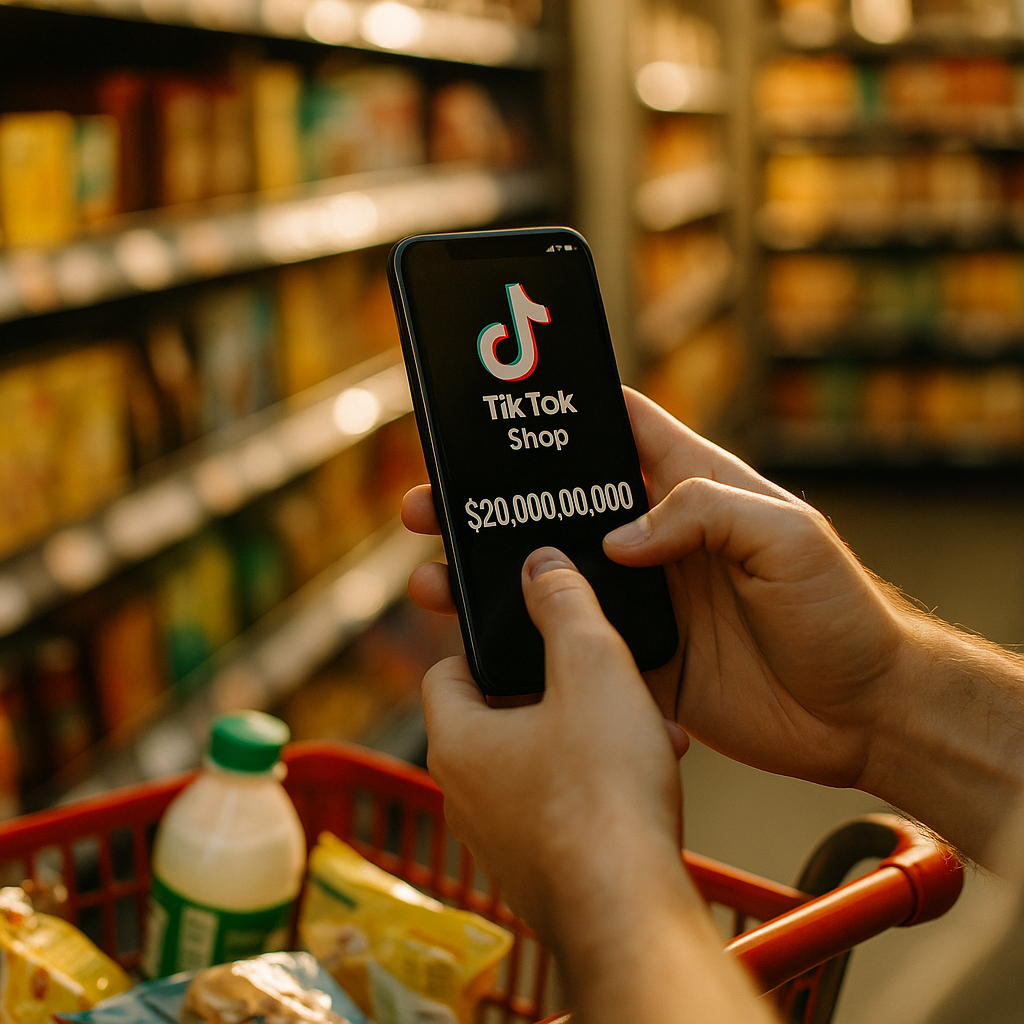
TikTok Shop just crossed $20 billion in annual sales. That’s not an influencer marketing stat anymore, it’s a retail channel stat. If your CPG brand is still treating TikTok Shop as a side experiment for the social team, you’re already behind the QVC-style creator economy reshaping how consumer goods move off shelves.
Let that number sink in for a second. Twenty billion dollars flowing through a platform that, five years ago, was known for dance challenges. This isn’t a fad. It’s a distribution channel with its own logistics, its own creator hierarchy, and its own rules of engagement. And CPG brands that treat it like a marketing line item instead of a sales channel are leaving real revenue on the table.
Why This Isn’t Just Another Influencer Trend
QVC built a billion-dollar business on a simple formula: charismatic hosts, live demos, urgency, and instant checkout. TikTok Shop essentially cloned that formula and gave it to millions of creators simultaneously. The difference is scale and specificity. Instead of one host selling to a broad TV audience, you have thousands of niche creators selling to hyper-targeted micro-audiences, live, with a “buy now” button baked into the video.
For CPG brands, this changes the math entirely. Traditional influencer marketing measured awareness, sentiment, maybe a discount code redemption. TikTok Shop measures units sold, in real time, attributed directly to the creator who moved them. That’s a fundamentally different accountability structure, and it’s why finance teams are suddenly interested in influencer budgets they used to wave through without scrutiny.
TikTok Shop’s $20 billion milestone means creator commerce has crossed from experimental marketing spend into a measurable, forecastable sales channel, one CPG finance teams can no longer ignore.
The New Fulfillment Problem Nobody Budgeted For
Here’s the part brands underestimate: selling through creators means you need to actually ship product, fast, at volume, with returns handled gracefully. A viral TikTok Shop moment can generate 10,000 orders overnight. Most CPG brands’ fulfillment infrastructure wasn’t built for that kind of spike.
This is why more brands are pulling fulfillment in-house rather than defaulting to third-party logistics providers who can’t flex fast enough. Our reporting on how brand-managed fulfillment is replacing 3PL defaults in creator commerce lays out exactly why legacy logistics models break under viral demand.
Add affiliate-style, no-inventory arrangements into the mix, and the operational picture gets more complex still. Creators increasingly want to sell without holding stock, which pushes brands toward dropship-adjacent models. If you haven’t looked at how no-inventory affiliate programs became the creator default, now’s the time. It’s reshaping vendor contracts across the CPG space.
Who’s Actually Driving the $20B, and Why It’s Not Who You Think
Ask most marketing directors who drives TikTok Shop sales, and they’ll say “big creators.” Wrong. The data consistently shows that mid-tier and micro-creators, often working under 10 hours a week on content, are responsible for a disproportionate share of conversions. Why? Trust and specificity. A micro-creator with 40,000 followers in the skincare-for-sensitive-skin niche converts better than a celebrity with 4 million generalist followers.
This matters enormously for budget allocation. If you’re still funneling most of your TikTok Shop budget into a handful of macro-influencers, you’re optimizing for reach when you should be optimizing for conversion density. We’ve covered how 63% of creators work under 10 hours a week, and what that means for how brands need to restructure seeding programs to actually reach these part-time, high-conversion creators.
The income distribution among creators tells a similar story. A small number of top earners capture outsized brand deal revenue, while a large tail of capable, product-obsessed creators remain underpaid and underutilized. That imbalance is actually good news for brands willing to look past follower count. Our analysis of the creator income gap and negotiating leverage breaks down how to structure deals that reward performance instead of reach.
The Live Shopping Format Is Doing the Heavy Lifting
Live shopping isn’t a nice-to-have anymore, it’s the format doing most of the $20 billion’s heavy lifting. QVC succeeded because live TV created urgency: limited stock, ticking clocks, real-time social proof from callers. TikTok Shop replicates all of that but compresses the sales cycle to minutes instead of a broadcast slot.
For CPG brands, this means creative production has to move at a completely different speed than a traditional campaign shoot. You can’t storyboard a live stream three weeks in advance the way you’d plan a hero video.
This is exactly why AI-assisted production tools are gaining traction fast. Brands are using AI to generate product demo scripts, live-stream talking points, and rapid-turn creative assets so creators can go live within hours of a product drop rather than weeks. Our piece on how AI creator workflows cut campaign timelines to hours is essential reading if your team is still stuck on multi-week production cycles for live commerce content.
There’s also a discovery angle worth flagging. Live shopping success on TikTok often hinges less on a creator’s total following and more on how well the platform’s discovery algorithm surfaces that specific live session to buyers actively browsing a category. Regional data backs this up: in APAC markets, discovery is outperforming reach for micro-creator sales, a pattern CPG brands in Western markets should expect to see replicated as TikTok Shop matures.
Budget Reallocation Is Already Happening
D2C brands are now routing roughly 45% of their marketing budgets toward creators, a number that would’ve sounded absurd three years ago. That shift isn’t happening in isolation from TikTok Shop’s rise, it’s a direct response to it. When a channel proves it can move product at scale with trackable ROI, finance teams stop treating it as experimental and start treating it as core spend.
Media teams inside these organizations are scrambling to adapt reporting structures accordingly. Our coverage of how creators now claim 45% of D2C budgets details the internal reporting and attribution changes brands are making to keep finance stakeholders comfortable with the shift.
Naturally, this raises questions about agency involvement. Some brands are cutting out the middleman entirely, using AI matching platforms to find and vet creators directly rather than paying agency markups. If your agency relationship feels expensive relative to the value delivered, it’s worth reading how AI matching platforms let brands skip agency fees while maintaining creator quality control.
Compliance Risk Scales With Sales Volume
Here’s the uncomfortable truth nobody likes to discuss at the kickoff meeting: as TikTok Shop sales grow, so does regulatory exposure. The FTC has made disclosure enforcement a priority, and live shopping formats make compliance genuinely harder. A creator improvising during a live stream doesn’t always remember to say “this is sponsored” the way a scripted video does.
YouTube has already faced scrutiny over sponsored content disclosure gaps, and there’s no reason to assume TikTok Shop creators are immune from similar attention. Our report on the YouTube FTC probe and disclosure gaps is a useful preview of what enforcement could look like once regulators turn their attention to shoppable live content specifically.
Brands should treat this as a contractual and training issue, not just a legal footnote. Build disclosure requirements into creator agreements explicitly, require verbal disclosure during live segments, and audit a sample of live streams monthly. It’s cheaper than a settlement.
What Smart CPG Brands Are Doing Differently
- Diversifying creator tiers deliberately. Instead of chasing follower counts, brands are building programs with layered tiers: a few macro-creators for reach, a larger bench of micro-creators for conversion, and affiliate-only creators for long-tail coverage.
- Investing in live-ready production. Static product photography isn’t enough anymore. Brands need AI-assisted, rapid-turn assets creators can use live, on short notice.
- Rebuilding fulfillment for spikes. Whether through brand-managed logistics or flexible 3PL contracts, brands are stress-testing their supply chain against viral demand scenarios before they happen, not after.
- Structuring performance-based creator pay. Flat fees are giving way to commission and hybrid models that reward creators for actual units sold, mirroring the shift toward performance pay seen across affiliate creator networks scaling fast.
- Tightening disclosure protocols. Legal and marketing teams are collaborating earlier in the campaign process rather than treating compliance as an afterthought.
Industry benchmarking data from firms like eMarketer continues to show social commerce growing faster than traditional e-commerce, and platforms like TikTok’s advertising platform have been expanding shoppable features specifically to capture more of that CPG spend. Tools tracked by Statista similarly point to live commerce as one of the fastest-growing subcategories in retail media. This is a category brands can benchmark against, not guess at.
The Takeaway
TikTok Shop’s $20 billion milestone isn’t a headline to admire from the sidelines, it’s a signal to rebuild your creator commerce infrastructure now, before your competitors lock in the best mid-tier creators and fulfillment partners. Start with a fulfillment stress test and a tiered creator audit this quarter, not next year’s planning cycle.
Frequently Asked Questions
What made TikTok Shop reach $20 billion in sales?
Growth came primarily from live shopping formats and a broad base of micro and mid-tier creators driving high-conversion, niche-specific sales, rather than a handful of celebrity endorsements. The platform’s discovery algorithm surfaces relevant live sessions to active shoppers, which accelerates conversion beyond what traditional influencer posts achieve.
How should CPG brands budget for TikTok Shop compared to traditional influencer marketing?
Brands should shift from flat sponsorship fees toward performance-based and hybrid compensation tied to units sold, while reserving a portion of budget for production speed and fulfillment infrastructure that can handle demand spikes from viral moments.
What compliance risks come with TikTok Shop’s live commerce growth?
Live, unscripted selling makes sponsored content disclosure harder to enforce consistently. The FTC has increased scrutiny on influencer disclosure practices generally, and brands should build explicit disclosure requirements into creator contracts and audit live sessions regularly.
Do micro-creators really outperform macro-influencers on TikTok Shop?
Data consistently shows niche micro-creators often convert better than broad-reach macro-influencers because their audiences trust category-specific recommendations. Brands optimizing purely for follower count typically underperform those building layered, tiered creator programs.
What fulfillment changes do brands need for creator-driven sales spikes?
Brands need logistics that can flex quickly, whether through brand-managed fulfillment or more responsive 3PL contracts, since a single viral live shopping session can generate thousands of orders within hours.
Top Influencer Marketing Agencies
The leading agencies shaping influencer marketing in 2026
Agencies ranked by campaign performance, client diversity, platform expertise, proven ROI, industry recognition, and client satisfaction. Assessed through verified case studies, reviews, and industry consultations.
Moburst

-
2

The Shelf
Boutique Beauty & Lifestyle Influencer AgencyA data-driven boutique agency specializing exclusively in beauty, wellness, and lifestyle influencer campaigns on Instagram and TikTok. Best for brands already focused on the beauty/personal care space that need curated, aesthetic-driven content.Clients: Pepsi, The Honest Company, Hims, Elf Cosmetics, Pure LeafVisit The Shelf → -
3

Audiencly
Niche Gaming & Esports Influencer AgencyA specialized agency focused exclusively on gaming and esports creators on YouTube, Twitch, and TikTok. Ideal if your campaign is 100% gaming-focused — from game launches to hardware and esports events.Clients: Epic Games, NordVPN, Ubisoft, Wargaming, Tencent GamesVisit Audiencly → -
4

Viral Nation
Global Influencer Marketing & Talent AgencyA dual talent management and marketing agency with proprietary brand safety tools and a global creator network spanning nano-influencers to celebrities across all major platforms.Clients: Meta, Activision Blizzard, Energizer, Aston Martin, WalmartVisit Viral Nation → -
5

The Influencer Marketing Factory
TikTok, Instagram & YouTube CampaignsA full-service agency with strong TikTok expertise, offering end-to-end campaign management from influencer discovery through performance reporting with a focus on platform-native content.Clients: Google, Snapchat, Universal Music, Bumble, YelpVisit TIMF → -
6

NeoReach
Enterprise Analytics & Influencer CampaignsAn enterprise-focused agency combining managed campaigns with a powerful self-service data platform for influencer search, audience analytics, and attribution modeling.Clients: Amazon, Airbnb, Netflix, Honda, The New York TimesVisit NeoReach → -
7

Ubiquitous
Creator-First Marketing PlatformA tech-driven platform combining self-service tools with managed campaign options, emphasizing speed and scalability for brands managing multiple influencer relationships.Clients: Lyft, Disney, Target, American Eagle, NetflixVisit Ubiquitous → -
8

Obviously
Scalable Enterprise Influencer CampaignsA tech-enabled agency built for high-volume campaigns, coordinating hundreds of creators simultaneously with end-to-end logistics, content rights management, and product seeding.Clients: Google, Ulta Beauty, Converse, AmazonVisit Obviously →