


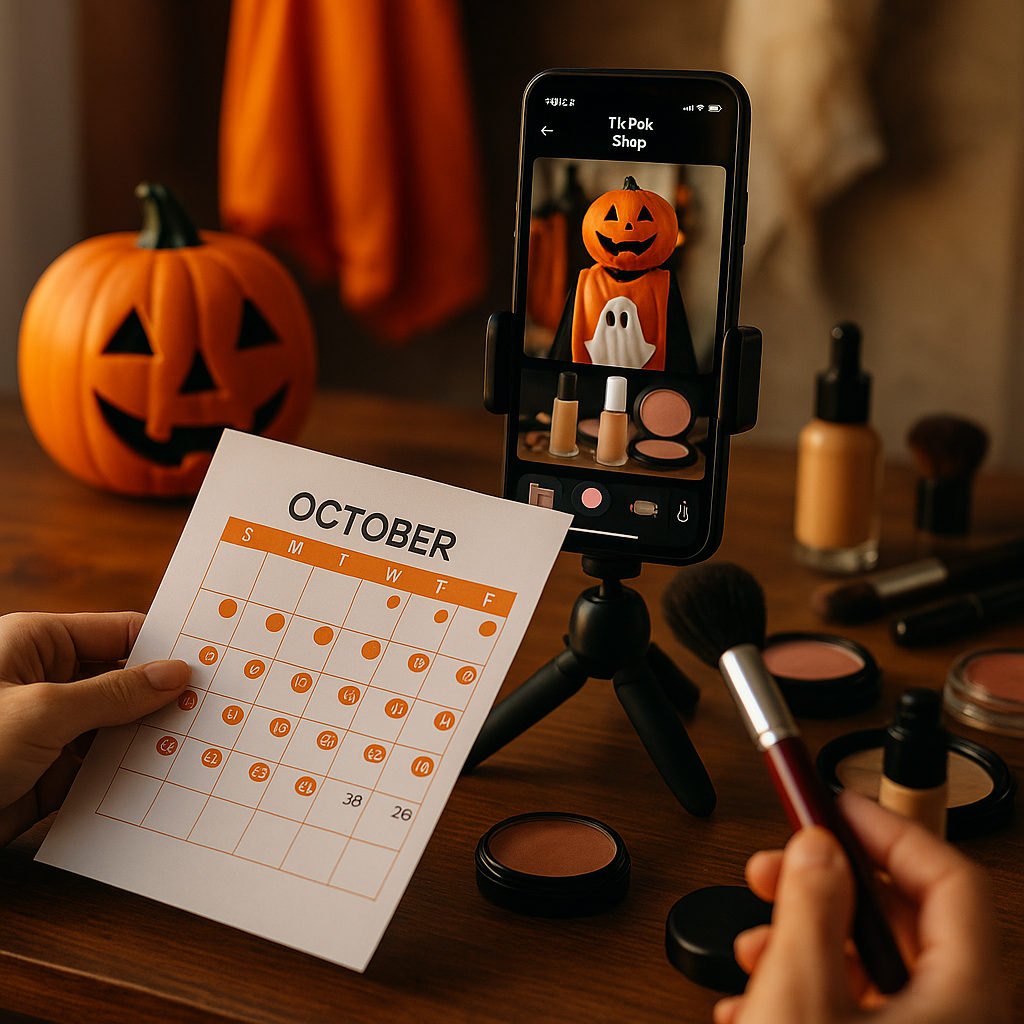
Costume searches on TikTok Shop spike more than 400% in the first ten days of October, then collapse almost overnight once Halloween passes. Beauty SKUs do the opposite: they build slowly and peak in the final week, feeding straight into November gifting. If you’re running both categories on the same posting cadence, you’re leaving GMV on the table. The TikTok Shop October saturation calendar isn’t a nice-to-have this quarter. It’s the difference between a merchant who rides two separate demand curves and one who flattens both by launching everything at once.
Why October Breaks Normal Posting Rhythms
Most brands treat October like any other month: pick a content cadence, stick to it, adjust based on last month’s numbers. That approach fails here because October contains two distinct, overlapping demand cycles inside a single 31-day window. Costume and party SKUs front-load hard. Beauty and skincare SKUs back-load into the holiday runway. Run one calendar for both and you either burn costume inventory too late or launch beauty content into a feed still saturated with pumpkin and skeleton content.
TikTok’s recommendation system also compounds the problem. The platform’s shift toward infrastructure changes affecting ranking behavior means creator content that performed well in September doesn’t automatically carry momentum into October. Every seasonal category effectively restarts its trust signals when search intent shifts. That reset window is exactly when a saturation calendar earns its keep.
Costume SKUs live and die in a ten-day window. Beauty SKUs get a four-week runway. Treating them the same is the single most common October planning mistake among TikTok Shop merchants.
The Saturation Curve: Mapping Costume vs Beauty Windows
Think of October as three distinct blocks, not one continuous month. Each block has different creator behavior, different ad costs, and different conversion windows.
- October 1 to 10: Costume search volume climbs fast as shoppers start planning. This is the highest-opportunity, lowest-competition window for costume SKUs because most merchants haven’t launched yet.
- October 11 to 20: Costume saturation peaks. Ad costs rise, creator inventory tightens, and differentiation gets harder. Beauty SKUs should start seeding here, quietly, without competing for the same creator slots.
- October 21 to 31: Costume demand craters after the 25th. Beauty and gifting content should be at full volume by now, capturing the audience that’s already shifted mental gears toward November.
The mistake almost every mid-tier seller makes is launching beauty content in the first block, when the feed is still dominated by costume creators, or holding costume launches until block two when the competitive window has already closed. Timing isn’t a minor optimization here. It’s the whole strategy.
Building the Week-by-Week Calendar
A working saturation calendar needs three inputs: category, creator tier, and format. Here’s how a mid-size beauty and costume seller might structure it.
Week one. Push costume SKUs with mid-tier and micro creators. Avoid top-tier talent here; their rates spike once brands realize the window is short, and you don’t need reach yet, you need volume and search coverage. Beauty content in week one should be limited to evergreen, non-seasonal posts that keep the shop’s trust signals warm.
Week two. Costume content hits paid amplification. This is when countdown-style drop mechanics work best, since urgency is already baked into the calendar. Beauty seeding begins quietly with gifting-angle content (not holiday-specific yet, just “treat yourself” framing that doesn’t compete for costume attention).
Week three. Costume budget starts winding down. Shift spend toward beauty and start layering in creator tiers you held back earlier. This is also when livestream frequency for beauty should ramp, since live formats convert better once search intent has shifted from “what costume” to “what gift.”
Week four. Full beauty push. Costume SKUs should be near zero spend by October 26 unless you’re clearing inventory at discount, in which case that’s a different campaign entirely with different messaging.
None of this works if your creative team is producing identical assets across every phase. Reusing the same base video across multiple platform formats can save production time, but the seasonal framing (costume urgency vs beauty gifting) still needs to be rebuilt week to week.
Creator Selection Isn’t Static Either
Here’s something a lot of brand teams miss: the creators who crush costume content in week one aren’t necessarily the right fit for beauty in week four. Costume content rewards personality-driven, comedic, high-energy creators. Beauty content in the gifting window rewards trust, tutorial competence, and repeat-viewer relationships. Trying to run the same five creators across both categories usually produces mediocre results in both.
TikTok Shop’s algorithm has also shifted toward rewarding established trust over raw posting frequency. That matters enormously for the October calendar because it means you can’t just flood the feed in week one and expect the same creators to carry beauty momentum in week four without a genuine content shift. Plan creator contracts in two separate tranches, not one long-running retainer.
Running the same creator roster across costume and beauty phases without adjusting brief tone is one of the fastest ways to flatten performance on both ends of the calendar.
Compliance Doesn’t Take a Month Off
Seasonal urgency tends to loosen disclosure discipline, and that’s exactly when the FTC pays closer attention. Countdown timers, limited-stock claims, and “last chance” language around costume SKUs need the same scrutiny you’d apply in any other month. If your team is running AI-generated voiceovers or avatars in Shop Lives during this crunch period, double-check current platform rules, since TikTok has specific restrictions on AI voice usage in live selling that don’t apply uniformly across all content types. The broader AI disclosure toggle requirements also apply regardless of how tight your seasonal window feels.
Ad syndication adds another layer worth checking before you scale spend across both categories simultaneously. Merchants running the same creative through multiple ad accounts or syndicated partners should review the current syndication compliance requirements before the October volume ramp, not during it. Compliance reviews take longer when everyone’s team is scrambling to hit Halloween deadlines.
For general reference on disclosure standards, the FTC’s endorsement guidance hasn’t changed its core principles, but enforcement attention during high-volume retail periods tends to increase. Build your review process assuming scrutiny, not assuming it won’t happen this year.
What the Data Actually Shows
Industry data consistently shows Q4 as the highest-volume quarter for social commerce, with October functioning as the ramp period before November and December take over. According to eMarketer’s retail forecasting, seasonal category shifts within a single month are becoming more pronounced as short-form commerce matures, meaning the costume-to-beauty handoff inside October isn’t a fluke, it’s a pattern that’s likely to sharpen further as more merchants compete for the same attention windows.
Platform-level ad cost data from TikTok’s advertising resources also supports the saturation curve model: CPMs for seasonal costume content climb sharply mid-month before dropping fast, while beauty and gifting CPMs rise steadily through the back half of the month. If your media buying team isn’t adjusting bids weekly through October, you’re almost certainly overpaying in one phase and underbidding in another.
Tools like Sprout Social’s trend tracking or general benchmarking through Statista’s ecommerce data can help validate whether your category follows the same curve locally, since niche verticals sometimes shift a few days earlier or later than the broad pattern described here.
Fitting This Into a Broader Platform Strategy
None of this happens in isolation from your other channels. If you’re also running Instagram and YouTube alongside TikTok Shop, the October handoff needs to be reflected in how you allocate format and funnel stage across platforms, since costume urgency content performs differently on TikTok’s discovery feed than it would on Instagram Reels or YouTube Shorts. A single calendar for TikTok Shop doesn’t need to match your broader channel mix exactly, but it should acknowledge that shoppers are seeing costume and beauty messaging across multiple touchpoints simultaneously, not just one app.
Bottom line: build two calendars inside one month, staff them with different creator profiles, and shift your compliance review cadence to match the volume spike rather than reacting to it after launch. Start mapping your week one costume creator list this week. Waiting until October 1 means you’re already behind the merchants who planned in September.
Frequently Asked Questions
When should costume SKUs launch on TikTok Shop to avoid early saturation?
The first ten days of October offer the best balance of rising search intent and lower creator competition. Waiting past October 10 typically means fighting for the same creator slots as every other seasonal merchant.
How early should beauty SKU content start if costume is dominating the feed?
Begin quiet, non-seasonal beauty seeding in week one to keep trust signals active, then ramp gifting-angle content starting week two. Full beauty volume should hit by the third week of October.
Do the same creators work for both costume and beauty campaigns?
Rarely with the same effectiveness. Costume content rewards high-energy, comedic creators, while beauty gifting content performs better with trust-driven, tutorial-style creators. Splitting your roster typically outperforms reusing the same talent across both phases.
Does TikTok’s algorithm treat seasonal content differently than evergreen content?
Seasonal content faces a faster decay curve once demand shifts, and the platform’s growing emphasis on creator trust over raw posting volume means late entrants can’t simply outspend early movers once a category’s saturation window has passed.
What compliance risks increase during high-volume October campaigns?
Urgency-driven messaging like countdown timers and limited-stock claims draws more regulatory attention during high-volume periods, and AI-generated voice or avatar usage in Shop Lives carries specific platform restrictions that merchants sometimes overlook during seasonal crunch.
Top Influencer Marketing Agencies
The leading agencies shaping influencer marketing in 2026
Agencies ranked by campaign performance, client diversity, platform expertise, proven ROI, industry recognition, and client satisfaction. Assessed through verified case studies, reviews, and industry consultations.
Moburst

-
2

The Shelf
Boutique Beauty & Lifestyle Influencer AgencyA data-driven boutique agency specializing exclusively in beauty, wellness, and lifestyle influencer campaigns on Instagram and TikTok. Best for brands already focused on the beauty/personal care space that need curated, aesthetic-driven content.Clients: Pepsi, The Honest Company, Hims, Elf Cosmetics, Pure LeafVisit The Shelf → -
3

Audiencly
Niche Gaming & Esports Influencer AgencyA specialized agency focused exclusively on gaming and esports creators on YouTube, Twitch, and TikTok. Ideal if your campaign is 100% gaming-focused — from game launches to hardware and esports events.Clients: Epic Games, NordVPN, Ubisoft, Wargaming, Tencent GamesVisit Audiencly → -
4

Viral Nation
Global Influencer Marketing & Talent AgencyA dual talent management and marketing agency with proprietary brand safety tools and a global creator network spanning nano-influencers to celebrities across all major platforms.Clients: Meta, Activision Blizzard, Energizer, Aston Martin, WalmartVisit Viral Nation → -
5

The Influencer Marketing Factory
TikTok, Instagram & YouTube CampaignsA full-service agency with strong TikTok expertise, offering end-to-end campaign management from influencer discovery through performance reporting with a focus on platform-native content.Clients: Google, Snapchat, Universal Music, Bumble, YelpVisit TIMF → -
6

NeoReach
Enterprise Analytics & Influencer CampaignsAn enterprise-focused agency combining managed campaigns with a powerful self-service data platform for influencer search, audience analytics, and attribution modeling.Clients: Amazon, Airbnb, Netflix, Honda, The New York TimesVisit NeoReach → -
7

Ubiquitous
Creator-First Marketing PlatformA tech-driven platform combining self-service tools with managed campaign options, emphasizing speed and scalability for brands managing multiple influencer relationships.Clients: Lyft, Disney, Target, American Eagle, NetflixVisit Ubiquitous → -
8

Obviously
Scalable Enterprise Influencer CampaignsA tech-enabled agency built for high-volume campaigns, coordinating hundreds of creators simultaneously with end-to-end logistics, content rights management, and product seeding.Clients: Google, Ulta Beauty, Converse, AmazonVisit Obviously →