


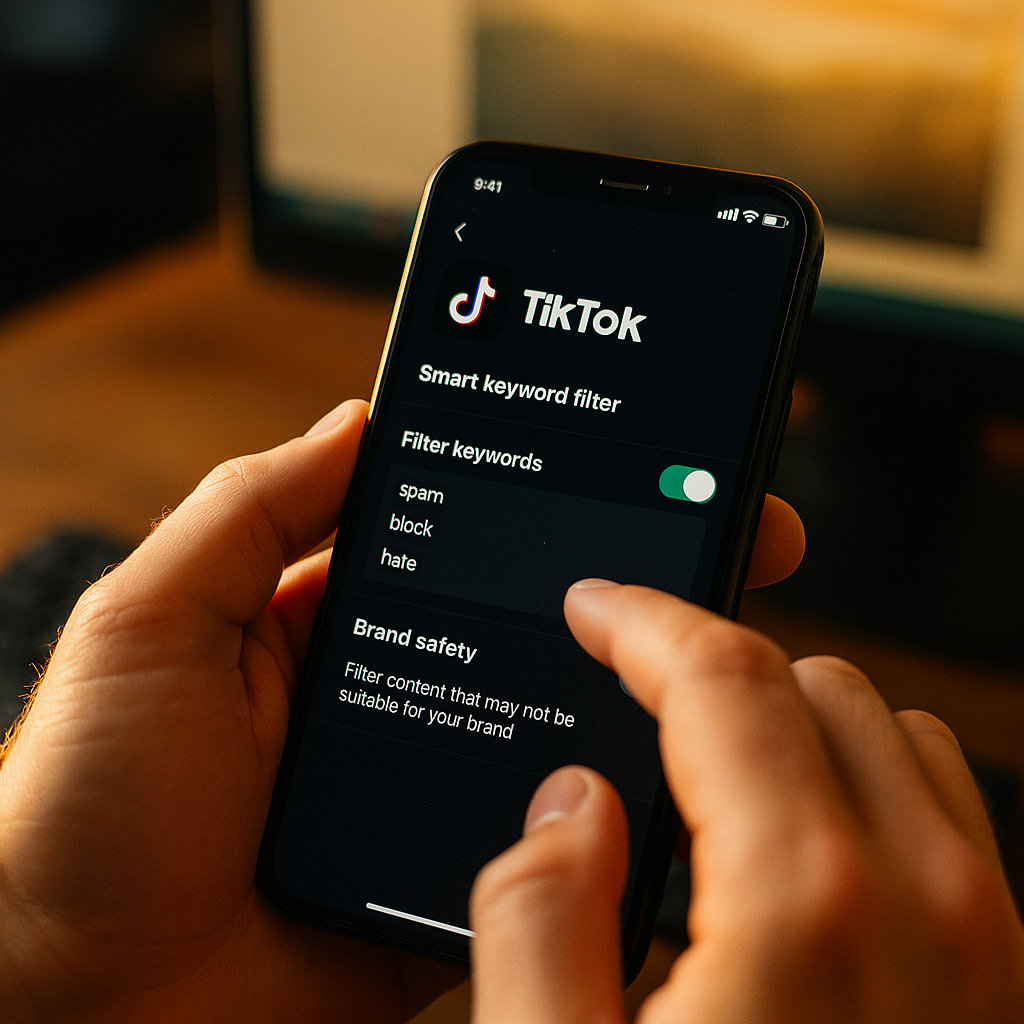
One misplaced ad adjacency can erase months of brand equity. TikTok’s Smart Keyword Filters inside the Manage Topics tool now use AI-powered synonym blocking to catch contextually risky content that exact-match keyword lists routinely miss — and most brand safety teams are barely scratching the surface of what the system can do.
Why Exact-Match Blocking Alone Is a Liability
For years, brand safety on social platforms meant maintaining a blocklist: a spreadsheet of banned words you’d paste into an ad platform and call it a day. That approach worked tolerably when content was slower, more predictable, and largely text-based. TikTok in 2026 is none of those things.
The platform processes over 1 billion pieces of content per day, with a significant share using slang, coded language, visual storytelling, and audio cues to communicate meaning that never appears in a caption. An exact-match filter blocking “violence” will not catch a trending sound clip associated with a real-world incident, nor will it intercept a hashtag chain that’s been repurposed by a controversy. The gap between what a static blocklist catches and what actually appears next to your ad is where brand safety incidents live.
According to data referenced by the Global Alliance for Responsible Media, keyword-only brand safety tools miss up to 40% of contextually inappropriate adjacencies because they cannot interpret semantic meaning or audiovisual signals.
TikTok’s Smart Keyword Filters are designed to close that gap. Understanding how they work, and how to configure them correctly, is now a core operational competency for any brand safety or media team running paid campaigns on the platform.
What the Manage Topics Tool Actually Does
The Manage Topics tool sits inside TikTok Ads Manager under inventory management settings. At its core, it allows advertisers to define content categories their ads should or should not appear alongside. But the Smart Keyword Filter layer adds something more sophisticated: semantic clustering.
When you enter a keyword into the Smart Keyword Filter, TikTok’s AI doesn’t just block that exact string. It maps the term to a synonym and contextual cluster, identifying related phrases, alternate spellings, common abbreviations, and trending vernacular that carry similar meaning. A term like “self-harm,” for instance, would expand to include coded language variants that regularly circulate in adjacent communities on the platform. The system also factors in audio transcripts, on-screen text from video OCR, and creator profile signals — not just post captions.
This matters enormously for brands in regulated categories: financial services, pharmaceuticals, CPG alcohol, and children’s products all operate under compliance frameworks where adjacency to certain content types creates legal exposure, not just reputational risk. If your legal team has asked your media buyers “can you prove the ad didn’t run next to that content?” — this is the layer of the stack that produces the audit trail.
Configuring Smart Keyword Filters: A Practitioner’s Workflow
Most teams approach keyword filter setup the same way they’d approach a fire drill: reactive, rushed, and performed just before a campaign goes live. Build your filter architecture before you need it.
Step 1: Start with TikTok’s pre-built topic exclusions. Before adding any custom keywords, apply the platform’s native content category exclusions. TikTok segments content into tiers (Full Inventory, Standard Inventory, Limited Inventory) and these map roughly to GARM’s brand safety floor and suitability framework. Set your baseline at Standard Inventory for most campaigns; step down to Limited Inventory for campaigns targeting younger demographics or touching sensitive brand categories.
Step 2: Build a seed keyword list from your brand risk register. Every brand with a mature risk management function maintains a list of topics that could create reputational harm. Extract the 20-30 most TikTok-relevant terms and enter them as seed keywords. The AI expands each to a cluster, but you need to review the cluster output before saving. Clusters occasionally include false positives — terms that are semantically adjacent but contextually harmless for your category.
Step 3: Audit the synonym expansion before activation. TikTok previews the expanded term cluster in the UI. This is the step most teams skip. A beauty brand blocking “razor” to avoid self-harm adjacency could inadvertently suppress delivery near legitimate grooming and skincare content. Review every suggested expansion against your campaign’s target context. Remove false positives manually.
Step 4: Layer in trending term monitoring. Static filters decay. TikTok’s audio-first culture means that a sound, a meme format, or an emerging slang term can attach to a controversy within 48 hours. Assign someone on your team — or your brand safety vendor — weekly responsibility to review trending terms via TikTok Creative Center and update the keyword filter accordingly. Think of it as a maintenance cadence, not a one-time setup.
Step 5: Cross-reference with your creator brief exclusions. If you’re running TikTok creator campaigns alongside paid placements, your keyword filter should mirror the content restrictions in your creator briefs. Disconnected guardrails are a compliance gap. What you prohibit in a brief should also be blocked at the ad serving level.
Where AI Synonym Blocking Still Has Blind Spots
The tool is good. It’s not infallible.
Synonym blocking works on language and text signals. It is less reliable for visual-only content where the risk is conveyed through imagery with no accompanying text. A video using a trending audio track that has been co-opted by a harmful community but shows no problematic on-screen text may pass through filters that would otherwise catch the context. TikTok’s content moderation team and third-party verification partners like Integral Ad Science and DoubleVerify operate at a layer above keyword filtering to catch these cases, but neither is a guarantee.
Cultural nuance is another gap. A term that is benign in one language or regional context may carry harmful connotations in another. For brands running multinational campaigns from a single TikTok Business Center, this means your English-language filter configuration may not adequately protect your ad from serving against problematic content in other languages. Build separate filter configurations per market, or at minimum, engage a local team to review your cluster expansions for each language.
There’s also the velocity problem. Controversy on TikTok can peak and recede within 72 hours. Your weekly filter update cadence may be too slow to prevent a placement incident during a fast-moving news cycle. Brands with zero-tolerance adjacency policies (large financial institutions, political advertisers, children’s brands) should consider pausing broad-reach campaigns during periods of elevated platform volatility and re-enabling them once the news cycle stabilizes.
Platform-native brand safety tools are a first line of defense, not a complete solution. Layering TikTok’s Smart Keyword Filters with third-party verification from IAS or DoubleVerify creates the redundancy that enterprise brand safety policies actually require.
Connecting Brand Safety to Media Efficiency
There’s a tension most media teams feel but rarely name: aggressive keyword filtering reduces brand safety risk but also shrinks your eligible inventory, which can push CPMs up and hurt delivery pacing. This is real. Blocking too broadly makes the algorithm work harder to find qualifying placements, and costs rise accordingly.
The answer isn’t to filter less. It’s to filter smarter. Semantic clustering usually produces tighter, more accurate exclusions than sprawling manual blocklists, which means you can often achieve equivalent or better brand safety protection with a smaller total exclusion footprint. Review your blocklist quarterly and remove terms where the risk is negligible for your specific category. A financial services brand doesn’t need to block cooking content because a recipe includes alcohol.
For teams running complex TikTok paid strategies, the keyword filter architecture should be part of your broader campaign setup documentation. If you’re coordinating TopReach and Branded Buzz buys alongside organic creator content, the brand safety configuration for each product type may differ and should be explicitly documented. Similarly, teams exploring TopReach creative sequencing need to ensure their sequence logic doesn’t inadvertently route users through unfiltered inventory during mid-funnel touchpoints.
The platform’s own guidance on inventory management can be found directly in TikTok Ads Manager. For teams benchmarking their brand safety posture against industry standards, the GARM framework remains the most widely adopted reference point, and cross-referencing your filter categories against GARM’s content categories is a defensible methodology for compliance documentation.
Beyond TikTok, adjacent brand safety practices are evolving across platforms. The YouTube Shorts brand safety settings documentation offers useful comparative context for teams managing multi-platform safety configurations. For teams also managing AI-generated content risk, the AI-generated creator content guidelines are directly relevant to how TikTok classifies and distributes certain video types that your keyword filters may need to account for.
For regulatory context, the FTC’s endorsement guidelines and platform-specific advertising policies intersect with brand safety in ways that compliance teams often underestimate: an ad adjacent to content that makes implicit product claims, for instance, can create associative liability even without direct sponsorship. Brand safety isn’t only about reputation. It’s about legal posture.
Teams investing in creator-led paid social should also review how TikTok creator campaign briefs can be structured to align organic and paid brand safety guardrails from the outset, reducing the gap between what creators produce and what your ad serving filters are configured to avoid.
Industry measurement bodies like IAB UK and DoubleVerify publish regular research on brand safety verification benchmarks worth reviewing as you build or audit your configuration methodology.
Next Step
Pull your current TikTok keyword filter list this week and run every term through the synonym expansion preview in Manage Topics. If you haven’t reviewed the cluster outputs since the campaign launched, you almost certainly have either gaps or false positives worth correcting before your next flight goes live.
Frequently Asked Questions
What is TikTok’s Smart Keyword Filter in the Manage Topics tool?
Smart Keyword Filters are an AI-powered feature within TikTok Ads Manager’s Manage Topics section that expands individual keywords into semantic clusters, blocking ads from appearing next to content that shares contextual meaning with your excluded terms — not just exact-match instances. The system analyzes captions, on-screen text, audio transcripts, and creator profile signals to determine content relevance.
How does AI-powered synonym blocking differ from a standard keyword blocklist?
A standard blocklist only prevents ad delivery when your exact keyword appears in content metadata. AI synonym blocking maps each keyword to a cluster of related terms, alternate spellings, slang equivalents, and contextually associated phrases. This significantly reduces the volume of risky adjacencies that slip through, particularly on a platform like TikTok where trending slang and coded language evolve rapidly.
How often should brand safety teams update their TikTok keyword filters?
At minimum, keyword filters should be reviewed weekly to account for trending terms and emerging platform controversies. Brands in regulated categories or with zero-tolerance adjacency policies may require more frequent monitoring, particularly during live cultural moments, elections, or fast-moving news cycles where TikTok content pivots quickly.
Can Smart Keyword Filters catch visual or audio-only content risks?
Partially. TikTok’s system incorporates audio transcripts and OCR-derived on-screen text, which extends filtering beyond caption-only signals. However, visual-only risks — imagery with no accompanying text or audio — remain a gap. Layering platform-native filters with third-party verification tools like Integral Ad Science or DoubleVerify is the recommended approach for comprehensive coverage.
Does aggressive keyword filtering affect campaign delivery and CPMs?
Yes. Overly broad exclusion lists reduce eligible inventory, which can constrain delivery and increase CPMs. The advantage of semantic clustering is that it typically produces a more precise exclusion footprint than manually built blocklists, allowing teams to achieve strong brand safety protection without sacrificing as much inventory scale. Quarterly blocklist audits to remove low-risk terms help maintain efficiency.
Should keyword filter settings align with creator brief restrictions?
They should match as closely as possible. When your paid ad serving filters and your organic creator content guidelines are misaligned, you create a compliance gap where creator-produced content could appear in contexts your ad filters would otherwise block. Treating keyword filters and creator briefs as one integrated brand safety framework is the operationally sound approach.
Top Influencer Marketing Agencies
The leading agencies shaping influencer marketing in 2026
Agencies ranked by campaign performance, client diversity, platform expertise, proven ROI, industry recognition, and client satisfaction. Assessed through verified case studies, reviews, and industry consultations.
Moburst

-
2

The Shelf
Boutique Beauty & Lifestyle Influencer AgencyA data-driven boutique agency specializing exclusively in beauty, wellness, and lifestyle influencer campaigns on Instagram and TikTok. Best for brands already focused on the beauty/personal care space that need curated, aesthetic-driven content.Clients: Pepsi, The Honest Company, Hims, Elf Cosmetics, Pure LeafVisit The Shelf → -
3

Audiencly
Niche Gaming & Esports Influencer AgencyA specialized agency focused exclusively on gaming and esports creators on YouTube, Twitch, and TikTok. Ideal if your campaign is 100% gaming-focused — from game launches to hardware and esports events.Clients: Epic Games, NordVPN, Ubisoft, Wargaming, Tencent GamesVisit Audiencly → -
4

Viral Nation
Global Influencer Marketing & Talent AgencyA dual talent management and marketing agency with proprietary brand safety tools and a global creator network spanning nano-influencers to celebrities across all major platforms.Clients: Meta, Activision Blizzard, Energizer, Aston Martin, WalmartVisit Viral Nation → -
5

The Influencer Marketing Factory
TikTok, Instagram & YouTube CampaignsA full-service agency with strong TikTok expertise, offering end-to-end campaign management from influencer discovery through performance reporting with a focus on platform-native content.Clients: Google, Snapchat, Universal Music, Bumble, YelpVisit TIMF → -
6

NeoReach
Enterprise Analytics & Influencer CampaignsAn enterprise-focused agency combining managed campaigns with a powerful self-service data platform for influencer search, audience analytics, and attribution modeling.Clients: Amazon, Airbnb, Netflix, Honda, The New York TimesVisit NeoReach → -
7

Ubiquitous
Creator-First Marketing PlatformA tech-driven platform combining self-service tools with managed campaign options, emphasizing speed and scalability for brands managing multiple influencer relationships.Clients: Lyft, Disney, Target, American Eagle, NetflixVisit Ubiquitous → -
8

Obviously
Scalable Enterprise Influencer CampaignsA tech-enabled agency built for high-volume campaigns, coordinating hundreds of creators simultaneously with end-to-end logistics, content rights management, and product seeding.Clients: Google, Ulta Beauty, Converse, AmazonVisit Obviously →