


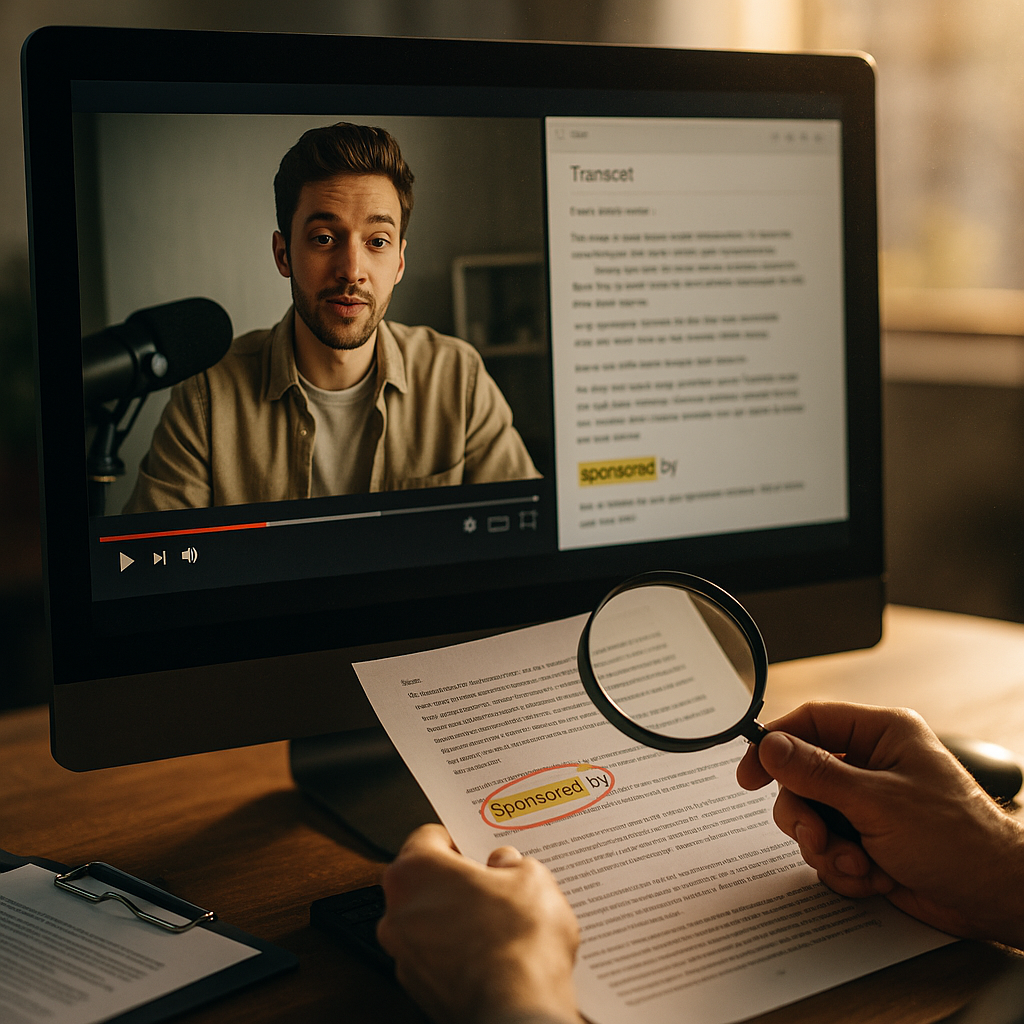
The FTC closed over 20 influencer disclosure cases last enforcement cycle, and most of them started with a plain-text transcript, not a screenshot. If your compliance process still relies on manual video reviews or spot-checking a few high-profile creators, you’re gambling with brand reputation. A video transcript audit system built to scan every piece of sponsored content across platforms isn’t a nice-to-have anymore. It’s the only scalable way to catch undisclosed sponsorships before they go live.
Why Manual Review Doesn’t Cut It Anymore
Think about the math for a second. A mid-sized brand running 150 creator partnerships a quarter, each posting to TikTok, Instagram Reels, and YouTube Shorts, generates roughly 1,350 videos per quarter if you count reposts and story variants. Nobody’s watching all of that in real time. Compliance teams end up sampling 5-10% and hoping the rest holds up.
That’s not a compliance program. That’s a lottery ticket.
Video transcripts change the equation. Whisper-based transcription models and platform-native captioning APIs now produce searchable text from any video in under a minute. Once you have text, you have something you can pattern-match, keyword-flag, and run through NLP classifiers at scale. Suddenly reviewing 1,350 videos a quarter isn’t a staffing problem, it’s a pipeline problem.
A transcript-based audit system doesn’t replace human judgment, it triages it, sending the 3% of ambiguous cases to a compliance reviewer instead of forcing someone to watch everything.
What a Cross-Platform Transcript Audit System Actually Looks Like
Strip away the buzzwords and it’s four components working together: ingestion, transcription, classification, and escalation.
Ingestion pulls video content from wherever your creators post, via TikTok’s Creator Marketplace API, Meta’s Content Library, and YouTube’s Data API. Some brands also monitor X and LinkedIn video, particularly for B2B influencer programs where LinkedIn video hooks increasingly carry sponsorship weight without clear labeling.
Transcription converts audio and on-screen text (captions, lower-thirds, verbal disclosures) into a unified text layer. This matters because disclosure isn’t just spoken, it’s sometimes a tiny caption overlay that flashes for two seconds. Your system needs OCR on video frames, not just speech-to-text.
Classification is where the real value lives. You’re running the transcript against a rules engine that flags:
- Absence of required disclosure language (“ad,” “sponsored,” “paid partnership”) within the first 30 seconds or the caption
- Presence of a platform’s native paid partnership tag versus actual verbal or on-screen disclosure (these are not the same thing, and a paid partnership label alone won’t satisfy FTC rules)
- Health, financial, or performance claims that require enhanced disclaimers
- Mismatches between contract terms and actual on-screen behavior (a creator contracted for “clear and conspicuous” disclosure who buries it in a description box)
Escalation routes flagged content to a human reviewer with the timestamp, transcript excerpt, and contract clause pulled automatically. That last part is what separates a functioning system from a glorified keyword search.
Legal and compliance teams don’t need more alerts, they need alerts with context.
The Disclosure Gap Nobody’s Talking About
Here’s the uncomfortable part. Most brands assume that if the platform’s paid partnership toggle is switched on, they’re covered. It’s not that simple. The FTC’s endorsement guidance requires disclosure to be clear, conspicuous, and difficult to miss regardless of platform features. A creator can enable Instagram’s branded content tag and still fail FTC standards if the tag isn’t visible on the specific surface where the video gets viewed, like when it’s embedded on a third-party site or clipped for a YouTube Short.
Platform tags are a signal, not a shield. Your disclosure compliance approach across platforms has to account for that gap, and a transcript system is one of the few tools that can verify actual visible or spoken disclosure independent of what a platform’s metadata claims.
This is also where cross-platform matters more than people realize. A creator might disclose properly on the original TikTok post, then a fan account reposts it to Instagram Reels with the caption stripped. Your brand is still on the hook for that redistributed content depending on your contract language, and redistribution liability clauses are becoming standard for exactly this reason. An audit system that only monitors the original posting platform misses the redistribution risk entirely.
Building the Keyword and Pattern Library
The classification engine is only as good as the rules feeding it. Start with FTC-required phrasing variants: “ad,” “sponsored,” “paid partnership,” “gifted,” “#ad” versus vague hashtags like “#sp” or “#collab” that courts and regulators have flagged as insufficient. Then layer in category-specific triggers.
Supplement and wellness content needs an extra pass for health claims that require FDA-adjacent disclaimers, which is a different animal from disclosure compliance and worth handling as a separate disclaimer review layered onto the same transcript.
Financial and crypto-adjacent content needs its own library entirely, partly because of SEC overlap in revenue-share arrangements that carry securities risk. Your transcript system should flag any mention of returns, earnings claims, or investment language and route it to legal, not marketing compliance.
One thing that trips up teams building this for the first time: negative keyword lists matter as much as positive ones. If your classifier flags every instance of the word “partner,” you’ll drown reviewers in false positives from creators saying things like “my workout partner” or “business partner” in unrelated context. Tune the model with real transcripts from your existing creator roster before you scale it, not generic training data.
Where AI Transcription Still Gets It Wrong
Nobody wants to hear this, but automated transcription has failure modes you need to plan for.
Fast speech, overlapping audio (multiple creators talking over each other), and heavy accents still produce transcription errors at meaningful rates, sometimes 8-12% word error rate depending on the model and language, according to benchmarks published by transcription vendors and referenced in eMarketer’s creator economy research. A missed “ad” because the model transcribed it as “add” or dropped it entirely due to background music is a false negative that matters.
Build in a confidence threshold. Anything the transcription model flags below, say, 85% confidence on the specific segment where disclosure would appear should get automatic human review, no exceptions.
Non-English content adds another layer. If your influencer program spans US, UK, and EU creators, your transcript system needs multilingual disclosure libraries, because “publicité” or “Werbung” carry the same legal weight as “ad” but won’t trigger an English-only keyword rule. This becomes especially relevant given how DSA enforcement is tightening ad compliance expectations across EU markets, with regulators showing less patience for “we didn’t catch it” excuses.
An 8-12% transcription error rate sounds small until you realize that’s potentially one in eight sponsored videos where your system could miss the exact word that determines FTC compliance.
Operationalizing It: Who Owns This, and When
The best transcript audit systems run at two checkpoints, not one.
Pre-publication for creators who submit drafts for approval (common in enterprise programs with formal contract review). The transcript engine scans the draft, flags issues, and sends it back before the creator posts. This is the cheapest place to catch problems, before anything is public.
Post-publication, near-real-time for programs with looser pre-approval workflows, or for monitoring organic reposts and redistribution. This runs continuously, checking new content within hours of it going live rather than during a weekly or monthly audit cycle.
Ownership typically splits between marketing ops (who manage the ingestion pipeline and creator relationships) and legal/compliance (who own the classification rules and escalation review). Get this wrong and you end up with either a system nobody maintains or a system that generates alerts nobody acts on. Assign a named owner for the escalation queue, not a shared inbox. Alerts that sit in a shared inbox for 72 hours defeat the entire purpose of building this in the first place.
It’s also worth tying this into your broader creator data governance work. If you’re already building consent frameworks for creator data under FTC and GDPR rules, the transcript audit logs themselves become a data asset that needs the same retention and access controls. Don’t bolt this on as a separate, ungoverned system.
What This Costs, and What It Saves
Realistic budget range for a mid-market brand: transcription API costs run $0.10-$0.25 per minute of video depending on volume and vendor (Google Cloud, AWS Transcribe, or specialized creator-economy vendors), plus engineering time to build ingestion pipelines and a classification layer, plus a compliance reviewer’s time for escalations. For a program processing 1,000+ videos monthly, expect to land somewhere in the $3,000-$8,000 monthly range once you include tooling and a fractional reviewer’s time, though this scales down fast if you’re using open-source Whisper deployments instead of paid API tiers.
Compare that to a single FTC enforcement action, which can carry penalties well into six figures, plus the reputational cost that’s much harder to price. According to Sprout Social’s consumer trust research, undisclosed sponsorships erode audience trust in ways that outlast any single campaign, hurting every future creator partnership the brand runs.
The ROI case isn’t really about avoiding fines. It’s about avoiding the slow bleed of trust erosion that happens when audiences start assuming your brand’s sponsored content is hiding something.
Next Step
Start small: pull transcripts from your last 90 days of sponsored content, run them through a basic disclosure keyword check, and see how many videos would have been flagged. That single audit will tell you whether you need a full system or just tighter contract enforcement, and it’ll do it in an afternoon, not a quarter.
FAQs
What is a video transcript audit system in the influencer marketing context?
It’s a compliance pipeline that converts sponsored creator videos into searchable text, then scans that text for required disclosure language, claim violations, and contract mismatches before or shortly after publication.
Do platform paid partnership tags already handle disclosure compliance?
No. Platform tags are a helpful signal but don’t guarantee FTC compliance on their own, especially when content gets embedded, clipped, or reposted outside the original platform where the tag lives.
How accurate is automated transcription for catching disclosure language?
Accuracy varies by content type, with word error rates commonly in the 8-12% range for fast or overlapping speech. Brands should set confidence thresholds and route low-confidence segments to human review rather than trusting automation blindly.
Who should own a transcript audit system inside a brand or agency?
Typically marketing operations owns the ingestion and tooling, while legal or compliance owns the classification rules and escalation review. A named individual, not a shared inbox, should own the final escalation queue.
What’s the realistic cost of building this for a mid-sized creator program?
Expect roughly $3,000-$8,000 monthly for a program processing 1,000+ videos, covering transcription API costs, pipeline maintenance, and reviewer time, though open-source transcription models can reduce this significantly.
FAQs
What is a video transcript audit system in the influencer marketing context?
It’s a compliance pipeline that converts sponsored creator videos into searchable text, then scans that text for required disclosure language, claim violations, and contract mismatches before or shortly after publication.
Do platform paid partnership tags already handle disclosure compliance?
No. Platform tags are a helpful signal but don’t guarantee FTC compliance on their own, especially when content gets embedded, clipped, or reposted outside the original platform where the tag lives.
How accurate is automated transcription for catching disclosure language?
Accuracy varies by content type, with word error rates commonly in the 8-12% range for fast or overlapping speech. Brands should set confidence thresholds and route low-confidence segments to human review rather than trusting automation blindly.
Who should own a transcript audit system inside a brand or agency?
Typically marketing operations owns the ingestion and tooling, while legal or compliance owns the classification rules and escalation review. A named individual, not a shared inbox, should own the final escalation queue.
What’s the realistic cost of building this for a mid-sized creator program?
Expect roughly $3,000-$8,000 monthly for a program processing 1,000+ videos, covering transcription API costs, pipeline maintenance, and reviewer time, though open-source transcription models can reduce this significantly.
Top Influencer Marketing Agencies
The leading agencies shaping influencer marketing in 2026
Agencies ranked by campaign performance, client diversity, platform expertise, proven ROI, industry recognition, and client satisfaction. Assessed through verified case studies, reviews, and industry consultations.
Moburst

-
2

The Shelf
Boutique Beauty & Lifestyle Influencer AgencyA data-driven boutique agency specializing exclusively in beauty, wellness, and lifestyle influencer campaigns on Instagram and TikTok. Best for brands already focused on the beauty/personal care space that need curated, aesthetic-driven content.Clients: Pepsi, The Honest Company, Hims, Elf Cosmetics, Pure LeafVisit The Shelf → -
3

Audiencly
Niche Gaming & Esports Influencer AgencyA specialized agency focused exclusively on gaming and esports creators on YouTube, Twitch, and TikTok. Ideal if your campaign is 100% gaming-focused — from game launches to hardware and esports events.Clients: Epic Games, NordVPN, Ubisoft, Wargaming, Tencent GamesVisit Audiencly → -
4

Viral Nation
Global Influencer Marketing & Talent AgencyA dual talent management and marketing agency with proprietary brand safety tools and a global creator network spanning nano-influencers to celebrities across all major platforms.Clients: Meta, Activision Blizzard, Energizer, Aston Martin, WalmartVisit Viral Nation → -
5

The Influencer Marketing Factory
TikTok, Instagram & YouTube CampaignsA full-service agency with strong TikTok expertise, offering end-to-end campaign management from influencer discovery through performance reporting with a focus on platform-native content.Clients: Google, Snapchat, Universal Music, Bumble, YelpVisit TIMF → -
6

NeoReach
Enterprise Analytics & Influencer CampaignsAn enterprise-focused agency combining managed campaigns with a powerful self-service data platform for influencer search, audience analytics, and attribution modeling.Clients: Amazon, Airbnb, Netflix, Honda, The New York TimesVisit NeoReach → -
7

Ubiquitous
Creator-First Marketing PlatformA tech-driven platform combining self-service tools with managed campaign options, emphasizing speed and scalability for brands managing multiple influencer relationships.Clients: Lyft, Disney, Target, American Eagle, NetflixVisit Ubiquitous → -
8

Obviously
Scalable Enterprise Influencer CampaignsA tech-enabled agency built for high-volume campaigns, coordinating hundreds of creators simultaneously with end-to-end logistics, content rights management, and product seeding.Clients: Google, Ulta Beauty, Converse, AmazonVisit Obviously →