


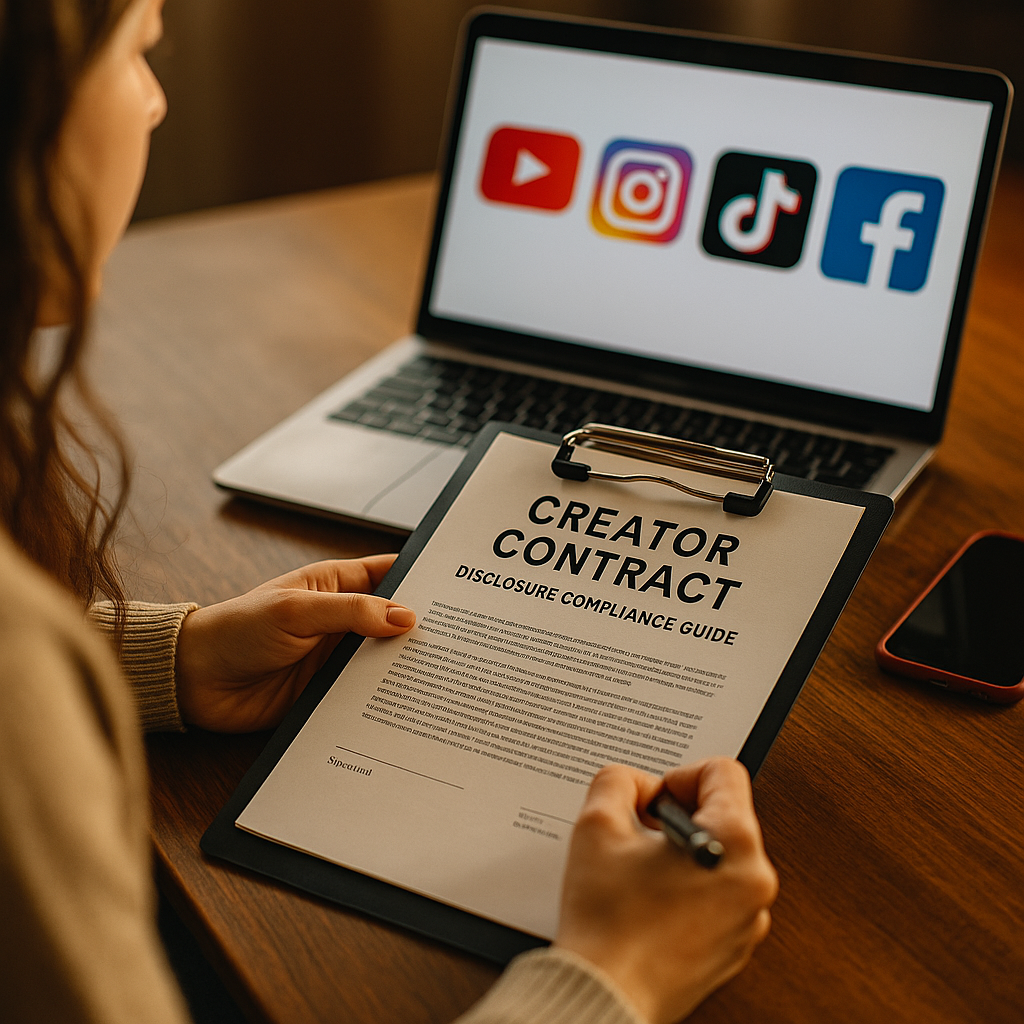
The FTC closed almost 250 influencer-related complaints and inquiries in a single recent enforcement window, and platform-specific labeling rules keep multiplying faster than most legal teams can track them. If your creator contracts still treat disclosure as an afterthought, you’re one audit away from a mess. A real compliance guide to embedding disclosure checks into contracts and workflows isn’t optional anymore. It’s infrastructure.
Why “One Contract Template” No Longer Works
Here’s the uncomfortable truth: TikTok, Instagram, YouTube, and X each handle disclosure differently. Different label placements. Different automated tools. Different enforcement thresholds. A brand running a multi-platform campaign with a single boilerplate disclosure clause is essentially gambling that no one platform’s quirks will trip up the whole program.
Think about it this way. Instagram’s Paid Partnership tag and TikTok’s Branded Content toggle look similar on the surface, but a paid partnership label alone won’t satisfy FTC rules if the underlying disclosure language in the creator’s caption doesn’t independently meet the “clear and conspicuous” standard. Regulators don’t care that the platform gave the creator a checkbox. They care whether an average consumer scrolling past would understand the post is an ad.
Platform-native disclosure tools are a floor, not a ceiling. Contracts that treat them as the entire compliance solution are building on sand.
Build Disclosure Language Into the Contract, Not the Brief
Too many brands park disclosure requirements in a creative brief or a Slack message. That’s a mistake. Briefs get lost. Slack threads get deleted. Contracts survive discovery requests.
Your master services agreement or influencer contract should include a dedicated disclosure clause specifying:
- The exact language or approved phrasing options (e.g., “#ad,” “Paid partnership with [Brand]”)
- Placement requirements — above the fold, not buried in a hashtag pile
- Platform-specific tool usage, such as mandatory use of Instagram’s branded content tool or TikTok’s ad label
- Consequences for non-compliance, including content takedown rights and payment holdbacks
- A representation and warranty that the creator understands FTC guidance and applicable local rules
This isn’t legal theater. It’s the paper trail that protects the brand if a regulator or platform trust-and-safety team comes asking questions. It also gives you contractual leverage to pull non-compliant content fast, before it snowballs into a bigger enforcement issue.
The Four-Platform Disclosure Matrix
Since disclosure mechanics differ across platforms, your pre-approval workflow needs a matrix, not a single checklist. Here’s roughly how the major four break down for contract and workflow purposes:
- Instagram/Meta: Requires the Paid Partnership label plus in-caption disclosure. Meta’s ad library and branded content tools create a data trail, but that trail is about ad transparency, not FTC substantiation — a distinction covered well in Meta conversion data is not FTC substantiation evidence.
- TikTok: The Branded Content Toggle is mandatory for paid content, and TikTok’s redistribution and remix features add a layer most legal teams miss. See TikTok redistribution liability clause guidance for how re-shared content can inherit disclosure obligations it never originally had.
- YouTube: Requires both the platform’s paid promotion checkbox and verbal or on-screen disclosure within the first 30 seconds. Watch-time algorithm shifts have made timing even more important — see YouTube’s dual disclosure checklist.
- X (formerly Twitter): Lacks a robust native disclosure tool, which pushes more responsibility onto contract language and creator training. Revenue-sharing features on X also raise indemnification questions worth reviewing in X creator revenue sharing clauses.
Running all four simultaneously means your pre-approval workflow needs conditional logic: different checklists trigger depending on which platform the content is going to. A generic “did you disclose?” checkbox in your approval software isn’t enough.
Pre-Approval Workflows: Where Most Programs Actually Fail
Contracts set the rules. Workflows enforce them. And this is where most brands quietly fall apart, because pre-approval is often handled by a coordinator using a spreadsheet, not a system with hard gates.
A defensible pre-approval workflow needs four checkpoints:
- Draft review: Before content is finalized, someone checks disclosure placement and language against the platform-specific requirement.
- Tool verification: Confirm the creator actually toggled the native disclosure tool (branded content tag, paid promotion checkbox), not just typed “#ad” and called it done.
- Legal spot-check: For higher-risk categories — health claims, financial products, anything regulated — route to legal or compliance before publish. This matters even more for sensitive verticals; see health and performance claim disclaimers that survive FTC review.
- Post-publish audit: Spot-check live posts within 24-48 hours. Platforms change UI constantly, and a disclosure toggle that worked in testing can silently fail at publish.
Skipping any one of these checkpoints is how brands end up with dozens of live posts missing disclosure, discovered only after a journalist or regulator flags it.
If your pre-approval workflow doesn’t have a hard “no toggle, no publish” gate, you don’t have a compliance workflow. You have a suggestion.
Fold Follower Authenticity Into the Same Workflow
Disclosure compliance and creator authenticity are usually managed in separate silos, which doesn’t make sense operationally. Both are FTC risk factors. Both need to be checked before a campaign goes live, not after.
Bake a follower-authenticity check into the same pre-approval gate you use for disclosure review. If a creator’s audience is padded with bots, any disclosure — however well-placed — sits on top of a deceptive engagement base, and that’s its own regulatory exposure. The fake followers FTC risk pre-contract audit checklist and the broader follower authenticity audit framework both make the case that authenticity checks belong at the same contract stage as disclosure language, not as a separate afterthought handled by a different team.
Data and Consent Overlap With Disclosure More Than You’d Think
Disclosure isn’t just about telling consumers a post is an ad. Increasingly, it intersects with how creator and audience data gets used, tracked, and shared. If your campaign involves retargeting pixels, affiliate tracking, or first-party data collection through creator content, you need consent language that complements your disclosure clause, not contradicts it.
This is where a lot of contracts get sloppy. They’ll nail the FTC disclosure requirement but ignore data consent entirely, leaving a gap that GDPR or state privacy laws can walk right through. The creator data consent framework for FTC and GDPR compliance is a useful companion document to run alongside your disclosure clause, especially for programs spanning US and EU audiences.
According to FTC guidance, disclosures must be unavoidable — not something a consumer has to hunt for. Pair that standard with data protection guidance from the UK Information Commissioner’s Office if you’re running campaigns touching UK audiences, since disclosure and data consent obligations increasingly overlap in cross-border creator programs.
Operationalizing It: Tools and Cadence
You don’t need custom software to run this well, though larger programs increasingly use platforms like HubSpot or Sprout Social to centralize approval workflows and keep an audit trail. What matters more than the tool is the cadence:
- Quarterly contract template review, since platform disclosure rules shift often enough to outdate boilerplate fast
- Monthly spot-checks on live content across all four platforms, not just the ones where you post most
- Immediate escalation protocol when a creator publishes without proper disclosure — don’t wait for the next campaign cycle to fix it
Marketers researching creator spend trends through sources like eMarketer or Statista will notice influencer budgets keep climbing year over year. More spend means more scrutiny. Building disclosure compliance into contracts and workflows now is cheaper than retrofitting it after a platform or regulator flags your program.
Frequently Asked Questions
FAQs
What’s the minimum disclosure clause every creator contract should include?
At minimum, include approved disclosure language, required placement, mandatory use of the platform’s native disclosure tool, and consequences for non-compliance such as content removal or payment holdbacks.
Do platform-native disclosure tools satisfy FTC requirements on their own?
No. Native tools like Instagram’s Paid Partnership label or TikTok’s branded content toggle are helpful but not sufficient by themselves. The FTC still requires disclosure language that’s clear and conspicuous independent of any platform tool.
How often should disclosure contract templates be updated?
Quarterly at minimum. Platform disclosure tools and UI change frequently, and regulatory guidance evolves too, so a template that was compliant two quarters ago may already be outdated.
Should follower authenticity checks be part of the disclosure workflow?
Yes. Both are FTC risk factors tied to deceptive advertising practices, so checking them at the same pre-approval stage is more efficient and reduces the chance either gets skipped.
What happens if a creator publishes without proper disclosure?
Contracts should give the brand the right to require immediate takedown or edit, withhold payment until corrected, and in repeat cases, terminate the relationship. Document every incident for your compliance file.
Next Step
Pull your current creator contract template and check whether it names each platform’s disclosure mechanism explicitly. If it just says “disclose in accordance with FTC guidelines,” rewrite it this quarter, before your next campaign launches across all four platforms at once.
FAQs
What’s the minimum disclosure clause every creator contract should include?
At minimum, include approved disclosure language, required placement, mandatory use of the platform’s native disclosure tool, and consequences for non-compliance such as content removal or payment holdbacks.
Do platform-native disclosure tools satisfy FTC requirements on their own?
No. Native tools like Instagram’s Paid Partnership label or TikTok’s branded content toggle are helpful but not sufficient by themselves. The FTC still requires disclosure language that’s clear and conspicuous independent of any platform tool.
How often should disclosure contract templates be updated?
Quarterly at minimum. Platform disclosure tools and UI change frequently, and regulatory guidance evolves too, so a template that was compliant two quarters ago may already be outdated.
Should follower authenticity checks be part of the disclosure workflow?
Yes. Both are FTC risk factors tied to deceptive advertising practices, so checking them at the same pre-approval stage is more efficient and reduces the chance either gets skipped.
What happens if a creator publishes without proper disclosure?
Contracts should give the brand the right to require immediate takedown or edit, withhold payment until corrected, and in repeat cases, terminate the relationship. Document every incident for your compliance file.
Top Influencer Marketing Agencies
The leading agencies shaping influencer marketing in 2026
Agencies ranked by campaign performance, client diversity, platform expertise, proven ROI, industry recognition, and client satisfaction. Assessed through verified case studies, reviews, and industry consultations.
Moburst

-
2

The Shelf
Boutique Beauty & Lifestyle Influencer AgencyA data-driven boutique agency specializing exclusively in beauty, wellness, and lifestyle influencer campaigns on Instagram and TikTok. Best for brands already focused on the beauty/personal care space that need curated, aesthetic-driven content.Clients: Pepsi, The Honest Company, Hims, Elf Cosmetics, Pure LeafVisit The Shelf → -
3

Audiencly
Niche Gaming & Esports Influencer AgencyA specialized agency focused exclusively on gaming and esports creators on YouTube, Twitch, and TikTok. Ideal if your campaign is 100% gaming-focused — from game launches to hardware and esports events.Clients: Epic Games, NordVPN, Ubisoft, Wargaming, Tencent GamesVisit Audiencly → -
4

Viral Nation
Global Influencer Marketing & Talent AgencyA dual talent management and marketing agency with proprietary brand safety tools and a global creator network spanning nano-influencers to celebrities across all major platforms.Clients: Meta, Activision Blizzard, Energizer, Aston Martin, WalmartVisit Viral Nation → -
5

The Influencer Marketing Factory
TikTok, Instagram & YouTube CampaignsA full-service agency with strong TikTok expertise, offering end-to-end campaign management from influencer discovery through performance reporting with a focus on platform-native content.Clients: Google, Snapchat, Universal Music, Bumble, YelpVisit TIMF → -
6

NeoReach
Enterprise Analytics & Influencer CampaignsAn enterprise-focused agency combining managed campaigns with a powerful self-service data platform for influencer search, audience analytics, and attribution modeling.Clients: Amazon, Airbnb, Netflix, Honda, The New York TimesVisit NeoReach → -
7

Ubiquitous
Creator-First Marketing PlatformA tech-driven platform combining self-service tools with managed campaign options, emphasizing speed and scalability for brands managing multiple influencer relationships.Clients: Lyft, Disney, Target, American Eagle, NetflixVisit Ubiquitous → -
8

Obviously
Scalable Enterprise Influencer CampaignsA tech-enabled agency built for high-volume campaigns, coordinating hundreds of creators simultaneously with end-to-end logistics, content rights management, and product seeding.Clients: Google, Ulta Beauty, Converse, AmazonVisit Obviously →