


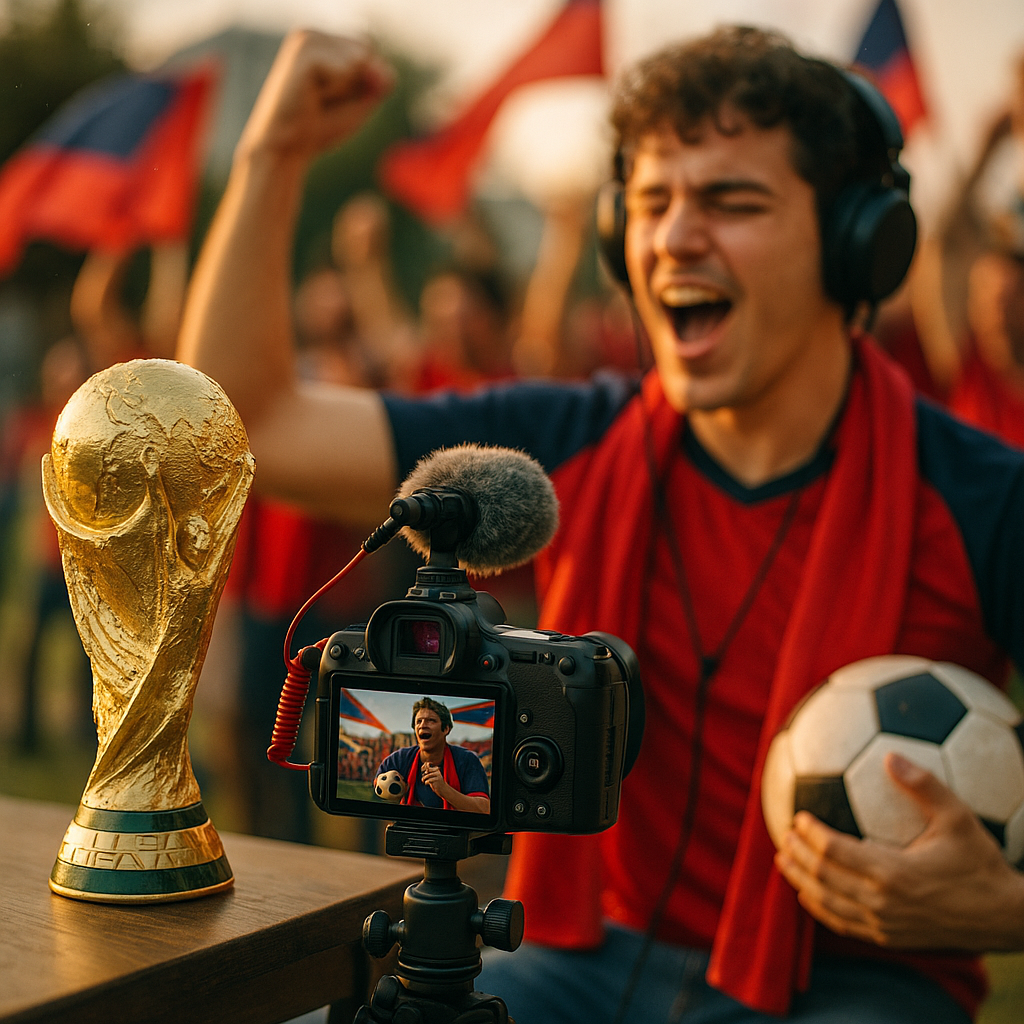
Broadcast Reach Is Dead. Participatory Fandom Is the New Inventory.
Over 60% of Gen Z fans say they follow a match primarily through creators, not broadcasters. That single stat should be enough to trigger a budget architecture review at every major brand with World Cup exposure. The creator-led sports entertainment shift is not a future trend. It is the operating reality brands are navigating right now.
What “Simultaneous Consumption” Actually Means for Sponsorship
Think about how a 19-year-old in São Paulo or Jakarta actually experiences a World Cup match. They have the broadcast or stream in one tab. They are live-reacting in a Discord server with 40,000 members. They are watching a creator’s hot-take explainer on YouTube. They are scrolling TikTok for the clip their favorite football content creator just posted. And they are arguing on X while the match is still live.
This is not second-screen behavior. This is multi-layered participation where the creator layer often carries more emotional weight than the broadcast itself. The match is the raw material. Creators are the editorial voice. And brands that still think in terms of logo placement and 30-second spots are buying real estate in a neighborhood people have largely moved out of.
The match is the raw material. Creators are the editorial voice. Sponsorship models built around broadcast impressions are purchasing access to an audience that has already left the building.
This behavioral pattern creates a structural problem for traditional sponsorship architecture, which was designed around scarcity: limited broadcast slots, finite stadium visibility, controlled media environments. Creator-led consumption is infinite, distributed, and algorithmically amplified. You cannot buy your way into every conversation. You have to be invited into it.
The Four Platforms and What They Demand from Brands
Each platform in this ecosystem operates on different native logic, and brands that treat them as interchangeable distribution channels are wasting budget.
YouTube is where depth lives. Long-form analysis, player breakdowns, tactical explainers, and documentary-style content from channels like The Overlap or the Tifo Football model pull audiences who want to understand the game, not just watch it. Brand integrations here need to fund production quality and earn placement through editorial relevance, not interruption. The sports creator IP model coming out of podcast and video networks shows exactly how durable these audience relationships can be.
TikTok is where culture moves fastest. A single creator moment during the tournament can define how a brand is perceived by an entire generation within 48 hours. The platform rewards participation and authenticity. Brands that brief creators with rigid messaging frameworks will get content that looks sponsored because it is, visibly and awkwardly. The brief structure has to change. Start with entertainment-first briefing principles before you touch a script.
Discord is the most underinvested platform in most brand activation plans. It is where the most engaged fans live permanently, not just during tournaments. Brands that show up in Discord servers as genuine participants, whether through creator partnerships, exclusive content drops, or community-specific activations, build trust that carries forward. Brands that treat Discord as an ad placement get publicly roasted.
X moves at match speed. It is the real-time reaction layer, and it is the hardest to activate well because it punishes anything that feels manufactured. Brands with social teams empowered to respond fast, with personality and contextual awareness, win here. Brands running approval chains that take four hours will miss every relevant moment.
Why Traditional Sponsorship Architecture Cannot Absorb This
The legacy sponsorship model is built around three pillars: broadcast reach guarantees, exclusivity packages, and passive logo visibility. All three assumptions break down in a creator-led environment.
Broadcast reach guarantees mean less when a significant portion of your target demographic is not watching the broadcast at all. Exclusivity packages become harder to enforce when a creator who likes a competitor’s product will simply say so to their audience regardless of category restrictions. And passive logo visibility generates exactly zero participation, which is the currency that actually converts in this ecosystem.
The financial implications are significant. Paid amplification is increasingly outpacing flat sponsorship fees because brands have learned that reach without activation is inert. A $2M stadium naming deal that generates no creator conversation is less valuable than a $300K creator partnership program that generates 50 million organic impressions and measurable search lift.
This is not to say broadcast and event sponsorships have no value. They do. But their value is increasingly dependent on the creator amplification layer that activates around them. The stadium deal is infrastructure. The creator program is the activation. Brands that invest heavily in one and ignore the other are running a lopsided strategy.
Redesigning Sponsorship Architecture Around Participation
What does it actually look like to rebuild your sponsorship model for this environment? Several structural changes matter.
- Shift from reach contracts to participation briefs. Instead of buying impressions, buy creative co-ownership with creators who have genuine sports audiences. Give them real access: behind-the-scenes, exclusive data, player interactions if possible. Access generates participation. Participation generates reach.
- Build creator tiers across platform types. Your World Cup creator roster should include YouTube long-form voices, TikTok reaction creators, Discord community managers, and X commentators. They serve different functions in the fan journey. Treating them as interchangeable is a planning error. The niche vs. macro creator debate is particularly relevant here: a mid-tier creator with 200K deeply engaged football fans will outperform a macro lifestyle creator with 5M passive followers every time.
- Operationalize real-time content production. This requires structural investment: dedicated social teams, pre-approved creative frameworks, and creator partners who are briefed and on-call during match windows. Brands that win on TikTok and X during a tournament have done the operational work before kick-off, not during.
- Measure participation metrics, not just reach. Comment volume, Discord thread activity, duet and stitch behavior on TikTok, X reply chains: these are the signals that indicate whether your brand is part of the conversation or a sponsored overlay on top of it. Social listening tools like Sprout Social can surface this signal at scale.
- Budget for creator-led content that lives independently. The best-performing brand moments in sports happen when creator content stands on its own as entertainment. That means funding production, not just the integration fee. It means allowing creators editorial latitude. And it means accepting that some of the best brand storytelling will not lead with your product.
The brands winning participatory sponsorship are not buying access to audiences. They are co-funding the content those audiences already want to watch. The distinction is everything.
The Compliance and Measurement Gap Brands Need to Close
One operational risk that gets under-discussed in the excitement around participatory models: disclosure compliance at scale. When your creator roster spans four platforms, multiple countries, and dozens of individual voices, ensuring FTC disclosure compliance and equivalent international standards (the ICO in the UK, for example) becomes genuinely complex. Brands running World Cup creator programs without a compliance framework are accumulating regulatory risk in proportion to the scale of their activation.
On the measurement side, the multi-platform nature of this consumption pattern creates attribution challenges that standard sponsorship reporting cannot handle. eMarketer data consistently shows that brands undercount the downstream search and conversion impact of creator-driven campaigns because they measure platforms in silos rather than as a unified ecosystem. Investing in cross-platform attribution infrastructure before the tournament rather than trying to retrofit it afterward is the difference between knowing what worked and guessing.
For brands managing creator tech infrastructure across a large roster, a creator tool stack audit can surface redundancies and gaps before you scale into a tournament activation. The last thing you want is platform-specific measurement tools that cannot talk to each other when you need a unified performance view.
What the Forward-Looking Budget Looks Like
There is no universal allocation formula. But the directional shift is consistent across brands that are executing this well: more budget into creator production and partnership fees, less into passive broadcast adjacency; more into always-on creator relationships that peak during tournament windows, less into one-off event sponsorships that generate no audience connection outside the match.
Statista’s creator economy data puts the global market at scale that makes these investments clearly defensible. Brands that built creator programs before the World Cup cycle will spend far less per impression than brands scrambling to buy creator access during peak demand. The operational lesson is to treat creator relationships as infrastructure, not campaign assets.
The linear TV budget reallocation question also comes back here: if your audience is 18-34 and skewing toward creator-native consumption patterns, the linear TV vs. creator channel budget decision should have a clear answer by now.
Start by auditing which platforms your target audience actually uses during live sports events, then map your current sponsorship spend against that behavior. The gap between where your money is going and where your audience’s attention lives is your action item.
FAQs
What is participatory fandom and why does it matter for World Cup sponsorships?
Participatory fandom refers to the behavior where fans actively engage with sports content across platforms like TikTok, Discord, YouTube, and X simultaneously, rather than passively watching a broadcast. For World Cup sponsorships, it matters because brand visibility and engagement now depend on being part of these multi-platform conversations, not just securing broadcast placements. Brands that do not design for participation will be invisible to the most engaged and youngest fan segments.
How should brands restructure their creator rosters for a major sports tournament?
Brands should build tiered creator rosters mapped to platform function: long-form YouTube voices for depth and analysis, TikTok creators for cultural speed and reaction content, Discord community managers for engaged fan communities, and X commentators for real-time match conversation. Niche creators with highly engaged sports-specific audiences typically outperform macro influencers with broad but passive followings in tournament contexts.
What metrics should replace broadcast reach in a creator-led sponsorship model?
Key metrics include creator content engagement rates, comment and reply volume, TikTok duet and stitch activity, Discord thread engagement, branded hashtag participation, and cross-platform share behavior. These participation metrics indicate whether a brand is genuinely embedded in fan conversation. Supplement them with cross-platform attribution data to capture downstream search and conversion impact that platform-siloed reporting misses.
How do brands manage FTC disclosure compliance across a multi-platform creator program?
Brands need a centralized compliance framework that maps disclosure requirements by platform and geography before the campaign launches. This includes pre-approved disclosure language per platform, contractual disclosure obligations in creator agreements, and a monitoring process to verify compliance at scale. For international tournaments like the World Cup, brands must also account for equivalent regulations in other jurisdictions, including UK and EU standards.
Is traditional event sponsorship still worth investing in alongside creator programs?
Yes, but its value is increasingly dependent on the creator amplification layer built around it. Stadium naming rights, broadcast adjacency, and official partnership designations provide credibility and access that can fuel creator content. However, without a parallel creator activation strategy, these investments generate passive impressions with minimal engagement from younger audiences. The most effective models treat event sponsorships as infrastructure and creator programs as the activation engine.
Top Influencer Marketing Agencies
The leading agencies shaping influencer marketing in 2026
Agencies ranked by campaign performance, client diversity, platform expertise, proven ROI, industry recognition, and client satisfaction. Assessed through verified case studies, reviews, and industry consultations.
Moburst

-
2

The Shelf
Boutique Beauty & Lifestyle Influencer AgencyA data-driven boutique agency specializing exclusively in beauty, wellness, and lifestyle influencer campaigns on Instagram and TikTok. Best for brands already focused on the beauty/personal care space that need curated, aesthetic-driven content.Clients: Pepsi, The Honest Company, Hims, Elf Cosmetics, Pure LeafVisit The Shelf → -
3

Audiencly
Niche Gaming & Esports Influencer AgencyA specialized agency focused exclusively on gaming and esports creators on YouTube, Twitch, and TikTok. Ideal if your campaign is 100% gaming-focused — from game launches to hardware and esports events.Clients: Epic Games, NordVPN, Ubisoft, Wargaming, Tencent GamesVisit Audiencly → -
4

Viral Nation
Global Influencer Marketing & Talent AgencyA dual talent management and marketing agency with proprietary brand safety tools and a global creator network spanning nano-influencers to celebrities across all major platforms.Clients: Meta, Activision Blizzard, Energizer, Aston Martin, WalmartVisit Viral Nation → -
5

The Influencer Marketing Factory
TikTok, Instagram & YouTube CampaignsA full-service agency with strong TikTok expertise, offering end-to-end campaign management from influencer discovery through performance reporting with a focus on platform-native content.Clients: Google, Snapchat, Universal Music, Bumble, YelpVisit TIMF → -
6

NeoReach
Enterprise Analytics & Influencer CampaignsAn enterprise-focused agency combining managed campaigns with a powerful self-service data platform for influencer search, audience analytics, and attribution modeling.Clients: Amazon, Airbnb, Netflix, Honda, The New York TimesVisit NeoReach → -
7

Ubiquitous
Creator-First Marketing PlatformA tech-driven platform combining self-service tools with managed campaign options, emphasizing speed and scalability for brands managing multiple influencer relationships.Clients: Lyft, Disney, Target, American Eagle, NetflixVisit Ubiquitous → -
8

Obviously
Scalable Enterprise Influencer CampaignsA tech-enabled agency built for high-volume campaigns, coordinating hundreds of creators simultaneously with end-to-end logistics, content rights management, and product seeding.Clients: Google, Ulta Beauty, Converse, AmazonVisit Obviously →