


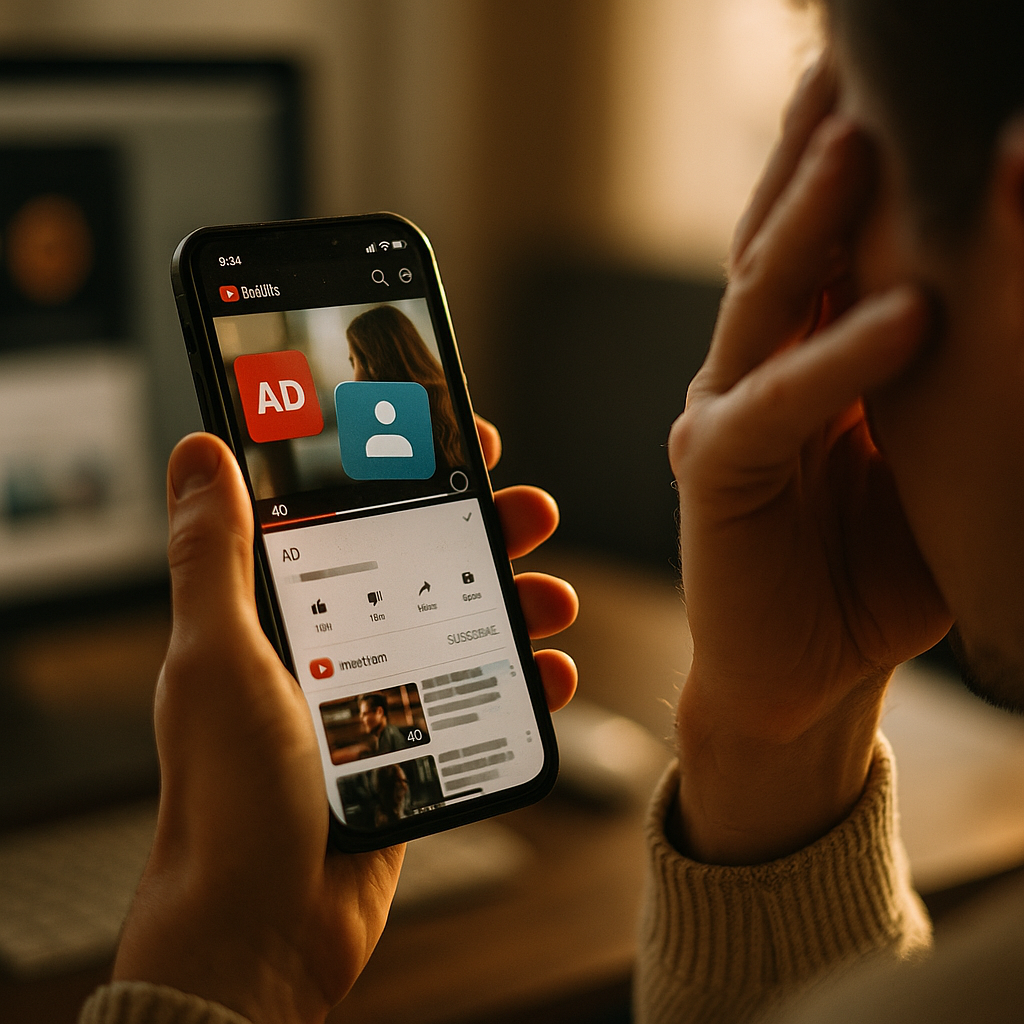
YouTube Premium has crossed 100 million subscribers globally — and every one of them is invisible to your standard pre-roll buy. If your influencer program was built around ad-supported viewership assumptions, your reach model, your brief requirements, and your amplification strategy are all pointing at the wrong audience.
The Segmentation Problem Nobody’s Briefing Around
Here’s the structural reality: YouTube now operates as two overlapping ecosystems. Ad-supported viewers experience content through an interruption model — your brand message arrives as a pre-roll, a mid-roll, or a display overlay. Premium subscribers watch the same videos without any of that. The creator’s content is the only brand exposure they receive.
For brands targeting high-income, high-intent consumers — the exact profile that over-indexes on YouTube Premium adoption — this isn’t a minor footnote. It’s a fundamental breakdown in how you’re buying access. A standard paid amplification strategy layered on top of organic creator content will reach the ad-supported segment efficiently. It will functionally miss the premium segment entirely, unless the integration is baked into the content itself.
When your highest-value audience segment opts out of ads by definition, every dollar you spend on pre-roll against that channel’s audience has zero exposure to Premium subscribers. The integration fee isn’t a premium — it’s the only media buy that actually works.
This isn’t an edge case. Premium subscribers skew toward 25–44, higher household income, and longer average watch times. If you’re marketing financial services, premium consumer electronics, luxury travel, or health-tech — you’re marketing to the Premium segment. Act accordingly.
How Recommendation Engine Drift Compounds the Problem
YouTube’s recommendation engine doesn’t treat Premium and ad-supported viewers identically. This is documented behavior, not speculation. Premium subscribers have different engagement signal profiles: they complete more videos, they return to creators more consistently, and they’re less likely to rage-quit a piece of content when an ad interrupts. The algorithm reads those signals and serves them a content diet that drifts — gradually but measurably — from the ad-supported feed.
What does that mean operationally? A creator who ranks highly in ad-supported recommendation feeds may surface differently — or less — in Premium feeds. The recommendation weighting for Premium users deprioritizes creators whose content is heavily dependent on ad-load formatting: short teaser hooks designed to hold viewers through pre-rolls, pacing decisions built around ad break insertion points, and retention graphs optimized for the ad-supported watch experience.
For brands, the brief implication is direct. If you’re handing a creator a brief that optimizes for ad-supported watch mechanics — tight hooks in the first five seconds, content paced around mid-roll interruptions — you’re inadvertently producing content that underperforms in Premium recommendation surfaces. You’re writing the wrong brief for the audience you’re paying most to reach.
Dig deeper into how algorithm mechanics should shape brief design with this breakdown on YouTube partnership briefs and ROI — the core principles apply directly here.
Rewriting the Brief for a Premium-First Context
The practical differences aren’t cosmetic. They affect structure, pacing, integration placement, and the type of creator you source.
Integration depth over interruption logic. In an ad-free environment, the brand integration can’t live at the pre-roll layer because that layer doesn’t exist. It has to live inside the content — embedded, contextual, and credible. That means your brief needs to specify integration depth, not just placement timestamp. “Brand mention at 2:30” is insufficient. “Host demonstrates product in the context of [specific use case relevant to the video topic]” is a brief that survives the Premium context.
Longer-form content performs differently here. Premium subscribers watch longer. The average Premium session duration is materially higher than ad-supported. Briefs that cap content at 8–10 minutes because “retention drops after mid-roll” are applying ad-supported logic to a Premium behavior pattern. For Premium-indexed channels, consider briefing for 15–20 minute formats where the integration can develop naturally rather than feeling inserted.
Creator selection shifts. The Premium recommendation engine over-indexes on creators who produce consistent long-form content with high completion rates. Deep-dive channels — personal finance, productivity, tech reviews, documentary-style content — are disproportionately surfaced to Premium subscribers. If your channel selection is still driven by subscriber count and CPM estimates from the ad-supported inventory, you’re missing the signal. Look at Premium-adjacent engagement metrics: completion rate, return viewer rate, and comment-to-view ratio as a proxy for invested audience quality.
For comparison on how brief architecture varies by platform, the framework outlined for Instagram Reels brief design highlights how algorithm-specific mechanics should drive brief structure — the same logic applies here but with inverted assumptions about interruption tolerance.
Paid Amplification Strategy in a Bifurcated Audience Model
YouTube’s paid amplification tools — specifically Google Ads’ video campaign formats — do not distinguish between serving to Premium and non-Premium viewers at the creative level. You can’t buy a “Premium subscriber only” line item. What you can do is structure your campaign to make this split less damaging.
Paid promotion of integrated content. When you promote a creator’s organic video (via Google Ads allowlisting or paid partnership amplification), you’re driving additional viewership to a piece of content where your brand lives inside the video. Premium subscribers who discover that video through recommendation — or through paid promotion — will see the integration regardless of ad-skip behavior. This is the only amplification mechanic that works across both audience segments simultaneously.
Skippable vs. non-skippable logic needs revisiting. Non-skippable formats only serve to ad-supported viewers. If your campaign is heavily weighted toward non-skippable six-second bumpers for awareness, you’re running a campaign architecture that is structurally incapable of reaching Premium subscribers. That may be acceptable if Premium isn’t your target segment. If it is, you need to shift budget toward paid promotion of integrated creator content rather than standalone ad units.
The most efficient media buy against a Premium-heavy audience isn’t a smarter ad format. It’s a deeper integration in content the algorithm already wants to serve them.
The broader principle here connects to what’s already reshaping platform strategy: paid-first sponsorship models are becoming the operational standard precisely because organic reach assumptions keep breaking down in exactly this way.
Budget Reallocation and the Real Cost of Integration
The math changes when you account for the Premium segment properly. A creator charging $25,000 for a dedicated integration in a long-form video that over-indexes with Premium subscribers is a different ROI calculation than a $25,000 pre-roll buy against the same channel’s audience. One reaches everyone. One reaches only the ad-supported half.
That doesn’t mean integration is always the right call. It means your media planning model needs a Premium-adjusted reach figure. If 35–40% of a channel’s audience is Premium (higher on channels in finance, productivity, and tech), your effective reach from ad units alone is materially lower than your gross reach estimate. Model that in. Budget for the integration fee not as an “additional” cost but as the cost of actually reaching the audience you’re targeting.
Channel-level Premium adoption rates aren’t publicly disclosed by YouTube, but Statista and eMarketer both publish YouTube demographic and subscription penetration data that can help you model segment size by vertical. Use that as your baseline assumption rather than treating total subscribers as a uniform addressable audience.
For broader media mix thinking — particularly when reallocating budget across platforms — the creator budget allocation framework covers the cross-platform prioritization logic in detail.
Compliance, Disclosure, and the FTC Dimension
One operational point that often gets missed in the Premium context: disclosure requirements don’t change based on whether a viewer is ad-supported or not. Integrated sponsorships in long-form content still require clear disclosure under FTC endorsement guidelines. YouTube’s own paid promotion disclosure tools apply to integrated content regardless of the audience’s subscription status.
Brands managing campaigns across Premium-heavy channels should ensure creator briefs explicitly require both the YouTube “paid promotion” label and verbal or on-screen disclosure within the first 30 seconds of integration — not because Premium subscribers are more skeptical, but because content that surfaces heavily in Premium recommendation feeds tends to have higher completion rates, which means more viewers reach the disclosure moment regardless of placement.
What to Do Next
Audit your current YouTube creator roster and estimate Premium adoption by channel vertical. Rewrite your brief templates to specify integration depth and format length separately from ad-break mechanics. Then shift at least a portion of your amplification budget from standalone ad units to paid promotion of integrated creator content — it’s the only format that reaches both segments at once. For additional perspective on how platform-specific briefs should be architected around algorithm behavior, that’s worth reviewing before your next campaign cycle.
Frequently Asked Questions
Does YouTube Premium subscription data affect how brands should select creators?
Yes, significantly. Channels that over-index with Premium subscribers — typically long-form content in finance, technology, productivity, and documentary formats — require a different selection logic. Subscriber count and CPM estimates from ad-supported inventory don’t reflect Premium audience quality. Brands should prioritize completion rate, return viewer rate, and comment-to-view ratio as proxies for an engaged, Premium-heavy audience when targeting high-income or high-intent consumer segments.
Can brands specifically target YouTube Premium subscribers through Google Ads?
No. Google Ads video campaign formats don’t offer a “Premium subscriber only” targeting option. Premium subscribers are exposed to brand messages only through content-integrated sponsorships, not through standard ad units. The practical workaround is to promote integrated creator content via paid amplification, which delivers brand exposure to all viewers — Premium and ad-supported — who discover or are served that video.
How should creator briefs change for channels with high Premium audience share?
Briefs for Premium-heavy channels should prioritize integration depth over placement timestamp, allow for longer content formats (15–20 minutes rather than 8–10), and avoid pacing logic built around ad-break insertion points. The goal is to produce content that performs in an uninterrupted watch environment, where the integration is the only brand touchpoint the viewer experiences.
Does YouTube’s recommendation algorithm treat Premium and ad-supported viewers differently?
Yes. Premium subscribers generate different engagement signals — higher completion rates, stronger return viewership, less drop-off at mid-roll insertion points — which the recommendation engine interprets as distinct preference data. Over time, this produces recommendation drift: Premium subscribers are increasingly served creators and content formats that perform well in uninterrupted viewing conditions, which differs from the content that ranks highest in ad-supported feeds.
What disclosure requirements apply to integrated sponsorships in Premium-watched content?
FTC endorsement guidelines and YouTube’s paid promotion disclosure tools apply regardless of whether a viewer is on an ad-supported or Premium subscription. Brands should require creators to use YouTube’s built-in “paid promotion” label and include verbal or on-screen disclosure within the first 30 seconds of any integration. Premium content often achieves higher completion rates, making disclosure placement earlier in the video both a compliance best practice and a practical reach consideration.
Top Influencer Marketing Agencies
The leading agencies shaping influencer marketing in 2026
Agencies ranked by campaign performance, client diversity, platform expertise, proven ROI, industry recognition, and client satisfaction. Assessed through verified case studies, reviews, and industry consultations.
Moburst

-
2

The Shelf
Boutique Beauty & Lifestyle Influencer AgencyA data-driven boutique agency specializing exclusively in beauty, wellness, and lifestyle influencer campaigns on Instagram and TikTok. Best for brands already focused on the beauty/personal care space that need curated, aesthetic-driven content.Clients: Pepsi, The Honest Company, Hims, Elf Cosmetics, Pure LeafVisit The Shelf → -
3

Audiencly
Niche Gaming & Esports Influencer AgencyA specialized agency focused exclusively on gaming and esports creators on YouTube, Twitch, and TikTok. Ideal if your campaign is 100% gaming-focused — from game launches to hardware and esports events.Clients: Epic Games, NordVPN, Ubisoft, Wargaming, Tencent GamesVisit Audiencly → -
4

Viral Nation
Global Influencer Marketing & Talent AgencyA dual talent management and marketing agency with proprietary brand safety tools and a global creator network spanning nano-influencers to celebrities across all major platforms.Clients: Meta, Activision Blizzard, Energizer, Aston Martin, WalmartVisit Viral Nation → -
5

The Influencer Marketing Factory
TikTok, Instagram & YouTube CampaignsA full-service agency with strong TikTok expertise, offering end-to-end campaign management from influencer discovery through performance reporting with a focus on platform-native content.Clients: Google, Snapchat, Universal Music, Bumble, YelpVisit TIMF → -
6

NeoReach
Enterprise Analytics & Influencer CampaignsAn enterprise-focused agency combining managed campaigns with a powerful self-service data platform for influencer search, audience analytics, and attribution modeling.Clients: Amazon, Airbnb, Netflix, Honda, The New York TimesVisit NeoReach → -
7

Ubiquitous
Creator-First Marketing PlatformA tech-driven platform combining self-service tools with managed campaign options, emphasizing speed and scalability for brands managing multiple influencer relationships.Clients: Lyft, Disney, Target, American Eagle, NetflixVisit Ubiquitous → -
8

Obviously
Scalable Enterprise Influencer CampaignsA tech-enabled agency built for high-volume campaigns, coordinating hundreds of creators simultaneously with end-to-end logistics, content rights management, and product seeding.Clients: Google, Ulta Beauty, Converse, AmazonVisit Obviously →