


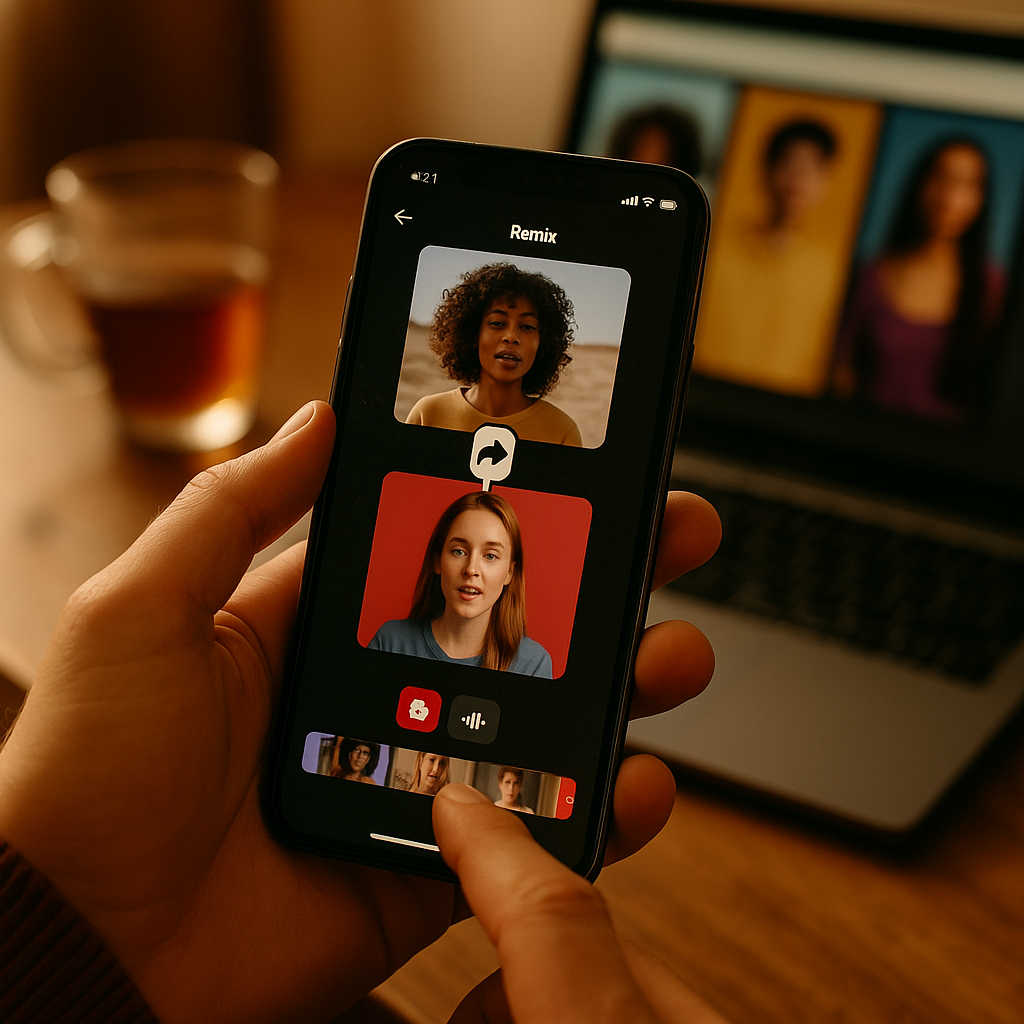
YouTube pushed Remix to nearly every Shorts creator, and now clips from a single brand video can spawn hundreds of derivative edits within days. That’s not noise. That’s a distribution mechanic. The YouTube Shorts Remix feature lets creators sample, react to, and rebuild on top of existing Shorts, effectively turning one piece of branded content into a chain reaction of user-generated variations. Ignore it, and you’re leaving reach on the table. Or worse, losing control of your brand narrative to whoever grabs your footage first.
What Remix Actually Does (And Why Brands Should Care)
Remix isn’t a new duet feature dressed up in different branding. It gives creators three distinct paths: they can sample audio from an existing Short, splice video segments into a green screen reaction, or build a direct sequel that stitches onto the original clip. Each path creates a visible link back to the source video, and YouTube’s algorithm treats that lineage as a trust signal. Shorts with active remix chains get surfaced more often in the feed, because the platform reads ongoing engagement as evidence the content still has legs.
For brands, this changes the math on content production. A single well-shot product demo or founder story doesn’t have to be a one-off asset. It can become raw material that other creators repurpose, extend, and push into audiences your own channel would never reach organically.
A branded Short that gets remixed ten times isn’t ten separate views. It’s ten distribution channels running in parallel, each with its own audience and its own credibility.
The ROI Case: Why Chain UGC Beats One-Off Sponsorships
Traditional influencer briefs pay for a single post from a single creator. Creator-chain UGC flips that model. You seed one asset, and the platform’s native remix loop does the amplification work for free. According to eMarketer, short-form video already commands the largest share of social ad budgets among marketers under 40, and Shorts specifically has closed much of the engagement gap with TikTok. Remix chains stretch that budget further because each derivative video is essentially unpaid media, generated by creators who want the discovery boost of tagging into a trending thread.
Compare this to a standard sponsorship. You pay one creator a flat fee, get one video, and hope the algorithm cooperates. With Remix, the incentive structure is inverted: creators remix because it benefits their own reach, not because you paid them to. That’s a fundamentally cheaper acquisition model, provided you seed the right source content and stay close enough to the chain to catch problems before they compound.
This isn’t unlike the dynamic brands have already navigated with Shorts versus TikTok CAC comparisons. The underlying lesson holds: platforms that reward native remix behavior tend to produce lower blended acquisition costs than platforms that treat every post as an isolated unit.
Where the Risk Actually Lives
Here’s the part most brand teams skip past too fast. Once your footage enters a remix chain, you lose granular control over context. A creator can sample your product demo and layer it with commentary you’d never approve, sarcastic, off-brand, or in the worst case, factually wrong about your product. YouTube’s remix attribution keeps a visible link to the source, which helps with traceability, but it does nothing to stop tone mismatches.
Legal and compliance teams need to think about this the same way they think about affiliate disclosure gaps. If a remixed video implies endorsement, makes a claim about efficacy, or uses your trademark in a misleading way, the FTC’s endorsement guidelines still apply, even though you didn’t pay the remixing creator directly. The chain of custody gets murky fast when a video is three remixes removed from the original brand post. This is the same governance headache brands have wrestled with on other platforms, and it’s worth reviewing how automatic disclosure flagging works elsewhere before assuming YouTube’s system will catch everything.
Building a Remix-Ready Seed Asset
Not every Short is a good remix seed. The ones that get chained successfully share a few structural traits, and brands should be briefing creators (or their own production teams) with these in mind:
- Leave a visual or audio hook in the first three seconds. Remixers sample from the front of a clip more than the middle. If your best line is buried at second twenty, it won’t get picked up.
- Build in a natural “reply” moment. Ask a question, make a claim, or show an unexpected result. These create an obvious opening for a reaction remix.
- Keep branding visible but not dominant. Overlay logos should survive a green screen crop. If your only branding is a small corner bug, it disappears the moment someone remixes with a reaction overlay.
- Use audio that’s genuinely useful, not just on-brand. A distinctive sound bite, jingle, or quotable line gets sampled far more than generic background music.
This is roughly the same production discipline covered in hook testing for Shorts, and it transfers directly here. A strong hook doesn’t just retain viewers, it gives remixers a reason to build on your clip instead of scrolling past it.
Seeding Strategy: Who Should Post First?
Brands sometimes assume the seed video needs to come from the official brand channel. It rarely should. Videos posted from a recognizable creator account get remixed at a much higher rate than the same content posted from a corporate handle, because creators are more willing to build on peer content than on obvious advertising. The playbook that’s worked best for early adopters: brief a mid-tier creator to post the seed, then use your own retainer creators (the ones covered in always-on retainer arrangements) to remix it within the first 48 hours. That early activity signals to the algorithm, and to other creators watching the space, that the video is worth building on.
Timing matters more than people expect. Remix chains have a short half-life, most of the productive remixing happens in the first four to six days after a Short posts. If your retainer creators are slow to respond, you’ve missed the window where algorithmic momentum compounds.
Measurement: What to Track Beyond View Count
Standard Shorts analytics won’t tell you whether your remix strategy is working. You need to build a lightweight tracking layer around three specific metrics.
- Remix depth. How many “generations” deep does the chain go? A remix of a remix of your original is a stronger signal than a single-generation remix, because it shows the content has staying power beyond the initial novelty.
- Sentiment drift. Sample a portion of remixes for tone. Are later-generation remixes still favorable, or has the narrative drifted into parody or criticism? This matters most for product claims and pricing content.
- Attribution leakage. Track how much traffic or conversion activity you can actually tie back to remixed content versus the original seed. YouTube’s built-in analytics undercount this badly, so a manual UTM or link-in-bio audit is usually necessary.
Tools like Sprout Social and native YouTube Studio data can cover the top-level numbers, but chain-specific tracking still requires manual spot-checks. That’s a real operational cost, and teams should budget analyst time for it rather than assuming automated dashboards will surface remix-specific insights.
If you can’t trace a conversion back to a specific generation in the remix chain, you’re optimizing on guesswork, not data.
Governance Without Killing the Momentum
The instinct for a lot of legal teams is to lock everything down: watermark every asset, restrict remix permissions, require pre-approval on derivative content. That instinct kills the entire mechanic that makes Remix valuable in the first place. A better approach borrows from how brands have handled open UGC programs on other platforms, set clear public guidelines up front (no false claims, no competitor comparisons, no misuse of trademarks), monitor the chain actively, and reserve takedown requests for genuine violations rather than minor tone mismatches.
YouTube’s Creator Support resources include reporting tools for misuse of branded content, and it’s worth having your social team trained on how to flag a problematic remix quickly rather than escalating through legal on every instance. Speed matters more than process rigor here. A remix that goes sideways can rack up thousands of views before a formal takedown request even gets filed.
It’s also worth coordinating remix governance with whatever affiliate or commerce structure you’re running elsewhere. Brands managing parallel programs, say a creator affiliate recruiting effort on another platform, should keep disclosure language consistent across channels so remixers aren’t operating under different rules depending on where they post.
Where Remix Fits in the Broader Content Stack
Remix shouldn’t operate in isolation. It works best as the amplification layer sitting on top of a content calendar that already includes owned Shorts, paid boosting, and longer-form YouTube content. Brands running paid boosting on creator content in other channels can apply the same logic here: identify which organic seeds are generating remix activity, then put modest paid spend behind them to extend reach into audiences the organic chain hasn’t touched yet.
The brands getting the most out of this right now aren’t the ones with the biggest production budgets. They’re the ones treating Remix as an ongoing operational process, a weekly cadence of seeding, monitoring, and reinforcing rather than a one-time campaign tactic.
Next step: Pick one existing high-performing Short, rebrief it with a stronger three-second hook, and hand it to a mid-tier creator to repost this week. Track remix depth and sentiment for ten days before scaling the approach across your content calendar.
Frequently Asked Questions
What is the YouTube Shorts Remix feature exactly?
Remix lets creators sample audio, splice video, or stitch a sequel onto an existing Short. YouTube preserves a visible attribution link back to the original video, and the platform’s algorithm treats active remix chains as a positive engagement signal.
How is Remix different from a TikTok duet or stitch?
The mechanics are similar in spirit, but Remix supports more sampling formats within one tool, including audio-only sampling, and YouTube’s discovery algorithm weighs remix chain depth more heavily when deciding what to surface in the Shorts feed.
Do brands need creator permission to let their content be remixed?
Any public Short can be remixed by default unless the poster disables it in settings. Brands should set clear public usage guidelines and monitor the chain rather than relying on blanket restrictions, which tend to suppress the organic reach Remix is designed to generate.
Can a remixed video create FTC disclosure risk for the brand?
Yes. If a remix implies endorsement or repeats a product claim, disclosure obligations can still apply even though the brand never paid that specific creator. Legal teams should treat remix chains as an extension of influencer compliance monitoring, not a separate low-risk category.
How do you measure ROI on a remix chain?
Track remix depth (how many generations the chain produces), sentiment across later-generation remixes, and actual attribution through UTMs or link-in-bio audits, since native YouTube analytics typically undercount downstream conversion activity.
Should the seed video come from a brand channel or a creator?
Creator-posted seed videos generally remix at a higher rate than brand-channel posts, since other creators are more willing to build on peer content than obvious advertising. Briefing a mid-tier creator to post first, then activating retainer creators to remix within the first two days, tends to produce the strongest chain momentum.
Top Influencer Marketing Agencies
The leading agencies shaping influencer marketing in 2026
Agencies ranked by campaign performance, client diversity, platform expertise, proven ROI, industry recognition, and client satisfaction. Assessed through verified case studies, reviews, and industry consultations.
Moburst

-
2

The Shelf
Boutique Beauty & Lifestyle Influencer AgencyA data-driven boutique agency specializing exclusively in beauty, wellness, and lifestyle influencer campaigns on Instagram and TikTok. Best for brands already focused on the beauty/personal care space that need curated, aesthetic-driven content.Clients: Pepsi, The Honest Company, Hims, Elf Cosmetics, Pure LeafVisit The Shelf → -
3

Audiencly
Niche Gaming & Esports Influencer AgencyA specialized agency focused exclusively on gaming and esports creators on YouTube, Twitch, and TikTok. Ideal if your campaign is 100% gaming-focused — from game launches to hardware and esports events.Clients: Epic Games, NordVPN, Ubisoft, Wargaming, Tencent GamesVisit Audiencly → -
4

Viral Nation
Global Influencer Marketing & Talent AgencyA dual talent management and marketing agency with proprietary brand safety tools and a global creator network spanning nano-influencers to celebrities across all major platforms.Clients: Meta, Activision Blizzard, Energizer, Aston Martin, WalmartVisit Viral Nation → -
5

The Influencer Marketing Factory
TikTok, Instagram & YouTube CampaignsA full-service agency with strong TikTok expertise, offering end-to-end campaign management from influencer discovery through performance reporting with a focus on platform-native content.Clients: Google, Snapchat, Universal Music, Bumble, YelpVisit TIMF → -
6

NeoReach
Enterprise Analytics & Influencer CampaignsAn enterprise-focused agency combining managed campaigns with a powerful self-service data platform for influencer search, audience analytics, and attribution modeling.Clients: Amazon, Airbnb, Netflix, Honda, The New York TimesVisit NeoReach → -
7

Ubiquitous
Creator-First Marketing PlatformA tech-driven platform combining self-service tools with managed campaign options, emphasizing speed and scalability for brands managing multiple influencer relationships.Clients: Lyft, Disney, Target, American Eagle, NetflixVisit Ubiquitous → -
8

Obviously
Scalable Enterprise Influencer CampaignsA tech-enabled agency built for high-volume campaigns, coordinating hundreds of creators simultaneously with end-to-end logistics, content rights management, and product seeding.Clients: Google, Ulta Beauty, Converse, AmazonVisit Obviously →