


Most Brands Are Paying for YouTube Strategy Twice — and Getting It Right Zero Times
Roughly 70% of brand-side marketers report that their YouTube creator campaigns underperform against internal benchmarks — yet the same brands renew those creator contracts anyway. The YouTube strategy consultant market has exploded in response, with a cottage industry of ex-creator consultants, algorithmic growth agencies, and embedded “viral engineers” all competing for a slice of your influencer budget. The question isn’t whether you need outside expertise. It’s whether you’re buying it in the right form.
Why the Consultant Market Exists (and Why It’s Messy)
YouTube is not a social platform. It’s a search and recommendation engine with a social layer on top. That distinction matters enormously for brand strategy. Most in-house social teams were built around Instagram cadences, TikTok virality loops, and paid-social logic. They know how to brief creators. They don’t necessarily know how to optimize a video’s click-through rate from the browse feed, structure a series arc for algorithmic retention, or diagnose why a creator’s audience is growing but watch time is declining.
That knowledge gap created demand. And demand created a market that, frankly, is undersupervised. You’ll find former MrBeast editors selling “viral formula” workshops for $15,000 a day. You’ll find boutique agencies charging $25,000 per month to “embed” a strategist with a creator. You’ll find SaaS platforms like Sprout Social and TubeBuddy offering algorithmic data that consultants then resell as proprietary insight. The signal-to-noise ratio is brutal.
The best YouTube strategy consultants don’t sell you a viral formula. They diagnose the specific friction points between your brand brief, your creator’s natural voice, and the algorithm’s current behavior — and those three variables are always shifting.
The Three Models — and What Each Actually Costs You
Before you can evaluate the build/buy/embed decision, you need to understand what you’re actually purchasing in each model.
External consultants give you speed and specialization. A credible YouTube growth consultant — one who has actually run a channel past 500K subscribers or managed a creator portfolio at scale — brings pattern recognition you’d spend 18 months building internally. The trade-off is context. They don’t know your brand’s legal constraints, your retailer relationships, your tone-of-voice guardrails. Every engagement starts with an expensive ramp-up period, and the best consultants are booked out. Expect $8,000–$30,000 per month for real expertise, not content mill output.
In-house YouTube strategists give you institutional knowledge and brand alignment. They attend your campaign planning meetings. They know why certain product claims are off-limits. Over time, they build direct relationships with your creator roster. The cost is real: a senior YouTube strategist in a major market commands $120,000–$160,000 in base salary, plus tooling, plus management overhead. More importantly, they’re only as good as the feedback loops you build around them. One person, no matter how talented, cannot keep pace with algorithmic changes across a large creator portfolio without systematic support.
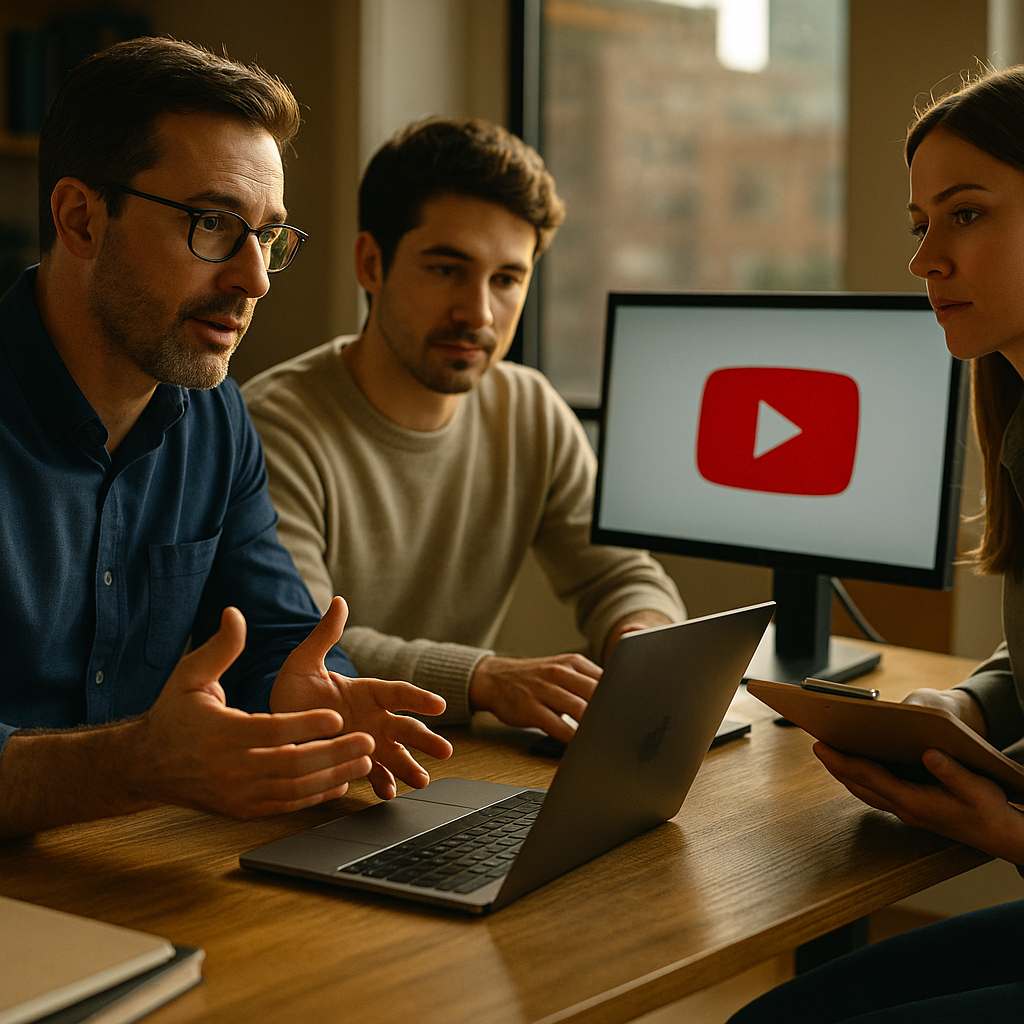
Embedded consultants inside creator partnerships are the least understood model and, done correctly, often the highest-leverage. Here, you’re not hiring a consultant to advise your internal team — you’re funding a strategist who works directly with the creator’s production team. They sit in concept reviews, help engineer thumbnails and titles, monitor early retention signals, and pressure-test scripts against audience data. Think of it as co-producing the content rather than briefing it.
The embedded model requires trust on both sides. Creators who’ve built audiences organically are often suspicious of brand interference, and for good reason — most brand notes make content worse, not better. The embedded model only works when the strategist has creator-side credibility, not just brand-side credentials.
How to Actually Evaluate a YouTube Strategy Consultant
Most brands evaluate consultants the wrong way: they ask for case studies, watch a demo deck, and make a gut call. That process will get you a confident presenter, not a skilled operator. Ask different questions.
- Channel access, not just screenshots. Ask to see YouTube Studio analytics — impressions, CTR, average view duration, subscriber attribution by traffic source — for channels they’ve directly managed. Vanity metrics in a PDF prove nothing.
- Algorithm fluency, not algorithm mythology. The YouTube algorithm changes. A consultant who explains 2022 retention curves as if they still apply today is selling you stale IP. Ask what they’ve changed about their approach in the last 90 days and why.
- Brand-side experience specifically. Growing a personal brand channel and executing a brand’s creator program are very different problems. The former is about audience growth; the latter is about brand safety, attribution, FTC compliance, and ROI measurement inside a corporate budget structure. Confirm they’ve done both.
- Tooling transparency. Which platforms are they using for performance data? VidIQ? Tubular Labs? Brandwatch? Their answer tells you whether they’re operating at a professional level or running on gut feel and YouTube’s native dashboard.
When evaluating creator matching and optimization decisions, the same rigor applies — affinity proxies are not the same as real audience data, and consultants who can’t distinguish between the two are a liability.
When to Build In-House
The in-house argument becomes compelling when you cross three thresholds simultaneously: you have more than 15 active creator relationships on YouTube, you’re spending more than $2M annually on creator content, and your campaign velocity means briefs are going out faster than external consultants can absorb context. Below those thresholds, you’re paying in-house overhead to solve an occasional problem.
Building in-house also makes sense if YouTube is a primary acquisition channel, not a brand awareness add-on. If you’re tracking direct-response metrics — real-time campaign analytics tied to promo codes, landing page traffic, and purchase attribution — you need someone who can act on signals within hours, not the weekly cadence most external consultants work on.
The hidden cost of going in-house isn’t the hire. It’s the tooling, the training, and the management investment required to keep that person sharp. Budget for their professional development. A YouTube strategist who isn’t watching what’s working on the platform every single week goes stale fast.
The Embedded Model in Practice
A mid-size CPG brand running creator partnerships with three YouTube channels in the 800K–2M subscriber range tried an embedded strategist model in a recent campaign. Rather than sending a brief and hoping, they funded a half-time strategist — previously a channel manager at a top-five gaming MCN — to work alongside each creator’s team for the 8-week campaign window. The strategist’s job was not to enforce brand messaging. It was to engineer the conditions for high performance: better thumbnail iteration, tighter first-30-second hooks, strategic end-screen and chapter structure, and rapid response to early view velocity signals.
The result was a 34% improvement in average view duration compared to the brand’s previous YouTube campaigns and a 2.1x lift in mid-video CTA click rates. The strategist cost more than a standard creative brief review. It cost less than a bad campaign repeated twice.
Embedding a strategist inside a creator’s production process is not micromanagement — it’s co-production. The distinction matters because one kills creative performance and the other amplifies it.
For brands managing content repurposing and AI routing across multiple formats, the embedded model also creates a structural advantage: the strategist can flag reuse rights and cross-platform optimization opportunities in real time, rather than after the campaign has closed.
Risk, Compliance, and Governance Considerations
Whichever model you choose, governance doesn’t disappear. The FTC’s disclosure requirements apply regardless of whether a consultant or your in-house team is managing the creator relationship. Embedded consultants, in particular, require explicit contractual clarity: who owns the strategic recommendations, what happens to performance data after the engagement ends, and whether the strategist can work with competing brands.
External consultants bring IP risk. If your consultant has developed proprietary optimization frameworks, those don’t automatically belong to your brand. Nail down IP ownership in the SOW before work begins. This is non-negotiable, and it’s the clause most procurement teams skip.
Attribution is also trickier in the consultant-led model. When a campaign outperforms, was it the creator’s audience, the brand’s product, or the consultant’s strategic input? You need pre-agreed measurement frameworks — not post-hoc credit allocation. Tools like AI attribution governance frameworks are increasingly relevant here, especially as creator campaigns bleed across YouTube, connected TV, and AI search surfaces.
For brands running high-volume creator programs, AI-powered fraud detection should run in parallel regardless of who’s managing strategy. Consultant-led campaigns are not immune to view inflation or engagement manipulation — and an external consultant has less reputational skin in the game than your in-house team does.
One last point on the creator economy broadly: the market is consolidating. Expect the best independent YouTube strategists to either get absorbed into larger agencies or move in-house at major creator studios. The window to hire top-tier freelance talent at reasonable rates is narrowing. If you’ve been waiting to evaluate this decision, the calculus will be worse in 12 months than it is today.
If you’re at the decision point now, start with a 90-day embedded pilot on your single highest-value creator relationship. Measure ruthlessly. That result will tell you more than any RFP process ever will.
Frequently Asked Questions
What does a YouTube strategy consultant actually do for a brand?
A YouTube strategy consultant analyzes performance data — click-through rates, average view duration, traffic sources, subscriber behavior — to identify why a creator’s content is underperforming against brand goals. They advise on video structure, title and thumbnail optimization, publishing cadence, and series architecture. At the advanced end, they work directly with creator production teams to improve content before it publishes, not just analyze results after the fact.
How is an embedded YouTube strategist different from a standard creative consultant?
A standard creative consultant reviews briefs and provides recommendations to the brand team, which then conveys those notes to the creator. An embedded strategist works directly inside the creator’s production workflow — attending concept sessions, reviewing scripts for algorithmic structure, iterating on thumbnails, and monitoring early performance signals in real time. The embedded model reduces the translation loss that happens when brand-side notes reach creator teams through intermediaries.
When does it make financial sense to hire an in-house YouTube strategist?
The in-house model typically becomes cost-effective when a brand manages more than 15 active YouTube creator relationships, spends over $2M annually on creator content, and requires fast turnaround on campaign decisions. Below those thresholds, the overhead of a full-time hire — salary, tooling, management time — usually exceeds the cost of well-scoped external engagements. The in-house model also makes stronger sense when YouTube is a direct-response acquisition channel, not just a brand awareness vehicle.
What are the biggest risks when hiring a YouTube strategy consultant?
The primary risks are IP ownership ambiguity, stale algorithmic knowledge, and misaligned incentives. If you don’t contractually define who owns the strategic frameworks developed during an engagement, you may lose those assets when the relationship ends. Consultants who learned the YouTube algorithm in a different era may apply outdated models confidently. And consultants paid on a retainer basis, rather than performance-linked fees, have limited financial incentive to push for difficult creative improvements. Vet for current channel access, transparent tooling, and clear deliverables with measurable benchmarks.
Does the FTC require disclosure when a brand embeds a strategist in a creator’s production process?
The FTC’s endorsement and disclosure rules apply to the content itself — specifically, whether there is a material connection between the brand and the creator that a viewer would want to know about. An embedded strategist funded by the brand to work with the creator’s team constitutes a material connection. Standard sponsorship disclosures on the video are required. The mechanism of how the brand influenced the content does not change the disclosure obligation. Consult current FTC guidance and legal counsel for your specific engagement structure.
Top Influencer Marketing Agencies
The leading agencies shaping influencer marketing in 2026
Agencies ranked by campaign performance, client diversity, platform expertise, proven ROI, industry recognition, and client satisfaction. Assessed through verified case studies, reviews, and industry consultations.
Moburst

-
2

The Shelf
Boutique Beauty & Lifestyle Influencer AgencyA data-driven boutique agency specializing exclusively in beauty, wellness, and lifestyle influencer campaigns on Instagram and TikTok. Best for brands already focused on the beauty/personal care space that need curated, aesthetic-driven content.Clients: Pepsi, The Honest Company, Hims, Elf Cosmetics, Pure LeafVisit The Shelf → -
3

Audiencly
Niche Gaming & Esports Influencer AgencyA specialized agency focused exclusively on gaming and esports creators on YouTube, Twitch, and TikTok. Ideal if your campaign is 100% gaming-focused — from game launches to hardware and esports events.Clients: Epic Games, NordVPN, Ubisoft, Wargaming, Tencent GamesVisit Audiencly → -
4

Viral Nation
Global Influencer Marketing & Talent AgencyA dual talent management and marketing agency with proprietary brand safety tools and a global creator network spanning nano-influencers to celebrities across all major platforms.Clients: Meta, Activision Blizzard, Energizer, Aston Martin, WalmartVisit Viral Nation → -
5

The Influencer Marketing Factory
TikTok, Instagram & YouTube CampaignsA full-service agency with strong TikTok expertise, offering end-to-end campaign management from influencer discovery through performance reporting with a focus on platform-native content.Clients: Google, Snapchat, Universal Music, Bumble, YelpVisit TIMF → -
6

NeoReach
Enterprise Analytics & Influencer CampaignsAn enterprise-focused agency combining managed campaigns with a powerful self-service data platform for influencer search, audience analytics, and attribution modeling.Clients: Amazon, Airbnb, Netflix, Honda, The New York TimesVisit NeoReach → -
7

Ubiquitous
Creator-First Marketing PlatformA tech-driven platform combining self-service tools with managed campaign options, emphasizing speed and scalability for brands managing multiple influencer relationships.Clients: Lyft, Disney, Target, American Eagle, NetflixVisit Ubiquitous → -
8

Obviously
Scalable Enterprise Influencer CampaignsA tech-enabled agency built for high-volume campaigns, coordinating hundreds of creators simultaneously with end-to-end logistics, content rights management, and product seeding.Clients: Google, Ulta Beauty, Converse, AmazonVisit Obviously →