


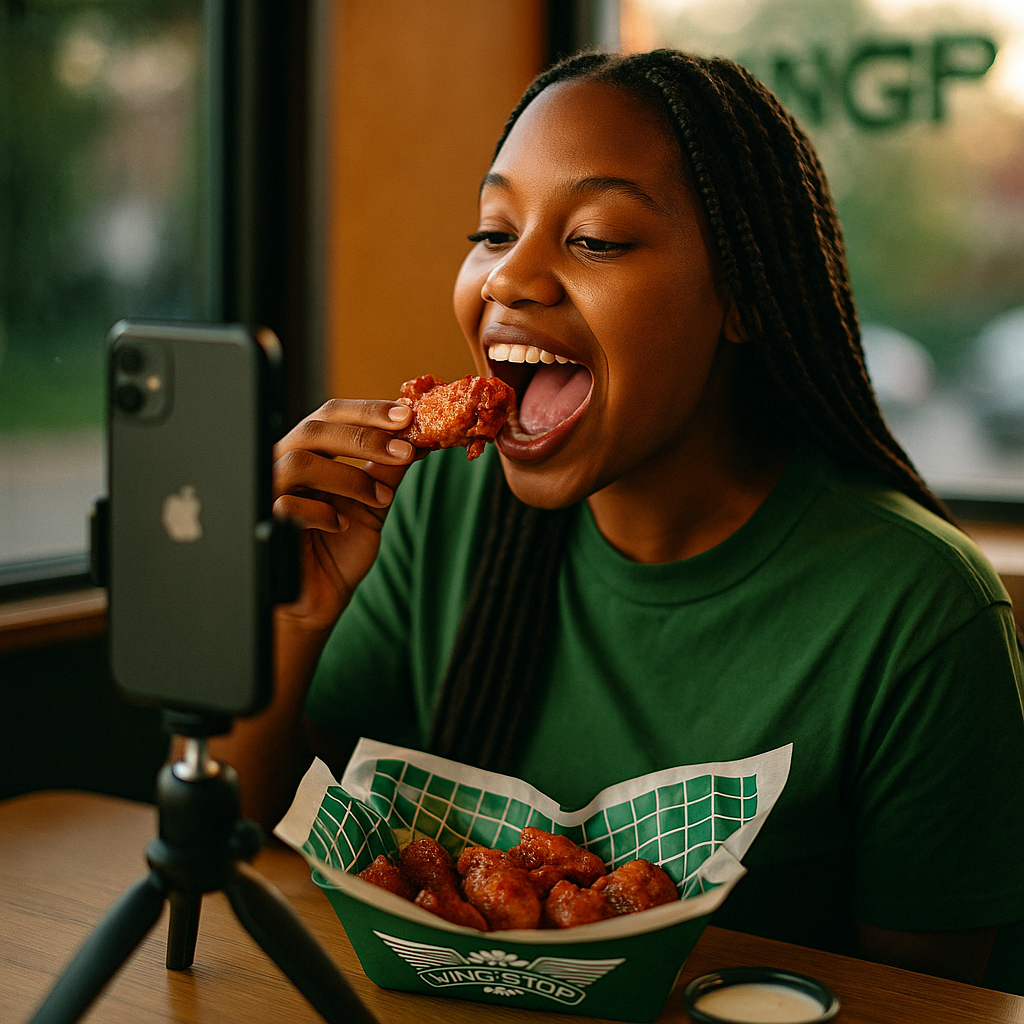
Wingstop Stopped Buying Reach. It Started Buying Intent.
When Wingstop shifted budget away from traditional broadcast toward creator-led campaigns, same-store sales growth followed. That’s not a coincidence. It’s a blueprint. And it raises an uncomfortable question for every QSR brand still anchoring media plans to TV CPMs: what exactly are you buying?
The Strategic Logic Behind Ditching Broadcast-First Thinking
Wingstop’s leadership has been public about treating the brand as a media company, not just a restaurant chain. That framing matters operationally. When you think like a media company, you stop optimizing for impressions and start optimizing for attention quality, conversion proximity, and audience specificity.
Broadcast television delivers scale but almost zero targeting resolution at the purchase-intent level. A 30-second spot during a sports broadcast reaches fans of the game, yes, but it can’t distinguish between someone who orders wings every Friday and someone who hasn’t eaten fast food in six months. Creator content, deployed through the right niche communities, collapses that gap dramatically.
The brand leaned into this by building a creator roster skewed toward gaming, sports commentary, and late-night food culture. These aren’t broad lifestyle categories. They’re specific behavioral clusters where wing consumption is already habitual or aspirational. That alignment between creator community and purchase behavior is where the real leverage lives.
Audience-content fit matters more than follower count. A creator with 80,000 followers in a highly specific gaming or sports niche can generate more incremental purchase intent than a lifestyle macro with 2 million generalist followers, because the former audience is already pre-qualified.
Niche Creators as Precision Targeting Infrastructure
Think of niche creators as targeting layers that no DSP can fully replicate. They come pre-loaded with trust, context, and community norms. When a gaming streamer organically integrates Wingstop into a session, it doesn’t read as advertising. It reads as authentic consumption behavior. That’s not accidental. It requires briefing discipline.
Wingstop’s approach to creator briefs emphasizes behavioral authenticity over product recitation. Creators aren’t asked to describe the menu. They’re invited to show consumption moments that fit naturally inside the content they’re already making. The brand appears as a character in the creator’s world, not as an interruption to it.
This is a meaningful operational shift for most brand teams. It requires moving away from approval processes that police messaging and toward ones that protect brand safety while enabling creative latitude. For a deeper look at how brief architecture affects creator performance, the framework behind creator brief architecture and timing is directly applicable here.
The niche-first roster also provides competitive moat value. When Wingstop embeds itself inside specific creator communities over time, competitors face a real barrier. Audiences develop brand-creator associations that are difficult and expensive to displace, because the relationship is triangulated between creator, community, and brand.
Platform-Native Formats and Why They Outperform Repurposed TV Creative
Platform-native means content built for how a specific platform’s algorithm and user behavior work. Not a TV spot cut to 15 seconds and uploaded to TikTok. That distinction sounds obvious but brands still get it wrong at scale.
TikTok rewards content that holds attention through the first three seconds, triggers saves and shares, and fits within recognizable format patterns: reaction videos, GRWM, taste tests, day-in-the-life. Wingstop leans into these formats because the platform’s algorithm amplifies content that users engage with, not content that looks expensive. A creator filming a late-night Wingstop haul in a car performs better than a polished brand-produced spot because it matches user content expectations.
This connects to a broader pattern seen across QSR and food brands. organic TikTok briefs beating paid campaigns isn’t anomalous. It’s what happens when brands stop trying to import broadcast logic into social-first environments.
Instagram Reels, YouTube Shorts, and Twitch integrations each demand different format logic. Wingstop’s team treats each platform as a distinct creative environment rather than a distribution channel for the same content. That operational investment pays off in engagement rates and, critically, in algorithmic amplification that extends reach without proportional spend increases.
Commerce-Linked Attribution: Closing the Loop Between Content and Transaction
This is where Wingstop’s strategy becomes genuinely sophisticated and where most brands still have significant infrastructure gaps.
Commerce-linked attribution means connecting specific creator content touchpoints to actual orders. For a delivery-heavy brand like Wingstop, this is achievable through multiple mechanisms: unique promo codes surfaced in creator content, deep links tied to specific creator posts that route to the ordering app, and pixel-based attribution for users who viewed creator content before converting through paid social or direct channels.
The operational challenge is multi-touch. A user might watch a creator’s TikTok, see a retargeted ad on Instagram two days later, and finally convert through the Wingstop app. Giving full credit to the creator undervalues paid media. Giving full credit to the last touchpoint undervalues creator content entirely. Wingstop’s attribution model, like most sophisticated food delivery attribution stacks, uses data clean rooms and incrementality testing to assign fractional credit across the funnel.
eMarketer research consistently shows that brands using incrementality testing rather than last-click attribution report materially different (and more accurate) ROAS figures across social channels. For QSR brands with high order frequency, incrementality measurement is essential because the baseline conversion rate is already elevated, making it easy to overcredit any single touchpoint.
Promo codes remain the bluntest but most reliable attribution tool at the creator level. They’re trackable, creator-specific, and customer-activated, meaning they require deliberate consumer action that signals genuine intent. Wingstop has used flavor-specific codes and limited-time offers tied to creator launches to create urgency and improve code redemption rates while generating clean first-party attribution data.
For brands mapping their own attribution architecture, the approach Ulta Beauty uses for TikTok Shop attribution offers a comparable commerce-first model worth studying.
Commerce-linked attribution isn’t just a measurement upgrade. It’s a budget justification engine. When you can show that a specific creator’s content drove a measurable lift in orders, you can reallocate broadcast dollars with confidence rather than faith.
The Budget Reallocation Case
Traditional broadcast spend at the national QSR level runs into tens of millions annually. The CPM efficiency argument for TV has eroded steadily as linear viewership declines and streaming environments fragment audiences further. Statista data on linear TV viewership trends confirm consistent year-over-year declines across 18-34 demographics, the core QSR audience.
Wingstop’s public position has been to treat digital-first media, including creator partnerships, as the primary channel rather than a supplementary one. This isn’t a budget trim on TV. It’s a structural reorientation. The economics support it: creator campaigns with commerce attribution can show direct revenue lift, while broadcast spend relies on brand equity models that are harder to defend in quarterly business reviews.
The risk is real though. Creator-led programs require more operational overhead per impression than a single national TV buy. You’re managing dozens or hundreds of creator relationships, content approvals, attribution setups, and performance monitoring simultaneously. That’s a capability investment. Brands that see creator programs as a cheap TV alternative usually underinvest in the operational infrastructure and then attribute poor results to the channel rather than the execution. See how Kimberly-Clark built platform-native creator rosters to understand the infrastructure required to run this at scale.
What Brands Should Take From the Wingstop Model
The Wingstop playbook has three replicable components: audience-content fit (not just audience size), platform-native format discipline, and commerce-linked attribution that connects content to transactions. None of these require Wingstop’s budget to implement. They require operational rigor and a willingness to manage more complexity than a broadcast media plan demands.
The restaurant vertical offers useful proof points across this model. The 34% reservation lift Benihana drove through creator campaigns demonstrates that food and dining brands can connect influencer spend directly to measurable business outcomes, not just awareness metrics.
Brands evaluating creator investment should also pressure-test their attribution setup before scaling spend. A creator program without clean attribution data is a marketing cost. A creator program with commerce-linked attribution is a revenue lever. That distinction determines how it survives budget reviews.
For external benchmark data on influencer marketing ROI measurement, Sprout Social’s research tools and FTC disclosure guidelines for paid creator content are the two reference points every team managing creator programs should have bookmarked.
Your next step: Audit your current creator briefs against platform-native format requirements for each channel you’re active on, and map every active creator partnership to a specific attribution mechanism before your next budget cycle.
Frequently Asked Questions
What makes Wingstop’s creator strategy different from standard influencer marketing?
Wingstop prioritizes niche creator audiences with high behavioral alignment to wing consumption occasions (gaming, sports, late-night food culture) over broad lifestyle influencers. The brand also couples creator content with commerce-linked attribution tools like unique promo codes and deep links, allowing it to measure direct sales impact rather than relying on impressions or brand lift surveys alone.
How does Wingstop attribute sales to specific creator content?
Wingstop uses a combination of creator-specific promo codes, deep links tied to individual posts that route to the ordering app, and multi-touch attribution models that include incrementality testing. This allows the brand to assign fractional credit across touchpoints rather than relying on last-click attribution, which typically undervalues upper-funnel creator content.
Why does platform-native content outperform repurposed broadcast creative on social?
Platform-native content is built to match the algorithm behavior and user expectations of a specific platform. On TikTok, for example, content that mimics organic user behavior (haul videos, reactions, taste tests) earns stronger algorithmic amplification than polished brand spots. Repurposed broadcast creative signals “advertisement” to users and algorithms alike, which reduces watch time, shares, and saves.
Is this creator model viable for smaller QSR brands without Wingstop’s budget?
Yes. The core components (audience-content fit, platform-native formats, commerce attribution) scale down effectively. Micro and mid-tier creators typically have stronger audience trust and lower CPMs than macro influencers. The operational investment in attribution infrastructure (promo codes, deep links, basic incrementality testing) is accessible to brands at significantly lower budget levels. The key is operational rigor, not spend volume.
What attribution tools support commerce-linked creator measurement?
Common tools include creator-specific UTM parameters and promo codes for direct-response tracking, TikTok Shop’s native attribution for in-app commerce, Meta’s Conversions API for cross-channel attribution, and data clean room solutions for multi-touch modeling. For QSR brands with ordering apps, first-party app data combined with incrementality testing provides the most accurate picture of creator-driven sales lift.
Top Influencer Marketing Agencies
The leading agencies shaping influencer marketing in 2026
Agencies ranked by campaign performance, client diversity, platform expertise, proven ROI, industry recognition, and client satisfaction. Assessed through verified case studies, reviews, and industry consultations.
Moburst

-
2

The Shelf
Boutique Beauty & Lifestyle Influencer AgencyA data-driven boutique agency specializing exclusively in beauty, wellness, and lifestyle influencer campaigns on Instagram and TikTok. Best for brands already focused on the beauty/personal care space that need curated, aesthetic-driven content.Clients: Pepsi, The Honest Company, Hims, Elf Cosmetics, Pure LeafVisit The Shelf → -
3

Audiencly
Niche Gaming & Esports Influencer AgencyA specialized agency focused exclusively on gaming and esports creators on YouTube, Twitch, and TikTok. Ideal if your campaign is 100% gaming-focused — from game launches to hardware and esports events.Clients: Epic Games, NordVPN, Ubisoft, Wargaming, Tencent GamesVisit Audiencly → -
4

Viral Nation
Global Influencer Marketing & Talent AgencyA dual talent management and marketing agency with proprietary brand safety tools and a global creator network spanning nano-influencers to celebrities across all major platforms.Clients: Meta, Activision Blizzard, Energizer, Aston Martin, WalmartVisit Viral Nation → -
5

The Influencer Marketing Factory
TikTok, Instagram & YouTube CampaignsA full-service agency with strong TikTok expertise, offering end-to-end campaign management from influencer discovery through performance reporting with a focus on platform-native content.Clients: Google, Snapchat, Universal Music, Bumble, YelpVisit TIMF → -
6

NeoReach
Enterprise Analytics & Influencer CampaignsAn enterprise-focused agency combining managed campaigns with a powerful self-service data platform for influencer search, audience analytics, and attribution modeling.Clients: Amazon, Airbnb, Netflix, Honda, The New York TimesVisit NeoReach → -
7

Ubiquitous
Creator-First Marketing PlatformA tech-driven platform combining self-service tools with managed campaign options, emphasizing speed and scalability for brands managing multiple influencer relationships.Clients: Lyft, Disney, Target, American Eagle, NetflixVisit Ubiquitous → -
8

Obviously
Scalable Enterprise Influencer CampaignsA tech-enabled agency built for high-volume campaigns, coordinating hundreds of creators simultaneously with end-to-end logistics, content rights management, and product seeding.Clients: Google, Ulta Beauty, Converse, AmazonVisit Obviously →