


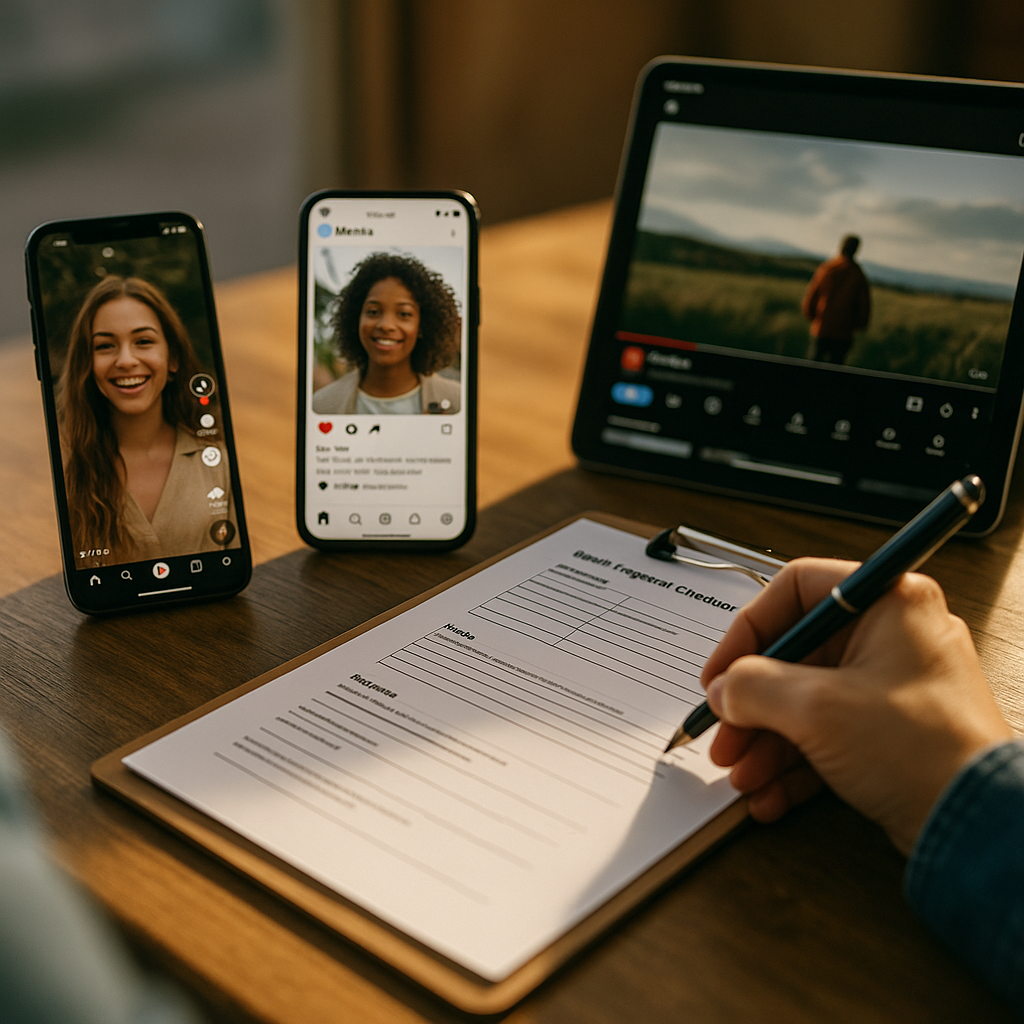
One Shoot. Four Platforms. Zero Excuses.
Brands that run separate shoots for each platform are burning budget. A single well-designed production session can yield TikTok 9:16, Meta 1:1, YouTube Shorts, and LinkedIn video variants that each feel native — if your brief is engineered for it from the start. Multi-format creator production session design is the operational discipline separating efficient programs from expensive ones.
Why Most Cross-Platform Briefs Fail Before the Camera Rolls
The failure mode is familiar. A brand sends a creator a brief optimized for one platform, the shoot happens, and then someone in post-production tries to crop, reframe, and repurpose the footage into three other formats. The result is a TikTok with a talking head shoved into the bottom third, a LinkedIn clip that opens with dead air, and a Meta square that cuts off the product.
The problem is structural. Most briefs treat format as a post-production problem. It isn’t. Format is a production problem that must be solved in the brief itself.
According to Sprout Social, multi-platform video campaigns consistently outperform single-platform executions on reach and brand recall, yet the majority of brands still repurpose content reactively rather than engineering it proactively. That gap is where budget leaks.
Platform-native feel is not about the aspect ratio. It is about the creator’s body language, pacing, vocabulary, and hook structure matching the audience expectation of that specific feed — and all of that must be written into the brief before the shoot.
The Architecture of a Multi-Format Brief
A brief that successfully spans TikTok, Meta, YouTube Shorts, and LinkedIn needs four distinct layers baked into a single document.
Layer 1: The Safe Zone Grid. Every brief should include a visual diagram showing the “safe zone” for each format. The TikTok 9:16 interface places UI elements (likes, comments, share button, caption text) along the right edge and bottom 20% of the frame. Meta’s 1:1 feed compresses the vertical canvas. YouTube Shorts mirrors TikTok’s 9:16 but the subscribe button placement and title card area differ. LinkedIn’s video feed tends to auto-expand to 16:9 on desktop, even when uploaded as 1:1. Brief creators to keep the primary action — face, product, demonstration — within the central 60% of the frame throughout the shoot. This one instruction saves your post-production team hours.
Layer 2: Platform-Specific Hook Directives. The first two seconds of a TikTok need a pattern interrupt. The first two seconds of a LinkedIn video need a credibility signal. These are not the same creative instruction, and a brief that conflates them will produce content that underperforms on both. For TikTok and Reels hook structures, the brief should specify an on-screen action or spoken provocation before any product mention. For LinkedIn, the brief should direct the creator to open with a declarative professional statement or counterintuitive data point.
Layer 3: Modular Segment Scripting. Instead of one continuous script, structure the brief around three to five modular segments: hook, context, demonstration, social proof, CTA. Each segment can be recombined for different platform lengths. TikTok might use hook plus demonstration plus CTA, running 30 to 45 seconds. YouTube Shorts might use all five segments at 55 seconds. LinkedIn might use context plus social proof plus CTA, leaning into a more deliberate, conversational register. Brief the creator to shoot each segment as a discrete take, with clear slates or verbal cues between them. This is the structural move that makes multi-format production economically viable.
Layer 4: Platform Vocabulary and Pacing Notes. TikTok rewards fast, casual, occasionally self-aware speech. LinkedIn rewards measured delivery, complete sentences, and professional vocabulary. Meta sits in the middle. YouTube Shorts tolerates slightly more scene-setting before the payoff. These are not subtle differences — they show up in completion rates and shares. Your brief should include explicit pacing notes: “Speak at a natural conversational pace” for LinkedIn, “Cut or elide hesitations in delivery” for TikTok. For a deeper framework on adapting a single brief across platforms, the guidance on briefing once and adapting across TikTok, Reels, and TV is directly applicable here.
Shooting Sequence: The Order Matters
Direct the creator to shoot TikTok-native content first, when energy is highest and delivery is freshest. TikTok’s algorithm is the most demanding in terms of authentic spontaneity — it is also the hardest to manufacture in a fatigued creator. LinkedIn takes can often come from a more deliberate, composed second pass of the same material, which actually benefits from the creator having already warmed up.
Meta 1:1 content should be briefed as a reframe exercise: the creator retakes the core demonstration segment specifically framing the product or their face for a square canvas. This is a 10-minute addition to any shoot. For detailed guidance on how Meta’s algorithm responds to safe-zone framing and composition signals, the resource on Meta 1:1 format and suppression avoidance covers the technical specifics.
YouTube Shorts rewards slightly longer setups and can tolerate a title card or intro sequence that TikTok would punish with early swipe-offs. Brief the creator to record a five-second “chapter opener” for Shorts specifically — something like a title overlay or a spoken episode framing. This signals to Shorts’ recommendation engine that the content has structure, which correlates with longer average view duration.
Algorithm Signals Are Not Interchangeable
Every platform’s distribution engine rewards different behavioral signals, and your brief must account for them explicitly.
- TikTok FYP: Rewards rewatch rate, comment provocation, and completion on short videos. Brief creators to end with a question or an incomplete statement that drives comment engagement.
- Meta Feed and Reels: Rewards shares and saves. Brief creators to include a “save this for later” moment — a tip, a list, or a comparison that has standalone utility. Meta for Business documentation confirms that save signals are weighted heavily in organic distribution.
- YouTube Shorts: Rewards average view duration percentage and subscription conversion. Brief creators to include a clear “subscribe for part two” or series framing that signals ongoing value.
- LinkedIn Video: Rewards dwell time and professional reshares. Brief creators to end with a perspective or takeaway that a senior professional would want to forward to a colleague. LinkedIn Business data shows that video posts with a clear point of view outperform neutral demonstrations by a significant margin on reshare rate.
The brief should state each of these signals explicitly — not as background context, but as direct creative instructions. Creators are not algorithm experts. That is your job as the strategist writing the brief.
Compliance and Disclosure Across Formats
Multi-format production adds a compliance wrinkle: disclosure placement must be platform-appropriate. TikTok’s creator tools place the paid partnership label at the top of the frame. On Meta, the branded content tag appears below the username. LinkedIn’s sponsored content label sits below the post text. On YouTube Shorts, disclosure must appear both verbally and in the description.
Brief creators to include a verbal disclosure in the first five seconds of every format variant. Verbal disclosure is the only disclosure method that survives any crop, reframe, or repurpose. The FTC’s endorsement guidelines are unambiguous: platform-native tags do not substitute for clear and conspicuous disclosure when material connection exists. This is not optional and it is not a post-production fix.
For a comprehensive approach to structuring creator briefs that hold up across both platform and compliance requirements, the creator brief templates for social feeds resource offers formats that build compliance architecture directly into the brief document.
Brands that build compliance into the shoot brief rather than the post-production checklist eliminate a full category of legal exposure and reshoots. One verbal disclosure instruction in the brief is worth more than three rounds of revision notes after the fact.
What to Measure After the Shoot
Efficiency only compounds if you measure it. After your first multi-format production session, benchmark three things: cost-per-platform-asset versus single-platform shoots, platform completion rate on each variant, and organic reach differential between native-briefed variants and previously repurposed content.
Most programs find that natively briefed multi-format content outperforms repurposed content on completion rate by 20 to 40%, with the LinkedIn variant showing the most dramatic improvement because it is the platform most sensitive to content that “feels like it was made for someone else.” Tools like Sprout Social and HubSpot can aggregate cross-platform performance data into a single view, making the comparison operationally feasible rather than a spreadsheet nightmare.
For teams scaling this into an AI-assisted production workflow, the framework for multi-format AI video production briefs addresses how to structure creator guidance when AI tools are generating or editing variants downstream of the shoot.
Audit your next campaign brief against these four layers before you send it. If any layer is missing, the shoot will produce footage — but not assets.
FAQs
How long does a multi-format production session add to a typical creator shoot?
When briefed correctly, a multi-format session adds 20 to 45 minutes to a standard shoot. The bulk of that time is the modular re-takes for platform-specific hooks and the Meta 1:1 reframe. The verbal disclosure take and the YouTube Shorts chapter opener each add under five minutes. The brief itself is what determines whether the additional time is structured or chaotic.
Can the same script work across all four platforms?
A single core script can anchor all four formats, but it cannot be delivered identically across platforms without hurting performance. The brief should provide a single “spine” script and then platform-specific delivery notes that adjust pacing, vocabulary, and hook structure for each destination. Think of it as one composition with four arrangements.
Should creators know which platform will receive which variant?
Yes, always. Creators who understand the distribution destination make better instinctive choices during the shoot — about energy level, camera distance, and conversational register. Withholding platform context to “simplify” the brief is a false economy that costs you in authenticity.
How do aspect ratio safe zones differ between TikTok 9:16 and YouTube Shorts 9:16?
Both are 9:16, but the UI overlay areas differ. TikTok places interactive elements (likes, comments, share, profile) on the right side and bottom 20%. YouTube Shorts places the title, channel name, and subscribe button at the bottom and overlaps less of the right column. Brief creators to keep the primary subject centered in the middle 60% of the frame, which clears both UI overlays simultaneously.
What is the single highest-impact change a brand can make to its current brief template?
Add a safe zone diagram and platform-specific hook instructions. Most briefs describe the brand message and the product but say nothing about where the creator’s face or hands should be in the frame, or how the first two seconds should differ by platform. Those two additions alone will measurably improve both algorithmic performance and post-production efficiency.
Top Influencer Marketing Agencies
The leading agencies shaping influencer marketing in 2026
Agencies ranked by campaign performance, client diversity, platform expertise, proven ROI, industry recognition, and client satisfaction. Assessed through verified case studies, reviews, and industry consultations.
Moburst

-
2

The Shelf
Boutique Beauty & Lifestyle Influencer AgencyA data-driven boutique agency specializing exclusively in beauty, wellness, and lifestyle influencer campaigns on Instagram and TikTok. Best for brands already focused on the beauty/personal care space that need curated, aesthetic-driven content.Clients: Pepsi, The Honest Company, Hims, Elf Cosmetics, Pure LeafVisit The Shelf → -
3

Audiencly
Niche Gaming & Esports Influencer AgencyA specialized agency focused exclusively on gaming and esports creators on YouTube, Twitch, and TikTok. Ideal if your campaign is 100% gaming-focused — from game launches to hardware and esports events.Clients: Epic Games, NordVPN, Ubisoft, Wargaming, Tencent GamesVisit Audiencly → -
4

Viral Nation
Global Influencer Marketing & Talent AgencyA dual talent management and marketing agency with proprietary brand safety tools and a global creator network spanning nano-influencers to celebrities across all major platforms.Clients: Meta, Activision Blizzard, Energizer, Aston Martin, WalmartVisit Viral Nation → -
5

The Influencer Marketing Factory
TikTok, Instagram & YouTube CampaignsA full-service agency with strong TikTok expertise, offering end-to-end campaign management from influencer discovery through performance reporting with a focus on platform-native content.Clients: Google, Snapchat, Universal Music, Bumble, YelpVisit TIMF → -
6

NeoReach
Enterprise Analytics & Influencer CampaignsAn enterprise-focused agency combining managed campaigns with a powerful self-service data platform for influencer search, audience analytics, and attribution modeling.Clients: Amazon, Airbnb, Netflix, Honda, The New York TimesVisit NeoReach → -
7

Ubiquitous
Creator-First Marketing PlatformA tech-driven platform combining self-service tools with managed campaign options, emphasizing speed and scalability for brands managing multiple influencer relationships.Clients: Lyft, Disney, Target, American Eagle, NetflixVisit Ubiquitous → -
8

Obviously
Scalable Enterprise Influencer CampaignsA tech-enabled agency built for high-volume campaigns, coordinating hundreds of creators simultaneously with end-to-end logistics, content rights management, and product seeding.Clients: Google, Ulta Beauty, Converse, AmazonVisit Obviously →