


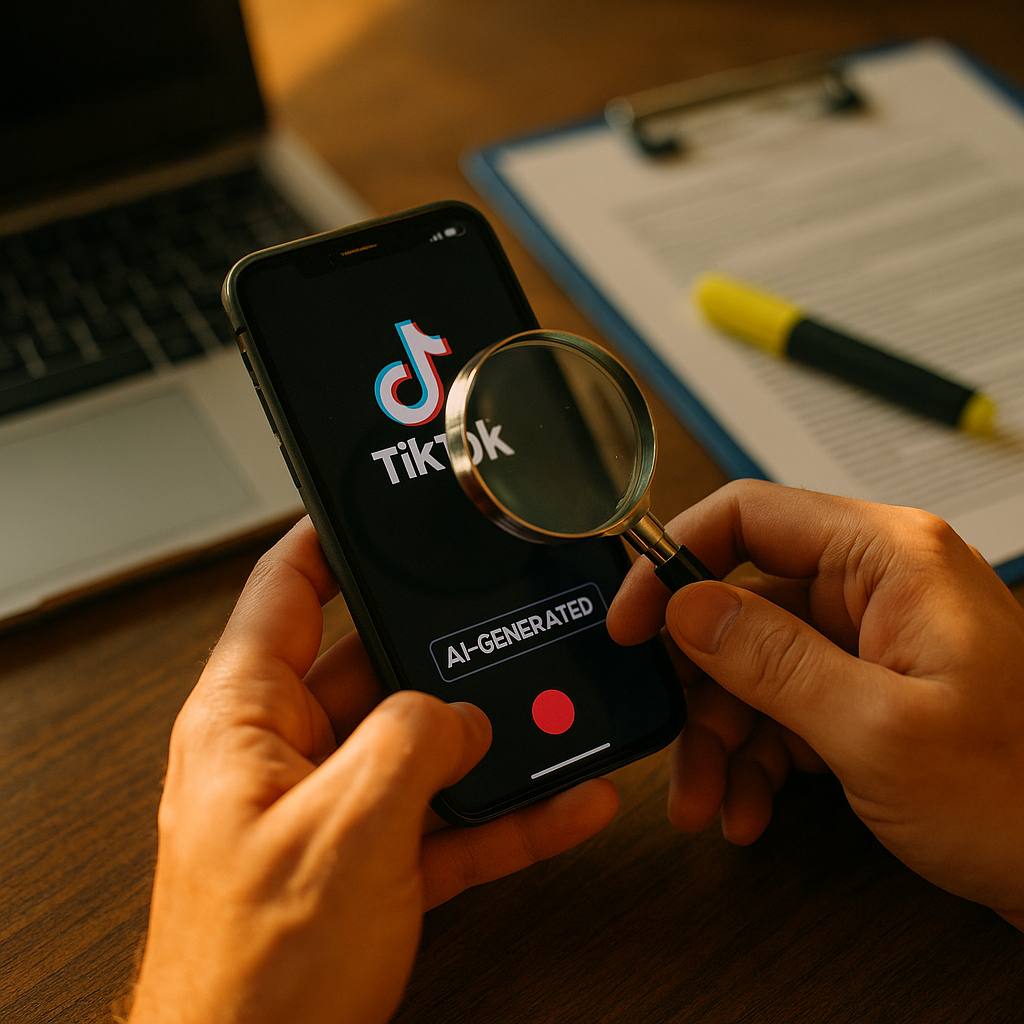
Miss TikTok’s AI-generated label requirement and you’re not just risking a takedown. You’re risking an FTC complaint, a brand safety headline, and a client asking why legal wasn’t looped in. The TikTok AI-generated label mandate isn’t a suggestion buried in community guidelines anymore — it’s an enforceable overlay requirement, and creative teams shipping campaigns without a compliance workflow are gambling with reach and reputation.
This isn’t a niche policy update. It’s a structural shift in how platforms want synthetic media flagged, and it’s arriving alongside parallel rules from Meta, YouTube, and a growing patchwork of state AI disclosure laws. If your creative pipeline still treats “add the AI label” as an afterthought, you’re already behind.
What TikTok Actually Requires
TikTok’s policy mandates a visible “AI-generated” label overlay on content created or significantly altered by AI tools, whether that’s a fully synthetic avatar, a voice clone, a background swap, or a realistic-looking scene that never happened. The platform auto-applies labels to content uploaded through its own AI effects, but the burden shifts to the uploader for anything produced externally — Runway, Sora, ElevenLabs, Midjourney-to-video pipelines, you name it.
That distinction matters enormously for brands. If your creative team generates a product demo using an AI avatar in a third-party tool and then uploads it natively, TikTok expects you to self-disclose. The platform’s detection systems catch a growing share of undisclosed synthetic content, but false negatives are common, and false positives (flagging real footage as AI) create their own headaches.
Brands that self-label proactively see fewer takedowns and faster moderation review than those relying on TikTok’s automated detection to catch undisclosed AI content after the fact.
The label itself isn’t cosmetic. It changes how the algorithm classifies and potentially distributes the content, and it’s increasingly cross-referenced by regulators building cases around deceptive AI practices. For a deeper look at how these disclosure mechanics intersect with FTC enforcement, see our FTC AI disclosure rules breakdown for TikTok Shop specifically.
Why This Isn’t Just a TikTok Problem
Here’s the uncomfortable truth: TikTok’s label requirement is downstream of a bigger regulatory current. The FTC has made clear that undisclosed synthetic endorsements can trigger Section 5 unfair-or-deceptive-practices liability, regardless of which platform hosts the content. Several states have layered on their own AI disclosure statutes with different thresholds for what counts as “AI-generated” versus “AI-assisted.”
That means a single piece of content might need to satisfy TikTok’s overlay rule, FTC disclosure guidance, and a state-specific AI labeling law simultaneously. Creative teams that build for TikTok’s checklist alone are solving one-third of the problem. Our dual compliance framework for state AI laws versus FTC Section 5 walks through how to avoid getting caught between conflicting standards.
eMarketer and Statista data consistently show AI-generated ad creative usage climbing across social platforms as brands chase production speed and cost savings. That growth curve is exactly why platforms are tightening enforcement now, before undisclosed synthetic content becomes the default rather than the exception. Check eMarketer’s creator economy research for the latest adoption figures if you’re building the business case internally.
The Compliance Checklist: What Creative Teams Actually Need to Do
Forget vague “be transparent” guidance. Here’s the operational checklist that should sit inside your creative brief template, not in a policy PDF nobody reads.
- Tag at the source. Every asset generated or edited with AI tools gets tagged in your DAM (digital asset management system) at creation, not at upload. Retrofitting labels after a campaign launches is how things slip through.
- Define your threshold. Decide internally what counts as “significantly altered.” A color grade isn’t AI-generated content. A face swap, synthetic voiceover, or AI-extended background is. Document the line so creative and legal aren’t guessing differently.
- Overlay placement matters. TikTok’s label needs to be visible and not obscured by other UI elements, captions, or brand watermarks. Test on mobile, not just desktop preview.
- Cross-check platform requirements. If the same asset runs on Instagram Reels or YouTube Shorts, confirm each platform’s own labeling mechanics. Our TikTok and Instagram ad labeling checklist covers the cross-platform gaps most teams miss.
- Build a creator disclosure clause. If creators are using AI tools independently (voice enhancement, AI captions, generated B-roll), your contracts need explicit language requiring them to disclose and apply platform labels themselves.
- Log everything. Keep a record of which assets were AI-generated, which tool produced them, and when the label was applied. If the FTC or a state AG comes asking, “we forgot” isn’t a defense.
Notice what’s missing from that list? Nothing about creative quality. This is pure operational hygiene, and it’s exactly the kind of work that gets skipped when teams are moving fast on tight deadlines.
Where Brands Are Getting This Wrong
Three failure patterns show up repeatedly in campaigns that get flagged or pulled.
First, teams assume AI voice-cloning tools count as “editing,” not “generating.” They don’t. A cloned voice reading a script the talent never recorded is squarely inside the disclosure requirement, and TikTok’s detection models are increasingly good at catching voice synthesis artifacts.
Second, agencies white-label AI production and never tell the brand. This is the scenario keeping legal teams up at night: a freelance editor uses an AI background extension tool to fix a shoot location, doesn’t flag it, and the brand has no idea their content is technically non-compliant until a platform review catches it. This is exactly why the FTC AI liability chain for brand responsibility matters — the brand is on the hook even when the AI use happened three vendors removed.
Third — and this one’s sneaky — teams treat the label as a one-time checkbox rather than something that needs re-verification when content gets repurposed. A TikTok video with a proper AI label, re-cut for a paid social ad on Meta, often loses that disclosure in the edit. Nobody re-adds it because nobody owns that step.
The single biggest compliance gap isn’t ignorance of the rule — it’s the handoff between teams when AI-generated content gets repurposed, re-cut, or re-published across platforms.
Building This Into Your Workflow, Not Bolting It On
The brands handling this well have done one thing consistently: they’ve assigned ownership. Somebody — usually a compliance lead embedded in the creative studio, not legal sitting three floors away — signs off on AI disclosure before an asset goes to publishing. That person has a checklist, a DAM tagging system, and authority to hold a launch if labeling is missing.
Compare that to the reactive model, where legal finds out about an AI-generated influencer ad after a journalist asks about it. That’s not a hypothetical; it’s happened publicly enough times that it should be table stakes risk planning by now.
If your team is running influencer campaigns where creators use AI tools independently — voice enhancement apps, AI editing suites, synthetic avatars for localized versions of content — your contracts need updating too. This overlaps heavily with broader social commerce compliance stacking, which we’ve mapped in detail in our AI social commerce compliance stack guide.
Practical tip: run a quarterly audit of published content against your AI-tagging log. Sample twenty assets, verify labels are present and correctly placed, and check whether repurposed versions on other platforms carried the disclosure forward. It’s tedious. It’s also cheaper than a platform strike or a regulatory inquiry.
For teams building internal training decks, HubSpot’s marketing compliance resources and TikTok’s own TikTok for Business policy center are useful reference points to cite alongside your internal checklist — regulators and platform trust teams both respond better to documented process than to good intentions.
The Cost of Getting This Wrong
Non-compliant content faces reduced distribution, outright removal, or repeated strikes against a brand’s TikTok account, which compounds over time into algorithmic suppression even for compliant future posts. That’s the platform-level cost. The regulatory cost is worse: the FTC has signaled it will pursue undisclosed synthetic endorsements as deceptive advertising, and state AI disclosure laws are adding statutory penalties on top of federal exposure.
Sprout Social’s platform trend research has repeatedly flagged declining audience trust as the softer, harder-to-quantify cost — audiences who feel misled by undisclosed AI content don’t just distrust that one post, they discount the brand’s entire feed. Check Sprout Social’s social media trust research if you need data to make this case to a skeptical stakeholder.
None of this is reversible with a quick apology post. Build the checklist now, assign ownership, and audit quarterly.
Next Step
Pull your last ten published TikTok assets, check for AI tool usage anywhere in the production chain, and confirm the label was applied correctly before you brief another campaign — that thirty-minute audit will surface more risk than any policy memo.
FAQs
Does TikTok’s AI label requirement apply to brand accounts as well as creators?
Yes. The requirement applies to any account uploading AI-generated or significantly AI-altered content, including brand-owned TikTok accounts, agency-managed accounts, and creator partners posting sponsored content.
What counts as “significantly altered” under TikTok’s policy?
Generally, synthetic voices, AI-generated avatars, face swaps, fabricated scenes, or AI-extended backgrounds count. Minor edits like color grading, cropping, or standard filters typically do not trigger the label requirement, though brands should document their own internal threshold to stay consistent.
Who is liable if a creator uses AI tools without disclosing it?
Liability can extend to the brand under FTC guidance, even if the undisclosed AI use happened at the creator or agency level. This is why contracts need explicit disclosure clauses and why brands should audit creator content rather than assume compliance.
Do repurposed videos need the AI label reapplied on each platform?
Yes. Each platform has its own labeling mechanics, and disclosure often gets lost when content is re-cut for a different channel. Brands should treat repurposing as a fresh compliance checkpoint, not an extension of the original approval.
How does this interact with state-level AI disclosure laws?
State AI disclosure statutes can impose additional or stricter requirements than TikTok’s platform policy. Brands operating nationally should treat platform labels as a floor, not a ceiling, and check state-specific thresholds separately.
FAQs
Does TikTok’s AI label requirement apply to brand accounts as well as creators?
Yes. The requirement applies to any account uploading AI-generated or significantly AI-altered content, including brand-owned TikTok accounts, agency-managed accounts, and creator partners posting sponsored content.
What counts as “significantly altered” under TikTok’s policy?
Generally, synthetic voices, AI-generated avatars, face swaps, fabricated scenes, or AI-extended backgrounds count. Minor edits like color grading, cropping, or standard filters typically do not trigger the label requirement, though brands should document their own internal threshold to stay consistent.
Who is liable if a creator uses AI tools without disclosing it?
Liability can extend to the brand under FTC guidance, even if the undisclosed AI use happened at the creator or agency level. This is why contracts need explicit disclosure clauses and why brands should audit creator content rather than assume compliance.
Do repurposed videos need the AI label reapplied on each platform?
Yes. Each platform has its own labeling mechanics, and disclosure often gets lost when content is re-cut for a different channel. Brands should treat repurposing as a fresh compliance checkpoint, not an extension of the original approval.
How does this interact with state-level AI disclosure laws?
State AI disclosure statutes can impose additional or stricter requirements than TikTok’s platform policy. Brands operating nationally should treat platform labels as a floor, not a ceiling, and check state-specific thresholds separately.
Top Influencer Marketing Agencies
The leading agencies shaping influencer marketing in 2026
Agencies ranked by campaign performance, client diversity, platform expertise, proven ROI, industry recognition, and client satisfaction. Assessed through verified case studies, reviews, and industry consultations.
Moburst

-
2

The Shelf
Boutique Beauty & Lifestyle Influencer AgencyA data-driven boutique agency specializing exclusively in beauty, wellness, and lifestyle influencer campaigns on Instagram and TikTok. Best for brands already focused on the beauty/personal care space that need curated, aesthetic-driven content.Clients: Pepsi, The Honest Company, Hims, Elf Cosmetics, Pure LeafVisit The Shelf → -
3

Audiencly
Niche Gaming & Esports Influencer AgencyA specialized agency focused exclusively on gaming and esports creators on YouTube, Twitch, and TikTok. Ideal if your campaign is 100% gaming-focused — from game launches to hardware and esports events.Clients: Epic Games, NordVPN, Ubisoft, Wargaming, Tencent GamesVisit Audiencly → -
4

Viral Nation
Global Influencer Marketing & Talent AgencyA dual talent management and marketing agency with proprietary brand safety tools and a global creator network spanning nano-influencers to celebrities across all major platforms.Clients: Meta, Activision Blizzard, Energizer, Aston Martin, WalmartVisit Viral Nation → -
5

The Influencer Marketing Factory
TikTok, Instagram & YouTube CampaignsA full-service agency with strong TikTok expertise, offering end-to-end campaign management from influencer discovery through performance reporting with a focus on platform-native content.Clients: Google, Snapchat, Universal Music, Bumble, YelpVisit TIMF → -
6

NeoReach
Enterprise Analytics & Influencer CampaignsAn enterprise-focused agency combining managed campaigns with a powerful self-service data platform for influencer search, audience analytics, and attribution modeling.Clients: Amazon, Airbnb, Netflix, Honda, The New York TimesVisit NeoReach → -
7

Ubiquitous
Creator-First Marketing PlatformA tech-driven platform combining self-service tools with managed campaign options, emphasizing speed and scalability for brands managing multiple influencer relationships.Clients: Lyft, Disney, Target, American Eagle, NetflixVisit Ubiquitous → -
8

Obviously
Scalable Enterprise Influencer CampaignsA tech-enabled agency built for high-volume campaigns, coordinating hundreds of creators simultaneously with end-to-end logistics, content rights management, and product seeding.Clients: Google, Ulta Beauty, Converse, AmazonVisit Obviously →