


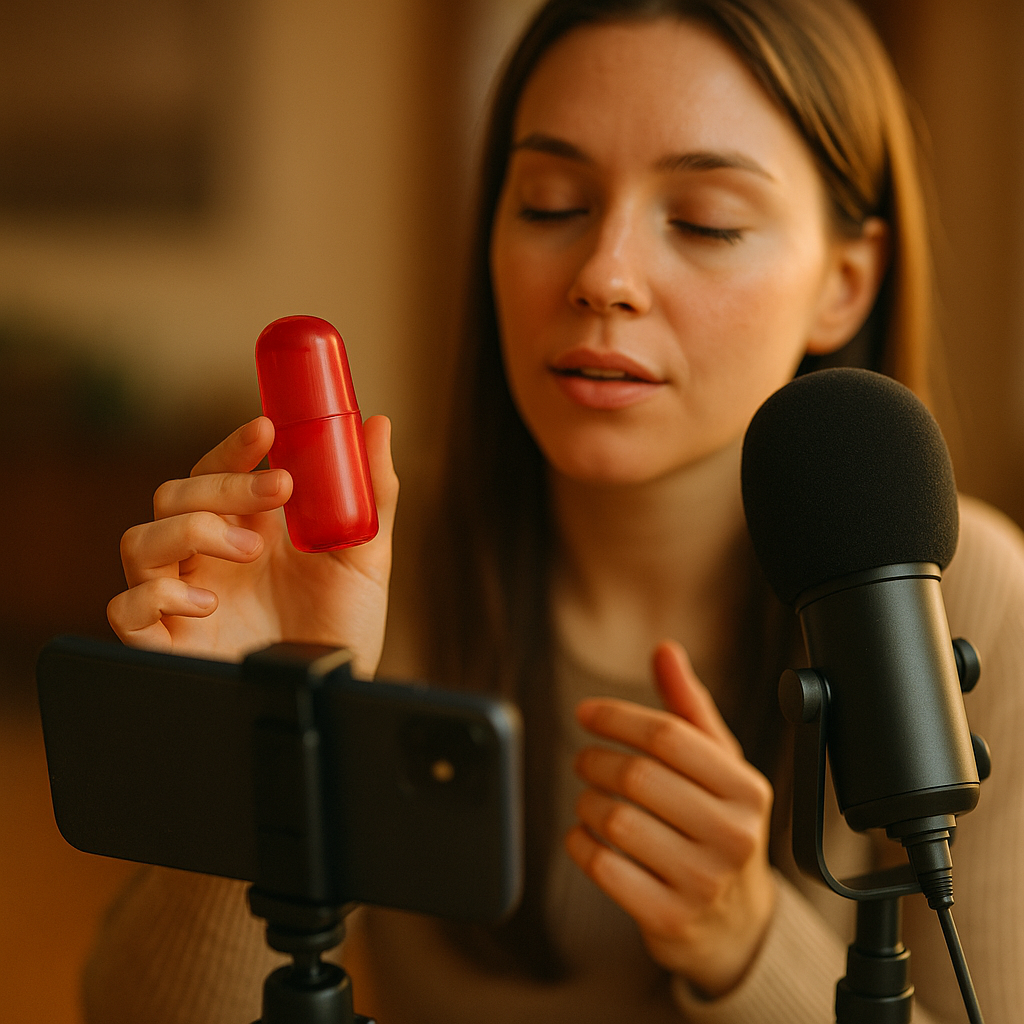
Save rates on beauty and home goods content jumped noticeably wherever creators leaned into sound: lid pops, cream swirls, fabric crinkles. The sensory ASMR demo format isn’t a gimmick anymore. It’s become one of the few reliable levers brands have for turning passive scrollers into people who tap “save” and come back later to buy. If your briefs still read like generic unboxing instructions, you’re leaving that behavior on the table.
Why Save Rates Are the Metric That Matters Now
Likes are cheap. Comments can be gamed. But saves? Saves mean someone stopped, thought “I need this later,” and bookmarked it. For beauty and home brands, that’s basically a self-reported purchase intent signal, free of charge.
Platforms have quietly shifted their ranking weight toward saves and shares over the past couple of algorithm cycles, according to creator economy trend reports from eMarketer. That’s partly why ASMR-style demos, slow pours, satisfying textures, crisp packaging sounds, outperform talking-head reviews on save-to-view ratio. The content rewards a second watch. It’s meditative. People save it the way they’d save a recipe they intend to cook eventually.
Save rate is the closest thing marketers have to a bookmarked purchase intention, and ASMR demos consistently generate it because the content invites rewatching, not just viewing.
What Actually Makes ASMR Demo Content Work
Strip away the trend label and ASMR product demos boil down to three sensory triggers: sound, texture, and pacing. Get those three right and the format does the selling for you. Get them wrong and you’ve just made a slow, boring video.
- Sound design first. Crinkle, click, pour, tap. If your product doesn’t naturally make a satisfying sound, the creator needs to find one, jar lid unscrewing, brush bristles against skin, fabric unfolding.
- Texture as the hero shot. Macro lens or phone macro mode on cream consistency, powder settling, or a candle wick catching flame. This is where beauty brands especially win.
- Unhurried pacing. Resist the urge to brief for speed. ASMR content works because it’s slow. Fifteen-second cuts kill the effect; this is one format where the speed-run demo logic doesn’t apply.
We covered the sensory fundamentals in an earlier piece on ASMR product demos. This article goes further: it’s a plug-and-play brief template built specifically for save-rate optimization in home goods and beauty categories.
The Creative Brief Template
Copy this structure directly into your next creator brief. Adjust the specifics, keep the skeleton.
- Objective line: “Maximize save rate through sensory demonstration of [product].” Say it explicitly. Creators optimize for whatever metric you name.
- Sound checklist: List every audio moment you want captured, lid pop, pump dispense, brush strokes, fabric rustle. Don’t assume the creator will find these instinctively; some will, most won’t without prompting.
- Texture shot list: Minimum three macro or close-up moments. For beauty, think swatch blending, product melting into skin, shimmer catching light. For home goods, think thread count close-ups, candle wax pooling, ceramic glaze reflections.
- Pacing note: Minimum 30 seconds, target 45-60. Explicitly instruct “no jump cuts faster than 3 seconds” to protect the meditative quality.
- Silence and ambient audio: Specify whether background music is allowed. Pure ASMR performs best with zero or minimal music, just product sound and room tone.
- CTA placement: Save prompts work better as on-screen text (“save this for your next reset”) than spoken CTAs, which break the sensory spell.
- Disclosure requirement: #ad or #partner tag per FTC endorsement guidelines, placed in the first three seconds of on-screen text, not buried in the caption.
That’s it. Seven fields. No creator wants to parse a five-page PDF, and frankly, the format doesn’t need one.
Beauty vs. Home Goods: Where the Brief Diverges
The core template holds for both categories, but the sensory priorities shift.
Beauty brands should brief for skin-contact sound and visual gratification: tapping a jar, the “schlick” of a serum pump, a brush swirling into powder. Save rates spike when the demo shows product transformation in real time, matte-to-dewy, bare-to-blended. Pair this with an before-and-after structure if you want the sensory hook plus a payoff shot.
Home goods brands lean harder into ambient sound: candle wicks crackling, fabric unfolding, a coffee grinder whirring, a diffuser’s first mist release. These products often lack an obvious “wear it” moment, so pacing and environment (a tidy, softly lit room) do more heavy lifting than in beauty content.
Either way, resist forcing a script. The best-performing ASMR demos we’ve tracked feel almost accidental, like the creator just happened to film themselves enjoying the product. That authenticity is coachable, but only if your brief leaves room for it instead of over-directing every second.
Common Mistakes That Tank Save Rates
Even good creators mess this up when the brief doesn’t guide them properly.
- Talking over the sound. Voiceover explaining ingredients kills the ASMR trigger. If narration is required for compliance or clarity, use on-screen text instead.
- Rushing the reveal. Marketers trained on the slow-motion reveal format sometimes still cut too fast out of habit. ASMR needs more patience than even slow-motion briefs typically call for.
- Studio-perfect audio. Overly clean, professionally mixed sound reads as fake. Slight room echo and natural ambient noise actually build trust.
- Ignoring caption strategy. Sound-driven content still needs to work for sound-off viewers. Borrow a page from sound-off video briefs and add descriptive captions (“that pump click though”) so the save trigger works even on mute.
- No save-specific CTA. If you never ask, don’t expect it. On-screen prompts like “save for later” or “bookmark this routine” measurably lift save counts, per creator platform behavior reported by Sprout Social.
Measuring What Matters
Track save rate as a percentage of total views, not raw save count. A video with 50,000 views and 4,000 saves (8%) is outperforming one with 500,000 views and 15,000 saves (3%), even though the second looks bigger on paper. Most platform analytics dashboards, including TikTok’s native creator tools via TikTok for Business, surface this ratio if you know where to look.
Benchmark against your own historical content, not industry averages, since category and audience size skew comparisons wildly. If your typical beauty content saves at 2%, and an ASMR demo hits 6%, that’s your signal to double down on the format, not chase a vanity number from a case study that used a different product category entirely.
Compare ASMR demo saves against your own baseline, not an industry benchmark. The format’s value shows up in the delta, not the absolute number.
Also worth tracking: save-to-purchase lag. Home goods and higher-consideration beauty items (skincare devices, multi-step routines) often see a 3-10 day gap between save and conversion. If your attribution window is set too short, you’ll undercount the format’s actual ROI.
Where This Fits in a Broader Content Mix
ASMR demos shouldn’t be your only format, they’re a save-rate specialist, not a full-funnel solution. Pair them with something that drives comments and shares for top-of-funnel reach, like a myth-busting format for category education, or a comment-reply series for community engagement. Use ASMR demos specifically when the goal is bottom-funnel intent capture: retargeting audiences, product launch weeks, or restock campaigns where “save now, buy later” behavior is exactly what you want.
Next step: Pull your last quarter of creator content, sort by save rate, and identify which videos already had accidental ASMR elements. Brief your next batch of creators using the seven-field template above, and measure the delta against that baseline before scaling spend.
FAQs
What is the sensory ASMR demo format in influencer marketing?
It’s a content style where creators emphasize sound, texture, and slow pacing, crinkling packaging, cream swirls, fabric sounds, to trigger a satisfying sensory response that drives higher save rates than standard product demos.
Why do ASMR-style demos get higher save rates than typical reviews?
They invite rewatching. Viewers save the content the way they’d bookmark a recipe, intending to return to it, which platforms interpret as a stronger intent signal than a like or comment.
Which brands benefit most from this format?
Beauty and home goods brands see the strongest lift because their products have inherently satisfying textures and sounds, cream consistency, candle wax, fabric, packaging clicks, that translate well to sensory content.
How long should an ASMR product demo video be?
Aim for 30 to 60 seconds. Shorter cuts undercut the meditative quality that makes the format work; this is one of the few formats where slower pacing outperforms speed-run editing.
Does ASMR content need FTC disclosure like other sponsored content?
Yes. Any paid partnership requires clear disclosure per FTC endorsement guidelines, ideally as on-screen text within the first three seconds, not just in the caption.
How do I measure ROI on ASMR demo content?
Track save rate as a percentage of views, compare it against your own historical baseline, and account for a save-to-purchase lag of several days when setting attribution windows.
Top Influencer Marketing Agencies
The leading agencies shaping influencer marketing in 2026
Agencies ranked by campaign performance, client diversity, platform expertise, proven ROI, industry recognition, and client satisfaction. Assessed through verified case studies, reviews, and industry consultations.
Moburst

-
2

The Shelf
Boutique Beauty & Lifestyle Influencer AgencyA data-driven boutique agency specializing exclusively in beauty, wellness, and lifestyle influencer campaigns on Instagram and TikTok. Best for brands already focused on the beauty/personal care space that need curated, aesthetic-driven content.Clients: Pepsi, The Honest Company, Hims, Elf Cosmetics, Pure LeafVisit The Shelf → -
3

Audiencly
Niche Gaming & Esports Influencer AgencyA specialized agency focused exclusively on gaming and esports creators on YouTube, Twitch, and TikTok. Ideal if your campaign is 100% gaming-focused — from game launches to hardware and esports events.Clients: Epic Games, NordVPN, Ubisoft, Wargaming, Tencent GamesVisit Audiencly → -
4

Viral Nation
Global Influencer Marketing & Talent AgencyA dual talent management and marketing agency with proprietary brand safety tools and a global creator network spanning nano-influencers to celebrities across all major platforms.Clients: Meta, Activision Blizzard, Energizer, Aston Martin, WalmartVisit Viral Nation → -
5

The Influencer Marketing Factory
TikTok, Instagram & YouTube CampaignsA full-service agency with strong TikTok expertise, offering end-to-end campaign management from influencer discovery through performance reporting with a focus on platform-native content.Clients: Google, Snapchat, Universal Music, Bumble, YelpVisit TIMF → -
6

NeoReach
Enterprise Analytics & Influencer CampaignsAn enterprise-focused agency combining managed campaigns with a powerful self-service data platform for influencer search, audience analytics, and attribution modeling.Clients: Amazon, Airbnb, Netflix, Honda, The New York TimesVisit NeoReach → -
7

Ubiquitous
Creator-First Marketing PlatformA tech-driven platform combining self-service tools with managed campaign options, emphasizing speed and scalability for brands managing multiple influencer relationships.Clients: Lyft, Disney, Target, American Eagle, NetflixVisit Ubiquitous → -
8

Obviously
Scalable Enterprise Influencer CampaignsA tech-enabled agency built for high-volume campaigns, coordinating hundreds of creators simultaneously with end-to-end logistics, content rights management, and product seeding.Clients: Google, Ulta Beauty, Converse, AmazonVisit Obviously →