


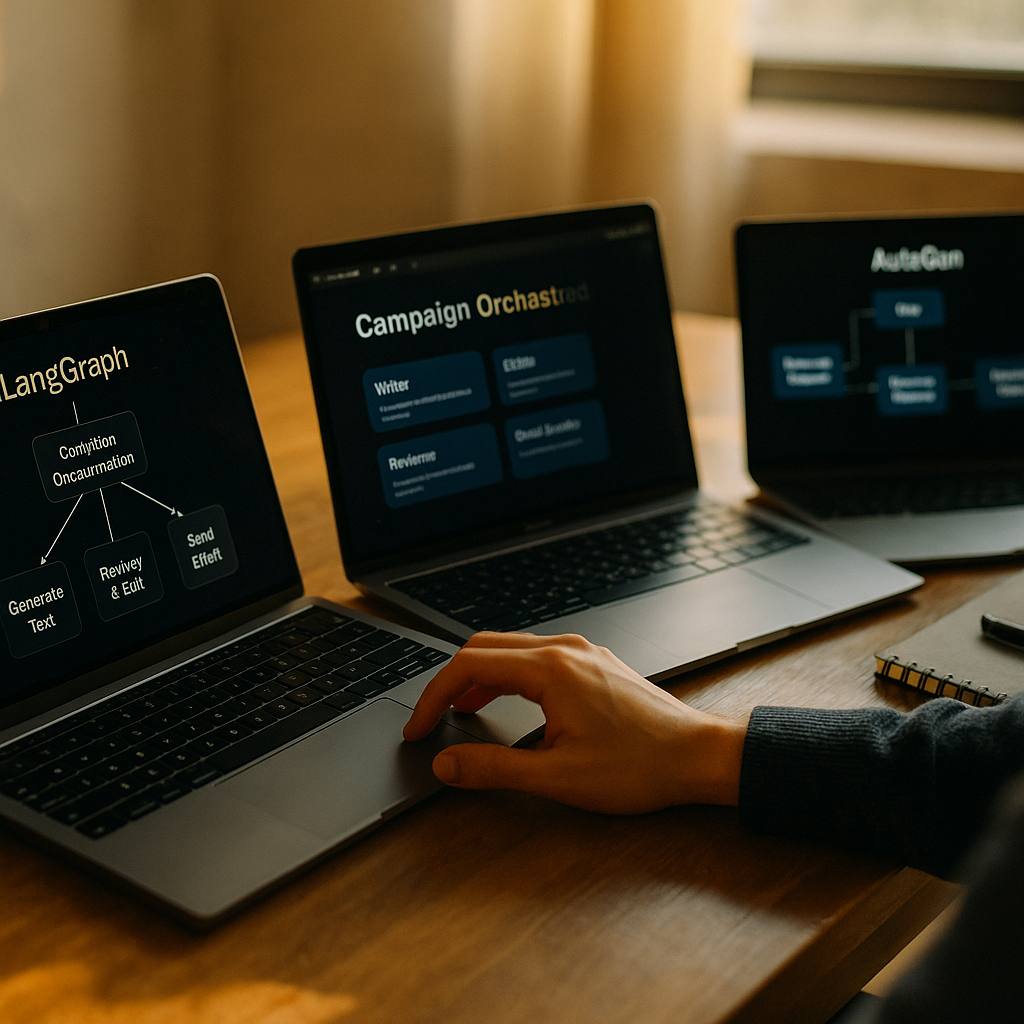
Three engineers on your team just spent six weeks building an “autonomous campaign agent” that broke the first time a creator missed a posting deadline. Sound familiar? Multi-agent orchestration is the hottest infrastructure bet in marketing AI right now, but picking the wrong framework means rebuilding your stack in a year. LangGraph, CrewAI, and AutoGen all promise coordinated AI agents that plan, execute, and adjust campaigns. They are not interchangeable, and treating them as such is how pilots quietly die.
Why Orchestration Frameworks Matter for Campaigns Now
A single AI agent can draft a caption or summarize sentiment. It cannot plan a multi-platform influencer campaign, allocate budget across TikTok and Meta, monitor creator performance, and escalate anomalies to a human, all while remembering what happened yesterday. That requires multiple agents with distinct roles talking to each other, sharing state, and following rules about when to stop and ask permission.
This is the gap orchestration frameworks fill. They are not marketing platforms. They are the plumbing underneath the next generation of marketing platforms, including the agentic tools inside TikTok’s Symphony and Meta’s Advantage+ stack. If you are building custom campaign automation, or evaluating a vendor who claims to have built one, understanding these three frameworks tells you what you’re actually buying.
Gartner has flagged agentic AI as one of the top strategic technology trends, and most enterprise “AI agents” shipping this year sit on top of one of these three open-source frameworks, or a thin wrapper around them.
LangGraph: The Control Freak’s Choice
LangGraph, built by the LangChain team, treats agent workflows as a graph. Nodes are tasks, edges are decisions, and you define exactly which paths an agent can take. Want your campaign agent to always route budget-reallocation decisions through a human approval node before touching spend? LangGraph makes that explicit and auditable.
This matters enormously for regulated or high-stakes marketing workflows. If you’re running programmatic budget shifts or automated creator payments, you need a paper trail showing exactly what the agent decided and why. LangGraph’s graph structure gives you that by design, not as an afterthought. It’s the same instinct behind why autonomous programmatic buying still needs human oversight baked into the architecture, not bolted on.
The tradeoff: LangGraph has a steeper learning curve. You’re essentially writing state machines. For a small marketing ops team without dedicated engineering support, this can be overkill for simpler use cases like generating a weekly report.
- Best for: compliance-sensitive workflows, budget allocation, anything touching write access to ad platforms or CRMs
- Watch out for: engineering overhead; requires someone comfortable with Python and graph logic
- Campaign fit: multi-step approval chains, cross-platform budget pacing, escalation-heavy workflows
CrewAI: Built for Role-Playing Teams
CrewAI takes a different mental model. Instead of a graph, you define a “crew” of agents, each with a role, a goal, and a backstory (yes, literally a backstory prompt). A researcher agent gathers creator performance data. A strategist agent interprets it. A writer agent drafts the brief. They pass work to each other like a small agency team.
This is the most intuitive framework for marketers to conceptualize, because it mirrors how campaign teams already work. If you’ve ever mapped out an agency org chart, CrewAI’s structure will feel familiar. That’s also its appeal for rapid prototyping: teams have shipped working multi-agent demos for AI creator brief generation in days, not weeks.
The catch? CrewAI is younger and less battle-tested for production-scale, high-volume workflows. Error handling and state persistence, critical for anything running unattended overnight, are less mature than LangGraph’s. Several teams we’ve spoken with use CrewAI for internal prototyping, then rebuild the production version in LangGraph once the workflow is proven. That’s not a failure. It’s a reasonable build path.
- Best for: fast prototyping, content ideation pipelines, internal proof-of-concept builds
- Watch out for: less mature production tooling, weaker audit trails out of the box
- Campaign fit: brief generation, competitive research summaries, creator shortlisting workflows
AutoGen: Microsoft’s Bet on Conversation
AutoGen, from Microsoft Research, treats agent collaboration as a conversation. Agents literally message each other in natural language, debate, and converge on an answer. It’s the most flexible of the three and arguably the most research-oriented.
Where AutoGen shines is in ambiguous, exploratory tasks: brainstorming campaign concepts, red-teaming a creative brief for brand-safety risk, or having one agent play devil’s advocate against another’s media plan. If your use case genuinely benefits from agents “arguing” toward a better answer, AutoGen’s conversational architecture is purpose-built for that.
It’s also the framework most likely to surprise you in production. Conversational agents can loop, over-explain, or drift off-task without tight guardrails. For a use case like automated creative sentiment review, drawn from techniques covered in sentiment analysis tools that catch sarcasm, that flexibility is an asset. For automated bid adjustments on live ad spend, it’s a liability.
- Best for: exploratory creative work, brand-safety red-teaming, scenario planning
- Watch out for: harder to bound behavior; needs strict token and turn limits to control cost and drift
- Campaign fit: creative concept generation, brand-risk simulation, strategy stress-testing
Head-to-Head: What Actually Changes for a Campaign Team
Strip away the technical architecture and here’s what matters to a brand or agency evaluating these frameworks for real campaign work.
Auditability. If your legal or compliance team needs to see exactly why an agent paused a budget or flagged a creator post, LangGraph’s explicit graph structure wins. This pairs directly with the governance questions raised in AI vendor scorecards on governance and override controls. CrewAI and AutoGen can log decisions too, but you’ll build more of that logging yourself.
Speed to prototype. CrewAI wins here, hands down. A marketing ops analyst with moderate Python skills can have a working multi-agent demo running in an afternoon. AutoGen is close behind. LangGraph takes longer to get right, but that time investment pays off at scale.
Cost predictability. Conversational frameworks like AutoGen tend to burn more tokens because agents talk to each other in full natural language, sometimes repeatedly. LangGraph’s structured state transitions are more token-efficient because you control exactly what gets passed between nodes. If you’re running these agents against GPT-4-class models at volume, that difference shows up fast on the invoice. Compare model behavior and cost tradeoffs the way you would when evaluating Claude, Gemini, and GPT for brand voice consistency.
Vendor lock-in risk. None of these three lock you into a specific LLM provider, which is a real advantage over some closed platform ecosystems. But how you architect your agent graph or crew still creates switching costs. Building deeply nested LangGraph state machines around one vendor’s function-calling format, for instance, isn’t trivial to migrate later. This is the same lock-in calculus covered in orchestration platforms trading complexity for lock-in.
The framework choice matters less than the decision of what an agent is allowed to do without a human in the loop. Get that wrong, and it doesn’t matter which framework you picked.
Where Interoperability Breaks Down
Here’s the part vendors don’t lead with: none of these frameworks natively solve the problem of getting your agent crew to actually talk to your CDP, your CRM, and your ad platforms in a standardized way. You still need custom connectors, and those connectors are where most agentic marketing projects quietly stall. This is the exact friction documented in why marketing AI tools still refuse to talk to each other and in the broader martech interoperability gap.
Before you build anything, map where your agent crew needs write access. Does it need to push budget changes into DV360? Update lifecycle stages in HubSpot? Pull creator audience data from a warehouse? Each of those integrations is a separate engineering task regardless of which orchestration framework you pick, and each one is a potential point of failure or unauthorized action. The checklist used for agentic CRM write access is a good starting template for any campaign agent touching live systems.
Data provenance matters here too. If your agents are being trained or fine-tuned on historical campaign data, you need the same scrutiny applied in MarTech vendor contracts requiring training data provenance audits. An orchestration framework doesn’t absolve you of that diligence, it just moves the question upstream.
Insurance, Liability, and the Uncomfortable Questions
If an autonomous agent crew authorizes a $40,000 overspend on a campaign, who’s liable? Your team, the framework, or the LLM provider? None of these three frameworks come with liability coverage, and most standard tech E&O policies weren’t written with autonomous multi-agent systems in mind. This is increasingly a procurement conversation, not just an engineering one. Review the coverage gaps raised in AI agent marketplace insurance before you give any agent crew unsupervised spending authority.
Regulators are watching too. The FTC has signaled increased scrutiny of automated decision-making that affects consumers, and disclosure obligations don’t disappear because a decision was made by an agent instead of a person. Build human checkpoints into your graph or crew now, not after an incident.
A Practical Evaluation Framework
Skip the framework hype cycle and score your use case against these questions instead:
- How reversible is the action? Reversible (draft a caption) favors flexibility, so lean CrewAI or AutoGen. Irreversible (spend money, publish live) favors LangGraph’s control.
- How many humans need visibility into the decision path? More stakeholders means you need stronger audit logging, which LangGraph handles more natively.
- How mature is your engineering support? No dedicated AI engineer on staff? Start with CrewAI for prototyping and bring in contract help for a LangGraph rebuild once you’ve proven value.
- What’s your token budget? Run a two-week cost pilot before committing. Conversational frameworks can surprise finance teams.
- What data does the agent crew need to touch? Map every integration point before writing a line of orchestration code. Reference the interoperability and provenance checkpoints above.
According to eMarketer, marketer confidence in AI-driven campaign automation continues to climb year over year, but confidence and readiness aren’t the same thing. The teams getting real ROI from agent orchestration are the ones who scoped tightly, piloted narrowly, and expanded only after proving the guardrails held under real campaign pressure, not the ones who bought the most sophisticated framework first.
Next step: pick one narrow, reversible campaign task, run it through both CrewAI and LangGraph for two weeks, and compare audit logs and token cost before committing to either for anything touching live budget.
Frequently Asked Questions
What is a multi-agent orchestration framework in marketing?
It’s a software layer that coordinates multiple AI agents, each handling a specific task like research, drafting, or approval, so they can work together on a campaign workflow without constant human prompting at every step.
Is LangGraph, CrewAI, or AutoGen best for influencer campaign automation?
It depends on the task. LangGraph suits budget or approval workflows needing audit trails. CrewAI suits fast prototyping of role-based tasks like brief generation. AutoGen suits exploratory work like creative concept testing or brand-risk simulation.
Do these frameworks lock brands into one AI vendor?
Not by design, all three support multiple LLM providers. But deeply customized agent graphs or crews built around one provider’s specific functions can still create meaningful switching costs later.
Can these frameworks connect directly to ad platforms and CRMs?
Not natively. You need custom connectors for each integration, whether that’s DV360, HubSpot, or a CDP. This integration work, not the orchestration framework itself, is typically the biggest project bottleneck.
Who is liable if an autonomous agent crew makes a costly campaign error?
Liability is unsettled and varies by contract. Most standard tech insurance policies don’t explicitly address autonomous multi-agent decision-making, which is why procurement and legal teams should review coverage before granting agents unsupervised spending authority.
Top Influencer Marketing Agencies
The leading agencies shaping influencer marketing in 2026
Agencies ranked by campaign performance, client diversity, platform expertise, proven ROI, industry recognition, and client satisfaction. Assessed through verified case studies, reviews, and industry consultations.
Moburst

-
2

The Shelf
Boutique Beauty & Lifestyle Influencer AgencyA data-driven boutique agency specializing exclusively in beauty, wellness, and lifestyle influencer campaigns on Instagram and TikTok. Best for brands already focused on the beauty/personal care space that need curated, aesthetic-driven content.Clients: Pepsi, The Honest Company, Hims, Elf Cosmetics, Pure LeafVisit The Shelf → -
3

Audiencly
Niche Gaming & Esports Influencer AgencyA specialized agency focused exclusively on gaming and esports creators on YouTube, Twitch, and TikTok. Ideal if your campaign is 100% gaming-focused — from game launches to hardware and esports events.Clients: Epic Games, NordVPN, Ubisoft, Wargaming, Tencent GamesVisit Audiencly → -
4

Viral Nation
Global Influencer Marketing & Talent AgencyA dual talent management and marketing agency with proprietary brand safety tools and a global creator network spanning nano-influencers to celebrities across all major platforms.Clients: Meta, Activision Blizzard, Energizer, Aston Martin, WalmartVisit Viral Nation → -
5

The Influencer Marketing Factory
TikTok, Instagram & YouTube CampaignsA full-service agency with strong TikTok expertise, offering end-to-end campaign management from influencer discovery through performance reporting with a focus on platform-native content.Clients: Google, Snapchat, Universal Music, Bumble, YelpVisit TIMF → -
6

NeoReach
Enterprise Analytics & Influencer CampaignsAn enterprise-focused agency combining managed campaigns with a powerful self-service data platform for influencer search, audience analytics, and attribution modeling.Clients: Amazon, Airbnb, Netflix, Honda, The New York TimesVisit NeoReach → -
7

Ubiquitous
Creator-First Marketing PlatformA tech-driven platform combining self-service tools with managed campaign options, emphasizing speed and scalability for brands managing multiple influencer relationships.Clients: Lyft, Disney, Target, American Eagle, NetflixVisit Ubiquitous → -
8

Obviously
Scalable Enterprise Influencer CampaignsA tech-enabled agency built for high-volume campaigns, coordinating hundreds of creators simultaneously with end-to-end logistics, content rights management, and product seeding.Clients: Google, Ulta Beauty, Converse, AmazonVisit Obviously →