


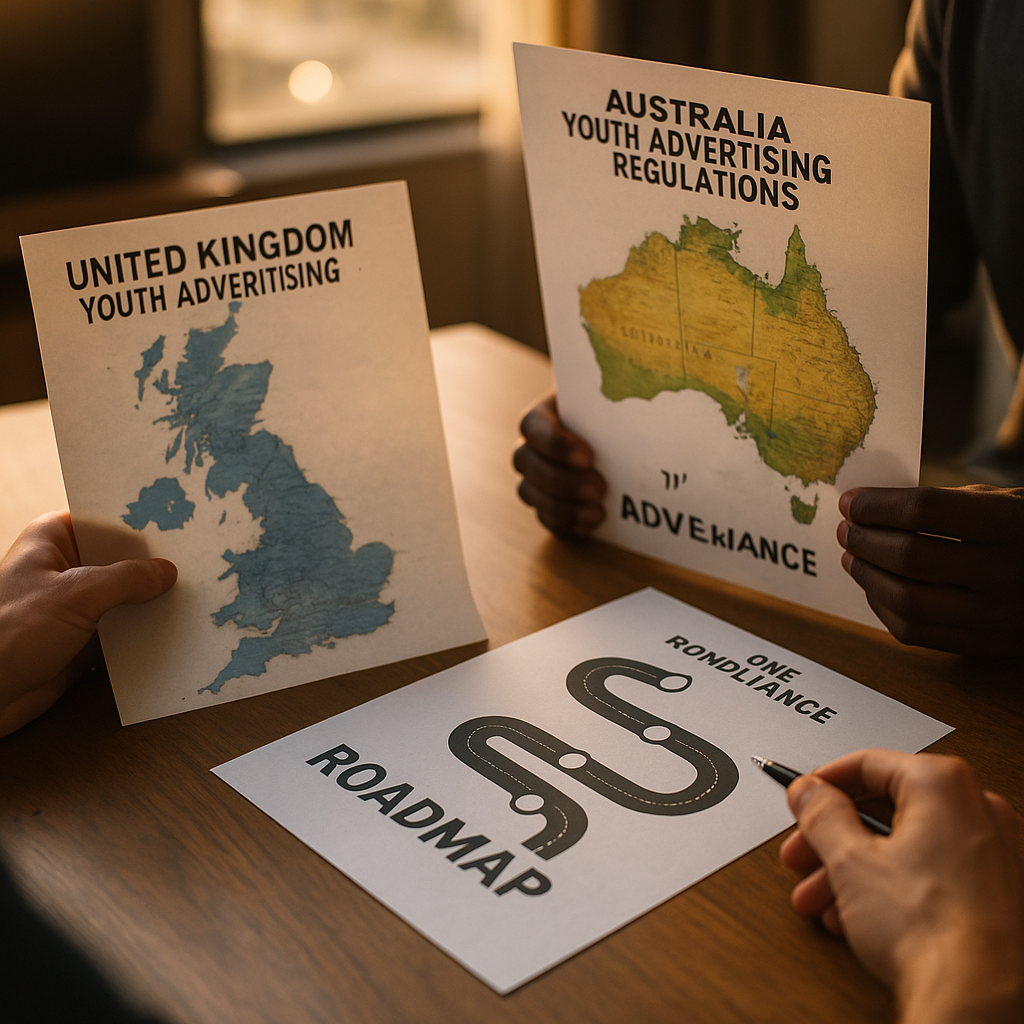
Two governments, one migraine: the UK’s under-16 social media ban is landing just as Australia doubles its penalties for platforms and, by extension, the advertisers riding on them. If your youth-adjacent campaigns still run on market-by-market guesswork, you’ve got roughly a year to fix that before Spring 2027 turns fragmented policy into fragmented liability.
Why this isn’t just a platform problem anymore
For years, age-gating was Meta’s headache, TikTok’s headache, YouTube’s headache. Brands watched from the sidelines, assuming platform-level compliance covered them. That assumption is dying fast.
The UK’s approach, expected to take firmer shape ahead of Spring 2027, pushes verification obligations onto platforms but creates downstream exposure for any brand running influencer or ad campaigns that reach minors, knowingly or not. Australia’s move to double penalties under its Online Safety Act amendments signals the same direction: regulators want deterrence sharp enough that ignorance stops being a defense. Ofcom has already shown its teeth on adjacent issues, and its Category 1 scam ad rules set a precedent for how UK regulators expect brands to self-audit rather than wait for enforcement letters.
If a 14-year-old sees your sponsored post because the platform’s age gate failed, “the platform should have caught that” is no longer a viable legal position in either the UK or Australia.
What’s actually changing on the ground
- UK platforms face mandatory age-assurance mechanisms for under-16 access, with enforcement tied to Ofcom’s existing Online Safety Act powers.
- Australia’s penalty increase applies to platforms but creates a compliance ripple: advertisers and agencies placing youth-adjacent campaigns will face pressure to prove audience targeting excluded minors.
- Both frameworks lean on “reasonable steps” language, meaning documentation of your compliance process matters as much as the outcome.
None of this is theoretical. eMarketer and Statista have both tracked rising regulatory scrutiny of youth-targeted digital advertising over the past two years, and Statista’s youth media consumption data consistently shows under-16 audiences migrating toward exactly the short-form platforms most implicated in these new rules.
The compliance gap most brands haven’t noticed yet
Here’s the uncomfortable part. Most brand compliance teams built their youth-safety protocols around COPPA and FTC guidance, a US-centric framework. That framework doesn’t map cleanly onto UK age-assurance mandates or Australia’s platform-penalty structure. Different triggers, different documentation requirements, different enforcement bodies.
Running three separate compliance playbooks — one for the US, one for the UK, one for Australia — isn’t just inefficient. It’s how gaps happen. A campaign cleared under FTC standards might still expose a brand to Ofcom scrutiny if the creative reached UK minors through an unverified age gate. Teams juggling this manually, market by market, will eventually miss something. Probably during a product launch, when nobody’s double-checking.
This is precisely why a unified roadmap matters more than a patchwork of local fixes. Brands already building cross-jurisdiction frameworks for other regulatory overlaps — like the one described in this EU-US compliance framework piece — have a head start. The same logic applies here: build once, adapt locally, audit centrally.
Building the one-roadmap approach
A cross-market youth compliance roadmap isn’t a document. It’s an operating rhythm. Here’s what it needs to cover, structurally.
1. Unified age-verification standard, tiered by market
Set your internal bar at the strictest requirement across your active markets, then document where local rules are lighter. If the UK’s under-16 threshold becomes your baseline, Australia’s and the US’s frameworks (which vary by platform and state) become exceptions you track, not separate systems you build from scratch.
2. Platform-level audit trail, not just policy acknowledgment
Regulators in both markets are moving toward evidentiary standards. Screenshot the age-gating mechanism. Log which audience-exclusion tools you used on each platform. Meta, TikTok, and YouTube all offer some form of audience segmentation controls; use them, and keep records. Meta’s business tools and TikTok’s ad platform both publish targeting exclusion guidance worth building into your standard operating procedure, not just consulting when something breaks.
3. Creator vetting for youth-adjacent content categories
Beauty, gaming, fashion, and toy-adjacent lifestyle content sit closest to this risk. If you’re running influencer campaigns in these categories, your creator brief needs explicit language about audience composition and content tone. Beauty and gaming ad exposure under US state youth privacy laws is a useful parallel case study: the same content categories that trigger domestic scrutiny are the ones drawing UK and Australian attention now.
A campaign brief that doesn’t specify “no targeting or incidental reach to under-16 audiences” isn’t a brief. It’s a liability waiting for a regulator to find it.
4. Escalation triggers baked into the workflow
Someone on your team needs a clear answer to: “What happens when we discover a campaign reached minors we didn’t intend to reach?” Build this escalation path before it’s needed, not during a crisis. Brands that have already built escalation systems for other disclosure failures, like the one outlined in this undisclosed sponsorship protocol, can adapt the same structure for youth-exposure incidents. The mechanics are nearly identical: detect, document, escalate, remediate, report.
Pre-campaign legal review: the new default, not the exception
Skipping legal review on a campaign because “it’s not really aimed at kids” is exactly the kind of thinking that gets brands into trouble under these frameworks. Intent doesn’t matter as much as reach and platform mechanics. A pre-campaign legal checklist built specifically around under-16 exposure risk should now sit alongside your standard brand safety and disclosure reviews, not as an occasional add-on.
This matters especially for agencies managing multi-market rosters. A campaign approved for US and Canadian audiences doesn’t automatically clear UK or Australian thresholds. Build the checklist once, apply it market by market, and treat any “we’ll figure it out later” instinct as a red flag.
What Spring 2027 actually means for your calendar
Spring 2027 isn’t a hard deadline in the sense of a single enforcement date. It’s the point at which UK age-assurance mandates are expected to be fully operational and Australia’s doubled penalties will have had roughly a year of enforcement precedent behind them. Regulators tend to ramp scrutiny once a framework has bedded in; the brands caught in early enforcement waves are usually the ones that treated the initial rollout period as a grace period rather than a build window.
Practically, that means you have two to four quarters to:
- Audit current campaign targeting against both frameworks.
- Update creator contracts to include youth-exposure exclusion language.
- Train campaign managers on the unified checklist rather than relying on legal to catch issues after launch.
- Build the documentation habit now, so it’s routine by the time enforcement tightens.
Data retention plays a role here too. If a regulator asks how you’re handling audience data tied to a campaign that reached minors, your answer needs to be more specific than “we deleted it eventually.” The retention discipline outlined in this audience data retention policy piece translates well to youth-compliance documentation: know what you kept, why, and for how long.
The efficiency case, not just the risk case
It’s tempting to frame all of this purely as risk mitigation. But there’s an ROI angle too. Brands running separate compliance processes per market spend more on legal review, more on agency coordination, more on the inevitable rework when a campaign gets flagged post-launch. A single roadmap, applied consistently, cuts review time and reduces the number of campaigns that need last-minute retargeting fixes.
Sprout Social’s brand safety research has repeatedly shown that proactive compliance processes correlate with fewer campaign delays and lower agency turnaround friction. That’s not a coincidence. Clear rules, applied early, move faster than ambiguous rules argued about after the fact.
The brands that get ahead of this won’t be the ones with the biggest legal teams. They’ll be the ones who treated a UK-Australia regulatory coincidence as the forcing function to finally build one system instead of three.
Frequently Asked Questions
FAQs
What does the UK’s under-16 social media ban actually restrict?
It requires platforms to implement age-assurance mechanisms preventing under-16 users from accessing certain features or content, with enforcement tied to Ofcom’s Online Safety Act powers. Brands are affected indirectly, through exposure if campaigns reach unverified minor audiences.
How do Australia’s doubled penalties affect advertisers, not just platforms?
While the penalties target platforms directly, advertisers face reputational and contractual risk if their campaigns contribute to a platform’s compliance failure, particularly in youth-adjacent categories like gaming, beauty, and toys.
Do US brands need to worry about UK and Australian youth compliance rules?
Yes, if campaigns run in or reach those markets. Global and multi-market brands can’t rely solely on FTC or COPPA frameworks; UK and Australian rules have distinct triggers and documentation expectations.
What’s the fastest way to start building a cross-market compliance roadmap?
Start with a pre-campaign legal checklist covering age-verification standards, creator brief language, and escalation triggers, then apply it uniformly across markets rather than building separate processes per region.
Is Spring 2027 a hard enforcement deadline?
Not exactly. It marks the point when UK age-assurance mandates are expected to be fully operational and when Australia’s penalty framework will have roughly a year of enforcement precedent, making early compliance the safer bet.
Start this quarter: run one campaign through both the UK and Australian frameworks side by side, document every gap, and use that gap list as your build spec for the unified roadmap, not next year’s problem.
Top Influencer Marketing Agencies
The leading agencies shaping influencer marketing in 2026
Agencies ranked by campaign performance, client diversity, platform expertise, proven ROI, industry recognition, and client satisfaction. Assessed through verified case studies, reviews, and industry consultations.
Moburst

-
2

The Shelf
Boutique Beauty & Lifestyle Influencer AgencyA data-driven boutique agency specializing exclusively in beauty, wellness, and lifestyle influencer campaigns on Instagram and TikTok. Best for brands already focused on the beauty/personal care space that need curated, aesthetic-driven content.Clients: Pepsi, The Honest Company, Hims, Elf Cosmetics, Pure LeafVisit The Shelf → -
3

Audiencly
Niche Gaming & Esports Influencer AgencyA specialized agency focused exclusively on gaming and esports creators on YouTube, Twitch, and TikTok. Ideal if your campaign is 100% gaming-focused — from game launches to hardware and esports events.Clients: Epic Games, NordVPN, Ubisoft, Wargaming, Tencent GamesVisit Audiencly → -
4

Viral Nation
Global Influencer Marketing & Talent AgencyA dual talent management and marketing agency with proprietary brand safety tools and a global creator network spanning nano-influencers to celebrities across all major platforms.Clients: Meta, Activision Blizzard, Energizer, Aston Martin, WalmartVisit Viral Nation → -
5

The Influencer Marketing Factory
TikTok, Instagram & YouTube CampaignsA full-service agency with strong TikTok expertise, offering end-to-end campaign management from influencer discovery through performance reporting with a focus on platform-native content.Clients: Google, Snapchat, Universal Music, Bumble, YelpVisit TIMF → -
6

NeoReach
Enterprise Analytics & Influencer CampaignsAn enterprise-focused agency combining managed campaigns with a powerful self-service data platform for influencer search, audience analytics, and attribution modeling.Clients: Amazon, Airbnb, Netflix, Honda, The New York TimesVisit NeoReach → -
7

Ubiquitous
Creator-First Marketing PlatformA tech-driven platform combining self-service tools with managed campaign options, emphasizing speed and scalability for brands managing multiple influencer relationships.Clients: Lyft, Disney, Target, American Eagle, NetflixVisit Ubiquitous → -
8

Obviously
Scalable Enterprise Influencer CampaignsA tech-enabled agency built for high-volume campaigns, coordinating hundreds of creators simultaneously with end-to-end logistics, content rights management, and product seeding.Clients: Google, Ulta Beauty, Converse, AmazonVisit Obviously →