


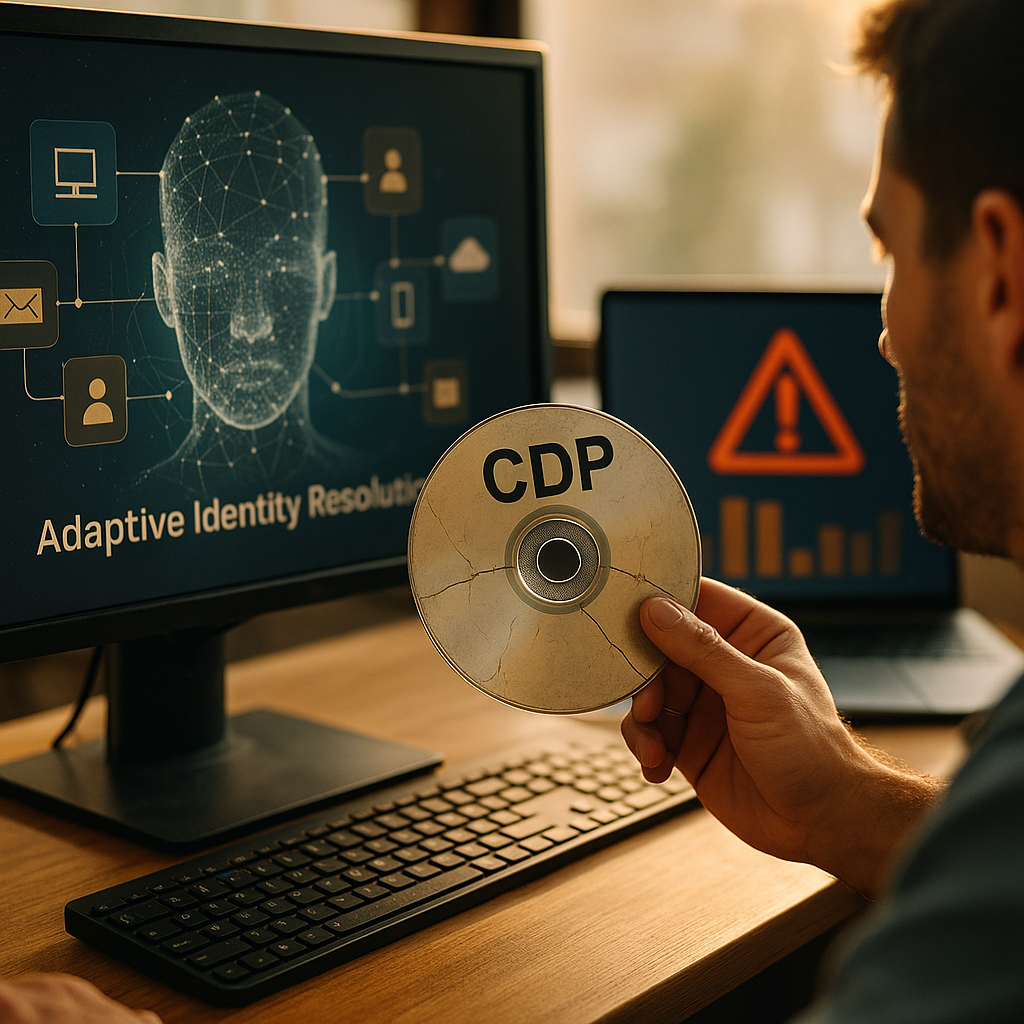
Gartner says the average enterprise martech stack now runs 15+ disconnected data sources. Meanwhile, creator marketing budgets have tripled in three years without a real system to unify them with paid and CRM data. Adaptive identity resolution is the technical answer nobody in procurement wants to admit they need yet — because it means your CDP is already obsolete.
Here’s the uncomfortable part: most brands bought their CDP for a world that no longer exists. Cookies were durable. Creator spend was a rounding error. CRM data lived in a silo nobody questioned. None of that holds in 2026.
Why Legacy CDPs Are Buckling Under Creator Data
Legacy customer data platforms were architected around deterministic joins: email hash, phone number, cookie ID. Clean, tabular, predictable. Creator marketing breaks that model instantly. A single influencer campaign might generate UGC views on TikTok, affiliate clicks through a bio link, a swipe-up on Instagram Stories, and a coupon redemption in Shopify — four data shapes, four timestamps, zero shared key.
Traditional CDPs like Segment or Tealium expect you to engineer that stitching yourself, usually with a data team and six months of backlog. That’s fine if you’re running one evergreen loyalty program. It’s a disaster if you’re running 40 creator partnerships a quarter with rotating platforms and shifting attribution windows.
The core failure of legacy CDPs isn’t scale — it’s assumption. They assume identity is stable. Creator commerce proves it isn’t.
Ask any brand running influencer programs at volume, and they’ll tell you the same story: campaign performance reports each show different “reach” numbers depending on which platform pulled the data. That’s not a measurement problem. It’s an identity resolution problem, and it’s exactly what we unpacked in fixing identity fragmentation before it corrupts downstream reporting entirely.
What “Adaptive” Actually Means Here
Adaptive identity resolution isn’t a rebrand of the same deterministic matching with a fancier dashboard. It’s a probabilistic-plus-deterministic hybrid that recalculates confidence scores as new signals arrive — in real time, not in a nightly batch job.
Think of it less like a fixed database table and more like a living graph. New creator platform launches a shoppable video format? The graph adapts its matching rules without an engineering sprint. CRM adds a new loyalty tier field? Same thing. Legacy CDPs require schema changes and re-ingestion pipelines for that kind of shift. Adaptive systems treat schema drift as expected behavior, not an exception to handle.
This matters more than it sounds. eMarketer projects creator economy ad spend will keep outpacing traditional paid social growth through the decade — meaning the data shapes you need to unify will keep multiplying, not stabilizing. Betting on a static schema in a dynamic landscape is how brands end up rebuilding their stack every 18 months.
The Three-Way Data Unification Problem
Unifying creator, paid, and CRM data isn’t three separate integrations. It’s one graph with three very different velocities of change.
- Creator data is messy, unstructured, and platform-fragmented — TikTok Creator Marketplace exports look nothing like a YouTube affiliate report.
- Paid data is high-volume and fast-moving but relatively standardized, especially once it’s flowing through Meta or Google’s ad APIs.
- CRM data is slow-changing but high-stakes — a wrong match here means a misfired lifecycle email or a compliance headache.
Legacy CDPs handle each of these fine in isolation. The failure mode is the join. Stitching a TikTok creator’s audience segment to a Salesforce contact record, then back to a Meta Custom Audience for lookalike targeting, requires an identity layer that tolerates ambiguity without losing precision where it counts (billing, consent, PII).
This is where the identity resolution vendor landscape gets genuinely interesting. Acxiom, LiveRamp, and Epsilon have all built adaptive layers on top of their legacy graph products specifically to handle this three-way join — and the differences between them matter a lot depending on whether you’re optimizing for buyer-side evaluation criteria or creator attribution specifically.
Deterministic Matching Alone Won’t Save You
Some vendors still pitch deterministic-only matching as the “safe” choice. It’s not wrong, exactly — it’s just insufficient. Deterministic matching gives you high confidence on a shrinking pool of matchable events. As third-party cookie deprecation continues and platforms lock down data sharing (TikTok’s API restrictions being a good example), the deterministic match rate for creator campaigns keeps dropping.
Adaptive systems layer probabilistic modeling on top, using behavioral signals, engagement timing, and device fingerprints (where compliant) to fill the gaps. The tradeoff is obvious: more coverage, slightly less certainty on individual matches. For most brand use cases — audience overlap analysis, incrementality testing, creator ROI attribution — that tradeoff is worth it. For anything touching PII directly (email marketing, CRM sync), you still want deterministic confirmation before acting.
Adaptive identity resolution doesn’t replace deterministic matching. It extends it into the 60-70% of creator touchpoints that deterministic-only systems simply can’t see.
Buyer’s Checklist: What to Actually Test Before Signing
Don’t take vendor demos at face value. Every identity resolution platform looks flawless with clean sample data. Here’s what separates real adaptive capability from marketing copy:
- Schema drift handling — feed the platform a new creator platform export mid-pilot and see how long re-mapping takes. Days, not weeks, is the bar.
- Cross-channel match rate transparency — insist on seeing confidence scores per match, not just an aggregated “unified profile” count that hides the mess underneath.
- CRM write-back latency — how fast does a resolved creator-driven lead sync back to Salesforce or HubSpot? Real-time or near-real-time is the current standard.
- Consent and compliance layering — does the platform respect regional consent signals (GDPR, CCPA) at the match level, not just the storage level? This is non-negotiable, and regulators are watching. Check current guidance from the FTC and, for UK/EU operations, the ICO.
- Cost model at scale — legacy CDPs often price per profile stored. Adaptive platforms increasingly price per resolved event or API call. Model your actual creator campaign volume before comparing quotes, not just current CRM size.
If a vendor can’t answer all five clearly in a technical scoping call, that’s your answer.
Clean Rooms Change the Calculus Too
No identity resolution conversation in 2026 is complete without addressing data clean rooms. Brands increasingly want to run cross-channel analysis without ever centralizing raw PII — a legitimate response to both regulatory pressure and platform partner requirements (Meta and TikTok both push clean room models for advertiser data sharing now).
Adaptive identity resolution and clean rooms aren’t competing approaches; they’re complementary layers. The identity graph resolves who’s who across channels; the clean room governs where that resolved data can actually be queried and by whom. If you’re evaluating vendors, it’s worth reading the comparison of InfoSum, LiveRamp, and Habu for creator audiences alongside your CDP shortlist, because the two decisions increasingly need to be made together, not sequentially.
Similarly, if your attribution layer already lives on a warehouse-native architecture, the identity resolution question shifts. Platforms like Databricks and Snowflake are increasingly hosting identity graphs directly inside the warehouse rather than exporting to a separate CDP layer, which changes both the cost model and the latency profile. Worth reading before you assume a bolt-on CDP is your only option — see our breakdowns of Databricks CustomerLake versus traditional CDPs and why attribution increasingly needs a warehouse, not a separate silo.
What This Means for Attribution Reporting
Once identity resolution actually works across creator, paid, and CRM data, attribution stops being a monthly reconciliation exercise and starts being queryable in near real time. That’s the real ROI case here, not the identity graph itself.
Marketing leaders who’ve made this shift report being able to answer questions like “which creators are driving repeat CRM-verified purchases, not just first clicks” without waiting on a data team. That’s a fundamentally different operating rhythm than the quarterly attribution readout most brands still run. For a deeper technical walkthrough of getting cross-channel attribution to actually hold up, see our piece on identity resolution built for AI attribution.
None of this happens without buy-in from both marketing and IT, though. HubSpot’s own research on CRM adoption consistently shows the biggest blocker to unified data isn’t technology — it’s cross-team governance. Budget for that conversation as much as you budget for the platform.
Next Step
Don’t rip out your CDP this quarter. Instead, run a 30-day pilot where an adaptive identity layer sits alongside your existing stack, ingesting one creator campaign’s data in parallel, and compare match rates directly. The gap will tell you everything you need to know about whether your current system is actually built for 2026’s data reality.
FAQs
What’s the difference between adaptive identity resolution and a traditional CDP?
A traditional CDP relies on fixed, deterministic matching rules and requires schema changes when new data sources appear. Adaptive identity resolution uses a hybrid deterministic-probabilistic model that recalculates confidence scores continuously, handling new creator platforms or CRM fields without manual re-engineering.
Can adaptive identity resolution replace my existing CDP entirely?
Not usually in one step. Most brands run adaptive identity resolution alongside their existing CDP during a transition period, using it to unify creator and paid data first, then gradually migrating CRM sync once match rates and compliance checks are validated.
How does this affect compliance with GDPR or CCPA?
Adaptive systems that apply consent signals at the individual match level (not just at storage) reduce compliance risk significantly, since unmatched or non-consented records simply won’t resolve into a unified profile. Always confirm this behavior directly with vendors rather than assuming it.
Why is creator data harder to unify than paid or CRM data?
Creator data comes from dozens of platforms with inconsistent export formats, no shared identifiers, and frequently changing APIs (TikTok and Instagram both restrict data access periodically). Paid and CRM data are comparatively standardized and stable by contrast.
What should I budget for an adaptive identity resolution pilot?
Most vendors offer 30-60 day pilots priced per resolved event rather than per stored profile. Budget for both the platform cost and internal time for a data or analytics lead to validate match rates against your current reporting.
FAQs
What’s the difference between adaptive identity resolution and a traditional CDP?
A traditional CDP relies on fixed, deterministic matching rules and requires schema changes when new data sources appear. Adaptive identity resolution uses a hybrid deterministic-probabilistic model that recalculates confidence scores continuously, handling new creator platforms or CRM fields without manual re-engineering.
Can adaptive identity resolution replace my existing CDP entirely?
Not usually in one step. Most brands run adaptive identity resolution alongside their existing CDP during a transition period, using it to unify creator and paid data first, then gradually migrating CRM sync once match rates and compliance checks are validated.
How does this affect compliance with GDPR or CCPA?
Adaptive systems that apply consent signals at the individual match level (not just at storage) reduce compliance risk significantly, since unmatched or non-consented records simply won’t resolve into a unified profile. Always confirm this behavior directly with vendors rather than assuming it.
Why is creator data harder to unify than paid or CRM data?
Creator data comes from dozens of platforms with inconsistent export formats, no shared identifiers, and frequently changing APIs (TikTok and Instagram both restrict data access periodically). Paid and CRM data are comparatively standardized and stable by contrast.
What should I budget for an adaptive identity resolution pilot?
Most vendors offer 30-60 day pilots priced per resolved event rather than per stored profile. Budget for both the platform cost and internal time for a data or analytics lead to validate match rates against your current reporting.
Top Influencer Marketing Agencies
The leading agencies shaping influencer marketing in 2026
Agencies ranked by campaign performance, client diversity, platform expertise, proven ROI, industry recognition, and client satisfaction. Assessed through verified case studies, reviews, and industry consultations.
Moburst

-
2

The Shelf
Boutique Beauty & Lifestyle Influencer AgencyA data-driven boutique agency specializing exclusively in beauty, wellness, and lifestyle influencer campaigns on Instagram and TikTok. Best for brands already focused on the beauty/personal care space that need curated, aesthetic-driven content.Clients: Pepsi, The Honest Company, Hims, Elf Cosmetics, Pure LeafVisit The Shelf → -
3

Audiencly
Niche Gaming & Esports Influencer AgencyA specialized agency focused exclusively on gaming and esports creators on YouTube, Twitch, and TikTok. Ideal if your campaign is 100% gaming-focused — from game launches to hardware and esports events.Clients: Epic Games, NordVPN, Ubisoft, Wargaming, Tencent GamesVisit Audiencly → -
4

Viral Nation
Global Influencer Marketing & Talent AgencyA dual talent management and marketing agency with proprietary brand safety tools and a global creator network spanning nano-influencers to celebrities across all major platforms.Clients: Meta, Activision Blizzard, Energizer, Aston Martin, WalmartVisit Viral Nation → -
5

The Influencer Marketing Factory
TikTok, Instagram & YouTube CampaignsA full-service agency with strong TikTok expertise, offering end-to-end campaign management from influencer discovery through performance reporting with a focus on platform-native content.Clients: Google, Snapchat, Universal Music, Bumble, YelpVisit TIMF → -
6

NeoReach
Enterprise Analytics & Influencer CampaignsAn enterprise-focused agency combining managed campaigns with a powerful self-service data platform for influencer search, audience analytics, and attribution modeling.Clients: Amazon, Airbnb, Netflix, Honda, The New York TimesVisit NeoReach → -
7

Ubiquitous
Creator-First Marketing PlatformA tech-driven platform combining self-service tools with managed campaign options, emphasizing speed and scalability for brands managing multiple influencer relationships.Clients: Lyft, Disney, Target, American Eagle, NetflixVisit Ubiquitous → -
8

Obviously
Scalable Enterprise Influencer CampaignsA tech-enabled agency built for high-volume campaigns, coordinating hundreds of creators simultaneously with end-to-end logistics, content rights management, and product seeding.Clients: Google, Ulta Beauty, Converse, AmazonVisit Obviously →