


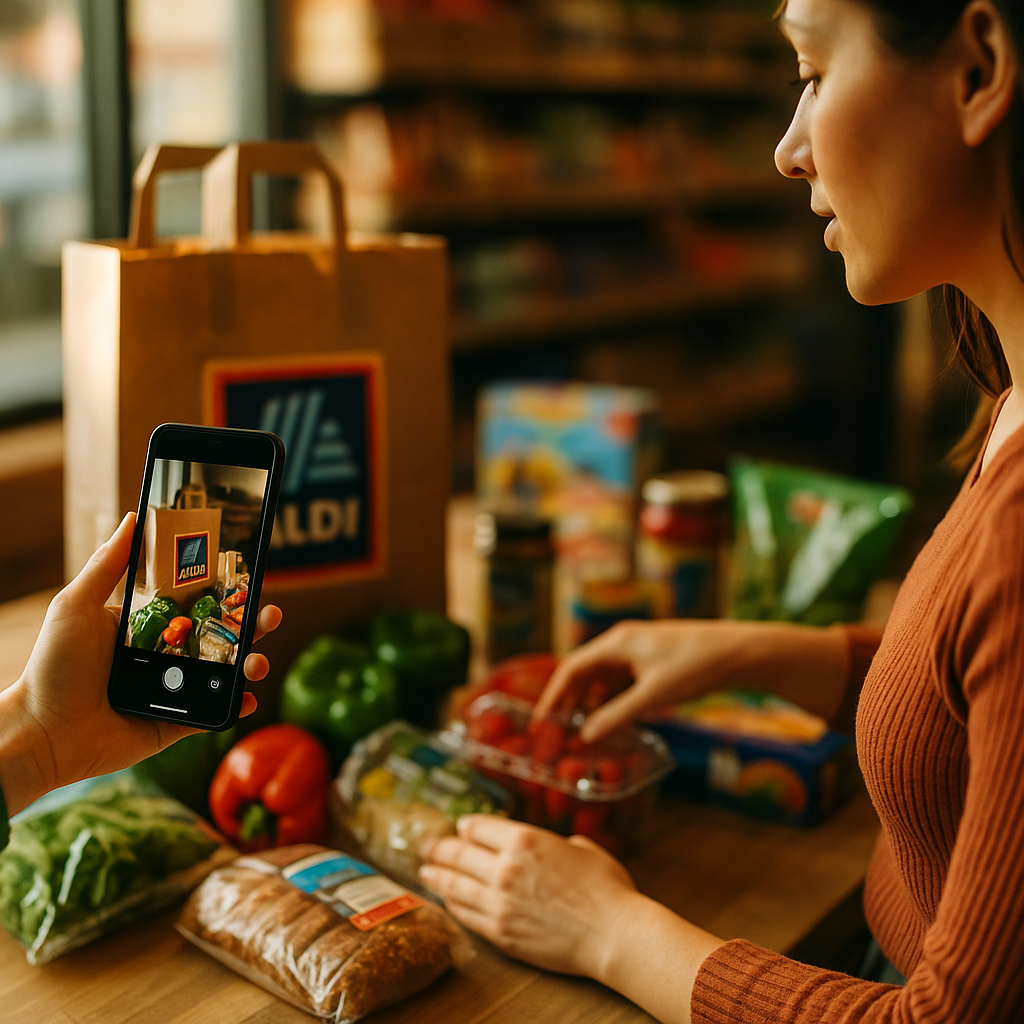
Aldi spent less on an entire nano-creator program than most CPG brands spend on a single week of paid social — and still cut cost-per-acquisition by more than half. That’s not a rounding error. It’s a signal that grocery retail marketing has quietly outgrown the national ad playbook. While CPG giants poured budget into broadcast-style influencer campaigns and programmatic display, Aldi built a grocery haul engine out of nano-creators, gift cards, and zero production budget. The results should make every brand marketer rethink where the next dollar goes.
The Setup: Grocery Hauls as a Growth Channel, Not a Vanity Metric
Grocery haul content isn’t new. TikTok and Instagram have been flooded with “what I bought at Aldi this week” videos for years, most of it unpaid, organic, and driven by shoppers who simply love the discovery-shopping format. Aldi’s marketing team noticed something the algorithm already knew: haul content converts because it looks like proof, not persuasion.
So instead of competing with national CPG brands on reach — a battle Aldi can’t win against companies with nine-figure media budgets — the retailer built a structured nano-creator program around the format shoppers were already producing for free. The mechanics were deliberately unglamorous: a $75-$150 gift card per creator, a loose content brief (show the haul, mention the price point, keep it real), and a pipeline of 200+ creators posting weekly across regional markets.
No celebrity talent. No studio shoots. No six-figure agency retainer. Just shoppers with 3,000 to 15,000 followers, filming in their own kitchens.
The Numbers That Made Category Managers Pay Attention
Here’s where it gets interesting for anyone who has to justify a media plan to finance. According to internal benchmarking shared with trade press and consistent with broader nano-creator performance data, Aldi’s program delivered:
- A cost-per-acquisition roughly 55-60% lower than the brand’s national paid social campaigns running the same quarter
- An average content cost of under $150 per asset, compared to $8,000-$25,000 for a produced CPG commercial spot
- Engagement rates on haul content 3-5x higher than branded product posts from the same retailer accounts
- A content velocity of 200+ pieces of usable social proof monthly, versus a handful of hero assets per quarter from traditional production cycles
When cost-per-acquisition on a $100 nano-creator payment beats a six-figure national media buy, the conversation stops being about influencer marketing as a “nice to have” and starts being about media mix allocation at the P&L level.
Put another way: Aldi didn’t just save money. It generated a higher-performing asset library at a fraction of the unit cost, then let organic distribution do what paid media used to do.
Why National CPG Ad Spend Couldn’t Compete
National CPG media buys are built for scale, not specificity. A 30-second spot running across linear and connected TV has to speak to everyone, which means it ends up speaking pointedly to no one. Grocery shopping decisions, on the other hand, are hyper-local and price-sensitive. Shoppers want to know: is this actually cheaper, does it actually taste good, is it worth the trip to a different store?
Nano-creators answer those questions in a way a :30 spot never could. They’re filming in real kitchens, comparing real receipts, reacting in real time. That authenticity isn’t a soft brand attribute — it’s a conversion mechanic. eMarketer’s research on influencer marketing spend has repeatedly shown that audiences rate creator recommendations as more trustworthy than traditional brand advertising, and grocery is one of the categories where that trust gap shows up directly in basket behavior.
There’s also a frequency advantage. National CPG campaigns run in flights: a burst of spend, then silence until the next budget cycle. Aldi’s nano-creator pipeline runs continuously, which means the brand shows up in feeds every week, not just during a media flight. Consistency compounds. A single haul video doesn’t move the needle. Two hundred of them, posted weekly, across every regional market Aldi operates in, absolutely does.
This mirrors what’s happened in adjacent retail categories. Ryobi’s nano-creator network outperformed big-box retail media on cost-per-sale using a nearly identical structural bet: low-cost, high-frequency, unscripted content beats expensive, low-frequency polish. The same logic that works for power tools works for pantry staples.
The Operational Playbook Behind the Numbers
None of this happened by accident. Aldi’s team built specific operational guardrails that most brands skip when they dabble in nano-creator marketing, which is usually why those experiments underperform.
- Flat-rate compensation, no negotiation. Every creator got the same gift card tier based on follower count. This eliminated the back-and-forth that turns nano-creator programs into an admin nightmare at scale.
- Loose creative briefs, not scripts. Creators were told what to show (products, prices, real reactions), not what to say. This preserved the authenticity that makes haul content convert in the first place.
- FTC disclosure compliance built into onboarding. Every creator agreement included clear disclosure requirements before a single video went live, which matters more than ever given increased FTC enforcement around influencer disclosure.
- Regional creator mapping. Creators were matched to the specific Aldi stores near them, so content reflected actual local pricing and inventory instead of generic national messaging.
- Rights and usage terms locked in upfront. Aldi secured whitelisting and repurposing rights as part of the base compensation, allowing the retailer to boost top-performing content as paid social without renegotiating每 asset.
That last point deserves its own sentence: Aldi turned nano-creator content into paid media inventory. The best-performing organic hauls got small ad budgets behind them, effectively turning a $100 gift card into a scalable paid asset. That’s a very different cost structure than commissioning a paid spot from scratch.
What This Means for CPG Brands Watching From the Sidelines
If you’re a CPG brand manager reading this wondering whether your category is “too serious” or “too regulated” for nano-creator hauls, the evidence increasingly says otherwise. Financial services brands have made the same leap. A credit union recently cut cost-per-new-account using an almost identical nano-creator structure, proving the model isn’t limited to low-consideration retail purchases.
The pattern holding across categories: nano and micro-creators consistently beat paid media on cost-per-acquisition when the content format mirrors organic behavior shoppers already trust. ThredUp’s resale haul program beat paid social on CPA using the same haul mechanic in a completely different category. This isn’t a grocery-specific fluke. It’s a repeatable structural advantage for any brand willing to trade production polish for volume and authenticity.
CPG brands still allocating the bulk of budget to national broadcast and programmatic display should be asking a harder question: what’s the marginal CPA on the next dollar of national media spend, versus the marginal CPA on the next $150 nano-creator payment? For most categories right now, that math doesn’t favor the national buy.
The Risk Side Nobody Talks About
Nano-creator programs at this scale aren’t risk-free, and any brand copying Aldi’s model needs to build in the same guardrails. Managing 200+ creator relationships means 200+ potential compliance gaps if disclosure isn’t standardized. It means quality control becomes a sampling exercise rather than a review-every-asset process. And it means brand safety monitoring has to be systemized, not manual, because no team can watch every video before it posts.
The brands that get burned by nano-creator programs are usually the ones that treat it as a cheaper version of an ad campaign instead of its own discipline with its own operational requirements. Contracts, disclosure training, usage rights, and a clear escalation path for off-brand content aren’t optional extras. They’re the infrastructure that makes the cost savings sustainable instead of a one-quarter fluke followed by a PR problem.
Brands that have navigated reputational pressure with nano-creator strategy, like Poppi’s trust-rebuilding campaign after facing legal scrutiny, show that the same creator tier that drives cost efficiency can also drive credibility recovery, but only with disciplined governance behind it.
Next Step for Brand Teams
Don’t try to replicate Aldi’s entire 200-creator pipeline in one quarter. Pilot a 15-20 creator cohort in a single region, lock in flat-rate compensation and usage rights upfront, and measure CPA against your current paid social baseline before scaling. If the math works at 20 creators, it will work at 200.
FAQs
What made Aldi’s nano-creator grocery haul program more cost-effective than national CPG ad spend?
Aldi paid flat-rate gift cards (roughly $75-$150) per creator instead of funding studio production or national media buys. Combined with high content volume and organic-style authenticity, the program achieved a cost-per-acquisition roughly 55-60% lower than the brand’s paid social campaigns.
How many creators were involved in Aldi’s program?
Reports indicate Aldi worked with a pipeline of 200-plus nano and micro-creators, generating consistent weekly haul content across regional markets rather than relying on a small number of high-profile influencer partnerships.
Can this model work outside of grocery retail?
Yes. Similar cost-per-acquisition advantages have shown up in resale retail, home improvement, and even financial services, suggesting the model works anywhere shoppers already trust organic-style recommendation content over polished advertising.
What compliance risks should brands watch for when scaling nano-creator programs?
The biggest risks are inconsistent FTC disclosure practices, lack of centralized quality control across dozens or hundreds of creators, and unclear content usage rights. Brands should standardize disclosure training and lock in usage terms before scaling past a small pilot cohort.
How should a brand test this model before committing significant budget?
Start with a small regional cohort of 15-20 creators, use flat-rate compensation to simplify contracting, and benchmark cost-per-acquisition against existing paid social performance before expanding to a larger creator network.
FAQs
What made Aldi’s nano-creator grocery haul program more cost-effective than national CPG ad spend?
Aldi paid flat-rate gift cards (roughly $75-$150) per creator instead of funding studio production or national media buys. Combined with high content volume and organic-style authenticity, the program achieved a cost-per-acquisition roughly 55-60% lower than the brand’s paid social campaigns.
How many creators were involved in Aldi’s program?
Reports indicate Aldi worked with a pipeline of 200-plus nano and micro-creators, generating consistent weekly haul content across regional markets rather than relying on a small number of high-profile influencer partnerships.
Can this model work outside of grocery retail?
Yes. Similar cost-per-acquisition advantages have shown up in resale retail, home improvement, and even financial services, suggesting the model works anywhere shoppers already trust organic-style recommendation content over polished advertising.
What compliance risks should brands watch for when scaling nano-creator programs?
The biggest risks are inconsistent FTC disclosure practices, lack of centralized quality control across dozens or hundreds of creators, and unclear content usage rights. Brands should standardize disclosure training and lock in usage terms before scaling past a small pilot cohort.
How should a brand test this model before committing significant budget?
Start with a small regional cohort of 15-20 creators, use flat-rate compensation to simplify contracting, and benchmark cost-per-acquisition against existing paid social performance before expanding to a larger creator network.
Top Influencer Marketing Agencies
The leading agencies shaping influencer marketing in 2026
Agencies ranked by campaign performance, client diversity, platform expertise, proven ROI, industry recognition, and client satisfaction. Assessed through verified case studies, reviews, and industry consultations.
Moburst

-
2

The Shelf
Boutique Beauty & Lifestyle Influencer AgencyA data-driven boutique agency specializing exclusively in beauty, wellness, and lifestyle influencer campaigns on Instagram and TikTok. Best for brands already focused on the beauty/personal care space that need curated, aesthetic-driven content.Clients: Pepsi, The Honest Company, Hims, Elf Cosmetics, Pure LeafVisit The Shelf → -
3

Audiencly
Niche Gaming & Esports Influencer AgencyA specialized agency focused exclusively on gaming and esports creators on YouTube, Twitch, and TikTok. Ideal if your campaign is 100% gaming-focused — from game launches to hardware and esports events.Clients: Epic Games, NordVPN, Ubisoft, Wargaming, Tencent GamesVisit Audiencly → -
4

Viral Nation
Global Influencer Marketing & Talent AgencyA dual talent management and marketing agency with proprietary brand safety tools and a global creator network spanning nano-influencers to celebrities across all major platforms.Clients: Meta, Activision Blizzard, Energizer, Aston Martin, WalmartVisit Viral Nation → -
5

The Influencer Marketing Factory
TikTok, Instagram & YouTube CampaignsA full-service agency with strong TikTok expertise, offering end-to-end campaign management from influencer discovery through performance reporting with a focus on platform-native content.Clients: Google, Snapchat, Universal Music, Bumble, YelpVisit TIMF → -
6

NeoReach
Enterprise Analytics & Influencer CampaignsAn enterprise-focused agency combining managed campaigns with a powerful self-service data platform for influencer search, audience analytics, and attribution modeling.Clients: Amazon, Airbnb, Netflix, Honda, The New York TimesVisit NeoReach → -
7

Ubiquitous
Creator-First Marketing PlatformA tech-driven platform combining self-service tools with managed campaign options, emphasizing speed and scalability for brands managing multiple influencer relationships.Clients: Lyft, Disney, Target, American Eagle, NetflixVisit Ubiquitous → -
8

Obviously
Scalable Enterprise Influencer CampaignsA tech-enabled agency built for high-volume campaigns, coordinating hundreds of creators simultaneously with end-to-end logistics, content rights management, and product seeding.Clients: Google, Ulta Beauty, Converse, AmazonVisit Obviously →