


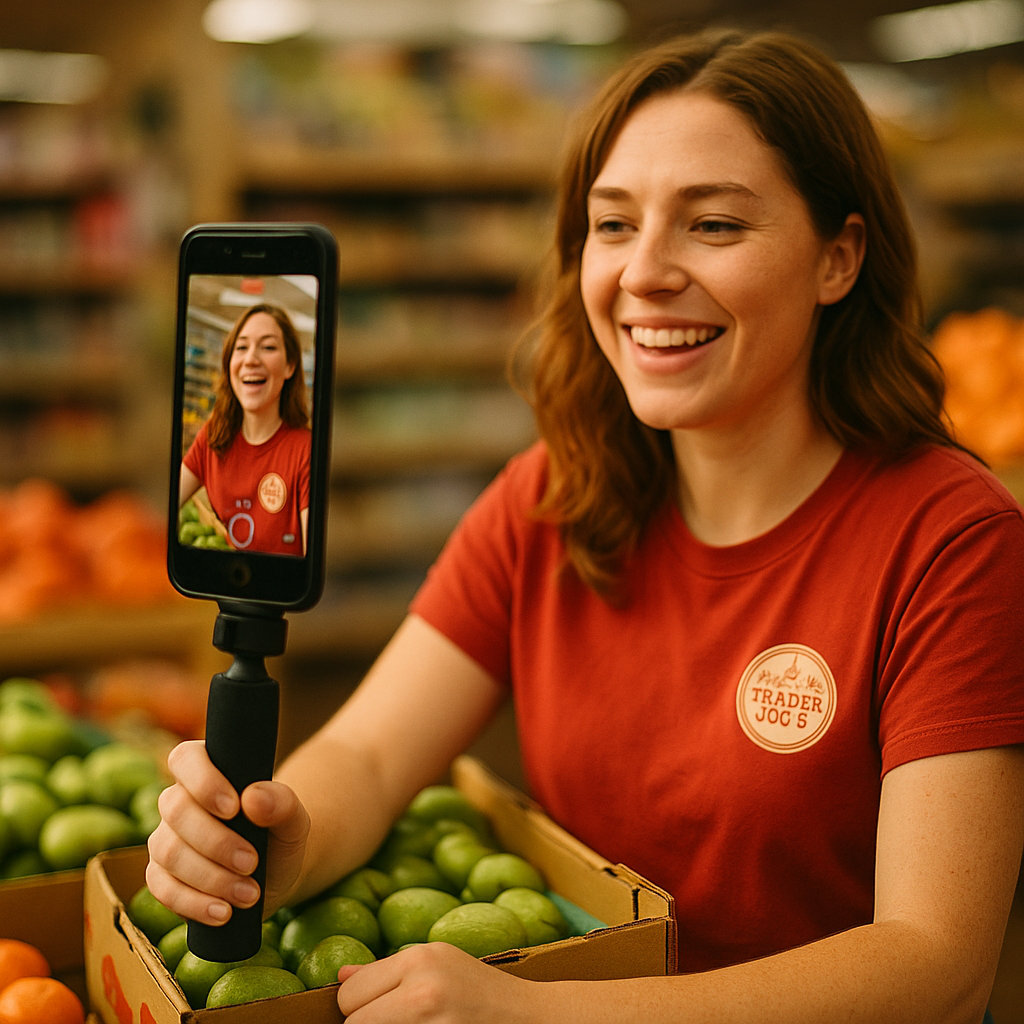
Trader Joe’s spends roughly zero dollars on traditional advertising. No paid influencer campaigns, no celebrity endorsements, no programmatic media buys chasing impressions. Yet Trader Joe’s employee-generated content — crew members gushing about Cosmic Brownie Cookies or Speculoos cookie butter on TikTok — routinely outperforms brand accounts with ten times the budget. What does that tell brand strategists about where trust actually lives?
The Anti-Influencer Playbook
Trader Joe’s has never run a formal influencer program. It doesn’t send PR boxes to creators. It doesn’t negotiate usage rights or track affiliate codes. Instead, it built something harder to fake: a workforce that genuinely loves the products and talks about them unprompted, on their own accounts, in their own voice.
Search “Trader Joe’s haul” on TikTok and you’ll find millions of views spread across thousands of videos, many posted by employees identifying themselves as “Crew Members” in captions or bios. These aren’t sanctioned brand ambassadors. They’re cashiers and stockers filming what’s new on the shelf during their commute home, because the product genuinely surprised them.
Trader Joe’s proves that the highest-converting content asset a brand owns might already be on payroll — no contract, no usage fee, no disclosure gray area.
Compare that to the typical CPG playbook: sign a roster of mid-tier creators, brief them on talking points, pay per post, hope the algorithm cooperates. Trader Joe’s inverted the model. Instead of renting trust from strangers, it cultivated it internally and let it spill outward organically.
Why Employee Content Converts Where Paid Media Stalls
Consumers have gotten sharp at spotting sponsored content. According to eMarketer research on influencer marketing, skepticism toward paid partnerships has climbed steadily as disclosure fatigue sets in. Audiences scroll past the fortieth “#ad” unboxing without a second thought. But an employee talking about a product they didn’t get paid to promote? That reads differently. It reads like a friend’s recommendation, not a media placement.
Three structural advantages separate employee-generated content from paid influencer content:
- Zero commercial framing. There’s no contract, no brand deal disclosure required under FTC endorsement guidelines, because the employee isn’t being compensated to post. That absence of a paid relationship is precisely what makes the content land as credible.
- Proximity to the product. Employees see inventory before customers do. They know what’s discontinued, what’s a seasonal limited run, what’s actually flying off shelves. That insider knowledge creates urgency no scripted influencer brief can replicate.
- Volume without spend. Trader Joe’s employs roughly 50,000 crew members across its store footprint. Even if a small fraction post occasionally, that’s a distributed content engine larger than most brands’ entire creator rosters — at zero media cost.
This isn’t charity from employees. It’s culture. Trader Joe’s has spent decades building an internal brand identity, quirky product names, a scavenger-hunt vibe, genuine product enthusiasm baked into onboarding, that makes crew members want to talk about the products. The content is a downstream effect of internal brand health, not a marketing tactic bolted on afterward.
The “Cult Product” Mechanism
Trader Joe’s has mastered manufactured scarcity better than almost any retailer. Seasonal items disappear. Regional exclusives create FOMO. Limited runs of items like the Mini Croissants or the return of a beloved discontinued snack turn into genuine news events within online grocery communities.
Employee content amplifies that scarcity mechanic naturally. A crew member posting “restocked today, won’t last” carries more urgency than a brand account running the same caption, because the crew member is signaling real-time, on-the-ground truth. They’re not selling. They’re reporting.
This mirrors a pattern seen across other CPG categories where nano and micro creators outperform bigger media buys on cost efficiency. Aldi’s nano-creator grocery hauls beat traditional CPG ad spend on cost-per-acquisition for similar reasons: proximity and perceived authenticity beat production value and reach. Trader Joe’s just took the model one step further by skipping the “creator” label entirely and relying on staff.
What Brands Get Wrong When They Try to Copy This
Every few months, a brand tries to manufacture an “employee advocacy” program and it falls flat. Why? Because forced enthusiasm reads as fake instantly. You cannot brief someone into sounding authentic. The moment a company mandates posting quotas or scripts responses, the content collapses into the same stale corporate voice it was meant to escape.
Trader Joe’s success rests on three preconditions most brands skip:
- Product quality that earns enthusiasm. No content strategy fixes a mediocre product. Employees won’t rave about something they don’t personally like.
- Internal culture investment predating any content strategy. Trader Joe’s built its quirky, tight-knit store culture over decades. The content is a symptom, not the cause.
- Zero pressure to post. No KPIs, no incentive structure, no “content creation” clause in job descriptions. The moment it becomes a job requirement, it stops being credible.
That last point matters enormously for compliance-minded brand teams. Because Trader Joe’s isn’t directing, compensating, or scripting employee posts, it sidesteps the disclosure and compliance questions that dog formal influencer programs. There’s no material connection to disclose under FTC guidance because there’s no exchange of value. The second a brand starts paying employees specifically to post, or requiring it, that legal shelter disappears and disclosure rules kick back in.
The absence of a formal program is the program. Trader Joe’s advantage isn’t a tactic you can license — it’s a culture you have to actually build.
Lessons for Brands Without a Trader Joe’s Culture
Most brands reading this don’t have fifty thousand employees who’ll organically evangelize on TikTok. So what’s the transferable lesson?
Start smaller. Look at how Chamberlain Coffee’s creator-first retail launch strategy built demand before securing shelf space, or how Liquid I.V. rebuilt trust with nano-creator seeding after credibility took a hit. Neither required celebrity budgets. Both required identifying people already close to the product, whether employees, retail partners, or genuine superfans, and giving them a reason and a platform, not a script.
Practical steps for brand and marketing teams evaluating this model:
- Audit unsanctioned employee content already happening. Search your brand name plus “employee,” “staff,” or “team” across TikTok and Instagram. You may already have advocates you haven’t noticed.
- Remove friction, don’t add incentives. If employees want to post, make sure HR and social media policies don’t create unnecessary legal anxiety around doing so casually.
- Invest in internal culture before external content strategy. Products and workplace experience that generate real enthusiasm will always outperform scripted advocacy.
- Track earned mentions separately from paid influencer KPIs. Treat organic employee and customer content as its own channel with its own measurement approach, not a footnote in influencer reporting.
Tools that support this kind of organic content tracking are increasingly part of the martech stack. Platforms covered by Sprout Social and similar social listening tools can help brand teams surface earned employee and customer content at scale, even without a formal ambassador program driving it.
The ROI Case, Without the Media Spend Line Item
Marketing leaders evaluating influencer budgets should treat Trader Joe’s as a control group. Zero dollars in influencer fees, zero dollars in paid media for product content, and yet consistent viral product demand cycles that drive real foot traffic. The brand’s cult status functions as free distribution.
Compare the cost structure. A mid-tier CPG influencer campaign might run $50,000 to $200,000 for a coordinated push across a handful of creators, per HubSpot’s marketing benchmark data on influencer spend. Trader Joe’s gets comparable or greater reach from content it didn’t commission, didn’t pay for, and doesn’t control. That’s not a replicable line item on a media plan. It’s a strategic asset built over years, closer to brand equity than a campaign tactic.
Brands chasing a quick version of this should temper expectations. This isn’t a hack. It’s the output of sustained product quality and internal culture work that most quarterly marketing budgets aren’t structured to fund. But the direction is instructive: the more a brand invests in internal enthusiasm and product-market fit, the less it needs to rent external credibility.
For teams still building formal creator programs, the takeaway isn’t “abandon paid influencers.” It’s “audit whether you’re overpaying for authenticity you could be generating internally for free.” That’s a budget conversation worth having before the next fiscal year’s influencer line item gets rubber-stamped.
FAQs
Frequently Asked Questions
Does Trader Joe’s pay employees to post about products on social media?
No. Trader Joe’s does not run a formal employee advocacy or influencer program. Content from crew members is unpaid, unscripted, and posted voluntarily on personal accounts, which is a key reason it avoids FTC disclosure requirements tied to compensated endorsements.
Why does employee-generated content outperform paid influencer content for grocery brands?
Employee content carries no commercial framing, so audiences perceive it as more credible. Employees also have direct product access and insider knowledge about restocks and limited releases, creating urgency that scripted influencer content typically lacks.
Can other brands replicate Trader Joe’s employee content strategy?
Partially. Brands can encourage organic employee content by removing social media friction and investing in internal culture, but forcing or incentivizing posts introduces both inauthenticity and FTC disclosure obligations that Trader Joe’s model currently avoids.
Is employee-generated content subject to FTC disclosure rules?
It depends on compensation. If an employee posts voluntarily with no payment or directive tied to the content, disclosure rules generally don’t apply. Once a brand pays, requires, or scripts posts, standard endorsement disclosure requirements under FTC guidelines apply.
What’s the biggest risk in trying to manufacture employee advocacy?
Forced or incentivized posting tends to read as inauthentic, undermining the exact trust advantage brands are trying to capture. It also shifts the legal framework from casual personal expression to a compensated endorsement requiring disclosure.
Top Influencer Marketing Agencies
The leading agencies shaping influencer marketing in 2026
Agencies ranked by campaign performance, client diversity, platform expertise, proven ROI, industry recognition, and client satisfaction. Assessed through verified case studies, reviews, and industry consultations.
Moburst

-
2

The Shelf
Boutique Beauty & Lifestyle Influencer AgencyA data-driven boutique agency specializing exclusively in beauty, wellness, and lifestyle influencer campaigns on Instagram and TikTok. Best for brands already focused on the beauty/personal care space that need curated, aesthetic-driven content.Clients: Pepsi, The Honest Company, Hims, Elf Cosmetics, Pure LeafVisit The Shelf → -
3

Audiencly
Niche Gaming & Esports Influencer AgencyA specialized agency focused exclusively on gaming and esports creators on YouTube, Twitch, and TikTok. Ideal if your campaign is 100% gaming-focused — from game launches to hardware and esports events.Clients: Epic Games, NordVPN, Ubisoft, Wargaming, Tencent GamesVisit Audiencly → -
4

Viral Nation
Global Influencer Marketing & Talent AgencyA dual talent management and marketing agency with proprietary brand safety tools and a global creator network spanning nano-influencers to celebrities across all major platforms.Clients: Meta, Activision Blizzard, Energizer, Aston Martin, WalmartVisit Viral Nation → -
5

The Influencer Marketing Factory
TikTok, Instagram & YouTube CampaignsA full-service agency with strong TikTok expertise, offering end-to-end campaign management from influencer discovery through performance reporting with a focus on platform-native content.Clients: Google, Snapchat, Universal Music, Bumble, YelpVisit TIMF → -
6

NeoReach
Enterprise Analytics & Influencer CampaignsAn enterprise-focused agency combining managed campaigns with a powerful self-service data platform for influencer search, audience analytics, and attribution modeling.Clients: Amazon, Airbnb, Netflix, Honda, The New York TimesVisit NeoReach → -
7

Ubiquitous
Creator-First Marketing PlatformA tech-driven platform combining self-service tools with managed campaign options, emphasizing speed and scalability for brands managing multiple influencer relationships.Clients: Lyft, Disney, Target, American Eagle, NetflixVisit Ubiquitous → -
8

Obviously
Scalable Enterprise Influencer CampaignsA tech-enabled agency built for high-volume campaigns, coordinating hundreds of creators simultaneously with end-to-end logistics, content rights management, and product seeding.Clients: Google, Ulta Beauty, Converse, AmazonVisit Obviously →