


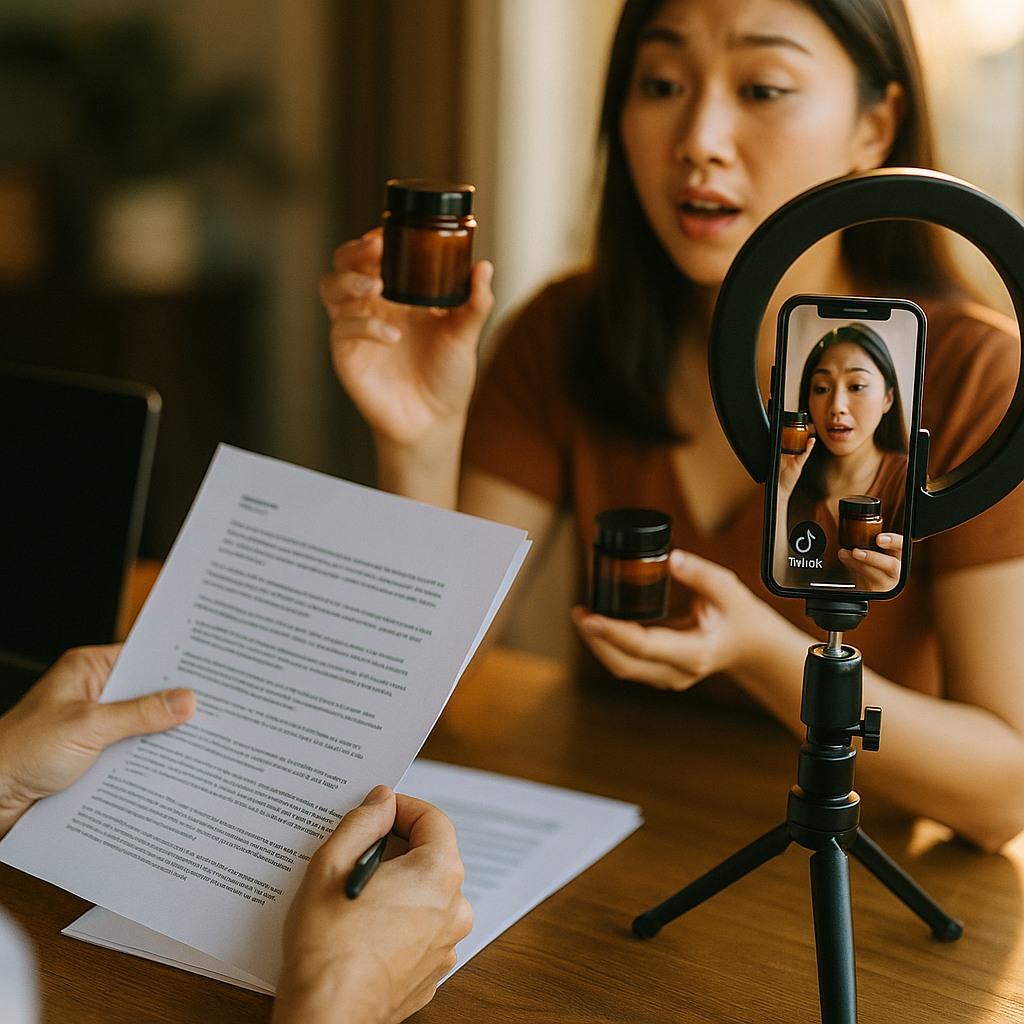
The FTC issued more than $130 million in penalties tied to deceptive urgency claims last year, and TikTok Shop’s live format — unscripted, fast-talking, timer-driven — is a compliance minefield most brands haven’t mapped. If your hosts are saying “only 3 left” when the warehouse has 3,000, you don’t have a marketing problem. You have a legal one.
This is why TikTok Shop live-selling script audits need to move from “nice to have” to standard operating procedure. Brands running live commerce at scale are exposed in ways static ad copy never was — live audio is harder to review, easier to improvise, and nearly impossible to walk back once it airs.
Why Live Commerce Breaks the Old Compliance Playbook
Traditional ad review works because someone reviews the ad before it runs. Live selling flips that model. A host on a four-hour TikTok Shop stream might make forty urgency claims, ad-lib half of them, and never touch the approved script again after minute six.
That’s the structural problem. Legal teams built their FTC compliance muscle around static assets: banner ads, product pages, thirty-second video spots. Live-selling scripts are a different animal — dynamic, host-dependent, and produced under real-time sales pressure. The host wants viewers to buy now. Urgency is the entire mechanic of live commerce. That’s exactly why regulators are watching it so closely.
The FTC doesn’t care whether urgency was scripted or improvised — if the scarcity claim isn’t true, the brand carrying the product listing is on the hook, not just the host.
What Counts as Deceptive Urgency, Exactly?
The FTC’s guidance on deceptive practices, refreshed with its updated endorsement and testimonial rules, doesn’t single out live commerce by name. But the principles apply directly: claims must be truthful, substantiated, and not misleading to a reasonable consumer.
In live-selling context, that translates to a few recurring red flags:
- Fake countdown timers that reset after they hit zero, or that don’t correspond to any real deadline.
- Inventory claims (“only 12 left!”) that don’t match actual TikTok Shop backend stock data.
- Recurring “last chance” language used in every single stream, which undermines the claim that it’s actually the last chance.
- Price-drop framing implying a limited-time discount when the “sale” price is the everyday price.
- Bundled false scarcity — claiming a bonus gift or upsell is disappearing when it’s actually evergreen inventory.
None of these require malicious intent to be a violation. Sloppy scripting is enough. A host repeating a line the brand wrote eight weeks ago, without checking whether it’s still accurate, is still a deceptive claim if the facts changed.
The Improvisation Problem
Here’s the part most legal teams underestimate: hosts go off-script constantly, and they’re often incentivized to. Commission structures reward high urgency, high energy, high conversion. A host who says “this is literally selling out as we speak” gets more sales than one who calmly states availability. That commercial incentive is precisely what makes audits necessary — nobody polices their own urgency language when urgency is what pays the bills.
Brands that have layered commission or equity structures onto live hosts face compounding risk here. If a host has a financial stake in overstating scarcity, that’s a governance issue as much as a script issue — worth reading alongside live-shopping governance for equity and commission structures.
Building the Actual Audit Framework
An effective audit isn’t a one-time script read. It’s a recurring, three-layer process: pre-stream script review, live monitoring, and post-stream reconciliation.
Layer One: Pre-Stream Script Review
Before any host goes live, someone — legal, compliance, or a trained brand manager — should review the planned talking points against three data points: actual current inventory, actual current pricing history, and actual promotion end dates. If the script says “ends tonight,” there needs to be a real, documented reason it ends tonight.
Build a standing checklist. For reference, brands running high-frequency TikTok Shop programs are already formalizing this with tools like the TikTok Shop live-selling compliance checklist for timers, which is a useful starting template for what pre-stream review should actually catch.
Layer Two: Live Monitoring, Not Just Recording
Recording a stream for later review is table stakes. It doesn’t stop a violation from airing live to thousands of viewers in real time. Brands with serious live commerce volume need someone (or some system) watching in real time, with authority to flag or interrupt.
Some brands are experimenting with AI-assisted transcript monitoring — flagging specific phrases (“only,” “last,” “ends today,” “selling out”) as they’re spoken, cross-referencing them against a live inventory feed. This is where compliance dashboards earn their keep. A creator compliance dashboard that catches violations in near-real time is far more defensible than a “we’ll review the recording tomorrow” posture, especially if a regulator later asks what monitoring was in place at the time of the broadcast.
If your only proof of compliance is a recording nobody watched until a complaint came in, you don’t have a monitoring program — you have an archive.
Layer Three: Post-Stream Reconciliation
After the stream ends, reconcile what was actually said against what was actually true. Did the host claim “only 5 left” when the platform showed 400 units in stock? Did the “24-hour flash sale” run for four days? Log every discrepancy, however small.
This reconciliation step matters for two reasons. First, it catches repeat offenders — hosts who consistently drift from approved language. Second, it creates the documentation trail regulators actually want to see if they ever investigate. An audit trail for AI marketing decisions methodology applies just as well here: the goal is a timestamped, reviewable record of what claims were made, when, and whether they were true at the time.
Who Owns the Risk When the Host Goes Rogue?
This is the question every brand legal team eventually asks, usually after something’s already gone wrong. Short answer: the brand does, mostly. The FTC has been consistent that advertisers bear responsibility for claims made on their behalf, even by third-party creators, even when the brand didn’t write the exact words.
That doesn’t mean the host has zero exposure. It means the brand can’t outsource the risk simply by handing a creator talking points and hoping for the best. Contracts need explicit language on urgency and scarcity claims, tied to real-time inventory data the host is contractually required to check before making any claim. This overlaps heavily with disclosure obligations for equity-paid creators — compensation structure doesn’t change the underlying FTC exposure.
Brands should also build indemnification language that reflects reality. If a host improvises a false scarcity claim against explicit brand instructions, indemnification clauses should shift some liability back to the creator or their agency. But courts and regulators generally look past indemnification clauses to ask who benefited from the deception — and that’s usually the brand selling the product.
Scarcity Claims Aren’t the Only Trap
Urgency and scarcity get the headlines, but they’re often bundled with other violations in live commerce: missing #ad disclosures, unsubstantiated health claims, fake social proof (“everyone’s buying this right now”). A full audit should widen the lens beyond timers and stock counts. The livestream shopping compliance checklist for scarcity claims is a solid companion resource for teams building out a broader review process, not just an urgency-specific one.
If your brand also uses AI to help draft or adapt live-selling scripts, that introduces a separate compliance layer worth understanding — see FTC rules on AI co-written creator scripts for how machine-assisted copy changes the liability calculus.
Practical Cadence: How Often Should You Actually Audit?
There’s no FTC-mandated frequency, so brands have to set their own risk tolerance. A reasonable baseline for high-volume TikTok Shop programs:
- Weekly: spot-check transcripts from 10-15% of live streams, prioritizing top-performing hosts (they tend to push urgency hardest because it works).
- Monthly: full reconciliation report comparing claimed inventory/timing language against actual backend data across all hosts.
- Quarterly: full script and disclosure re-training for all live hosts, updated for any new FTC guidance or enforcement actions.
- Immediately: any time a promotion end date, price, or inventory level changes mid-campaign, scripts need re-approval before the next stream.
Brands running multiple hosts across multiple SKUs should treat this like any other recurring compliance function — staffed, budgeted, and reported up to legal or risk management, not left to the social team as an afterthought.
What This Costs vs. What a Violation Costs
Auditing live-selling scripts takes time and headcount. It’s genuinely annoying to build out, especially for brands running dozens of streams a week. But compare that cost to the alternative: FTC penalties, platform-level enforcement from TikTok Shop itself (including account suspension), and the reputational hit of a viral “gotcha” video showing your “only 3 left” claim next to a warehouse full of stock.
Per eMarketer estimates, live shopping in the US is growing fast enough that regulatory scrutiny is almost certain to intensify, not ease off. Brands treating audit infrastructure as a cost center now will be better positioned than those scrambling to build it after an enforcement letter arrives.
An audit program costs a few hours a week. An FTC enforcement action costs your legal budget, your TikTok Shop standing, and possibly a public settlement announcement with your brand name attached.
For brands building broader escalation processes around compliance failures — not just live commerce, but the full creator marketing stack — it’s worth pairing this audit framework with a formal FTC compliance escalation matrix so violations get routed to the right internal owner fast, instead of sitting in a shared inbox until someone notices.
Next step: Pull transcripts from your last ten TikTok Shop live streams this week and run them against real inventory and pricing data from that same window. If you find even one unsupported urgency claim, that’s your signal to formalize the three-layer audit process now, before a regulator — or a viral TikTok comment section — finds it for you.
Frequently Asked Questions
What counts as a deceptive urgency claim on TikTok Shop live streams?
Any statement about limited time, limited stock, or expiring discounts that doesn’t match verifiable facts. This includes fake countdown timers, inventory numbers that don’t match backend stock data, and recurring “last chance” language used in every stream regardless of actual availability.
Is the brand liable if a host improvises a false scarcity claim?
Generally yes. The FTC holds advertisers responsible for claims made on their behalf, even when a creator ad-libs beyond the approved script. Brands can shift some liability back to hosts through contract language and indemnification clauses, but the underlying regulatory exposure typically stays with the brand.
How often should brands audit live-selling scripts?
A reasonable cadence includes weekly spot-checks of a sample of streams, monthly full reconciliation of claims against actual inventory and pricing, and quarterly retraining for hosts. Any change to promotion terms mid-campaign should trigger an immediate script re-review.
Can real-time monitoring actually stop a violation before it airs?
Not entirely, since the claim is already spoken once a host says it live. But real-time transcript monitoring paired with an inventory feed can flag violations fast enough to correct on-screen, cut the stream, or issue an immediate follow-up correction, which materially reduces exposure compared to discovering the issue days later.
Do commission-based host incentives increase compliance risk?
Yes. Hosts paid on conversion or commission have a direct financial incentive to overstate urgency and scarcity, since aggressive framing tends to drive faster purchases. Brands with commission or equity-based host arrangements should build extra script oversight specifically because of that incentive misalignment.
What documentation should brands keep in case of an FTC inquiry?
Timestamped stream recordings, the approved pre-stream script, real-time inventory and pricing records for the promotion window, and a reconciliation log noting any discrepancies between claims made and actual conditions. This audit trail is what demonstrates a good-faith compliance program rather than negligence.
FAQs
Top Influencer Marketing Agencies
The leading agencies shaping influencer marketing in 2026
Agencies ranked by campaign performance, client diversity, platform expertise, proven ROI, industry recognition, and client satisfaction. Assessed through verified case studies, reviews, and industry consultations.
Moburst

-
2

The Shelf
Boutique Beauty & Lifestyle Influencer AgencyA data-driven boutique agency specializing exclusively in beauty, wellness, and lifestyle influencer campaigns on Instagram and TikTok. Best for brands already focused on the beauty/personal care space that need curated, aesthetic-driven content.Clients: Pepsi, The Honest Company, Hims, Elf Cosmetics, Pure LeafVisit The Shelf → -
3

Audiencly
Niche Gaming & Esports Influencer AgencyA specialized agency focused exclusively on gaming and esports creators on YouTube, Twitch, and TikTok. Ideal if your campaign is 100% gaming-focused — from game launches to hardware and esports events.Clients: Epic Games, NordVPN, Ubisoft, Wargaming, Tencent GamesVisit Audiencly → -
4

Viral Nation
Global Influencer Marketing & Talent AgencyA dual talent management and marketing agency with proprietary brand safety tools and a global creator network spanning nano-influencers to celebrities across all major platforms.Clients: Meta, Activision Blizzard, Energizer, Aston Martin, WalmartVisit Viral Nation → -
5

The Influencer Marketing Factory
TikTok, Instagram & YouTube CampaignsA full-service agency with strong TikTok expertise, offering end-to-end campaign management from influencer discovery through performance reporting with a focus on platform-native content.Clients: Google, Snapchat, Universal Music, Bumble, YelpVisit TIMF → -
6

NeoReach
Enterprise Analytics & Influencer CampaignsAn enterprise-focused agency combining managed campaigns with a powerful self-service data platform for influencer search, audience analytics, and attribution modeling.Clients: Amazon, Airbnb, Netflix, Honda, The New York TimesVisit NeoReach → -
7

Ubiquitous
Creator-First Marketing PlatformA tech-driven platform combining self-service tools with managed campaign options, emphasizing speed and scalability for brands managing multiple influencer relationships.Clients: Lyft, Disney, Target, American Eagle, NetflixVisit Ubiquitous → -
8

Obviously
Scalable Enterprise Influencer CampaignsA tech-enabled agency built for high-volume campaigns, coordinating hundreds of creators simultaneously with end-to-end logistics, content rights management, and product seeding.Clients: Google, Ulta Beauty, Converse, AmazonVisit Obviously →