


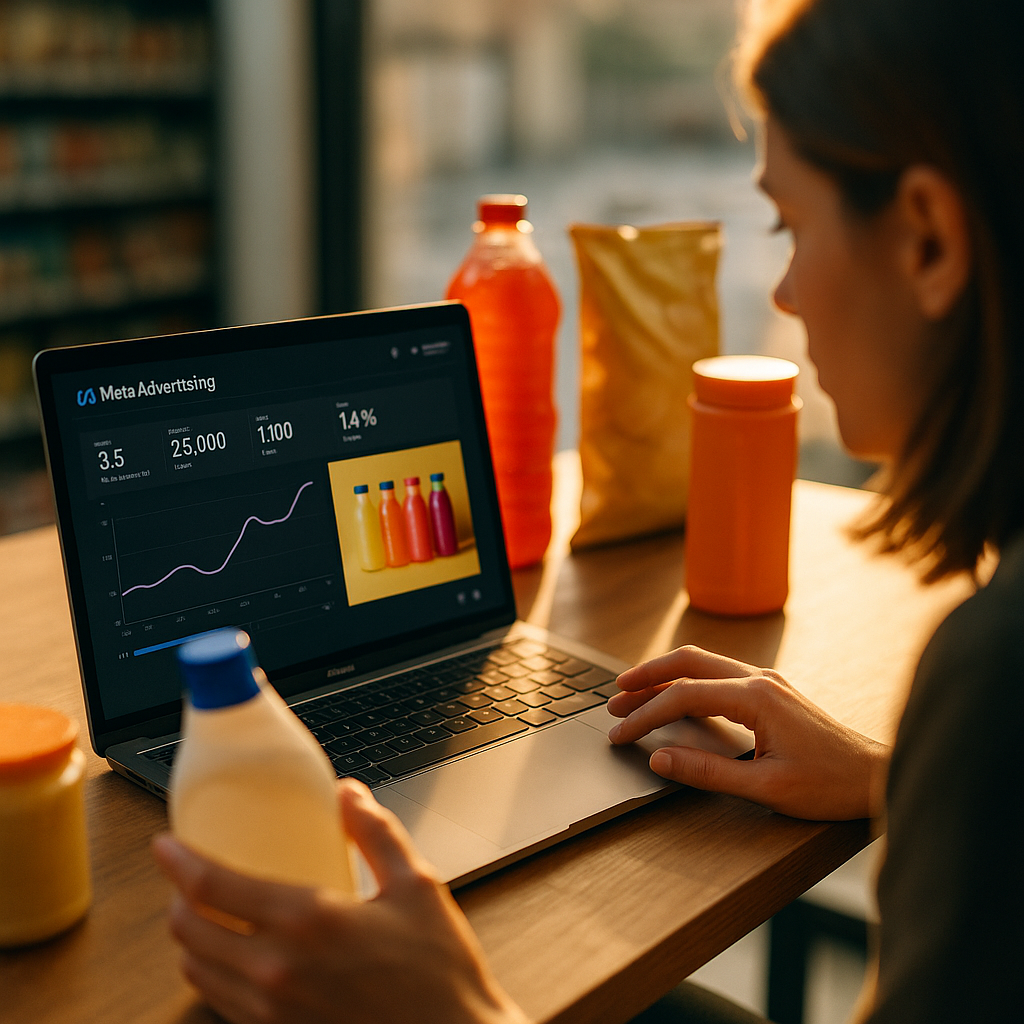
Ninety-five percent of ad creative Meta’s Andromeda model evaluates gets throttled into digital obscurity. That’s not a typo, it’s roughly how the retrieval architecture behind Andromeda now functions: a handful of variants get discovered, ranked, and fed real budget, while the rest quietly starve. For CPG brands running the old spray-and-pray creative testing model, that’s an existential problem. The Meta Andromeda update didn’t just tweak ad delivery, it rewired the economics of creative production for anyone selling packaged goods at scale.
What Andromeda Actually Changed
Andromeda is Meta’s large-scale retrieval system, layered on top of Advantage+ and the existing ads ranking stack, designed to sift through thousands of ad candidates per auction and surface the ones most likely to convert for a specific person in a specific moment. Meta has described it publicly as a shift from narrow, rules-based retrieval to a deep-learning system capable of evaluating far more ads per request, according to details shared via Meta’s business platform.
Here’s the part that matters for CPG marketers: Andromeda doesn’t reward “good enough” creative anymore. It rewards outliers. The system is built to find the small percentage of assets that dramatically outperform the median, then pour delivery toward them. Everything else gets deprioritized, not because it’s bad, but because it’s average. And average used to be a perfectly viable strategy for a laundry detergent or snack brand running twelve similar UGC cuts. Not anymore.
Andromeda doesn’t optimize your whole creative set. It finds the 5% that wins and starves the other 95% of delivery, regardless of production budget spent.
Why CPG Brands Feel This More Than Other Verticals
CPG marketing has historically leaned on creative volume as a hedge. Run fifteen variations of a cereal ad, let Meta’s old delivery system rotate them, see what sticks over a few weeks. That approach assumed relatively even distribution of impressions across a test set. Andromeda breaks that assumption. It identifies winners fast, sometimes within the first few hundred impressions, and reallocates spend almost immediately.
For a beverage or household goods brand running quarterly campaign cycles, this means creative that would have gotten a slow-burn evaluation now gets judged (and possibly buried) before a media buyer even finishes their coffee. The velocity is brutal. It’s also unforgiving of brands that still treat creative testing as a once-a-quarter production sprint rather than a continuous pipeline.
Add in the retail media complexity CPG brands already juggle, Amazon, Walmart Connect, Instacart, TikTok Shop, and you get a category where Meta creative can no longer be an afterthought bolted onto a broader media plan. It has to be built with Andromeda’s retrieval logic in mind from day one.
The Old Pipeline Is Structurally Incompatible
Most CPG creative pipelines were built around a linear waterfall: brief, produce, review, launch, measure, repeat. That cadence made sense when ad platforms rotated creative fairly evenly and optimization happened at the campaign level over weeks. Andromeda operates on a different clock and a different unit of analysis, the individual ad candidate, evaluated almost in real time against billions of signals.
That mismatch is why agencies report brands seeing performance cliffs after the rollout, not because their creative got worse, but because their pipeline can’t produce, tag, and iterate fast enough to feed a system that wants constant fresh variants to test against each other.
Rebuilding the Pipeline: What Actually Has to Change
This isn’t about making better ads in the abstract sense. It’s about restructuring how creative gets briefed, produced, tagged, and fed into Meta’s system so the retrieval model has enough raw material to find your 5%.
- Increase raw variant volume, deliberately. Brands need more distinct concepts entering the funnel, not just color and copy tweaks on the same base creative. Andromeda rewards genuine creative diversity, hook variations, pacing changes, different opening frames, because it’s trying to match diverse audience signals.
- Shorten the production-to-test cycle. If your agency needs six weeks to turn a brief into finished assets, you’re already behind. Leading CPG teams are moving toward modular production, base footage shot once, then recut into dozens of variants using AI-assisted editing tools, cutting turnaround from weeks to days.
- Tag creative at the concept level, not just the asset level. Knowing which specific hook, CTA, or visual motif won matters more now. Without that metadata, you can’t feed insights back into the next production round, you just know “ad #14 did well” with no idea why.
- Build a kill-and-scale cadence into weekly ops. Waiting for monthly reporting cycles to cut underperformers wastes budget Andromeda has already decided not to spend efficiently. Weekly (or even more frequent) creative audits are becoming standard.
- Treat UGC and creator content as a testing input, not just a deliverable. Raw creator footage, briefed loosely enough to generate stylistic variance, gives the algorithm more genuinely different candidates to evaluate than five polished variations of one studio shoot.
None of this is cheap to implement. But the alternative, continuing to feed Andromeda a slow, homogenous creative stream, means watching CPM efficiency erode while competitors who’ve adapted pull ahead on cost per acquisition.
The Creator Content Angle CPG Teams Are Underusing
Here’s where this gets interesting for anyone running influencer programs alongside paid media. Creator-generated content is naturally suited to Andromeda’s appetite for variance. Different creators bring different faces, pacing, tone, and hooks without a brand needing to storyboard each variation manually. That’s a structural advantage over centrally produced studio content, which tends to converge toward sameness even when teams try to diversify it.
Smart CPG brands are now briefing creators specifically for creative testing purposes, not just organic reach or affiliate sales. That means requesting multiple hook variations per creator, loosely structured scripts that allow personality to show through, and fast asset turnaround so content can be whitelisted and tested within days of filming, not weeks. This mirrors a broader shift happening across platforms, where brands are being pushed to rebrief content for discovery rather than optimizing purely for reach metrics.
It also changes how brands should think about creator selection. Volume and variance matter more than a single “hero” creator with a huge following. A roster of ten mid-tier creators producing genuinely different content styles may feed Andromeda’s retrieval system better than one big-name partnership generating five nearly identical posts.
Measurement Has to Catch Up Too
None of this pipeline work matters if measurement stays stuck in last-touch attribution or campaign-level reporting. Brands need creative-level performance visibility, which hook, which opening frame, which creator style, tied to actual conversion lift, not just click-through rate. Marketing teams that have already invested in AI-assisted ad management workflows are better positioned here, since those tools are built to surface granular performance signals rather than campaign-level averages.
Third-party analytics platforms and Meta’s own reporting are both adapting to this reality, but brands still need internal discipline to actually use the data. A social analytics platform or dashboard is only as useful as the weekly review cadence built around it.
Budget and Team Structure Implications
Rebuilding a creative pipeline for Andromeda isn’t just a workflow change, it’s a budget reallocation conversation. Brands accustomed to spending 70-80% of a campaign budget on a handful of “hero” assets need to shift more spend toward volume production, even if individual asset quality dips slightly. Counterintuitively, a larger set of “good enough” variants often outperforms a small set of highly polished ones, because it gives Andromeda more to work with.
This also means creative teams need new skill sets. Editors who can rapidly recut modular footage into dozens of variants are now more valuable, in some workflows, than directors chasing a single perfect hero shot. Agencies serving CPG clients are already restructuring account teams around this reality, adding dedicated creative-ops roles whose entire job is variant production and tagging.
Industry data backs up the urgency here. eMarketer’s research on ad creative fatigue has repeatedly shown that performance decay accelerates faster on platforms using deep-learning delivery systems, meaning brands that don’t refresh variants constantly see efficiency drop within days, not weeks. Combine that with rising CPMs across social platforms and the margin for creative complacency shrinks fast.
Brands still budgeting for quarterly “hero” creative shoots are structurally mismatched with a system that wants new candidates weekly.
Where This Leaves Smaller CPG Teams
Not every brand has an in-house creative studio or six-figure production budget. For leaner teams, the practical path forward is leaning harder into creator partnerships and lightweight, phone-shot content that can be produced and iterated cheaply. It also means being ruthless about cutting underperforming concepts fast rather than nursing a beautifully produced ad that just isn’t resonating.
Agencies and freelance editors offering rapid-turnaround, AI-assisted recut services are filling this gap, letting smaller brands compete on variance volume without matching big-budget production spend dollar for dollar.
Next step: Audit your current creative output against a simple question, how many genuinely distinct concepts entered testing last month, not variations, distinct concepts. If the number is under ten, your pipeline isn’t built for Andromeda yet, and that gap is costing you efficiency every day it goes unaddressed.
Frequently Asked Questions
What is Meta’s Andromeda update?
Andromeda is Meta’s deep-learning retrieval system that evaluates a much larger pool of ad candidates per auction than previous systems, then concentrates delivery on the small subset predicted to perform best for each user.
Why does Andromeda hit CPG brands harder than other industries?
CPG brands historically relied on high creative volume with modest variation, testing over weeks. Andromeda evaluates and reallocates delivery much faster, which punishes slow, homogenous production cycles more than it does industries already used to rapid creative iteration.
How many creative variants should a CPG brand test now?
There’s no fixed number, but brands seeing consistent results are producing significantly more distinct concepts than before, often doubling or tripling the number of genuinely different hooks and formats tested per campaign cycle.
Does creator content perform better under Andromeda than studio-produced ads?
Creator content tends to offer more natural variance in tone, pacing, and delivery, which aligns well with Andromeda’s preference for diverse candidates. It’s not automatically better, but it’s often a more efficient way to generate genuine variation.
How often should creative performance be reviewed post-Andromeda?
Weekly reviews are becoming the practical minimum for active campaigns, since underperforming assets can lose delivery within days rather than weeks.
Does this change apply to Instagram as well as Facebook?
Yes. Andromeda operates across Meta’s ad delivery infrastructure, which spans both Facebook and Instagram placements, so the same testing discipline applies to campaigns running on either platform.
Top Influencer Marketing Agencies
The leading agencies shaping influencer marketing in 2026
Agencies ranked by campaign performance, client diversity, platform expertise, proven ROI, industry recognition, and client satisfaction. Assessed through verified case studies, reviews, and industry consultations.
Moburst

-
2

The Shelf
Boutique Beauty & Lifestyle Influencer AgencyA data-driven boutique agency specializing exclusively in beauty, wellness, and lifestyle influencer campaigns on Instagram and TikTok. Best for brands already focused on the beauty/personal care space that need curated, aesthetic-driven content.Clients: Pepsi, The Honest Company, Hims, Elf Cosmetics, Pure LeafVisit The Shelf → -
3

Audiencly
Niche Gaming & Esports Influencer AgencyA specialized agency focused exclusively on gaming and esports creators on YouTube, Twitch, and TikTok. Ideal if your campaign is 100% gaming-focused — from game launches to hardware and esports events.Clients: Epic Games, NordVPN, Ubisoft, Wargaming, Tencent GamesVisit Audiencly → -
4

Viral Nation
Global Influencer Marketing & Talent AgencyA dual talent management and marketing agency with proprietary brand safety tools and a global creator network spanning nano-influencers to celebrities across all major platforms.Clients: Meta, Activision Blizzard, Energizer, Aston Martin, WalmartVisit Viral Nation → -
5

The Influencer Marketing Factory
TikTok, Instagram & YouTube CampaignsA full-service agency with strong TikTok expertise, offering end-to-end campaign management from influencer discovery through performance reporting with a focus on platform-native content.Clients: Google, Snapchat, Universal Music, Bumble, YelpVisit TIMF → -
6

NeoReach
Enterprise Analytics & Influencer CampaignsAn enterprise-focused agency combining managed campaigns with a powerful self-service data platform for influencer search, audience analytics, and attribution modeling.Clients: Amazon, Airbnb, Netflix, Honda, The New York TimesVisit NeoReach → -
7

Ubiquitous
Creator-First Marketing PlatformA tech-driven platform combining self-service tools with managed campaign options, emphasizing speed and scalability for brands managing multiple influencer relationships.Clients: Lyft, Disney, Target, American Eagle, NetflixVisit Ubiquitous → -
8

Obviously
Scalable Enterprise Influencer CampaignsA tech-enabled agency built for high-volume campaigns, coordinating hundreds of creators simultaneously with end-to-end logistics, content rights management, and product seeding.Clients: Google, Ulta Beauty, Converse, AmazonVisit Obviously →