


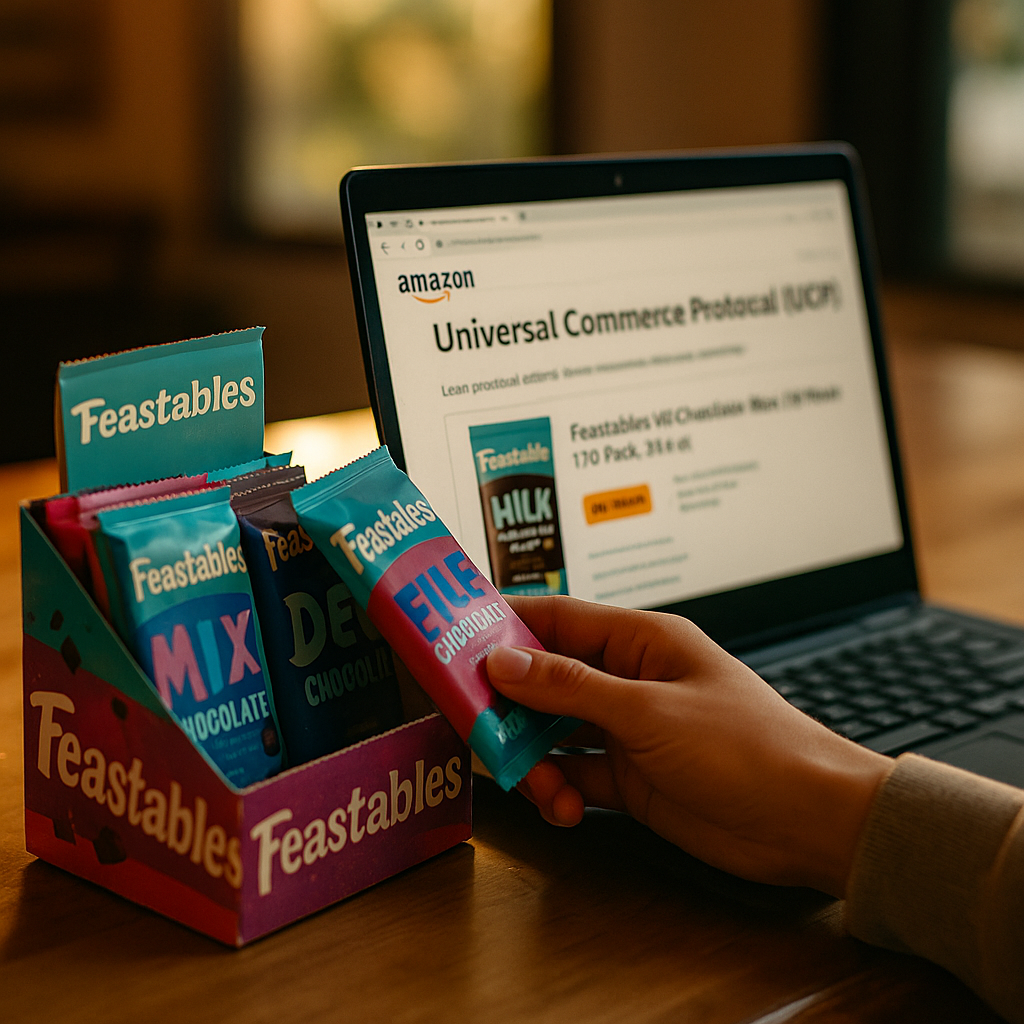
Ninety-four percent of a purchase decision used to happen in a human brain. Now a growing share happens in an AI agent’s context window before a shopper even opens an app. When Feastables let autonomous shopping agents complete real purchases through Amazon’s Universal Commerce Protocol, it wasn’t a gimmick — it was a live test of what brand marketing looks like when the buyer isn’t a person anymore.
This case study breaks down what Feastables actually did, why Amazon built the protocol in the first place, and what it means for every brand still optimizing purely for human eyeballs.
What Is the Universal Commerce Protocol, Exactly?
Amazon’s Universal Commerce Protocol (UCP) is an open transaction standard that lets third-party AI agents — think ChatGPT shopping extensions, Perplexity Shopping, or agentic browser assistants — query product catalogs, verify pricing and availability, and execute checkout on a customer’s behalf, without a human clicking “buy now.” It’s the commerce equivalent of what schema markup did for search: a structured layer that makes a brand’s product data machine-readable and machine-actionable.
Where things get interesting for marketers is trust and authorization. UCP requires brands to pre-authorize specific SKUs, price ceilings, and purchase frequency rules an agent is allowed to act on. A shopper might tell their assistant, “reorder my protein snacks when I’m under two boxes,” and the agent executes that instruction against pre-approved parameters, no manual approval loop required.
The brands winning early aren’t the ones with the biggest ad budgets. They’re the ones whose product data, pricing logic, and reorder rules are clean enough for a machine to trust without a human double-checking.
Why Feastables Was First in Line
Feastables, MrBeast’s chocolate and snack brand, has never been shy about experimenting with distribution mechanics ahead of the category. The brand already proved it could win retail shelf space with nano-creators rather than traditional trade spend, so leaning into an unproven Amazon protocol fit the brand’s operating pattern: move first, iterate in public, let the data do the talking.
Feastables’ commerce team had three things going for it that made UCP adoption low-risk:
- A tight SKU count (under 20 active products), which made data cleanup and price-rule mapping fast.
- Existing subscribe-and-save infrastructure on Amazon, meaning reorder logic already existed and just needed to be exposed to the protocol.
- A creator-driven demand engine that made the brand a frequent “add to cart” mention inside AI shopping conversations, since large language models trained on public web data already associate Feastables with snack recommendations.
That last point matters more than most marketers realize. If your brand isn’t part of the training data or real-time retrieval layer that shopping agents pull from, you don’t exist in the conversation — regardless of how good your Amazon listing looks to a human.
The Mechanics: How the Autonomous Purchase Actually Worked
Here’s the flow Feastables enabled during its pilot window, based on details shared in Amazon’s developer documentation and corroborating reporting from trade press covering the rollout:
- Intent capture. A user tells an AI agent (integrated with Amazon’s shopping API) something like, “keep me stocked on Feastables bars, don’t let me pay more than $28 for a 12-pack.”
- Authorization check. The agent verifies the request against the user’s stored payment method and Amazon’s spending guardrails, then checks whether Feastables has published a matching UCP price and quantity rule.
- Autonomous execution. If the current listing matches the pre-set ceiling, the agent completes checkout without further confirmation. If price moves above threshold, it holds and notifies the user.
- Post-purchase signal. The transaction feeds back into Amazon’s demand-forecasting layer, which Feastables’ team can access to see agent-driven order patterns separately from human-driven ones.
That separation is the part brand strategists should sit with. For the first time, a brand can see a distinct purchase channel: not paid, not organic, not retail media — agentic. And it behaves differently. Agent-driven reorders skewed toward exact repeat purchases with almost zero basket variance, while human orders on the same SKUs showed the usual promotional sensitivity and impulse add-ons.
The Results, and Why They’re Bigger Than a Sales Bump
Feastables hasn’t published a full performance breakdown publicly, but details shared at trade events and referenced by outlets covering Amazon’s agentic commerce push point to a few directional signals worth flagging:
- Agent-initiated reorders showed materially higher repeat-purchase consistency than standard Subscribe & Save, since the agent removes the “forgot to reorder” failure point entirely.
- Zero returns or disputes were logged during the pilot window tied to agent transactions, likely because purchases only executed against pre-approved parameters.
- Customer acquisition through agent discovery (new users whose first Feastables purchase was agent-initiated) was small but nonzero, suggesting some shopping agents are already recommending snack brands proactively based on nutritional or dietary prompts.
The bigger story isn’t the sales lift. It’s that Feastables essentially built a zero-friction retention channel that requires no ad spend, no discount, and no creator content to sustain itself once it’s set up. Compare that to the retail media tax most CPG brands pay just to stay visible on Amazon’s search results page, and the operational efficiency case becomes obvious.
Agentic reorders don’t need to be won every week. They need to be won once, correctly, with clean data — then they run largely on autopilot.
The Risk Side Nobody’s Talking About Enough
Before any brand rushes to replicate this, a few risk questions deserve real scrutiny from legal and compliance teams, not just growth marketers:
- Price-setting accountability. If an agent purchases at a stale or incorrectly synced price, who eats the margin difference — the brand, the retailer, or the platform?
- Consent and disclosure. Regulators are already scrutinizing algorithmic and automated commercial practices. The FTC has signaled interest in how autonomous purchasing tools disclose recurring charges to consumers, and brands relying on UCP should assume similar scrutiny is coming for agentic checkout flows.
- Data provenance. Agents pull product claims (ingredients, health claims, allergen info) from wherever they’re trained or retrieving in real time. If that data is outdated on a third-party retailer feed, the agent could complete a purchase based on inaccurate information, exposing the brand to liability it didn’t directly create.
- Brand safety in agent reasoning. Unlike a human scrolling a product page, an agent’s “reasoning” for recommending your snack over a competitor’s isn’t visible to the brand. That’s a black box marketers haven’t had to manage before.
None of this means brands should wait on the sidelines. It means the rollout needs a cross-functional team — legal, ecommerce ops, and marketing — not just a growth hacker with API access.
What This Means for the Rest of the Snack and CPG Category
Feastables’ pilot is a signal flare for the entire snack and beverage vertical, categories already comfortable with algorithmic discovery thanks to TikTok Shop and retail media auctions. Brands like Chomps, which built its category through creator seeding, and Olipop, which scaled through creator whitelisting, both operate with the kind of tight, well-documented SKU catalogs that would translate cleanly into UCP-ready data. That’s not a coincidence. Brands that have already invested in clean product data for retail media and TikTok Shop are structurally closer to agentic-commerce readiness than brands still running messy, inconsistent listings across channels.
There’s also a coming shift in how “share of voice” gets measured. Search rankings and social impressions won’t matter if an AI agent is the one making the final call. Instead, brands will need to think about share of agent recommendation — whether large language models and shopping copilots surface your product at all when a user asks for “healthy snack options” or “high-protein bars under $2 each.” That’s a new discipline, sitting somewhere between SEO, digital PR, and traditional brand awareness work, and almost nobody has fully operationalized it yet.
Marketing teams should also expect platforms beyond Amazon to move fast here. eMarketer’s ecommerce forecasts have already flagged agentic shopping as a growth category worth tracking, and expect Shopify, Walmart, and TikTok Shop to announce comparable protocols within the next reporting cycle. Brands waiting for a single dominant standard to emerge may find themselves needing to support three or four simultaneously.
Practical Steps Before You Try This Yourself
- Audit your product feed for consistency across every retail and marketplace listing. Agents don’t forgive inconsistent SKU data the way humans scroll past it.
- Set clear, documented price ceilings and reorder frequency rules before enabling any agentic purchase authorization.
- Loop in legal counsel early on disclosure and liability questions, especially around recurring or subscription-style agent purchases.
- Track agent-originated orders as a separate channel in your analytics stack from day one. Don’t let them get blended into “organic” or “direct” and disappear.
- Watch how your brand shows up in AI shopping assistant recommendations today, before you’ve built anything. That baseline tells you whether you have a discovery problem or a conversion problem.
For brands still building the fundamentals of creator-driven demand before tackling agentic commerce, it’s worth studying how Graza turned consistent creator content into a TikTok Shop bestseller — the underlying discipline of clean, consistent product storytelling is the same discipline that makes a brand agent-ready later.
Next step: don’t wait for a “best practices” playbook to fully form. Audit your product data hygiene this quarter, because whichever brand shows up clean and consistent when agentic commerce scales past pilot stage will own the reorder relationship — with no ad spend required to defend it.
FAQs
What is Amazon’s Universal Commerce Protocol?
It’s an open standard that lets AI shopping agents query product data, verify pricing, and complete purchases on a shopper’s behalf, based on rules and price ceilings that brands and retailers pre-authorize.
Did Feastables really let AI agents buy products without human approval?
Yes, within pre-set parameters. Purchases only executed autonomously if the price and quantity matched rules Feastables had already published; anything outside those limits required manual confirmation from the shopper.
Is agentic commerce only relevant for large brands like Feastables?
No. Smaller brands with clean, consistent product data across marketplaces are arguably better positioned than large brands with messy multi-SKU catalogs, since data hygiene is the main barrier to entry.
What are the biggest risks of enabling autonomous AI purchases?
Pricing errors, unclear liability for incorrect agent-driven transactions, regulatory scrutiny around disclosure, and lack of visibility into how an agent reasons about product recommendations.
How is agent-driven revenue different from typical ecommerce channels?
Early data suggests agent-driven reorders show far less basket variance and promotional sensitivity than human purchases, functioning more like automated retention revenue than typical acquisition or impulse-driven sales.
Will other retailers launch similar protocols?
Almost certainly. Analysts tracking ecommerce trends expect competing platforms to introduce comparable agentic commerce standards, meaning brands may eventually need to support multiple protocols simultaneously.
FAQs
What is Amazon’s Universal Commerce Protocol?
It’s an open standard that lets AI shopping agents query product data, verify pricing, and complete purchases on a shopper’s behalf, based on rules and price ceilings that brands and retailers pre-authorize.
Did Feastables really let AI agents buy products without human approval?
Yes, within pre-set parameters. Purchases only executed autonomously if the price and quantity matched rules Feastables had already published; anything outside those limits required manual confirmation from the shopper.
Is agentic commerce only relevant for large brands like Feastables?
No. Smaller brands with clean, consistent product data across marketplaces are arguably better positioned than large brands with messy multi-SKU catalogs, since data hygiene is the main barrier to entry.
What are the biggest risks of enabling autonomous AI purchases?
Pricing errors, unclear liability for incorrect agent-driven transactions, regulatory scrutiny around disclosure, and lack of visibility into how an agent reasons about product recommendations.
How is agent-driven revenue different from typical ecommerce channels?
Early data suggests agent-driven reorders show far less basket variance and promotional sensitivity than human purchases, functioning more like automated retention revenue than typical acquisition or impulse-driven sales.
Will other retailers launch similar protocols?
Almost certainly. Analysts tracking ecommerce trends expect competing platforms to introduce comparable agentic commerce standards, meaning brands may eventually need to support multiple protocols simultaneously.
Top Influencer Marketing Agencies
The leading agencies shaping influencer marketing in 2026
Agencies ranked by campaign performance, client diversity, platform expertise, proven ROI, industry recognition, and client satisfaction. Assessed through verified case studies, reviews, and industry consultations.
Moburst

-
2

The Shelf
Boutique Beauty & Lifestyle Influencer AgencyA data-driven boutique agency specializing exclusively in beauty, wellness, and lifestyle influencer campaigns on Instagram and TikTok. Best for brands already focused on the beauty/personal care space that need curated, aesthetic-driven content.Clients: Pepsi, The Honest Company, Hims, Elf Cosmetics, Pure LeafVisit The Shelf → -
3

Audiencly
Niche Gaming & Esports Influencer AgencyA specialized agency focused exclusively on gaming and esports creators on YouTube, Twitch, and TikTok. Ideal if your campaign is 100% gaming-focused — from game launches to hardware and esports events.Clients: Epic Games, NordVPN, Ubisoft, Wargaming, Tencent GamesVisit Audiencly → -
4

Viral Nation
Global Influencer Marketing & Talent AgencyA dual talent management and marketing agency with proprietary brand safety tools and a global creator network spanning nano-influencers to celebrities across all major platforms.Clients: Meta, Activision Blizzard, Energizer, Aston Martin, WalmartVisit Viral Nation → -
5

The Influencer Marketing Factory
TikTok, Instagram & YouTube CampaignsA full-service agency with strong TikTok expertise, offering end-to-end campaign management from influencer discovery through performance reporting with a focus on platform-native content.Clients: Google, Snapchat, Universal Music, Bumble, YelpVisit TIMF → -
6

NeoReach
Enterprise Analytics & Influencer CampaignsAn enterprise-focused agency combining managed campaigns with a powerful self-service data platform for influencer search, audience analytics, and attribution modeling.Clients: Amazon, Airbnb, Netflix, Honda, The New York TimesVisit NeoReach → -
7

Ubiquitous
Creator-First Marketing PlatformA tech-driven platform combining self-service tools with managed campaign options, emphasizing speed and scalability for brands managing multiple influencer relationships.Clients: Lyft, Disney, Target, American Eagle, NetflixVisit Ubiquitous → -
8

Obviously
Scalable Enterprise Influencer CampaignsA tech-enabled agency built for high-volume campaigns, coordinating hundreds of creators simultaneously with end-to-end logistics, content rights management, and product seeding.Clients: Google, Ulta Beauty, Converse, AmazonVisit Obviously →