


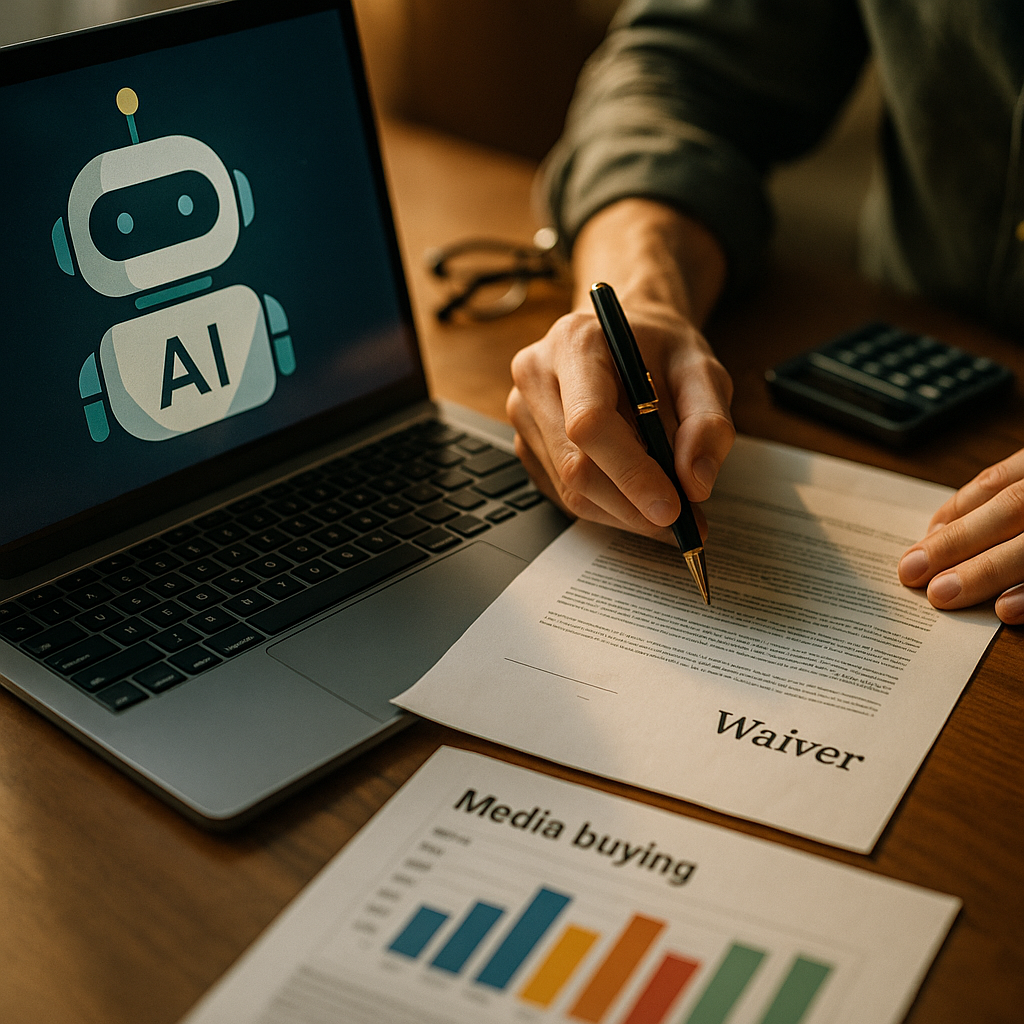
Autonomous media-buying tools now make thousands of targeting decisions per hour, often trained on creator content nobody asked permission to use. An AI agent liability waiver that ignores this reality isn’t protecting your brand. It’s a liability magnet with a letterhead. If your procurement team hasn’t asked where the training data came from, you already have a problem waiting to surface.
Here’s the uncomfortable truth: most brands buying autonomous media-buying platforms have no idea whether the underlying models were trained on scraped creator content, licensed datasets, or something murkier. Vendors rarely volunteer this. And when a creator’s likeness, voice pattern, or content style shows up in an AI-generated ad variant six months later, “we didn’t know” won’t hold up in front of a regulator or a plaintiff’s attorney.
Why This Problem Is Suddenly Everyone’s Problem
Media-buying AI agents used to just optimize bids. Now they generate creative variants, write ad copy mimicking creator tone, and select “lookalike” influencer profiles based on training data nobody audited. The tools got smarter faster than the contracts did.
Multiple platform vendors have quietly trained recommendation and generation models on scraped social content, including creator posts, captions, and engagement patterns, without direct consent from the individuals whose work built the dataset. Some of this falls into legal gray zones under fair use arguments. Some of it doesn’t. Either way, the brand deploying the tool is the one with the ad budget, the public campaign, and the deep pockets — which makes you the target, not the vendor.
If your AI vendor can’t produce a data provenance log for the training set, assume worst-case exposure and draft your waiver accordingly.
This isn’t theoretical. Regulatory attention on AI training data has intensified across the FTC, state attorneys general, and EU bodies. The FTC has signaled repeatedly that AI-washing and undisclosed data practices fall squarely within its unfair-and-deceptive-practices authority. Brands that assumed vendor contracts shielded them are finding out the hard way that indemnification clauses written for 2019-era software don’t cover 2026-era generative agents.
What a Liability Waiver Actually Needs to Cover
A generic “AI tools are provided as-is” clause is not a waiver. It’s wishful thinking. A defensible waiver needs to address specific failure modes, not vague AI risk in general.
- Training data provenance: Require the vendor to disclose, in writing, whether creator-generated content was used in training and under what legal basis (licensed, scraped, synthetic, or public domain).
- Consent chain documentation: Demand proof that any third-party creator data was obtained with consent, or a clear statement that it wasn’t, so your legal team can assess exposure before deployment.
- Output attribution risk: Address what happens if the agent’s generated creative resembles a specific creator’s identifiable style, voice, or likeness closely enough to trigger a right-of-publicity claim.
- Indemnification scope: Specify whether the vendor indemnifies you for claims arising from training data issues, or only for claims arising from your misuse of the tool. These are very different liability postures.
- Audit rights: Build in the right to request training data summaries or third-party audit reports on a recurring basis, not just at contract signing.
Notice what’s missing from most vendor-drafted waivers: any mention of the creators whose content trained the model in the first place. That absence is the whole risk.
The Consent Gap Nobody Wants to Admit
Ask your AI media-buying vendor a simple question: “Can you confirm no creator content was used in training without consent?” Watch how long it takes them to answer. Most can’t, because most don’t know. Training pipelines for large models often pull from aggregated web-scraped datasets assembled by third parties, meaning even the vendor may lack full visibility into what’s inside.
This is why waiver language needs to shift from assuming compliance to demanding evidence of it. A waiver that simply states “vendor represents that all data used complies with applicable law” is functionally useless if the vendor never verified that representation themselves. You want specificity: named data sources, licensing agreements, or a documented data minimization policy similar to what’s now standard in vendor data minimization clauses for TikTok Shop and Instagram integrations.
Compare this to how creator contracts have evolved. Most sophisticated brands now include an AI liability clause in creator contracts that spells out exactly who bears risk when generative tools touch a campaign. Media-buying vendor contracts need the mirror image of that clause, protecting the creators whose data trained the tool, not just the brand deploying it.
Drafting Language That Actually Holds Up
Vague waivers collapse under scrutiny. Specific ones survive discovery. Here’s what functional language looks like, adapted for your legal team’s review:
- “Vendor warrants that training datasets used in the development of the Autonomous Media-Buying Tool do not include creator-generated content obtained without documented consent, and shall provide such documentation upon request within fifteen business days.”
- “In the event that generated creative output is found to substantially replicate the identifiable likeness, voice, or stylistic signature of a third-party creator without consent, Vendor shall bear primary liability for resulting claims, including reasonable legal fees incurred by Client.”
- “Client reserves the right to suspend use of the Tool, without penalty, upon receipt of credible evidence that training data included non-consensual use of creator content.”
Notice the pattern: each clause creates an obligation, a documented remedy, and an exit ramp. None of them rely on trust. That’s the point. Waivers written on trust are the ones that end up cited in FTC consent decrees.
This mirrors the shift already happening in AI shopping agent compliance frameworks, where brands learned the hard way that “the platform handles compliance” isn’t a legal defense. It’s an assumption, and assumptions don’t survive regulatory inquiries.
Where Brands Get This Wrong
Three recurring mistakes show up in nearly every audit of AI media-buying contracts:
Mistake one: treating the waiver as a one-time document. Models get retrained. Datasets get updated. A waiver signed at contract inception says nothing about what happened during the last quarterly model refresh. Build in recurring disclosure obligations, tied to model version updates, not just annual contract renewals.
Mistake two: assuming platform-level AI labels solve the disclosure problem. They don’t. Platform disclosure requirements and your own FTC obligations are separate tracks that frequently conflict, as covered in how platform AI labels clash with FTC disclosure rules. A waiver that only references platform compliance ignores your independent legal exposure.
Mistake three: no escalation path when something goes wrong. If a creator files a complaint about their content appearing in AI-generated ad variants, who at your organization owns the response? Without a clear internal protocol, similar to the escalation matrix approach for FTC and state AG risk, the first person to hear about it is often someone in social media management with zero authority to pause the campaign.
A waiver without an escalation protocol is a document, not a defense. Regulators care about what you did after the problem surfaced, not just what the contract said.
Insurance and Risk Transfer: The Overlooked Layer
Legal teams love contract language. Risk managers should be asking a different question: does your media liability policy actually cover claims arising from AI training data disputes? Most standard media liability riders were written before generative AI agents existed and may exclude claims tied to machine-generated content entirely.
This is the same gap creators face with high-risk activations, addressed in depth in insurance riders for high-risk creator activations. Brands deploying autonomous media-buying tools need the equivalent: a rider specifically naming AI training data disputes, right-of-publicity claims from non-consenting creators, and generative output liability. Ask your broker directly whether your current policy has language covering “claims arising from third-party data used in AI model training.” If they pause, you have a gap.
Industry data backs the urgency here. eMarketer estimates continued double-digit growth in AI-driven programmatic and social ad spend, meaning exposure compounds every quarter you delay updating these contracts. The bigger the AI-managed budget, the bigger the potential claim.
A Quick Framework for Legal and Marketing Teams
When evaluating or renewing any autonomous media-buying tool, walk through this sequence before signing:
- Request a data provenance disclosure covering all training and fine-tuning datasets.
- Confirm whether creator-generated content appears in any dataset, and under what consent basis.
- Insert specific indemnification language naming training-data-related claims, not generic AI risk.
- Build in recurring audit rights tied to model retraining cycles.
- Confirm insurance coverage explicitly names AI training data disputes.
- Assign an internal owner for creator complaints related to AI-generated content resemblance.
None of this is exotic. It’s the same due diligence brands already apply to creator data processing agreements across multiple jurisdictions. The AI media-buying layer just hasn’t caught up yet, and that gap is exactly where liability lives.
For teams managing multi-market campaigns, cross-reference this against evolving frameworks like the EU AI Act’s high-risk classification criteria, since autonomous media-buying tools that profile or select creators may fall under similar scrutiny depending on how they’re deployed.
The Bottom Line for Legal and Marketing Leads
Waivers written for last generation’s AI tools won’t protect you from this generation’s exposure. Get specific, get documentation, and stop assuming your vendor already handled it.
Start by sending your top three AI media-buying vendors a written request for training data provenance this week. If any of them can’t answer within fifteen business days, that’s your risk ranking sorted for you.
FAQs
What is an AI agent liability waiver in the context of media buying?
It’s a contractual document that defines who bears legal and financial responsibility when an autonomous media-buying tool causes harm, including harm tied to training data sourced from third-party creators without consent. It should cover disclosure obligations, indemnification scope, and audit rights, not just general AI risk disclaimers.
Can a brand be held liable for a vendor’s AI training data practices?
Yes. Regulators and plaintiffs typically pursue whoever deployed the tool and profited from the campaign, not just the vendor that built it. This is consistent with how the FTC has approached deceptive practices claims involving third-party technology providers.
What should brands ask AI media-buying vendors before signing a contract?
Ask for a written data provenance disclosure, confirmation of whether creator-generated content was used in training, the legal basis for that use, and specific indemnification language covering training-data-related claims rather than generic liability disclaimers.
Does standard media liability insurance cover AI training data disputes?
Often not. Many policies predate generative AI agents and exclude claims tied to machine-generated content or training data disputes. Brands should confirm explicit coverage language with their broker before assuming protection exists.
How often should AI vendor waivers be updated?
At minimum, whenever the vendor retrains or significantly updates the underlying model. Annual contract renewal cycles are too infrequent given how often training data and model versions change.
What happens if a creator’s content appears in AI-generated ad output without consent?
This can trigger right-of-publicity claims, copyright disputes, or FTC scrutiny depending on jurisdiction and how closely the output resembles the creator’s identifiable work. Brands need a documented escalation protocol and clear indemnification terms before this scenario occurs, not after.
FAQs
What is an AI agent liability waiver in the context of media buying?
It’s a contractual document that defines who bears legal and financial responsibility when an autonomous media-buying tool causes harm, including harm tied to training data sourced from third-party creators without consent. It should cover disclosure obligations, indemnification scope, and audit rights, not just general AI risk disclaimers.
Can a brand be held liable for a vendor’s AI training data practices?
Yes. Regulators and plaintiffs typically pursue whoever deployed the tool and profited from the campaign, not just the vendor that built it. This is consistent with how the FTC has approached deceptive practices claims involving third-party technology providers.
What should brands ask AI media-buying vendors before signing a contract?
Ask for a written data provenance disclosure, confirmation of whether creator-generated content was used in training, the legal basis for that use, and specific indemnification language covering training-data-related claims rather than generic liability disclaimers.
Does standard media liability insurance cover AI training data disputes?
Often not. Many policies predate generative AI agents and exclude claims tied to machine-generated content or training data disputes. Brands should confirm explicit coverage language with their broker before assuming protection exists.
How often should AI vendor waivers be updated?
At minimum, whenever the vendor retrains or significantly updates the underlying model. Annual contract renewal cycles are too infrequent given how often training data and model versions change.
What happens if a creator’s content appears in AI-generated ad output without consent?
This can trigger right-of-publicity claims, copyright disputes, or FTC scrutiny depending on jurisdiction and how closely the output resembles the creator’s identifiable work. Brands need a documented escalation protocol and clear indemnification terms before this scenario occurs, not after.
Top Influencer Marketing Agencies
The leading agencies shaping influencer marketing in 2026
Agencies ranked by campaign performance, client diversity, platform expertise, proven ROI, industry recognition, and client satisfaction. Assessed through verified case studies, reviews, and industry consultations.
Moburst

-
2

The Shelf
Boutique Beauty & Lifestyle Influencer AgencyA data-driven boutique agency specializing exclusively in beauty, wellness, and lifestyle influencer campaigns on Instagram and TikTok. Best for brands already focused on the beauty/personal care space that need curated, aesthetic-driven content.Clients: Pepsi, The Honest Company, Hims, Elf Cosmetics, Pure LeafVisit The Shelf → -
3

Audiencly
Niche Gaming & Esports Influencer AgencyA specialized agency focused exclusively on gaming and esports creators on YouTube, Twitch, and TikTok. Ideal if your campaign is 100% gaming-focused — from game launches to hardware and esports events.Clients: Epic Games, NordVPN, Ubisoft, Wargaming, Tencent GamesVisit Audiencly → -
4

Viral Nation
Global Influencer Marketing & Talent AgencyA dual talent management and marketing agency with proprietary brand safety tools and a global creator network spanning nano-influencers to celebrities across all major platforms.Clients: Meta, Activision Blizzard, Energizer, Aston Martin, WalmartVisit Viral Nation → -
5

The Influencer Marketing Factory
TikTok, Instagram & YouTube CampaignsA full-service agency with strong TikTok expertise, offering end-to-end campaign management from influencer discovery through performance reporting with a focus on platform-native content.Clients: Google, Snapchat, Universal Music, Bumble, YelpVisit TIMF → -
6

NeoReach
Enterprise Analytics & Influencer CampaignsAn enterprise-focused agency combining managed campaigns with a powerful self-service data platform for influencer search, audience analytics, and attribution modeling.Clients: Amazon, Airbnb, Netflix, Honda, The New York TimesVisit NeoReach → -
7

Ubiquitous
Creator-First Marketing PlatformA tech-driven platform combining self-service tools with managed campaign options, emphasizing speed and scalability for brands managing multiple influencer relationships.Clients: Lyft, Disney, Target, American Eagle, NetflixVisit Ubiquitous → -
8

Obviously
Scalable Enterprise Influencer CampaignsA tech-enabled agency built for high-volume campaigns, coordinating hundreds of creators simultaneously with end-to-end logistics, content rights management, and product seeding.Clients: Google, Ulta Beauty, Converse, AmazonVisit Obviously →