


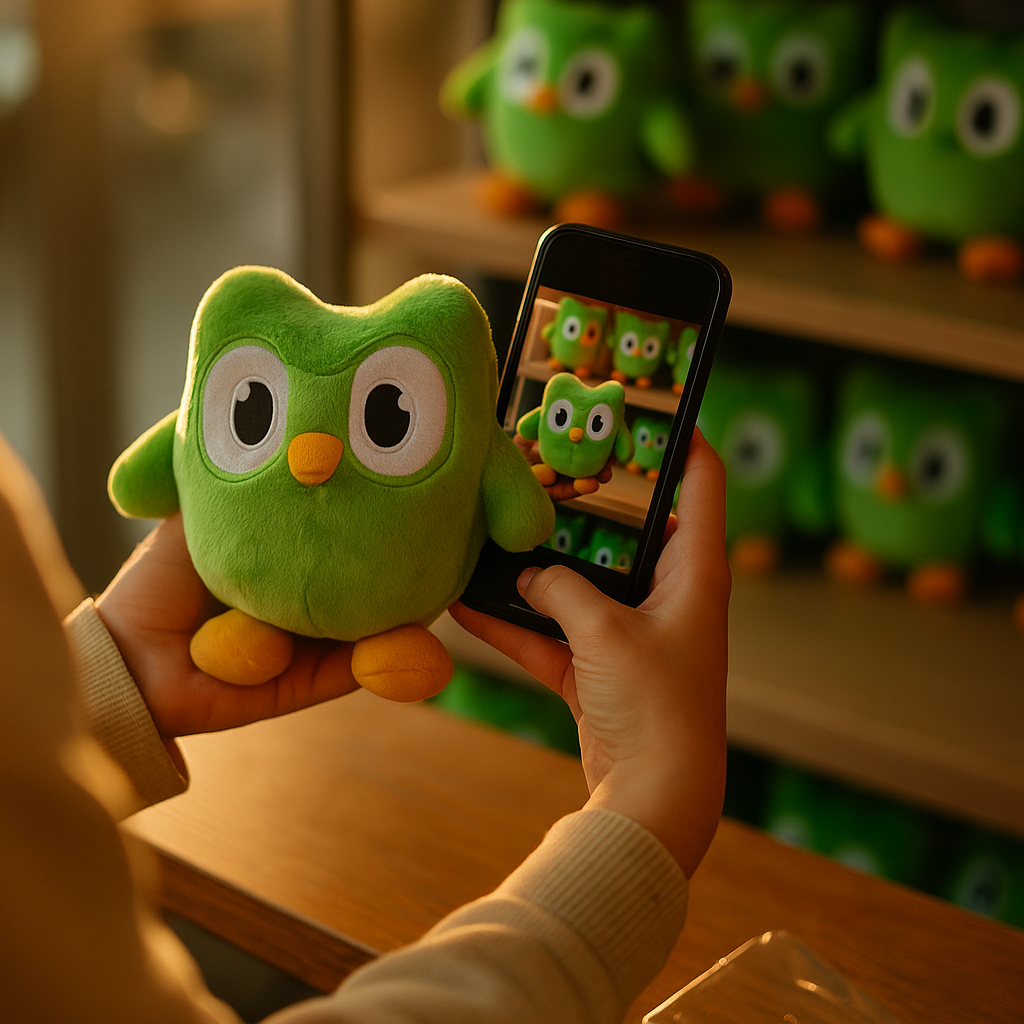
Duolingo’s owl has sold merch drops in minutes, appeared in a horror-movie-style TikTok trailer with over 20 million views, and helped push the app’s downloads without a single paid media dollar behind the bit. That’s not luck. It’s a repeatable UGC-to-commerce pipeline, and if you’re a brand strategist still treating TikTok Shop as an afterthought, this case study should change your roadmap. Here’s how the pipeline actually works, and what parts of it you can steal.
The Owl Wasn’t a Campaign. It Was an Operating System.
Most brands look at Duolingo’s owl, Duo, and see a mascot with good comedic timing. That’s the surface read. The deeper story is operational: Duolingo built a content engine that treats every meme as a potential product signal, and every product drop as fuel for more memes. It’s circular by design.
The brand’s social team doesn’t wait for a creative brief to greenlight a bit. They post fast, sometimes within hours of a cultural moment, and they let the audience’s reaction data — comments, duets, stitches, shares — tell them what deserves a second life. That second life increasingly means a product: a plush owl, an apparel drop, a limited collab. It’s the same seeding logic you’d see in weekly flavor drop marketing, just applied to a mascot instead of a menu item.
Duolingo doesn’t ask “how do we go viral?” It asks “what did the internet already make viral, and how fast can we productize it?” That reversal is the entire playbook.
How the UGC-to-Commerce Pipeline Actually Runs
Break it down into four stages, and it stops looking like magic and starts looking like a process you can build internally.
- Listen and mine: Duolingo’s social team monitors owl-related UGC across TikTok, X, and Instagram daily. They’re not just counting mentions — they’re categorizing sentiment and spotting recurring jokes (the owl “will find you,” the owl as a menacing debt collector for language practice, etc.).
- Amplify without ownership: Instead of issuing takedown notices or ignoring fan content, the brand duets, stitches, and reposts. This is the opposite of a legal-first approach to brand IP, and it’s a deliberate risk trade-off marketers should study closely.
- Signal-test before you manufacture: Before committing to inventory, Duolingo tests owl concepts as short-form content first. If a specific meme format (owl as horror villain, owl as toxic ex, owl doing a “silent walk”) gets outsized engagement, that’s the green light for merch.
- Convert on owned commerce, not just marketplaces: Drops route through Duolingo’s own store and select retail partners, with TikTok Shop-style social commerce layered in during peak virality windows. Speed from meme to buy button is the entire point — weeks, not quarters.
Compare that cadence to a traditional CPG merch cycle, which can take six to nine months from concept to shelf. Duolingo compresses that window because the “market research” already happened for free, in the comments section.
Why Zero-Paid-Media Isn’t a Slogan, It’s a Constraint That Forces Discipline
Here’s the uncomfortable truth for brands with big paid social budgets: paid media can mask weak creative. If you’re spending enough on amplification, mediocre content still gets impressions. Duolingo doesn’t have that luxury on the meme side of its business, so every post has to earn its own reach organically.
That constraint produces better content, not worse. It forces the team to obsess over timing, format, and cultural fluency instead of media mix modeling. According to eMarketer, brands are increasingly shifting incremental budget toward creator and organic social as paid CPMs climb across major platforms — Duolingo just got there years ahead of the curve out of necessity, not foresight.
It also changes how you measure success. There’s no media plan to reconcile against a CPM target. Instead, the KPI ladder looks like: engagement velocity → UGC volume → merch sell-through → app install lift. Each rung has to justify the next. If a meme doesn’t generate UGC, it never gets a merch conversation. If merch doesn’t sell in the first 48 hours, it doesn’t get restocked. This is a lean-startup approach to brand marketing, applied at a company with a nine-figure valuation.
The Creator Layer Most Case Studies Miss
Duolingo’s owl gets the headlines, but the pipeline depends on an under-discussed layer: nano and micro creators who riff on the owl bit organically, long before the brand’s official account touches it. These aren’t paid partnerships. They’re fans who’ve built entire content niches around roasting (or defending) the owl.
This mirrors what’s worked for brands like Aldi UK’s nano-creator seeding strategy and Wyze’s cult camera brand build: the initial spark rarely comes from a top-tier influencer with a rate card. It comes from dozens of smaller creators who have nothing to lose by being weird, and everything to gain if the brand notices them.
The strategic move isn’t paying those creators after the fact. It’s building a listening and response system fast enough to ride the wave while it’s still forming. Most brand social teams are structured for approval, not speed — a three-day sign-off process kills a meme’s shelf life before it starts. Duolingo’s team operates with more autonomy than a typical enterprise social function, which is worth flagging to any CMO reading this and wondering why their brand can’t replicate it.
What Breaks When Brands Try to Copy This Without the Infrastructure
Every marketer wants an owl. Almost none of them build the infrastructure required to sustain one.
Three failure points show up repeatedly when brands attempt a similar play:
- No fast-lane approval process. If legal and brand safety review takes longer than the meme’s lifecycle, you’ve already lost. Duolingo has clearly pre-negotiated risk tolerance internally, similar to how Duo Security made compliance-heavy content shareable by rethinking what “on-brand” actually means in a B2B-adjacent context.
- No product ops link to social. If your merch or e-commerce team isn’t looped into what’s trending on social in near-real time, you can’t convert attention into a buy button fast enough. The gap between “this is going viral” and “you can now purchase it” needs to be days, not months.
- Treating the meme as the campaign, not the input. Brands often chase virality as the end goal. Duolingo treats virality as raw material — an input to a commerce decision, not a vanity metric to report to the board.
The real differentiator isn’t creativity. It’s operational speed between “the internet likes this” and “you can buy it.” Most brands are structurally incapable of closing that gap in under a week.
There’s also a compliance dimension brands can’t ignore. When you’re amplifying fan-made content and blurring lines between UGC and owned marketing, disclosure and IP questions get murky fast. The FTC’s endorsement guidelines still apply if any compensation or material connection exists, even informally. Brands scaling a similar owl-style strategy should loop in legal early, not as a blocker, but as a co-architect of the fast-lane process mentioned above.
What This Means for Brand Strategy Budgets
If you’re building next year’s plan and still bucketing “organic social” as a low-priority line item beneath paid and influencer budgets, this case study is your signal to reallocate. Not because organic is trendy, but because it’s the cheapest test bed for product-market fit signals you’ll ever get.
Think about the sequencing other brands have used to validate demand before spending on inventory or ads. Chubbies sold out shorts in 48 hours using nano-creators to test demand cheaply. Graza turned olive oil into a TikTok Shop bestseller using a similar low-spend seeding approach before scaling paid support. Duolingo’s owl pipeline is the mascot-brand version of the same logic: let the audience tell you what to make, then make it fast, then sell it where the audience already is.
The operational lesson translates even if you don’t have a beloved mascot. Every brand has some recurring bit, character, or catchphrase buried in its customer conversations. The question is whether your team is structured to notice it and act on it inside a commercially relevant window — or whether it’ll take a quarterly report to even surface the idea.
FAQs
Frequently Asked Questions
What is the UGC-to-commerce pipeline Duolingo uses?
It’s a four-stage process: monitor fan-generated content about the owl mascot, amplify the best bits without heavy legal friction, test concepts as short-form content before committing to inventory, and convert demand quickly through owned and social commerce channels.
Does Duolingo use paid media to promote the owl?
The core meme-to-merch loop runs largely on organic and earned reach. Paid support may appear around specific product launches, but the growth engine behind the owl’s virality is driven by organic social and user-generated content, not media spend.
Can smaller brands replicate this strategy without a big social team?
Yes, but it requires a fast internal approval process and close coordination between social and product/commerce teams. Brands without that infrastructure typically miss the narrow window when a meme is commercially actionable.
What role do nano and micro creators play in this pipeline?
They generate the earliest wave of organic content around a brand moment, often before the brand’s own accounts respond. Their content acts as a free demand signal that brands can use to decide what’s worth productizing.
What compliance risks should brands consider when amplifying fan-made content?
Brands need to watch for FTC disclosure requirements if any compensation or material connection exists, and clarify intellectual property boundaries when reposting or building products off fan-created concepts.
Frequently Asked Questions
What is the UGC-to-commerce pipeline Duolingo uses?
It’s a four-stage process: monitor fan-generated content about the owl mascot, amplify the best bits without heavy legal friction, test concepts as short-form content before committing to inventory, and convert demand quickly through owned and social commerce channels.
Does Duolingo use paid media to promote the owl?
The core meme-to-merch loop runs largely on organic and earned reach. Paid support may appear around specific product launches, but the growth engine behind the owl’s virality is driven by organic social and user-generated content, not media spend.
Can smaller brands replicate this strategy without a big social team?
Yes, but it requires a fast internal approval process and close coordination between social and product/commerce teams. Brands without that infrastructure typically miss the narrow window when a meme is commercially actionable.
What role do nano and micro creators play in this pipeline?
They generate the earliest wave of organic content around a brand moment, often before the brand’s own accounts respond. Their content acts as a free demand signal that brands can use to decide what’s worth productizing.
What compliance risks should brands consider when amplifying fan-made content?
Brands need to watch for FTC disclosure requirements if any compensation or material connection exists, and clarify intellectual property boundaries when reposting or building products off fan-created concepts.
The takeaway isn’t “get a mascot.” It’s “build the internal speed to act on demand signals you’re already getting for free.” Audit your approval chain this quarter, because the meme window closes faster than most org charts can move.
Top Influencer Marketing Agencies
The leading agencies shaping influencer marketing in 2026
Agencies ranked by campaign performance, client diversity, platform expertise, proven ROI, industry recognition, and client satisfaction. Assessed through verified case studies, reviews, and industry consultations.
Moburst

-
2

The Shelf
Boutique Beauty & Lifestyle Influencer AgencyA data-driven boutique agency specializing exclusively in beauty, wellness, and lifestyle influencer campaigns on Instagram and TikTok. Best for brands already focused on the beauty/personal care space that need curated, aesthetic-driven content.Clients: Pepsi, The Honest Company, Hims, Elf Cosmetics, Pure LeafVisit The Shelf → -
3

Audiencly
Niche Gaming & Esports Influencer AgencyA specialized agency focused exclusively on gaming and esports creators on YouTube, Twitch, and TikTok. Ideal if your campaign is 100% gaming-focused — from game launches to hardware and esports events.Clients: Epic Games, NordVPN, Ubisoft, Wargaming, Tencent GamesVisit Audiencly → -
4

Viral Nation
Global Influencer Marketing & Talent AgencyA dual talent management and marketing agency with proprietary brand safety tools and a global creator network spanning nano-influencers to celebrities across all major platforms.Clients: Meta, Activision Blizzard, Energizer, Aston Martin, WalmartVisit Viral Nation → -
5

The Influencer Marketing Factory
TikTok, Instagram & YouTube CampaignsA full-service agency with strong TikTok expertise, offering end-to-end campaign management from influencer discovery through performance reporting with a focus on platform-native content.Clients: Google, Snapchat, Universal Music, Bumble, YelpVisit TIMF → -
6

NeoReach
Enterprise Analytics & Influencer CampaignsAn enterprise-focused agency combining managed campaigns with a powerful self-service data platform for influencer search, audience analytics, and attribution modeling.Clients: Amazon, Airbnb, Netflix, Honda, The New York TimesVisit NeoReach → -
7

Ubiquitous
Creator-First Marketing PlatformA tech-driven platform combining self-service tools with managed campaign options, emphasizing speed and scalability for brands managing multiple influencer relationships.Clients: Lyft, Disney, Target, American Eagle, NetflixVisit Ubiquitous → -
8

Obviously
Scalable Enterprise Influencer CampaignsA tech-enabled agency built for high-volume campaigns, coordinating hundreds of creators simultaneously with end-to-end logistics, content rights management, and product seeding.Clients: Google, Ulta Beauty, Converse, AmazonVisit Obviously →