


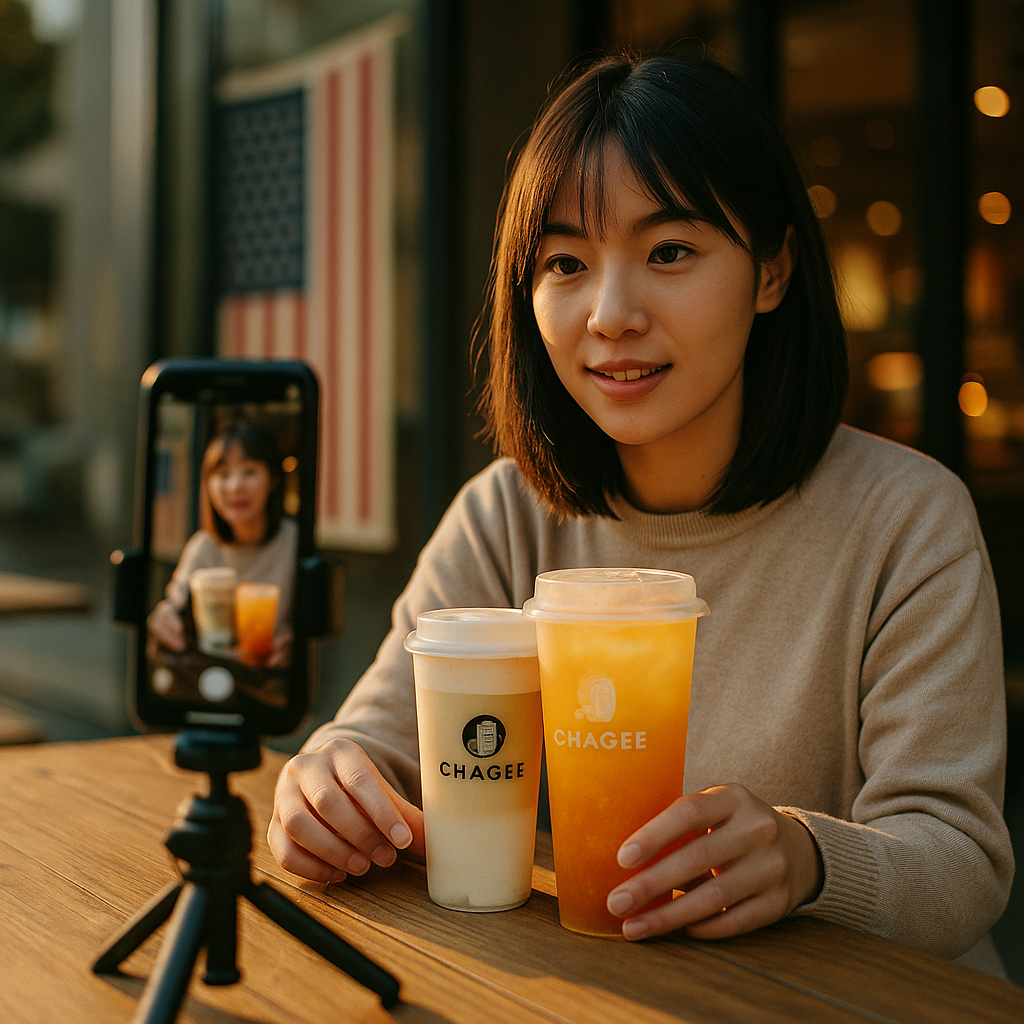
Zero celebrity endorsements. No Super Bowl spend. Just hundreds of nano-creators filming the same tea-shaking ritual on repeat. That’s how Chagee’s US retail debut built category awareness for a product most American consumers had never heard of. The results should make every CMO rethink what “market entry budget” actually means.
Launching a new beverage category is brutal. Launching a foreign beverage category, in a saturated US coffee-and-boba market, with zero brand recognition, is borderline masochistic. Chagee did it anyway, and it didn’t reach for celebrity spokespeople or splashy OOH buys to do it. It reached for nano-creators and a ritual.
The Problem: Nobody Knew What Chagee Even Was
Chagee is a Chinese tea chain, now one of the largest in the world by store count, expanding aggressively into international markets. When it set its sights on US retail and store openings, it faced a familiar problem for any brand crossing borders: category education has to happen before brand preference can.
Americans know Starbucks. They know boba, loosely, as “that drink with the bubbles.” They do not know what a proper tea-ritual pour looks like, what makes Chagee’s sourcing different, or why the shaking motion before serving matters. That’s a lot of unpaid education a brand normally has to buy through media.
The traditional playbook says: hire a celebrity or a mega-influencer with cultural crossover appeal, put them in front of the product, let their audience do the trusting for you. It’s expensive, and it’s also slow to build the kind of repeated, habitual exposure that turns a novelty drink into a daily order. Celebrity spend buys a moment. It doesn’t buy a habit.
Category education is a volume problem, not a reach problem. One celebrity post gets seen once. Two hundred nano-creators posting the same ritual gets normalized.
The Nano-Creator Bet
Instead of concentrating spend on a handful of high-follower names, Chagee’s US launch strategy leaned into nano-creators, generally people with under 10,000 followers, seeded across TikTok and Instagram in the metro areas where new stores were opening. The brief wasn’t “review this drink.” It was narrower and smarter: show the ritual.
Every video followed a loose but recognizable structure. The vigorous shake of the tea shaker. The pour. The reveal of the layered drink. Creators added their own captions, their own reactions, their own local flavor, but the visual grammar stayed consistent. That repetition is the whole point.
Nano-creators are cheap relative to macro talent, often working for product plus a modest fee rather than five- or six-figure contracts. But the real advantage isn’t cost. It’s authenticity signal. Audiences trust a friend-of-a-friend account showing genuine surprise at a new drink far more than they trust a celebrity who “just discovered” a brand that clearly paid for the discovery.
This mirrors what Fly By Jing did with chili crisp seeding, another case of an unfamiliar category getting normalized through volume creator seeding rather than celebrity endorsement. Category-defining brands increasingly skip the top of the funnel entirely and build directly at the grassroots level.
Why “Ritual” Content Outperforms Product Content
Here’s the insight that’s easy to miss: Chagee wasn’t asking creators to sell tea. It was asking them to perform a ritual. That distinction matters enormously for a new-to-market brand.
Product-focused content (“try this drink, it’s so good”) relies entirely on the viewer trusting the creator’s taste judgment. Ritual content works differently. It’s inherently watchable because it’s a small piece of visual theater, the shake, the pour, the layered color separation, regardless of whether the viewer cares about tea at all.
Ritual content also solves a second problem: repeatability without staleness. A hundred creators reviewing a drink in a hundred different ways feels chaotic and diluted. A hundred creators performing the same three-second shake motion, each with their own commentary layered on top, feels like a trend. It reads as a category behavior, not an ad campaign.
This is the same mechanic behind Grind Coffee’s TikTok Shop live playbook, where a repeatable visual moment did more heavy lifting than any single celebrity spot could. Repetition builds pattern recognition. Pattern recognition builds category ownership.
The Store-Opening Amplification Loop
Chagee’s retail debut wasn’t a single national moment. It was a rolling sequence of store openings, city by city. That structure is actually what made nano-creator seeding so efficient.
Each new store opening became a fresh seeding opportunity. Local nano-creators in that metro got early access, posted their ritual content timed to the opening, and generated hyperlocal buzz that a national campaign simply can’t replicate. A creator in Austin talking about “the new Chagee that just opened by my apartment” carries geographic relevance a celebrity spot never will.
This rolling structure also meant the brand wasn’t front-loading its entire creator budget into one launch moment. Spend scaled with store count, which kept CAC per market controllable, an underrated benefit when you’re expanding into a country you don’t have deep retail data on yet.
It’s a strategy with clear parallels to how Duluth Trading sold out workwear using nano-creators region by region rather than nationally all at once. Localized seeding lets a brand learn and adjust before it’s fully committed.
What This Means for Brand and Retail Marketers
If you’re a brand strategist watching Chagee’s approach and wondering whether it applies outside the beverage category, the honest answer is: it applies anywhere a brand needs to teach a behavior, not just sell a product.
Consider the operational lessons:
- Brief the behavior, not the pitch. Give creators a visual action to replicate, not a script to read. Behavior spreads faster than testimonials.
- Localize seeding to store openings or launch windows. Don’t spend the whole budget in week one. Let creator activity mirror your physical footprint.
- Track category search lift, not just branded search. If people start searching “tea ritual drink” instead of just “Chagee,” that’s category ownership forming.
- Resist the celebrity reflex. A celebrity post is a spike. A hundred nano-creators is a pattern. Patterns are what audiences internalize as normal, everyday behavior.
None of this means celebrity or macro-influencer partnerships are worthless. They still have a role, particularly once a category is established and a brand needs a halo moment. But for market entry, when trust and education matter more than glamour, nano-creators consistently outperform on cost-per-impression and, more importantly, cost-per-behavior-adopted.
Rare Beauty’s tiered creator strategy beating celebrity halo makes the same case in a completely different category. Tea shops and cosmetics don’t have much in common on the surface, but the underlying media logic is identical: distributed trust beats concentrated fame when the goal is habit formation.
Retail media budgets deserve scrutiny here too. Chagee’s approach implicitly argues that a chunk of what brands typically allocate to launch-week paid media and celebrity contracts might be better spent on a wider, cheaper, more repeatable creator base. That’s a hard pitch to make internally, especially to finance teams who like the predictability of a signed celebrity contract over the messier math of seeding hundreds of small creators. But the data on cost-per-acquisition for nano-tier programs, tracked across brands like Aldi UK’s nano-creator overstock sell-through, keeps pointing the same direction.
The Measurement Question Nobody Wants to Answer Honestly
Here’s where it gets uncomfortable for marketing leaders used to MMM models built around traditional media mix. Nano-creator category-education campaigns don’t produce clean, immediate attribution. You’re not going to see a tidy click-to-purchase path for “tea ritual content.” What you’ll see instead are proxy signals: branded search lift, foot traffic near new stores, UGC volume mentioning the brand unprompted, and social share of voice against boba and coffee competitors.
According to eMarketer, creator-driven campaigns increasingly get measured on engagement-to-consideration metrics rather than last-click conversion, precisely because category-education plays don’t behave like direct response campaigns. Brands entering the US retail space from abroad need to set that expectation with stakeholders before launch, not after the first earnings call.
HubSpot’s research on content marketing funnels backs this up: awareness-stage content, the kind nano-creator ritual videos deliver, needs different KPIs than bottom-funnel conversion content. Conflating the two is how good campaigns get killed early by impatient budget owners.
Platforms themselves are adjusting to this reality too. TikTok’s ad platform has been building better tools for tracking non-last-click impact specifically because brands running seeding-first strategies kept asking for it.
Compliance Still Matters, Even at Nano Scale
One risk brands underweight when scaling to hundreds of small creators: disclosure consistency. It’s easy to manage FTC compliance across ten macro-influencer contracts. It’s a different operational challenge across three hundred nano-creators, many of whom have never worked with a brand before and don’t know the rules.
Any brand running a program at this scale needs clear, simple disclosure guidance baked into the creator brief itself, not left to individual judgment. The FTC’s endorsement guidelines apply the same way to a 3,000-follower account as they do to a celebrity, and enforcement risk scales with volume, not just reach. A hundred non-compliant posts is a bigger liability surface than one.
This is one area where category-education campaigns run into friction the celebrity model doesn’t. A single signed contract with clear legal review is simpler to police than a distributed network of amateur creators. Brands considering this playbook should budget for a compliance layer, whether that’s a creator platform with built-in disclosure prompts or a dedicated review process, as part of the program cost, not an afterthought.
FAQs
Frequently Asked Questions
What made Chagee’s US launch different from a typical retail debut?
Chagee skipped celebrity endorsement and paid media saturation entirely, instead relying on nano-creators posting consistent, repeatable “tea ritual” content tied to individual store openings across US metros.
Why use nano-creators instead of macro-influencers for category education?
Nano-creators offer higher perceived authenticity and lower cost per post, and their content reads as organic behavior rather than sponsored endorsement, which matters when a brand is trying to normalize an unfamiliar product category.
How do you measure success for a category-education campaign like this?
Rather than last-click conversion, brands should track branded and category search lift, foot traffic near new store locations, unprompted UGC volume, and share of voice against established competitors like coffee and boba chains.
Does this approach work for categories beyond food and beverage?
Yes. Any brand entering a market with an unfamiliar product or behavior can apply the same logic: brief creators on a repeatable visual action rather than a sales pitch, and scale seeding geographically alongside physical expansion.
What compliance risks come with scaling to hundreds of nano-creators?
Disclosure consistency is the main risk. FTC endorsement rules apply regardless of follower count, so brands need standardized disclosure guidance built into creator briefs rather than relying on individual creators to self-police.
The takeaway for anyone planning a market entry in the coming year: budget for behavior repetition, not celebrity reach, and build your measurement plan around search and foot-traffic lift before the campaign launches, not after finance asks why last-click ROAS looks flat.
Top Influencer Marketing Agencies
The leading agencies shaping influencer marketing in 2026
Agencies ranked by campaign performance, client diversity, platform expertise, proven ROI, industry recognition, and client satisfaction. Assessed through verified case studies, reviews, and industry consultations.
Moburst

-
2

The Shelf
Boutique Beauty & Lifestyle Influencer AgencyA data-driven boutique agency specializing exclusively in beauty, wellness, and lifestyle influencer campaigns on Instagram and TikTok. Best for brands already focused on the beauty/personal care space that need curated, aesthetic-driven content.Clients: Pepsi, The Honest Company, Hims, Elf Cosmetics, Pure LeafVisit The Shelf → -
3

Audiencly
Niche Gaming & Esports Influencer AgencyA specialized agency focused exclusively on gaming and esports creators on YouTube, Twitch, and TikTok. Ideal if your campaign is 100% gaming-focused — from game launches to hardware and esports events.Clients: Epic Games, NordVPN, Ubisoft, Wargaming, Tencent GamesVisit Audiencly → -
4

Viral Nation
Global Influencer Marketing & Talent AgencyA dual talent management and marketing agency with proprietary brand safety tools and a global creator network spanning nano-influencers to celebrities across all major platforms.Clients: Meta, Activision Blizzard, Energizer, Aston Martin, WalmartVisit Viral Nation → -
5

The Influencer Marketing Factory
TikTok, Instagram & YouTube CampaignsA full-service agency with strong TikTok expertise, offering end-to-end campaign management from influencer discovery through performance reporting with a focus on platform-native content.Clients: Google, Snapchat, Universal Music, Bumble, YelpVisit TIMF → -
6

NeoReach
Enterprise Analytics & Influencer CampaignsAn enterprise-focused agency combining managed campaigns with a powerful self-service data platform for influencer search, audience analytics, and attribution modeling.Clients: Amazon, Airbnb, Netflix, Honda, The New York TimesVisit NeoReach → -
7

Ubiquitous
Creator-First Marketing PlatformA tech-driven platform combining self-service tools with managed campaign options, emphasizing speed and scalability for brands managing multiple influencer relationships.Clients: Lyft, Disney, Target, American Eagle, NetflixVisit Ubiquitous → -
8

Obviously
Scalable Enterprise Influencer CampaignsA tech-enabled agency built for high-volume campaigns, coordinating hundreds of creators simultaneously with end-to-end logistics, content rights management, and product seeding.Clients: Google, Ulta Beauty, Converse, AmazonVisit Obviously →