


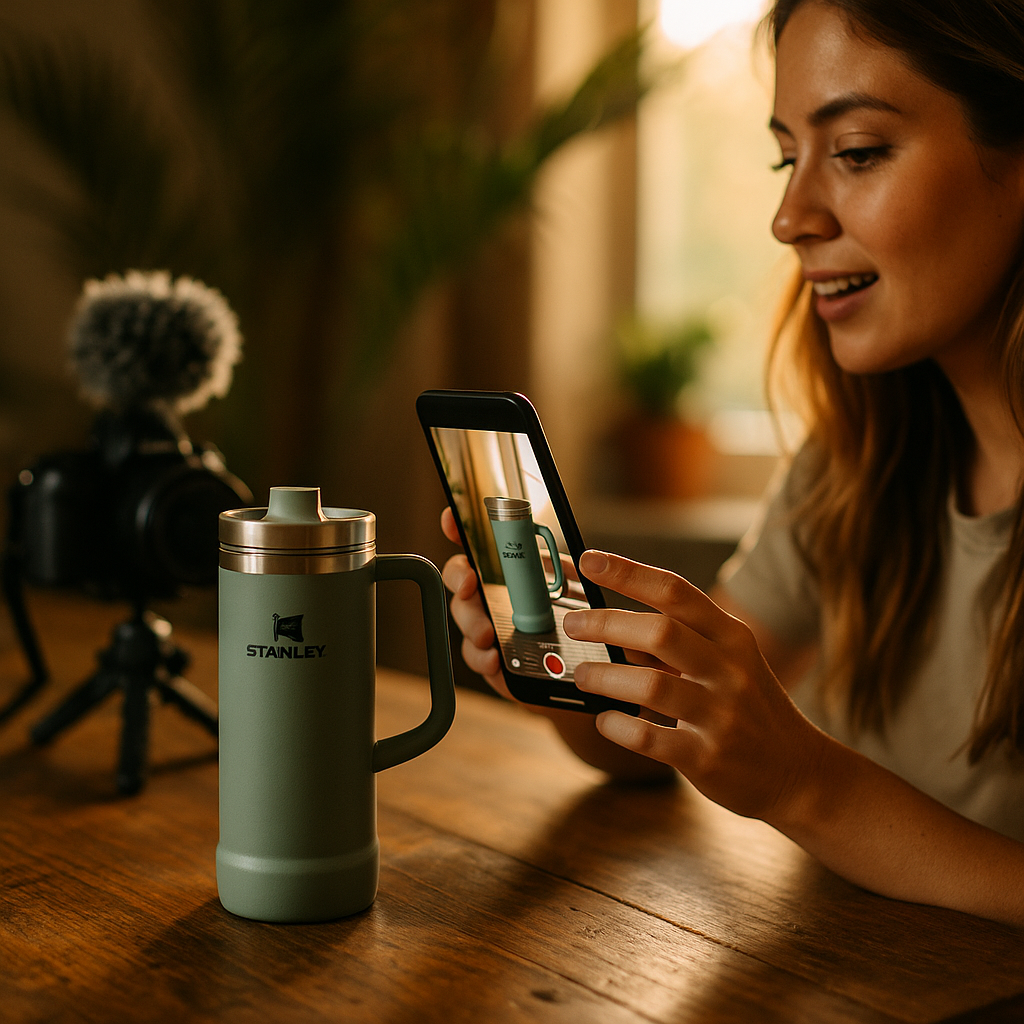
A 40-ounce water bottle outsold entire beverage categories on TikTok Shop. Stanley 1913, a company founded in 1913 that spent a century making unglamorous workwear thermoses, became the most talked-about consumer product on the platform almost overnight. The lesson for brand marketers isn’t “get lucky with Gen Z.” It’s that nano-creator seeding, done with discipline, can resurrect a legacy product faster than any paid media plan.
The Numbers Behind the Hype
Stanley’s Quencher tumbler went from a niche outdoor-industry SKU to a cultural object generating hundreds of millions of organic video views. Reports circulated of the company’s revenue climbing from around $70 million to well over $750 million in just a few years, largely credited to the Quencher line. That kind of growth doesn’t come from a Super Bowl spot. It comes from thousands of ordinary people filming themselves unboxing a cup.
Here’s the part most case studies skip: Stanley didn’t design this campaign from a boardroom deck. A group of bloggers known as The Buy Guide approached Stanley, bought bottles wholesale, and started gifting them to their own audiences. Stanley noticed the traction and leaned in, hard. That pivot, from ignoring grassroots demand to fueling it deliberately, is the actual playbook.
Stanley’s turnaround proves that virality isn’t an accident you wait for. It’s a seeding infrastructure you build, then get out of the way of.
What Nano-Creator Seeding Actually Means Here
Nano-creators, typically accounts with 1,000 to 20,000 followers, are not chosen for reach. They’re chosen for believability. A nano-creator’s audience is often friends, coworkers, or local community members who trust the recommendation because it doesn’t feel like an ad.
Stanley’s approach worked because it stacked hundreds of small, credible voices instead of betting everything on a handful of macro-influencers. Compare this to brands still allocating 80% of influencer budget to five celebrity partnerships. The math doesn’t hold up anymore. A single nano-creator video showing genuine surprise (“wait, this cup actually keeps ice for two days?”) outperforms a polished celebrity post on trust metrics, even if the raw view count is smaller.
This mirrors what worked for Chubbies when it sold out shorts using the same tiered, high-volume seeding logic instead of a single hero campaign.
Why Nostalgia Products Are Prime Candidates
Legacy brands sitting on decades-old product lines have an underrated advantage: authenticity is already baked in. Stanley didn’t need to manufacture a heritage story. It had one. The job was translating “durable, made-for-work thermos” into “aesthetic, color-coordinated lifestyle object” without losing the credibility of the original product.
Nano-creators are exceptional at this translation work because they’re not brand professionals. They talk about products the way normal consumers talk, which is exactly the register a 100-year-old brand needs to sound relevant on a platform built for spontaneity.
The Playbook: Five Moves Any Brand Can Copy
Strip away the Stanley-specific mythology and you get a repeatable operating model. Here’s what marketing teams should actually build.
- Seed wide before seeding deep. Send product to hundreds of nano-creators in relevant lifestyle niches (fitness, moms, office culture, outdoor) rather than a handpicked dozen. Volume creates statistical odds that some content breaks out organically.
- Let color and limited drops do the marketing. Stanley’s rotating seasonal colorways created natural FOMO content, unboxing videos, color-matching hauls, “which one should I buy” comment threads. Product variety is a content engine, not just a merchandising decision.
- Watch for organic breakout signals, then amplify. When The Buy Guide’s content started performing, Stanley didn’t ignore it as noise. It formalized the relationship and scaled the approach. Brands need social listening infrastructure to catch these signals early, not three months after the trend peaks.
- Whitelist top-performing organic content into paid media. Once a nano-creator video proves it converts, running it as a targeted ad extends its life well past the organic algorithm’s attention span.
- Make the product itself shareable. The Quencher’s handle, straw lid, and cup-holder fit weren’t accidents, they were built for a person to hold it up on camera. Product design and content strategy are no longer separate departments.
This is the same principle that powered Olipop’s creator whitelisting strategy, where organic wins got a paid-media second life instead of dying after 48 hours.
Where Most Brands Get the Seeding Math Wrong
The instinct for a lot of marketing teams is to over-brief nano-creators, treating them like mini agencies with talking points and hashtag requirements. That kills the exact authenticity that makes nano-seeding work. Stanley’s most effective content looked unscripted because, largely, it was.
Another common mistake: measuring nano-creator campaigns by follower count instead of engagement rate and conversion signal. A creator with 4,000 followers and an 8% engagement rate on TikTok Shop is worth more to a seeding program than one with 40,000 followers and a 1% rate. According to Sprout Social’s benchmarking research, engagement rates decline steadily as follower count rises, which is precisely why nano tiers outperform on trust-based metrics even when they underperform on reach.
Budget allocation is the other blind spot. Brands with legacy media-buying habits still want one big campaign moment. Stanley’s growth came from sustained, unglamorous seeding over many months, not a single viral spike. If your influencer budget is structured like a TV flight (burst, pause, burst) it’s fighting against how nano-seeded virality actually compounds.
The Retail and Foot Traffic Ripple Effect
Stanley’s online virality didn’t stay online. Target and other retail partners reported stockouts driven directly by TikTok demand, with shoppers walking into stores hunting for specific colorways they’d seen in a video the night before. That online-to-offline pull is a pattern brand teams should plan for explicitly, not treat as a happy accident.
Retail teams that coordinate inventory forecasting with social listening data can catch a surge before it empties shelves. A QSR chain’s use of TikTok’s local feed shows a similar logic applied to driving physical visits, proving the online-to-offline bridge isn’t unique to product brands.
Applying This Beyond Water Bottles
Skeptical this only works for a $45 lifestyle tumbler? It doesn’t. The same seeding logic has powered wins across categories that look nothing alike. Fly By Jing’s chili crisp seeding strategy built a cult condiment brand using near-identical nano-creator density. Wyze’s cult camera brand did it in consumer electronics, a category typically dominated by big-box advertising budgets.
The common thread isn’t the product category. It’s operational discipline: consistent seeding cadence, fast response to organic signal, and a willingness to let creators control the narrative voice instead of legal and brand teams.
The brands winning nano-creator seeding treat it as an always-on operations function, not a seasonal campaign line item.
Compliance Considerations Brand Teams Can’t Skip
Gifting product to hundreds of creators creates disclosure obligations that scale with volume. The FTC’s endorsement guidelines require clear disclosure whenever a material connection exists, including free product seeding, regardless of creator size. Brands running seeding programs at Stanley’s scale need contracts and disclosure training baked into onboarding, not an afterthought handled by whoever manages the shipping spreadsheet.
For teams operating in the UK or EU, the ICO’s guidance on advertising and marketing is worth reviewing alongside platform-specific rules, since disclosure standards aren’t identical across regions. TikTok’s own TikTok for Business platform includes branded content toggles that make disclosure easier to enforce at scale, and there’s no good reason not to require it as a condition of the free product.
Measuring What Actually Matters
Vanity metrics (views, likes) tell you a campaign is loud. They don’t tell you it’s working. Brand teams running nano-creator seeding programs should track:
- TikTok Shop conversion rate by creator tier, not just aggregate campaign performance
- Share of voice for branded hashtags relative to competitor mentions
- Retail point-of-sale lift in markets with concentrated seeding activity
- Whitelisting performance versus organic-only benchmark for the same content
According to eMarketer’s research on creator marketing, brands that tie influencer spend to commerce-attributed metrics report significantly stronger budget retention year over year than those measuring reach alone. That’s the internal argument every marketing lead needs ready for the next budget review.
The next step for any brand sitting on an underappreciated legacy product: audit whether your product is physically “camera-ready,” build a nano-creator seeding list of at least 200 names before your next launch, and set a 72-hour response protocol for amplifying organic breakout content the moment it appears.
FAQs
What is nano-creator seeding?
Nano-creator seeding is the practice of gifting products to creators with roughly 1,000 to 20,000 followers, prioritizing trust and engagement over reach. It works because audiences perceive these creators as peers rather than professional endorsers.
How many creators should a seeding campaign include?
There’s no fixed number, but successful programs like Stanley’s typically involve hundreds of creators rather than a small curated list, since volume increases the odds of organic breakout content.
Do nano-creators need to disclose gifted products?
Yes. Under FTC guidelines, any material connection, including free product, requires clear and conspicuous disclosure, regardless of the creator’s follower count.
How is nano-creator seeding different from influencer whitelisting?
Seeding is the initial gifting and content-generation phase. Whitelisting happens afterward, when a brand pays to run top-performing organic content as targeted paid media using the creator’s handle.
Can nano-creator seeding work for B2B or non-lifestyle products?
Yes, though the content style shifts. The underlying principle, trust-driven peer recommendation over polished endorsement, applies across categories, from consumer packaged goods to software.
Top Influencer Marketing Agencies
The leading agencies shaping influencer marketing in 2026
Agencies ranked by campaign performance, client diversity, platform expertise, proven ROI, industry recognition, and client satisfaction. Assessed through verified case studies, reviews, and industry consultations.
Moburst

-
2

The Shelf
Boutique Beauty & Lifestyle Influencer AgencyA data-driven boutique agency specializing exclusively in beauty, wellness, and lifestyle influencer campaigns on Instagram and TikTok. Best for brands already focused on the beauty/personal care space that need curated, aesthetic-driven content.Clients: Pepsi, The Honest Company, Hims, Elf Cosmetics, Pure LeafVisit The Shelf → -
3

Audiencly
Niche Gaming & Esports Influencer AgencyA specialized agency focused exclusively on gaming and esports creators on YouTube, Twitch, and TikTok. Ideal if your campaign is 100% gaming-focused — from game launches to hardware and esports events.Clients: Epic Games, NordVPN, Ubisoft, Wargaming, Tencent GamesVisit Audiencly → -
4

Viral Nation
Global Influencer Marketing & Talent AgencyA dual talent management and marketing agency with proprietary brand safety tools and a global creator network spanning nano-influencers to celebrities across all major platforms.Clients: Meta, Activision Blizzard, Energizer, Aston Martin, WalmartVisit Viral Nation → -
5

The Influencer Marketing Factory
TikTok, Instagram & YouTube CampaignsA full-service agency with strong TikTok expertise, offering end-to-end campaign management from influencer discovery through performance reporting with a focus on platform-native content.Clients: Google, Snapchat, Universal Music, Bumble, YelpVisit TIMF → -
6

NeoReach
Enterprise Analytics & Influencer CampaignsAn enterprise-focused agency combining managed campaigns with a powerful self-service data platform for influencer search, audience analytics, and attribution modeling.Clients: Amazon, Airbnb, Netflix, Honda, The New York TimesVisit NeoReach → -
7

Ubiquitous
Creator-First Marketing PlatformA tech-driven platform combining self-service tools with managed campaign options, emphasizing speed and scalability for brands managing multiple influencer relationships.Clients: Lyft, Disney, Target, American Eagle, NetflixVisit Ubiquitous → -
8

Obviously
Scalable Enterprise Influencer CampaignsA tech-enabled agency built for high-volume campaigns, coordinating hundreds of creators simultaneously with end-to-end logistics, content rights management, and product seeding.Clients: Google, Ulta Beauty, Converse, AmazonVisit Obviously →