


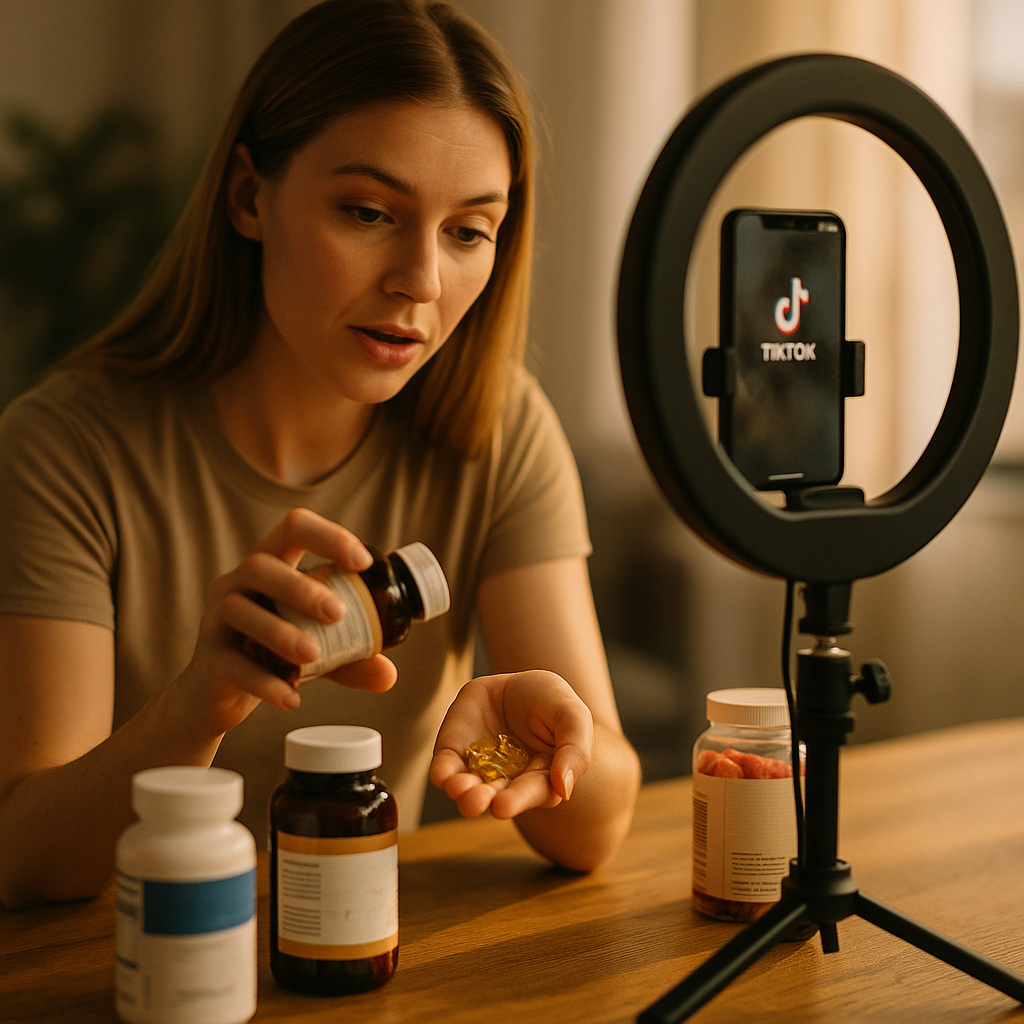
Supplements convert on TikTok Shop at rates most CPG categories would kill for — some brands report checkout rates north of 8% on live demo content. But here’s the catch: the same urgency-driven format that drives TikTok Shop supplement category conversion also sits closest to the platform’s compliance tripwires. Get the structure wrong, and you’re not losing reach. You’re losing the account.
Why Supplements Convert Differently Than Everything Else
Beauty converts on transformation. Fashion converts on aspiration. Supplements convert on relief — the promise that a nagging problem (bloating, low energy, poor sleep) goes away fast. That emotional trigger is what makes supplement demos so watchable, and so shoppable, in a single scroll.
TikTok’s own commerce data has consistently shown health and wellness as one of the top three GMV-driving categories on Shop, trailing only beauty and apparel in raw volume but often beating both on conversion rate per view. That’s not a fluke. It’s a format effect. Short, high-energy demos that show cause-and-effect (take the gummy, feel the difference) compress the consideration cycle that normally takes weeks into 30 seconds.
Supplement demos convert fast because they sell relief, not aspiration — but relief-based claims are exactly what regulators scrutinize hardest.
We covered the underlying numbers in detail in our breakdown of TikTok Shop supplement conversion data, and the pattern holds across categories: gut health, sleep aids, and pre-workout formulas post the highest add-to-cart velocity of any CPG subcategory tracked on the platform.
The Compliance Trap Hiding Inside High-Velocity Content
Here’s the tension every brand manager needs to sit with: the exact narrative structure that drives conversion — problem, demo, instant result, purchase link — is also the structure regulators associate with unsubstantiated health claims. The FTC doesn’t care that your creator was being “authentic.” If a video implies a supplement cures anxiety or melts fat overnight, that’s a liability regardless of how organically it performed.
TikTok has tightened enforcement here too. Health claims tied to weight loss, disease treatment, or mental health outcomes now trigger stricter content review on Shop specifically, and repeat violations can suspend a seller’s entire catalog, not just the offending video. That’s the operational risk marketing leads underestimate: one creator’s overzealous CTA can freeze revenue across an entire product line.
We detailed the mechanics of this risk in TikTok Shop supplement marketing compliance, and the throughline is simple — velocity and risk scale together in this category. You can’t optimize for one without actively managing the other.
What “Compliant High-Velocity” Actually Means
It doesn’t mean slow. It doesn’t mean boring. It means structuring the demo so the persuasive beats come from format and pacing, not from unverifiable claims. That’s a scripting discipline, not a creative constraint.
- Show, don’t diagnose. Demonstrate the product being used correctly. Avoid narrating what it “fixes” in medical terms.
- Anchor claims to labeled benefits. If the bottle says “supports digestion,” the script says “supports digestion” — not “cures bloating.”
- Separate personal testimony from brand claims. “This worked for me” carries different regulatory weight than “this works,” and TikTok’s review systems are increasingly sensitive to the distinction.
- Disclose consistently. Paid partnership labels aren’t optional theater. They’re the first thing platform trust-and-safety systems check when a video gets flagged.
Structuring the Demo: A Four-Beat Framework That Still Converts
Every high-performing supplement demo on TikTok Shop follows some version of this arc, whether the brand designed it deliberately or the creator stumbled into it. Formalizing it protects both performance and compliance.
- Hook (0–3 seconds): A relatable friction point, stated as experience, not diagnosis. “I’ve been so tired by 2pm every day” beats “chronic fatigue is ruining my life.”
- Demo (3–15 seconds): Physical product interaction. Scooping, swallowing, mixing. This is the trust-building beat — viewers need to see the product used as directed.
- Result framing (15–25 seconds): Personal, time-bound, and qualified. “After about two weeks, I noticed I wasn’t crashing as hard.” Avoid absolute language like “instantly” or “completely gone.”
- CTA (25–30 seconds): Direct to the Shop tab, with the paid partnership label visible and the on-screen caption reinforcing the labeled benefit, not an inferred one.
This structure isn’t a creative cage. It’s the same arc that already wins on the platform. You’re just closing the loopholes that get videos removed after they’ve already spent budget and built momentum.
Live Shopping Raises the Stakes
Live demos are where supplement brands see the steepest conversion spikes — and the steepest compliance exposure. Unscripted, real-time hosts riffing on benefits tend to drift into claims territory fast, especially during Q&A segments when viewers ask “will this help with my [specific condition]?”
This is where brand-side prep matters more than creative talent. Hosts need a claims cheat sheet, not just a product one-pager. What can be said, what can’t, and what the redirect language sounds like when a viewer pushes for a medical answer (“I’m not able to speak to that, but here’s what’s on the label”). Brands running frequent lives should treat this the same way they’d treat a call center script for a regulated product, because functionally, that’s what it is.
For brands adapting the broader high-energy demo format across the wellness category, our piece on the high-energy demo formula breaks down pacing techniques that hold up under both platform review and FTC scrutiny.
Creator Vetting Is Now a Compliance Function, Not Just a Casting One
Brands still treat creator selection as a content-quality decision: does this person have good lighting, a strong hook, an engaged audience? That’s necessary but no longer sufficient in the supplement category. You also need to vet for claims history. Has this creator been flagged before? Do they have a pattern of overstating outcomes in past sponsored content? Platforms increasingly weight creator-level trust signals when deciding how much reach a piece of branded content gets.
Run a claims audit on the last 10-15 sponsored videos from any creator you’re considering for a supplement campaign. It takes an afternoon and it will save you a suspended listing later.
This mirrors a trend we’re seeing platform-wide: reach itself is becoming conditional on disclosure hygiene. TikTok’s own paid partnership labeling rules now directly throttle distribution for videos that mislabel or skip disclosure, and the pattern shows up on other platforms too — see how Instagram now boosts labeled branded content instead of penalizing it. The incentive structure across every major platform is converging on the same principle: disclosed, compliant content gets algorithmic favor. Undisclosed content gets suppressed.
Building the Brief: What Legal, Growth, and Creative Need to Agree On Before Filming
The brands winning in this category have stopped treating legal review as a bottleneck that happens after creative is locked. They’ve built a pre-approved language bank — a list of claim phrasings that are both compliant and conversion-tested — that creators pull from during scripting, not after filming.
Practically, that means:
- A shared doc of approved benefit language, updated whenever label claims change.
- A short list of banned words (cure, treat, eliminate, instantly, guaranteed) that trigger automatic script revision.
- A fast-turnaround review lane (under 24 hours) for time-sensitive live shopping scripts, so compliance doesn’t become the reason a campaign misses a trend window.
Growth teams resist this at first because it feels like friction. In practice, it’s the opposite. A pre-approved language bank speeds up creator onboarding because there’s less back-and-forth over what can and can’t be said. HubSpot’s research on content operations backs this up broadly: standardized creative guardrails reduce production cycle time even as they increase review rigor.
Measuring What Actually Matters
Conversion rate alone is a dangerous north star in this category, because the highest-converting videos are sometimes the ones sitting closest to the compliance line. Smart teams are now tracking a second metric alongside conversion: claims density — the number of unsubstantiated or borderline statements per video, scored during review.
Pair that with platform-reported metrics like watch-through rate and Shop tab click rate, which TikTok’s TikTok for Business dashboard surfaces at the campaign level, and you get a much clearer picture of which videos are converting on format strength versus converting on claim intensity. The former scales safely. The latter is a countdown clock.
Third-party category data from firms like eMarketer continues to show social commerce, and supplements specifically, as one of the fastest-growing subsegments of retail media spend — which means scrutiny from both platforms and regulators will only intensify as more dollars flow in.
A Quick Gut Check Before You Greenlight the Next Demo Script
Ask three questions before any supplement demo goes live: Does the script attribute the result to the labeled benefit or an inferred one? Is the disclosure visible and unambiguous, not buried in a caption? And would this script survive a read-through from your legal team without a single edit? If the answer to any of those is no, you’re optimizing for a conversion spike that expires the moment compliance catches up.
Frequently Asked Questions
What conversion rates are typical for supplements on TikTok Shop?
Top-performing supplement demos have reported checkout rates in the high single digits, well above the platform average across most CPG categories, though performance varies heavily by subcategory and creator trust level.
What health claims are off-limits in TikTok Shop supplement content?
Any claim implying disease treatment, cure, or diagnosis is prohibited under both FTC guidelines and TikTok’s commerce policies. Benefit language should mirror what’s approved on the product label, not extend beyond it.
How does live shopping affect compliance risk for supplement brands?
Live formats increase risk because hosts often improvise responses to viewer questions in real time. Brands should provide a claims cheat sheet and redirect language for unscripted Q&A moments.
Does creator disclosure actually affect reach on TikTok?
Yes. TikTok’s paid partnership labeling requirements are now tied to distribution, meaning properly disclosed content is favored over undisclosed or ambiguously labeled videos.
How can brands balance high-velocity demo pacing with compliance review?
By pre-approving benefit language and banned terms before scripting begins, and building a fast review lane for time-sensitive content so compliance checks don’t slow down live shopping windows.
The brands winning in this category aren’t the ones with the boldest claims — they’re the ones who turned compliance into a scripting shortcut instead of a bottleneck. Build the language bank first, then let creators move fast inside it.
Top Influencer Marketing Agencies
The leading agencies shaping influencer marketing in 2026
Agencies ranked by campaign performance, client diversity, platform expertise, proven ROI, industry recognition, and client satisfaction. Assessed through verified case studies, reviews, and industry consultations.
Moburst

-
2

The Shelf
Boutique Beauty & Lifestyle Influencer AgencyA data-driven boutique agency specializing exclusively in beauty, wellness, and lifestyle influencer campaigns on Instagram and TikTok. Best for brands already focused on the beauty/personal care space that need curated, aesthetic-driven content.Clients: Pepsi, The Honest Company, Hims, Elf Cosmetics, Pure LeafVisit The Shelf → -
3

Audiencly
Niche Gaming & Esports Influencer AgencyA specialized agency focused exclusively on gaming and esports creators on YouTube, Twitch, and TikTok. Ideal if your campaign is 100% gaming-focused — from game launches to hardware and esports events.Clients: Epic Games, NordVPN, Ubisoft, Wargaming, Tencent GamesVisit Audiencly → -
4

Viral Nation
Global Influencer Marketing & Talent AgencyA dual talent management and marketing agency with proprietary brand safety tools and a global creator network spanning nano-influencers to celebrities across all major platforms.Clients: Meta, Activision Blizzard, Energizer, Aston Martin, WalmartVisit Viral Nation → -
5

The Influencer Marketing Factory
TikTok, Instagram & YouTube CampaignsA full-service agency with strong TikTok expertise, offering end-to-end campaign management from influencer discovery through performance reporting with a focus on platform-native content.Clients: Google, Snapchat, Universal Music, Bumble, YelpVisit TIMF → -
6

NeoReach
Enterprise Analytics & Influencer CampaignsAn enterprise-focused agency combining managed campaigns with a powerful self-service data platform for influencer search, audience analytics, and attribution modeling.Clients: Amazon, Airbnb, Netflix, Honda, The New York TimesVisit NeoReach → -
7

Ubiquitous
Creator-First Marketing PlatformA tech-driven platform combining self-service tools with managed campaign options, emphasizing speed and scalability for brands managing multiple influencer relationships.Clients: Lyft, Disney, Target, American Eagle, NetflixVisit Ubiquitous → -
8

Obviously
Scalable Enterprise Influencer CampaignsA tech-enabled agency built for high-volume campaigns, coordinating hundreds of creators simultaneously with end-to-end logistics, content rights management, and product seeding.Clients: Google, Ulta Beauty, Converse, AmazonVisit Obviously →