


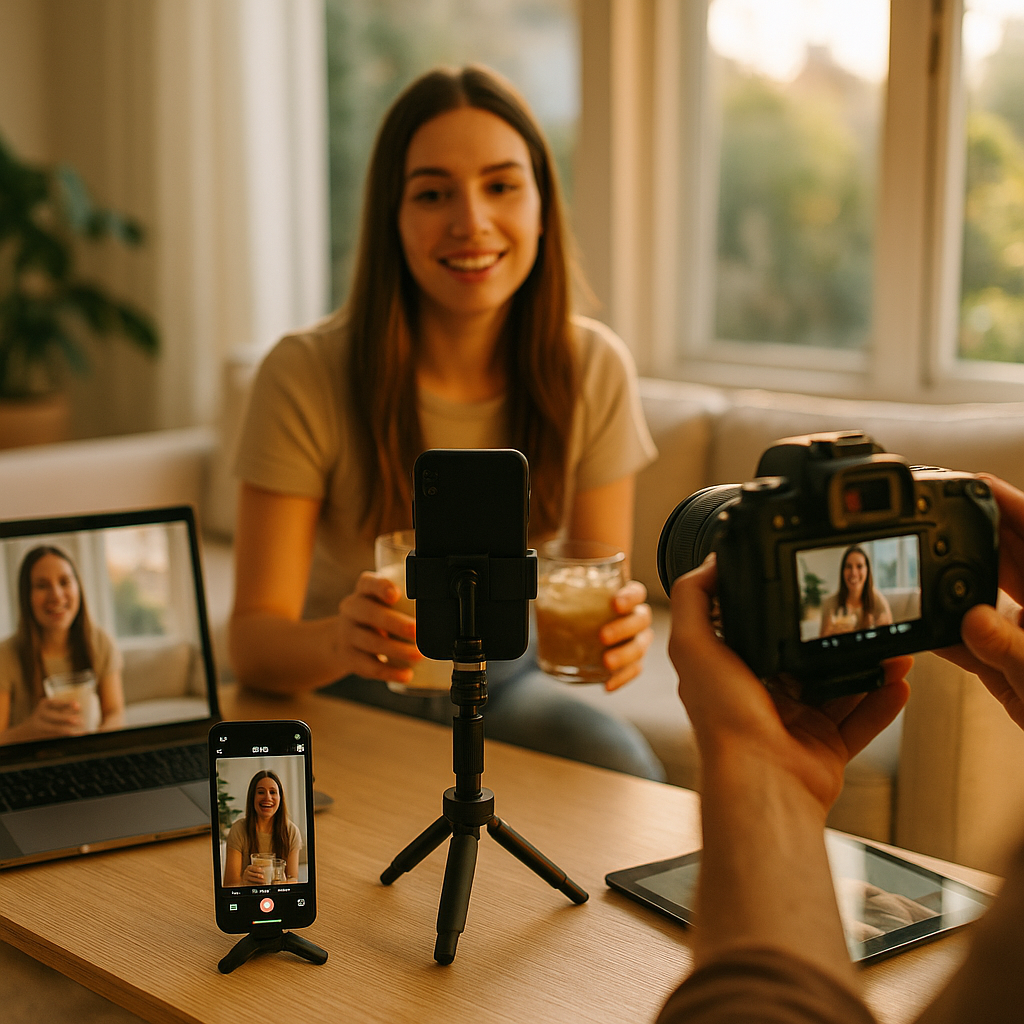
Brands are paying for one 30-second video and quietly needing eleven different versions of it. If your creator briefs still ask for a “finished piece of content” instead of raw modular components, you’re leaving reach — and budget — on the table. The remixable asset brief fixes that by treating every shoot as a footage library, not a final cut.
Most influencer briefs are written like a movie treatment: hook, story arc, CTA, done. That works fine for one placement on one channel. It falls apart the moment retail media, paid social, and organic all want a version tailored to their own specs. A remixable asset brief flips the model. Instead of directing a creator toward a single finished video, you direct them to shoot modular components — B-roll, talking segments, product beauty shots, text-on-screen moments — that your team (or an editor, or an AI recut tool) can reassemble into whatever the channel demands.
Why One Video Was Never Going to Be Enough
Think about where a single piece of creator content actually needs to live today. Organic Instagram wants something native and loose. TikTok Shop wants a demo with a clear CTA in the first three seconds. Amazon and Walmart Connect want square or vertical creative stripped of platform branding. Paid social wants a hook-heavy cutdown optimized for engaged view thresholds. That’s four distinct edits from four distinct specs, and most brands are still commissioning four separate shoots to get there.
That’s expensive, slow, and creatively inconsistent — four creators telling four slightly different stories about the same product. eMarketer and emarketer.com have tracked steady growth in retail media ad spend for several years running, and brands increasingly need the same creator asset repurposed across a marketplace listing, a Meta ad, and an organic post without paying for three shoots.
A single well-briefed UGC shoot can yield 8-12 distinct deliverables if the creator is directed to shoot in modular components instead of one continuous narrative.
What a Remixable Asset Brief Actually Contains
Forget “tell a story about how you use the product.” That’s a brief for a single output. A remixable brief instructs the creator to capture discrete, swappable units. Here’s the anatomy:
- The cold-open hook (3-5 versions): Different first lines, different framing — a question, a bold claim, a visual gag. Paid teams need options to A/B test.
- Silent B-roll blocks: Product-in-hand shots, close-ups, texture or ingredient detail, with zero dialogue. These become retail media hero footage and platform-agnostic filler.
- Modular proof points: Three or four standalone statements about benefits, each shot as its own clip so editors can drop in whichever claim fits the channel’s compliance needs.
- A native-style closer: A casual, off-the-cuff sign-off that reads as organic, separate from any hard sell.
- Clean plates: Shots with no text overlay or branding baked in, so retail media and paid teams can add their own graphics without re-shooting.
Notice what’s missing: a rigid script that locks dialogue to a single sequence. The brief specifies components, not a timeline. Sequencing happens in post, by your team, per channel.
Directing for Modularity Without Losing Authenticity
Here’s the objection every brand marketer raises: doesn’t this make the content feel stiff, over-produced, less “real”? Fair concern. UGC’s entire value proposition rests on it not looking like an ad.
The fix is directional language, not scripted lines. Instead of “say this exact sentence,” brief the creator on the job each clip needs to do: “In this clip, explain what made you skeptical before trying it.” Let them say it in their own words, three different ways, across three takes. You get natural performance and modular options in the same shoot. This is the same logic behind the skeptic-to-convert arc, where authenticity comes from letting the creator’s real reaction carry the narrative rather than a locked script.
It also helps to borrow structure from formats built for chopping. The multi-format UGC shoot template already establishes shot lists designed for multiple aspect ratios and durations in a single session — the remixable asset brief just extends that logic to channel-specific narrative purpose, not just format dimensions.
Retail Media Changes the Math
Retail media is the channel most brands underestimate when writing creator briefs, and it’s the one punishing them hardest for not planning ahead. Amazon Creator Connections, Walmart Connect, and Target Roundel all have their own creative specs, and none of them want your organic TikTok caption text baked into the footage. If your creator brief didn’t anticipate that, you’re paying for a re-shoot or a clumsy crop job.
Statista’s advertising data continues to show retail media as one of the fastest-growing ad categories globally — see statista.com for category tracking — which means the cost of not planning for retail media reuse only compounds each quarter.
Build retail media into the brief from day one: request clean product shots with generous negative space (retail platforms often add their own badges and pricing overlays), and ask creators to hold products steady for at least 2-3 seconds so retail media editors can freeze-frame for thumbnail use. Small details, big downstream savings.
The Paid Media Cutdown Problem
Paid social teams have a different complaint entirely: organic-first creator content rarely has a hook strong enough to survive the first few seconds of a cold feed. A remixable brief solves this by requesting hook variants as a separate, explicit deliverable — not something an editor tries to manufacture later from footage that was never built for it.
Meta’s own creative guidance, available at business.meta.com, consistently emphasizes front-loading value in the first few seconds for paid placements. If your creator only shot one slow-building intro, no editor can retroactively fix that in Premiere.
Briefing three hook variants per shoot costs almost nothing in creator time but can be the difference between a $12 CPA and a $34 CPA once the asset hits paid social.
Compliance Doesn’t Disappear Just Because Footage Is Modular
Modular doesn’t mean loose on disclosure. If anything, remixable assets raise the compliance stakes, because the same footage might end up in a sponsored paid ad, an organic post, and a retail listing — each with different disclosure expectations under FTC guidance. Bake disclosure into every version at the brief stage, not as an afterthought during editing. If a proof-point clip gets reused in a paid ad six months later, you don’t want to scramble to figure out whether it still needs a #ad tag baked in versus platform-level disclosure tools.
Brands that have been burned by this exact scenario tend to overcorrect the next time; it’s worth reviewing how token-gated content briefs handle compliance boundaries, since the same discipline applies to any asset with a long reuse tail.
Operationalizing the Library, Not Just the Shoot
A remixable brief is only half the equation. The other half is where that footage lives once it’s delivered. If your modular clips land in a shared drive with filenames like “IMG_4482.mov,” you’ve built a library nobody can use. Tag footage by component type (hook, B-roll, proof point, closer) and by usage rights at the point of ingestion, not three months later when legal asks.
This is exactly the problem unified library distribution is designed to solve — one ingestion pipeline, tagged and searchable, feeding every channel team from the same pool of creator-shot components.
Some brands are already using AI tools to accelerate the recut process itself, generating channel-specific cutdowns automatically once footage is tagged. The workflow for turning one live stream into a week of content with AI follows the same principle: shoot once with modularity in mind, let automation (or a lean internal team) handle the reassembly.
What to Put in the Brief Template Itself
If you’re building this from scratch, structure the document in four parts: campaign context and disclosure requirements up top; a component shot list (hooks, B-roll, proof points, closer, clean plates) with rough duration targets for each; channel destination notes so the creator understands why they’re shooting multiple hook variants; and a delivery spec (aspect ratios, file naming, raw footage vs. edited cuts). Keep the creative direction conversational — creators perform better when they understand intent, not just instructions.
It’s also worth cross-referencing budget expectations early. Modular shoots take slightly longer to direct and review than single-output shoots, and the content format diversification budget framework is a useful reference point for pricing that extra time fairly without overpaying for what’s still fundamentally one shoot day.
For more general guidance on structuring creator briefs and measuring content performance across formats, HubSpot’s marketing resources at hubspot.com and Sprout Social’s platform benchmarks at sproutsocial.com are both solid starting points for teams building this process for the first time.
Next step: pull your last three creator briefs and count how many separate shoots you commissioned to cover organic, paid, and retail. If it’s more than one per channel, rewrite your next brief as a component list instead of a script, and measure the cost-per-deliverable difference on the other side.
FAQs
What is a remixable asset brief?
It’s a creator brief structured around modular footage components — hooks, B-roll, proof points, closers — rather than a single finished video, so the resulting footage can be recut for multiple channels without additional shoots.
How is this different from a standard UGC brief?
A standard brief asks for one finished narrative. A remixable brief asks for discrete, swappable clips that a team can reassemble differently for organic, paid, and retail media, cutting reshoot costs and speeding up multi-channel launches.
Does modular footage cost more to produce?
Slightly, in creator direction and review time, but it typically costs far less than commissioning separate shoots per channel. Most brands see the savings show up in the second and third recut, not the first.
How do you keep modular content from feeling scripted or fake?
Brief the intent of each clip rather than exact dialogue, and let creators say it in their own words across multiple takes. Directional prompts preserve authenticity while still giving editors options to work with.
Does the same disclosure apply across every recut version?
Not automatically. Disclosure requirements can differ between organic posts, paid ads, and retail placements, so compliance needs to be addressed at the brief stage and checked again each time footage is reused in a new placement.
Visible FAQ (HTML)
(See FAQ section above — duplicated in schema format below.)
Top Influencer Marketing Agencies
The leading agencies shaping influencer marketing in 2026
Agencies ranked by campaign performance, client diversity, platform expertise, proven ROI, industry recognition, and client satisfaction. Assessed through verified case studies, reviews, and industry consultations.
Moburst

-
2

The Shelf
Boutique Beauty & Lifestyle Influencer AgencyA data-driven boutique agency specializing exclusively in beauty, wellness, and lifestyle influencer campaigns on Instagram and TikTok. Best for brands already focused on the beauty/personal care space that need curated, aesthetic-driven content.Clients: Pepsi, The Honest Company, Hims, Elf Cosmetics, Pure LeafVisit The Shelf → -
3

Audiencly
Niche Gaming & Esports Influencer AgencyA specialized agency focused exclusively on gaming and esports creators on YouTube, Twitch, and TikTok. Ideal if your campaign is 100% gaming-focused — from game launches to hardware and esports events.Clients: Epic Games, NordVPN, Ubisoft, Wargaming, Tencent GamesVisit Audiencly → -
4

Viral Nation
Global Influencer Marketing & Talent AgencyA dual talent management and marketing agency with proprietary brand safety tools and a global creator network spanning nano-influencers to celebrities across all major platforms.Clients: Meta, Activision Blizzard, Energizer, Aston Martin, WalmartVisit Viral Nation → -
5

The Influencer Marketing Factory
TikTok, Instagram & YouTube CampaignsA full-service agency with strong TikTok expertise, offering end-to-end campaign management from influencer discovery through performance reporting with a focus on platform-native content.Clients: Google, Snapchat, Universal Music, Bumble, YelpVisit TIMF → -
6

NeoReach
Enterprise Analytics & Influencer CampaignsAn enterprise-focused agency combining managed campaigns with a powerful self-service data platform for influencer search, audience analytics, and attribution modeling.Clients: Amazon, Airbnb, Netflix, Honda, The New York TimesVisit NeoReach → -
7

Ubiquitous
Creator-First Marketing PlatformA tech-driven platform combining self-service tools with managed campaign options, emphasizing speed and scalability for brands managing multiple influencer relationships.Clients: Lyft, Disney, Target, American Eagle, NetflixVisit Ubiquitous → -
8

Obviously
Scalable Enterprise Influencer CampaignsA tech-enabled agency built for high-volume campaigns, coordinating hundreds of creators simultaneously with end-to-end logistics, content rights management, and product seeding.Clients: Google, Ulta Beauty, Converse, AmazonVisit Obviously →