


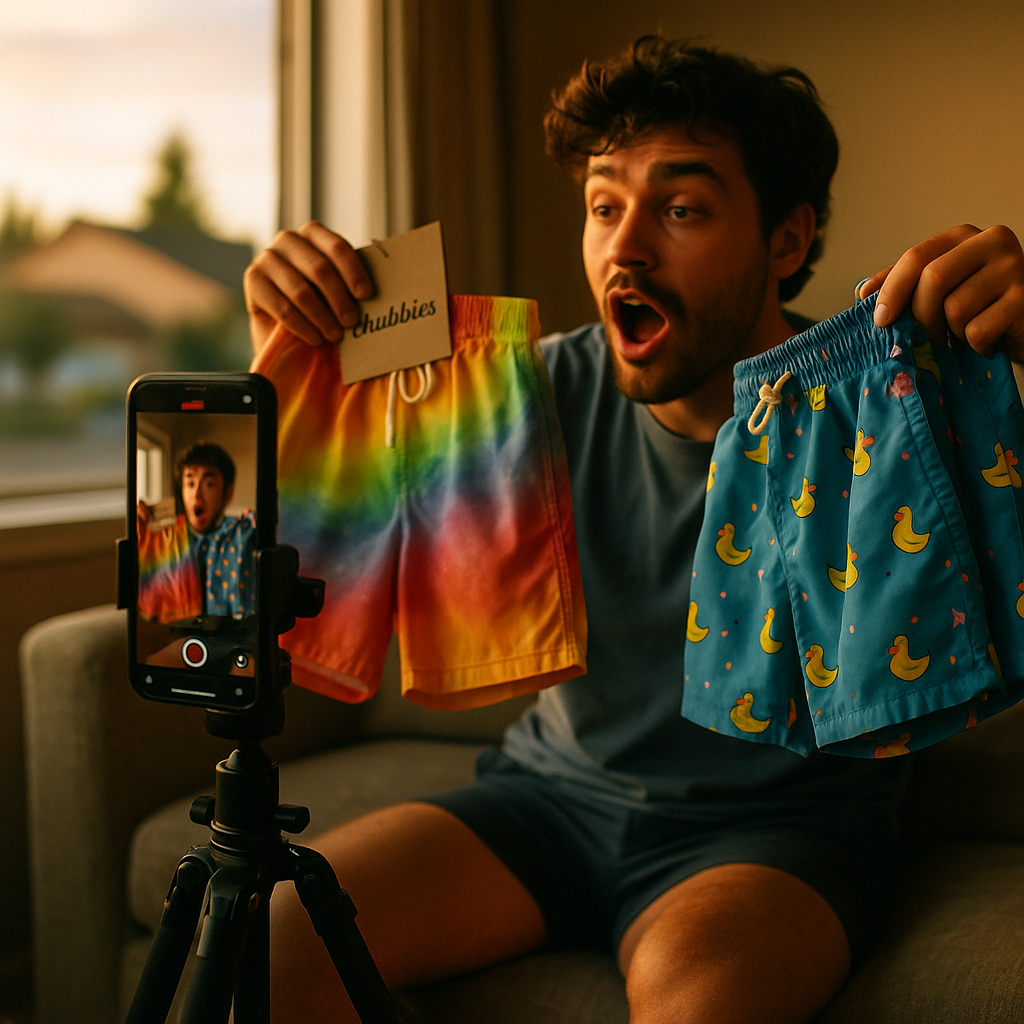
Chubbies hasn’t run a sitewide discount in years, yet its novelty shorts drops still sell out in hours. The secret isn’t scarcity marketing or influencer reach. It’s a TikTok creator brief built entirely around absurdist humor, engineered to make audiences want product at full price. In a category drowning in promo codes, that’s a genuinely counterintuitive flex.
The Discount Trap Most Apparel Brands Can’t Escape
Walk into any performance-apparel or novelty-clothing Slack channel and you’ll hear the same panic: margins are getting crushed by promo dependency. Consumers have been trained by a decade of 20%-off codes to wait out full-price windows. eMarketer has repeatedly flagged discount fatigue as a top concern for DTC apparel brands, and eMarketer’s retail research shows shoppers increasingly delay purchases until a deal appears.
Chubbies looked at that trend and did the opposite. Instead of training customers to wait for a sale, it trained them to fear missing a drop. That’s a fundamentally different psychological lever, and it’s why the brand’s TikTok Shop performance holds up without markdown support.
Chubbies doesn’t sell shorts through TikTok creators. It sells the anxiety of not owning a limited joke before it disappears.
Why Absurdist Humor Beats Product Benefits in the Brief
Most creator briefs open with product specs: fabric weight, inseam length, moisture-wicking claims. Chubbies’ briefs open with a bit. Literally a comedic premise, sometimes a fake conspiracy theory, sometimes an unhinged monologue about “shorts season” as a spiritual awakening. The product shows up almost as an afterthought, which is exactly the point.
This matters because novelty apparel doesn’t compete on functional benefit. Nobody buys neon watermelon-print shorts because they need better airflow. They buy them because a piece of content made them laugh, and laughing at a brand builds a different kind of purchase intent than a spec sheet ever will. HubSpot’s content research has long shown humor and surprise outperform straightforward product messaging on engagement metrics, and HubSpot’s marketing benchmarks back that pattern across verticals, not just apparel.
The brief doesn’t ask creators to be funny in the abstract. It gives them a specific absurdist scenario, a tone reference, and full license to improvise around it. That structure is deliberate. Loose enough for authenticity, tight enough for brand safety.
What the Brief Actually Contains
- A comedic premise, not a script: Creators get a scenario (“your shorts predicted the future”) rather than word-for-word dialogue.
- A hard no-discount clause: Creators are explicitly told not to mention price, promo codes, or urgency-driven markdown language.
- Tone guardrails: Absurdist, not sarcastic-at-the-customer’s-expense. Chubbies wants the joke to feel inclusive, not mocking.
- A single CTA: Drive to the drop page or TikTok Shop listing, nothing more complicated.
- Freedom on format: Skits, POV bits, mock interviews, whatever fits the creator’s existing voice.
That last point is underrated. Chubbies isn’t hiring comedians to perform a corporate script. It’s finding creators whose natural comedic instincts already align with the brand’s absurdist register, then giving them just enough structure to stay on-brief. Sprout Social’s creator marketing data consistently shows that content perceived as “native” to a creator’s normal output converts better than obviously sponsored formats, and Sprout Social’s influencer marketing reports reinforce that authenticity gap.
Selling Out Without a Single Percent Off
Here’s the mechanic that actually drives sell-outs: scarcity plus humor plus zero price anchoring. When a creator’s video frames a novelty short as a rare, slightly ridiculous cultural artifact rather than a discounted commodity, the audience’s mental model shifts. They’re not evaluating value against a markdown. They’re evaluating whether they want to be part of the joke before the print sells out.
This is a sharper version of a pattern Influencers Time has tracked across multiple novelty and DTC categories. Chubbies’ own nano-creator work has used a similar no-discount logic before, as covered in how Chubbies built FTC compliance into nano-creator drops and how Chubbies beats discounts with nano-creator comedy. The TikTok Shop absurdist-brief approach is really an evolution of that playbook, scaled up with tighter creative direction and faster drop cadence.
Other brands have proven variations on the theme. Shoezone won Gen Z on TikTok Shop without discounts using a similar scarcity-over-savings logic, and Ridge Wallet built a nine-figure brand on TikTok demos with no discounts by leaning entirely on product demonstration instead of price cuts. Chubbies’ twist is doing it through pure comedic performance rather than demo or utility content, which is a harder needle to thread but pays off bigger when it lands.
Cadence Is the Other Half of the Equation
Absurdist humor alone doesn’t sell out a drop. Cadence does the heavy lifting alongside it. Chubbies runs novelty drops on a tight, almost unpredictable schedule, so creators are briefed in short sprints rather than quarterly campaigns. That means briefs get refreshed constantly, jokes stay current, and nothing has time to feel stale or overexposed.
Compare this to brands running the same creator brief for months. Audiences get comedy fatigue fast. Chubbies avoids it by treating each drop as its own comedic universe with its own premise, cast of creators, and shelf life measured in days, not quarters.
The Risk Nobody Talks About: Humor Can Backfire
Absurdist humor is a high-variance creative strategy. It works spectacularly when it lands and it can read as tone-deaf or confusing when it doesn’t. Brand and legal teams should treat comedic creator briefs with the same rigor as any other sponsored content, not less.
Two risk areas deserve specific attention. First, disclosure. Absurdist skits can blur the line between entertainment and advertisement, which is exactly the kind of ambiguity the FTC’s endorsement guidance targets. Even a joke-format video needs a clear, conspicuous #ad or #partner disclosure; humor is not a compliance exemption. Brands that have handled this well, including Chubbies’ own nano-creator programs and Ollie’s vet-credentialed nano-creators, build disclosure directly into the creative brief rather than treating it as an afterthought caption.
Second, brand safety around “punching down” or alienating humor. Chubbies’ briefs work because the joke is self-aware, the brand mocks its own bro-y heritage more than it mocks the customer. That’s a deliberate creative choice, not an accident. Brands trying to copy the absurdist format without that self-deprecating anchor risk landing jokes that feel mean rather than fun.
Comedy briefs without compliance guardrails aren’t a growth hack. They’re a lawsuit with good engagement metrics.
How to Adapt This for Your Own Brief
You don’t need Chubbies’ brand history to borrow the mechanics. The transferable parts are the structure, not the specific jokes.
- Write premises, not scripts. Give creators a comedic scenario and trust them to execute it in their own voice.
- Ban discount language explicitly. If price or promo comes up, the video reframes as a deal pitch instead of entertainment, and you lose the psychological effect entirely.
- Anchor humor in self-deprecation, not audience mockery. It’s safer, funnier, and more shareable.
- Build FTC disclosure into the brief template. Don’t leave it to the creator’s discretion.
- Shorten your drop cycles. Comedic content has a short half-life; match your product cadence to it.
Brands in adjacent categories have run comparable playbooks with strong results. Duolingo’s owl comedy strategy proves absurdist brand humor can drive real growth metrics outside apparel entirely, while Scrub Daddy’s founder-led TikTok content shows how consistent comedic tone, sustained over time, compounds into serious revenue.
What This Means for Your Next Brief
If your TikTok Shop strategy still leans on discount codes to move novelty or limited-run product, you’re leaving margin on the table that a sharper creative brief could protect. Steal the structure, not the jokes: premise over script, scarcity over savings, self-deprecation over sarcasm, and disclosure baked in from the first draft.
FAQs
Why does absurdist humor work better than discounts for novelty product drops?
Absurdist humor builds emotional attachment and social currency around a limited item, shifting the audience’s focus from price comparison to fear of missing the joke. Discounts train customers to wait; humor trains them to act fast.
How do you brief a creator for comedy without losing brand control?
Give creators a comedic premise and tone guardrails instead of a word-for-word script. Specify what’s off-limits (discount language, mocking the customer) and let the creator’s natural voice fill in the execution.
Is comedic sponsored content still subject to FTC disclosure rules?
Yes. Humor and skit formats do not exempt content from FTC endorsement guidance. Disclosures like #ad or #partner still need to be clear and conspicuous within the video itself.
Can smaller brands replicate this without a big production budget?
Yes. The mechanics rely on brief structure and creator selection, not production value. Nano and micro-creators with strong comedic instincts can execute absurdist premises cheaply and authentically.
What’s the biggest risk of using absurdist humor in creator marketing?
The main risks are tone misfires (jokes that alienate rather than include the audience) and disclosure ambiguity, where the entertainment format obscures the fact that content is sponsored.
Top Influencer Marketing Agencies
The leading agencies shaping influencer marketing in 2026
Agencies ranked by campaign performance, client diversity, platform expertise, proven ROI, industry recognition, and client satisfaction. Assessed through verified case studies, reviews, and industry consultations.
Moburst

-
2

The Shelf
Boutique Beauty & Lifestyle Influencer AgencyA data-driven boutique agency specializing exclusively in beauty, wellness, and lifestyle influencer campaigns on Instagram and TikTok. Best for brands already focused on the beauty/personal care space that need curated, aesthetic-driven content.Clients: Pepsi, The Honest Company, Hims, Elf Cosmetics, Pure LeafVisit The Shelf → -
3

Audiencly
Niche Gaming & Esports Influencer AgencyA specialized agency focused exclusively on gaming and esports creators on YouTube, Twitch, and TikTok. Ideal if your campaign is 100% gaming-focused — from game launches to hardware and esports events.Clients: Epic Games, NordVPN, Ubisoft, Wargaming, Tencent GamesVisit Audiencly → -
4

Viral Nation
Global Influencer Marketing & Talent AgencyA dual talent management and marketing agency with proprietary brand safety tools and a global creator network spanning nano-influencers to celebrities across all major platforms.Clients: Meta, Activision Blizzard, Energizer, Aston Martin, WalmartVisit Viral Nation → -
5

The Influencer Marketing Factory
TikTok, Instagram & YouTube CampaignsA full-service agency with strong TikTok expertise, offering end-to-end campaign management from influencer discovery through performance reporting with a focus on platform-native content.Clients: Google, Snapchat, Universal Music, Bumble, YelpVisit TIMF → -
6

NeoReach
Enterprise Analytics & Influencer CampaignsAn enterprise-focused agency combining managed campaigns with a powerful self-service data platform for influencer search, audience analytics, and attribution modeling.Clients: Amazon, Airbnb, Netflix, Honda, The New York TimesVisit NeoReach → -
7

Ubiquitous
Creator-First Marketing PlatformA tech-driven platform combining self-service tools with managed campaign options, emphasizing speed and scalability for brands managing multiple influencer relationships.Clients: Lyft, Disney, Target, American Eagle, NetflixVisit Ubiquitous → -
8

Obviously
Scalable Enterprise Influencer CampaignsA tech-enabled agency built for high-volume campaigns, coordinating hundreds of creators simultaneously with end-to-end logistics, content rights management, and product seeding.Clients: Google, Ulta Beauty, Converse, AmazonVisit Obviously →