


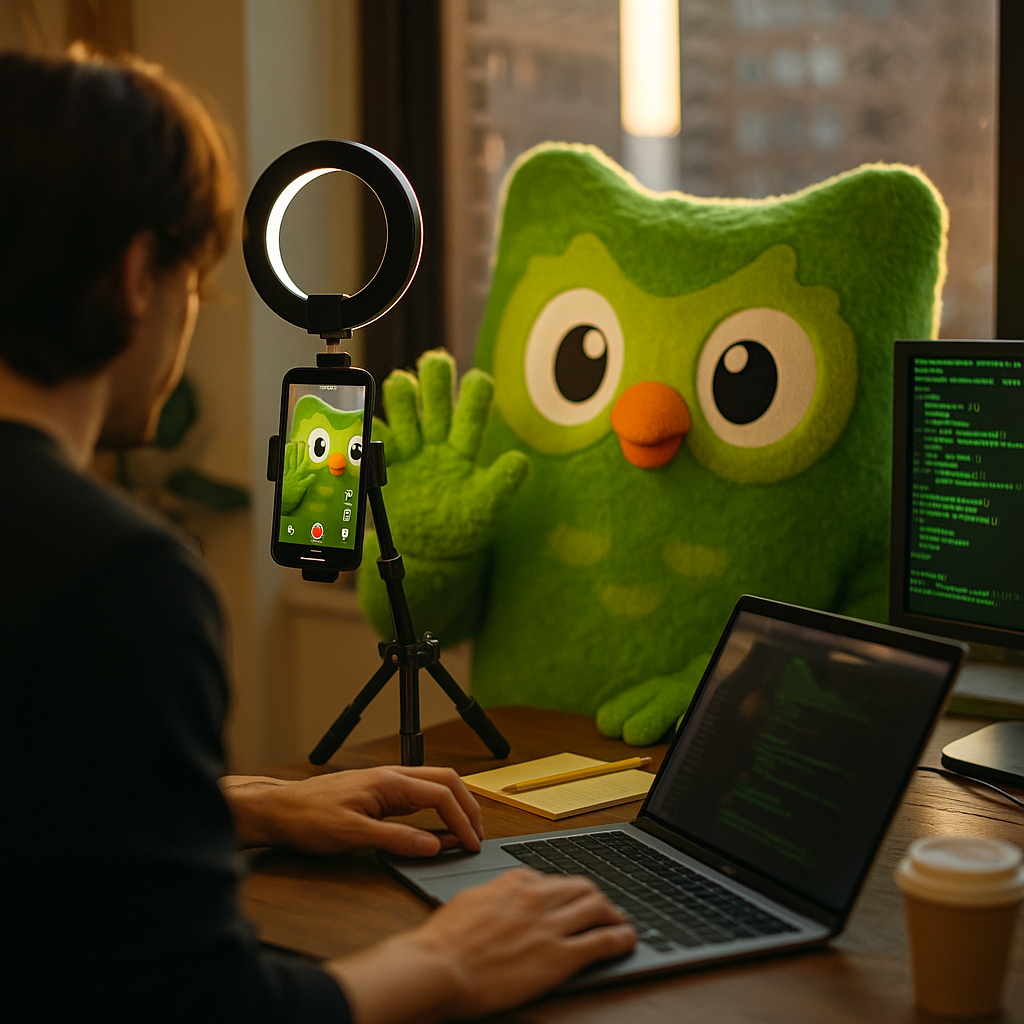
Duolingo posts to TikTok more than once a day, across multiple regional accounts, in a voice best described as “unhinged mascot having a breakdown.” Most brands can’t post that fast without a slip-up. Duolingo’s AI-assisted content pipeline is the reason it hasn’t torched its reputation while scaling chaos across markets. This is the operational story behind the memes.
Why This Case Study Matters to Anyone Running a Brand Channel
Every brand marketer has watched Duolingo’s owl get stabbed, dumped, and threatened on TikTok and thought: how do they get away with this? The real question isn’t creative permission. It’s production infrastructure. Duolingo publishes across roughly a dozen-plus country accounts, each with localized humor, while maintaining a single recognizable brand entity. That’s a governance problem disguised as a comedy bit.
We covered the creative origin story in our owl comedy teardown, which broke down how the app-store growth playbook actually worked. This piece goes further back in the stack, into the systems that let a small social team ship high volumes of on-brand chaos without a legal or compliance meltdown.
The Pipeline, Not the Punchline
Duolingo’s social team is famously lean for a brand with this much cultural footprint. That’s only possible because AI tools handle the repetitive, high-risk parts of production, freeing humans to do the part machines still can’t: knowing what’s actually funny.
- Trend detection and triage: AI-assisted listening tools flag emerging TikTok sounds, formats, and slang in near real time, so the team can decide fast whether a trend fits the owl’s persona before it dies out.
- Script and caption drafting: Generative drafting tools produce first-pass copy variants, which human writers then edit for tone, timing, and cultural specificity. Nothing ships as raw AI output.
- Localization at scale: Regional teams use AI translation and tone-matching to adapt a global joke for local slang, rather than posting a flat translated version that dies on arrival.
- Brand-safety screening: Before anything airs, automated checks scan for legal red flags, trademark misuse, and off-brand language drift.
None of this replaces the writers who decided a giant owl should have a public meltdown over Duo streaks. It just means those writers aren’t also manually monitoring twelve regional trend feeds at 11 p.m.
The lesson for brands isn’t “use AI to be funnier.” It’s “use AI to remove friction so humans can be funnier, faster, and more often, without breaking brand rules.”
How Do You Keep a Chaotic Voice Consistent Across Markets?
This is the part most brands get wrong. They either lock everything into rigid templates (killing the humor) or let every regional team freelance (killing the brand). Duolingo solves it with a layered system: a global brand voice guide defines the owl’s core personality traits, non-negotiable boundaries, and tone limits, while AI tools trained on that guide flag drafts that drift outside it before a human ever reviews them.
Think of it as a rubric, not a script. The owl can be petty, dramatic, or thirsty for engagement. The owl cannot mock a real tragedy, target a real person maliciously, or contradict Duolingo’s actual product claims. AI screening catches the second category. Humans still judge the first, because comedy timing isn’t a solved machine-learning problem yet.
Speed Without Sloppiness: The Compliance Layer Nobody Sees
Here’s what gets lost in “look how funny that brand is” commentary: Duolingo posts constantly, and constant posting is a compliance minefield. More posts mean more chances for a legal issue, a cultural misstep, or an off-brand joke that ages badly. The FTC’s endorsement guidance mostly targets influencer disclosure, but the same underlying principle applies to brand-owned content: if you’re moving fast, you need automated guardrails, not just good instincts.
Duolingo’s pipeline builds compliance checks into the workflow rather than bolting them on afterward. That mirrors what we’ve seen in nano-creator programs, where brands like Ollie built vet-credentialed review into the workflow instead of treating compliance as a final checkbox. Chubbies did something similar, building FTC compliance into nano-creator drops from the brief stage rather than the approval stage. The pattern holds regardless of whether the content comes from an owned brand account or a paid creator network: bake the guardrails into the pipeline, don’t inspect for problems after the fact.
For a brand-owned channel like Duolingo’s, that means AI-assisted screening for things like unauthorized IP references, factual claims about the product, and language that could read as targeting a protected group, all before a human approver even sees the draft. It’s not glamorous. It’s also why the brand hasn’t had a major TikTok scandal despite years of near-daily edgy posting.
What the Data Says About Volume and Engagement
Duolingo’s TikTok account has amassed tens of millions of followers, and its engagement rate consistently outperforms typical brand benchmarks tracked by platforms like Sprout Social. According to industry engagement benchmarks compiled by firms like eMarketer, most brand TikTok accounts see engagement rates well below 3%; Duolingo has repeatedly posted rates several multiples higher during peak moments.
Volume correlates with visibility on TikTok’s algorithm, but only if quality holds. Post often with mediocre content and the algorithm buries you just as fast as it would bury silence. Duolingo’s AI-assisted drafting exists specifically to solve that tension: more raw material, filtered by humans, so quality bar doesn’t slip as output climbs.
This is the operational insight brands consistently miss. They assume Duolingo’s success is a creative bet. It’s actually a throughput bet, backed by tooling that lets a small team generate, screen, and localize at a pace that would burn out a purely manual process.
Where This Breaks Down for Most Brands
Not every brand has Duolingo’s cultural permission to be this weird. A fintech brand or a healthcare company can’t just copy the “unhinged mascot” playbook and expect the same reception; the risk tolerance and regulatory exposure are completely different. What every brand can borrow, though, is the underlying operating model: define voice boundaries explicitly, use AI to flag drift and compliance risk early, and keep humans in the final creative decision seat.
We’ve seen this same tension play out in retail and CPG contexts, too. HelloFresh’s dual-strategy model pairing big campaigns with affiliates works because each layer has its own defined guardrails, not because everyone freelances. Warby Parker’s approach to YouTube Shorts ads that skipped discounts succeeded because the creative risk was calculated against a clear brand voice standard, not improvised on the fly. Consistency at scale is a systems problem before it’s a creative one.
If your brand can’t answer “what would our voice never say” in one sentence, no amount of AI tooling will save you from an off-brand post going viral for the wrong reasons.
Building the Playbook for Your Own Team
You don’t need Duolingo’s follower count to apply the logic here. Start smaller:
- Write the boundary document first. Not a tone-of-voice deck nobody reads, but a short, specific list of what your brand mascot or account voice will never do.
- Use AI for triage, not final output. Let tools surface trending formats and draft variants, but keep a human editor as the last gate before publishing.
- Build compliance checks into the drafting stage. Waiting until legal reviews the final post is too slow for platforms that reward speed.
- Localize with intent, not just translation. A joke that lands in one market can flop or offend in another; AI tone-matching helps, but regional human review is non-negotiable.
- Track engagement against volume, not just against virality. One viral hit means little if the surrounding posts are mediocre filler.
Tools referenced by marketing platforms like Meta Business Suite and TikTok’s ad platform increasingly bake in AI-assisted creative testing, which lowers the barrier for smaller teams to build a scaled-down version of this pipeline without a full engineering build.
Duolingo didn’t get lucky with a funny owl. It built infrastructure that lets creative risk-taking happen safely, repeatedly, and across markets — the actual takeaway for any brand chasing scale without losing control.
FAQs
What is Duolingo’s AI-assisted content pipeline, exactly?
It’s the combination of AI-powered trend detection, draft generation, localization, and compliance screening that Duolingo’s social team uses to produce high volumes of TikTok content while keeping a human editor as the final approval step for tone and humor.
Does Duolingo use AI to write its TikTok jokes?
AI tools assist with drafting variants and surfacing trends, but human writers and regional editors make the final creative and comedic calls. The brand’s distinctive voice comes from human judgment, not automated generation.
How does Duolingo avoid FTC or legal issues with such edgy content?
By building compliance screening into the production pipeline itself, checking for IP misuse, factual product claims, and off-brand language before content reaches human approvers, rather than reviewing only after a draft is finished.
Can smaller brands replicate this model without Duolingo’s budget?
Yes, at a smaller scale. Writing a clear brand voice boundary document, using accessible AI drafting and listening tools, and keeping a human in the final review loop captures most of the operational benefit without enterprise-level tooling.
Why does posting volume matter as much as creative quality on TikTok?
TikTok’s algorithm rewards consistent posting, but only when quality holds steady. High volume with declining quality gets buried just as fast as low volume. AI-assisted triage helps maintain quality while increasing output.
Top Influencer Marketing Agencies
The leading agencies shaping influencer marketing in 2026
Agencies ranked by campaign performance, client diversity, platform expertise, proven ROI, industry recognition, and client satisfaction. Assessed through verified case studies, reviews, and industry consultations.
Moburst

-
2

The Shelf
Boutique Beauty & Lifestyle Influencer AgencyA data-driven boutique agency specializing exclusively in beauty, wellness, and lifestyle influencer campaigns on Instagram and TikTok. Best for brands already focused on the beauty/personal care space that need curated, aesthetic-driven content.Clients: Pepsi, The Honest Company, Hims, Elf Cosmetics, Pure LeafVisit The Shelf → -
3

Audiencly
Niche Gaming & Esports Influencer AgencyA specialized agency focused exclusively on gaming and esports creators on YouTube, Twitch, and TikTok. Ideal if your campaign is 100% gaming-focused — from game launches to hardware and esports events.Clients: Epic Games, NordVPN, Ubisoft, Wargaming, Tencent GamesVisit Audiencly → -
4

Viral Nation
Global Influencer Marketing & Talent AgencyA dual talent management and marketing agency with proprietary brand safety tools and a global creator network spanning nano-influencers to celebrities across all major platforms.Clients: Meta, Activision Blizzard, Energizer, Aston Martin, WalmartVisit Viral Nation → -
5

The Influencer Marketing Factory
TikTok, Instagram & YouTube CampaignsA full-service agency with strong TikTok expertise, offering end-to-end campaign management from influencer discovery through performance reporting with a focus on platform-native content.Clients: Google, Snapchat, Universal Music, Bumble, YelpVisit TIMF → -
6

NeoReach
Enterprise Analytics & Influencer CampaignsAn enterprise-focused agency combining managed campaigns with a powerful self-service data platform for influencer search, audience analytics, and attribution modeling.Clients: Amazon, Airbnb, Netflix, Honda, The New York TimesVisit NeoReach → -
7

Ubiquitous
Creator-First Marketing PlatformA tech-driven platform combining self-service tools with managed campaign options, emphasizing speed and scalability for brands managing multiple influencer relationships.Clients: Lyft, Disney, Target, American Eagle, NetflixVisit Ubiquitous → -
8

Obviously
Scalable Enterprise Influencer CampaignsA tech-enabled agency built for high-volume campaigns, coordinating hundreds of creators simultaneously with end-to-end logistics, content rights management, and product seeding.Clients: Google, Ulta Beauty, Converse, AmazonVisit Obviously →