


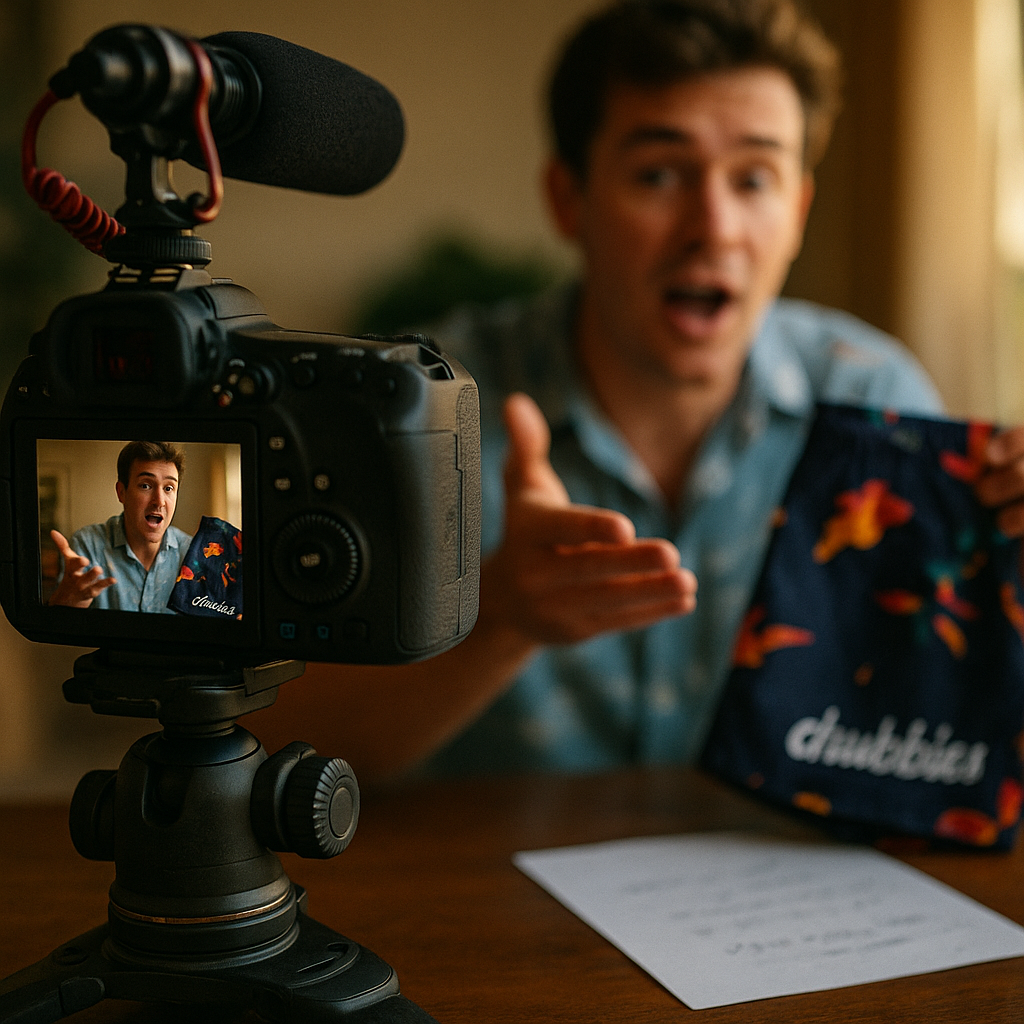
Chubbies sells out limited novelty shorts drops in hours, and the secret isn’t a celebrity endorsement or a six-figure media buy. It’s a repeatable nano-creator comedy format built on deliberately dumb sketches, tiny budgets, and creators nobody outside their zip code has heard of. If you’re still briefing influencers like it’s a press release, this teardown is your wake-up call.
The Format, Broken Down
Walk through Chubbies’ TikTok and Instagram feed during a drop week and you’ll notice a pattern almost immediately. It’s not polished. It’s not on-brand in the traditional sense of matching logos and color palettes. It’s a string of absurdist mini-sketches: a guy explaining to his HOA why he’s wearing shorts covered in bald eagles, a group of friends staging an “intervention” because someone bought the wrong print, a fake infomercial for shorts that “come with a free divorce.” The comedy is the product demo.
This isn’t improvisation. It’s a format with rules, and those rules are what make it scalable across dozens of nano-creators at once.
- Absurd premise, real product: The shorts are always visible, worn, and named. The scenario around them is ridiculous, but the product placement is unmissable.
- Sub-30-second runtime: Almost every clip resolves its joke before the 20-second mark, respecting short attention spans and the platform’s own pacing data.
- Local, unpolished production: Shot on phones, in backyards, at tailgates. No studio lighting. That rawness signals authenticity, not budget cuts.
- Repeatable premise templates: “Explaining the shorts to someone who doesn’t get it” is a template that’s been reused across dozens of creators with different jokes layered on top.
Compare this to a typical DTC brand’s influencer brief, which usually reads like a legal disclaimer with a discount code attached. Chubbies’ brief reads more like a comedy writers’ room prompt. That’s the fundamental difference, and it’s the reason their content doesn’t feel like an ad even when everyone knows it is one.
Chubbies doesn’t brief creators to sell shorts. It briefs them to make a joke that happens to require shorts as a prop. The sales lift is a byproduct of the laugh, not the pitch.
Why Nano-Creators, Not Bigger Names?
Here’s the part that trips up brands used to chasing follower counts. Chubbies deliberately works with nano-creators, typically under 50,000 followers, rather than macro-influencers or celebrities. Why trade reach for smaller accounts?
Three reasons, and they all map to ROI.
First, cost. A single celebrity placement can eat a quarter’s entire influencer budget. That same spend funds dozens of nano-creator briefs, each generating its own comment section, its own duet chain, its own micro-audience. Volume beats a single big swing when the format is designed to be shared, not just watched.
Second, believability. Nano-creators aren’t performing for a national audience, they’re performing for people who actually know them. A joke about wearing eagle-print shorts to a company picnic lands differently coming from someone’s actual coworker-adjacent creator than from a paid celebrity spot. Recent research on creator marketing consistently shows smaller creators driving higher engagement rates relative to audience size, and Chubbies is essentially arbitraging that gap.
Third, and most underrated: nano-creators are cheap enough to test at scale. Chubbies can run twenty different comedic premises across twenty different creators in a single week, see which ones spike saves and shares, then double down on the winning format for the next drop. That’s a testing velocity no celebrity contract allows.
This isn’t a new observation for Influencers Time readers. We’ve covered how Chubbies sells out shorts with absurdist TikTok creator briefs and the broader mechanics of how Chubbies beats discounts with nano-creator comedy. What’s changed heading into this cycle of drops is how tightly the format has been systematized. It’s no longer an experiment. It’s an operating model.
Scarcity Plus Comedy Equals Sell-Through
Novelty shorts drops aren’t restocked. That’s intentional. Chubbies limits print runs on its weirdest designs, which means the content isn’t just funny, it’s also a countdown clock. The comedy creates the awareness; the scarcity creates the urgency to actually buy before the joke becomes irrelevant.
This pairing matters more than either element alone. Plenty of brands run scarcity drops without compelling content, and plenty run funny content without any real supply constraint. Chubbies stacks both, and the result is a drop that sells out not because it’s rare, but because thousands of people were laughing at it an hour before it launched.
There’s a lesson here that echoes what we found when covering Stanley’s nano-creator seeding strategy: virality without inventory discipline just creates a supply chain headache. Chubbies treats the drop calendar and the content calendar as the same document, not two departments emailing each other.
What About Brand Safety and Compliance?
Absurdist comedy sounds risky on paper. Loose scripts, unpolished production, dozens of creators improvising jokes about your product — what could go wrong? Quite a lot, actually, if you don’t build guardrails in from the start.
Chubbies’ answer is structural, not creative. Every nano-creator brief includes disclosure requirements baked in at the script level, not bolted on as an afterthought. The FTC’s endorsement guidance requires clear and conspicuous disclosure of paid partnerships, and Chubbies treats that requirement as a creative constraint to write around, not a compliance checkbox to slap on after the fact. We detailed this exact system in how Chubbies built FTC compliance into nano-creator drops, and it’s worth revisiting if your legal team is nervous about scaling absurdist formats.
The compliance lesson generalizes well beyond Chubbies. Brands like the ones we covered in Ollie’s vet-credentialed nano-creator program show that regulatory risk and creative freedom aren’t actually opposed. The trick is designing the brief so disclosure feels native to the joke rather than a disruption to it. “Paid partnership, don’t tell my landlord” works both as a punchline and a disclosure.
The biggest brand-safety mistake in nano-creator comedy isn’t the joke going wrong. It’s treating disclosure as friction instead of writing it into the format itself.
The Content Ops Behind the Chaos
None of this works without operational discipline sitting underneath the absurdity. Somebody at Chubbies is managing creator outreach, tracking which premises are performing, coordinating drop timing with content release, and reviewing scripts for compliance, all at a volume that would break a manual process.
This is where the comparison to other DTC nano-creator programs gets useful. Chewy’s nano-creator subscription engine and Solo Stove’s year-round seeding program both rely on systems, not one-off campaigns, to keep creator relationships and content cadence running without a huge internal team. Chubbies fits the same pattern: a lean marketing team, a clear brief template, and enough creator relationships in the pipeline that any single drop doesn’t depend on any single creator showing up.
Practically, that means:
- A living brief template that’s updated after every drop based on what got the highest completion rate.
- A creator roster tiered by comedic reliability, not just follower count, so the team knows who can improvise and who needs a tighter script.
- A compliance layer built into the brief, not reviewed after content is filmed.
- A content release schedule tied directly to inventory drops, so the joke and the scarcity hit the feed in the same window.
If your team is still routing every creator brief through three rounds of legal review after the content is shot, you’re already behind brands running this model. Tools that streamline briefing and production, like the workflow shifts covered in Klaviyo’s Composer Assistant production time cuts, point to where a lot of this operational load is heading: automation handling the repeatable structure so humans can focus on the joke.
Could This Work Outside Apparel?
Fair question, and one every strategist reading this should be asking about their own category. Absurdist comedy works for Chubbies partly because shorts are low-stakes, impulse-friendly, and inherently a little silly as a category. Does the same format translate to, say, financial services or B2B SaaS?
Not directly. But the underlying mechanics do. Duolingo proved a version of this with its owl-centric chaos content, detailed in our owl comedy teardown of Duolingo’s growth playbook, showing that even an education app can win with unhinged, low-production comedy if the format is disciplined underneath the chaos. Ridge Wallet took a more demo-driven route, as we covered in Ridge Wallet’s nine-figure TikTok demo strategy, proving comedy isn’t the only lever nano-creators can pull, but it’s one of the most durable ones when the product itself invites playfulness.
The category determines the tone. The operating model, cheap volume, tight briefs, disclosure by design, scarcity synced to content, travels almost anywhere.
FAQs
Frequently Asked Questions
What makes nano-creator comedy different from a standard influencer campaign?
Nano-creator comedy relies on small-audience creators (typically under 50,000 followers) producing sketch-style, low-production content built around a joke rather than a direct product pitch. Standard influencer campaigns usually center on larger accounts delivering scripted testimonials or reviews.
Why does Chubbies use unpolished, low-budget video instead of professional production?
Raw, phone-shot content signals authenticity and blends into organic feed content rather than reading as an obvious ad. It also keeps per-creator costs low enough to run dozens of concurrent tests each drop cycle.
How does Chubbies handle FTC disclosure requirements in comedic content?
Disclosure language is written into the script itself as part of the joke, rather than added as a disclaimer after filming. This keeps compliance consistent across a large creator roster without disrupting the comedic format.
Can smaller brands replicate this model without Chubbies’ following?
Yes. The core elements, cheap nano-creator briefs, a repeatable comedic template, scarcity-driven drop timing, and built-in disclosure, don’t require existing scale. They require a disciplined brief and a willingness to test volume over a single big-name placement.
What metrics indicate this content format is working?
Completion rate, shares, and comment volume relative to follower count matter more than raw view count. Sell-through speed on the linked product drop is the ultimate business metric tying content performance to revenue.
Steal the structure, not the jokes: build a comedic brief template, tier your nano-creator roster by reliability, write disclosure into the script, and time your content drop to your inventory clock. Do that consistently and the sell-out becomes a system, not a lucky viral moment.
Top Influencer Marketing Agencies
The leading agencies shaping influencer marketing in 2026
Agencies ranked by campaign performance, client diversity, platform expertise, proven ROI, industry recognition, and client satisfaction. Assessed through verified case studies, reviews, and industry consultations.
Moburst

-
2

The Shelf
Boutique Beauty & Lifestyle Influencer AgencyA data-driven boutique agency specializing exclusively in beauty, wellness, and lifestyle influencer campaigns on Instagram and TikTok. Best for brands already focused on the beauty/personal care space that need curated, aesthetic-driven content.Clients: Pepsi, The Honest Company, Hims, Elf Cosmetics, Pure LeafVisit The Shelf → -
3

Audiencly
Niche Gaming & Esports Influencer AgencyA specialized agency focused exclusively on gaming and esports creators on YouTube, Twitch, and TikTok. Ideal if your campaign is 100% gaming-focused — from game launches to hardware and esports events.Clients: Epic Games, NordVPN, Ubisoft, Wargaming, Tencent GamesVisit Audiencly → -
4

Viral Nation
Global Influencer Marketing & Talent AgencyA dual talent management and marketing agency with proprietary brand safety tools and a global creator network spanning nano-influencers to celebrities across all major platforms.Clients: Meta, Activision Blizzard, Energizer, Aston Martin, WalmartVisit Viral Nation → -
5

The Influencer Marketing Factory
TikTok, Instagram & YouTube CampaignsA full-service agency with strong TikTok expertise, offering end-to-end campaign management from influencer discovery through performance reporting with a focus on platform-native content.Clients: Google, Snapchat, Universal Music, Bumble, YelpVisit TIMF → -
6

NeoReach
Enterprise Analytics & Influencer CampaignsAn enterprise-focused agency combining managed campaigns with a powerful self-service data platform for influencer search, audience analytics, and attribution modeling.Clients: Amazon, Airbnb, Netflix, Honda, The New York TimesVisit NeoReach → -
7

Ubiquitous
Creator-First Marketing PlatformA tech-driven platform combining self-service tools with managed campaign options, emphasizing speed and scalability for brands managing multiple influencer relationships.Clients: Lyft, Disney, Target, American Eagle, NetflixVisit Ubiquitous → -
8

Obviously
Scalable Enterprise Influencer CampaignsA tech-enabled agency built for high-volume campaigns, coordinating hundreds of creators simultaneously with end-to-end logistics, content rights management, and product seeding.Clients: Google, Ulta Beauty, Converse, AmazonVisit Obviously →