


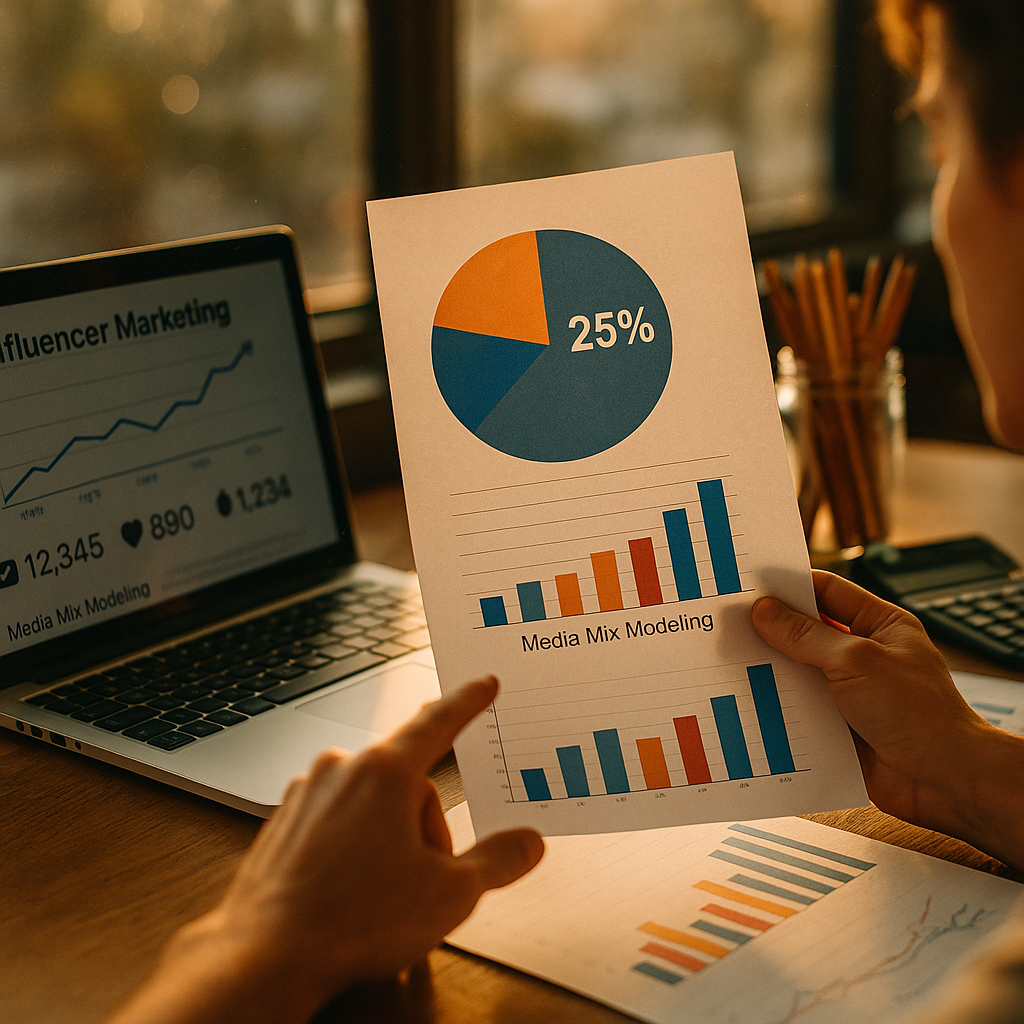
One in four marketing dollars now flows to creators. Not paid search, not linear TV, not programmatic display — creators. If your media mix model still treats influencer marketing as a test-and-learn line item, you’re building next year’s plan on a foundation that already collapsed.
The 25% benchmark isn’t a projection anymore. It’s showing up in budget actuals across CPG, beauty, fintech, and retail, and it’s forcing CMOs to answer an uncomfortable question: does your media mix model actually reflect how consumers discover and decide, or does it reflect how your org chart is structured?
Where the 25% Number Actually Comes From
Multiple industry surveys, including data tracked by eMarketer, have shown creator spend climbing steadily as a share of total digital budgets for three straight years. What’s changed isn’t the trajectory — it’s the ceiling. Influencer allocations that once topped out around 12-15% of digital spend are now regularly hitting a quarter of total brand marketing budgets at companies with mature programs.
Why now? Three forces converged. First, social commerce pathways matured to the point where creator content converts directly, not just influences upper-funnel awareness. Second, TikTok Shop and similar commerce layers gave finance teams hard attribution data to justify bigger checks. Third, traditional channels kept getting more expensive and less trusted — linear TV reach keeps fragmenting, and paid search costs keep climbing as zero-click search and AI overviews eat into organic discovery.
When a quarter of your budget sits in one channel, “test and learn” stops being an honest description. It’s a core media line, and it needs the same rigor as TV or paid search.
Why Your Current Media Mix Model Is Probably Wrong
Most media mix models (MMMs) were built for a world of discrete channels with clean spend data: TV GRPs, search impressions, display CPMs. Influencer spend doesn’t fit neatly into that framework. It’s messy. A single campaign might blend whitelisted paid amplification, organic posting, affiliate commission, and a flat creator fee — often across three platforms simultaneously.
This is where a lot of CMOs get burned. They bolt influencer spend onto an existing MMM as a single variable, then wonder why the model can’t explain variance in sales lift. The creator supply chain model treats influencers as a media buy, which is directionally right, but the inputs still need disaggregation by funnel stage, platform, and compensation structure to produce a usable output.
Consider how differently a dedicated YouTube integration performs versus a TikTok Shop affiliate post. One is upper-funnel brand-building with long decay curves. The other is bottom-funnel and nearly instantaneous. Lump them into one “influencer” bucket in your model and you’ll get an average that describes neither.
The Funnel-Stage Problem
This is precisely the gap covered in our analysis of TikTok and YouTube budget allocation by funnel stage: platforms don’t just differ by audience, they differ by where they sit in the purchase journey. A 2027 media mix model needs at minimum three influencer sub-categories — awareness/reach plays, consideration/education content, and conversion-driven commerce integrations — each with its own attribution logic and decay curve.
Rate card structures are shifting too, which complicates apples-to-apples comparisons year over year. As covered in our reporting on dedicated video fees, brands are increasingly paying premium rates for standalone dedicated content rather than cheaper integrated mentions, because dedicated placements produce measurably better recall and conversion. If your MMM is still using last year’s cost-per-placement assumptions, you’re underpricing the channel and misallocating budget as a result.
Building the 2027 Model: What Actually Needs to Change
Three structural adjustments separate MMMs that will hold up under a 25% influencer allocation from ones that will produce garbage-in-garbage-out forecasts.
- Disaggregate by compensation model, not just platform. Flat fee, performance-based, and hybrid retainer-plus-commission deals behave differently in a model. Performance-based contract structures are becoming standard precisely because they generate cleaner data for exactly this kind of modeling.
- Build in creator churn risk as a variable. Platforms lose top talent unpredictably. Our coverage of creators exiting TikTok at accelerating rates should be required reading for anyone modeling next year’s reach assumptions off this year’s roster.
- Treat UGC and organic creator content as a distinct line from paid influencer media. They have different cost structures, different production timelines, and wildly different scalability. Standardized UGC contract terms are making this content type more predictable to forecast, which is good news for modelers.
None of this is theoretical. Comfrt’s shift to a 500-creator content engine replacing traditional ad agencies only works financially because the brand modeled creator output against agency production costs with granular, channel-specific assumptions. That’s the level of precision a quarter-share budget line demands.
The Platform Allocation Question Nobody Wants to Answer
Here’s an uncomfortable truth: your platform mix from eighteen months ago is probably wrong for next year. Top creators are shifting toward Instagram in meaningful numbers, partly in response to TikTok’s regulatory uncertainty in the US and partly because Instagram’s monetization and Reels distribution have genuinely improved. Meanwhile, TikTok Shop’s forecasted growth trajectory suggests the platform’s commerce layer is still the strongest conversion engine available, at least for now, in categories like beauty and CPG.
So which platform gets the bigger allocation in your 2027 model? The honest answer is: it depends on whether you’re optimizing for reach stability or commerce conversion, and most brands haven’t picked a lane. A media mix model that hedges by splitting evenly across platforms “just in case” isn’t a strategy. It’s an admission that nobody ran the numbers.
A quarter of your budget shouldn’t be allocated by consensus or inertia. It should be allocated by the same rigor you’d apply to a nine-figure TV buy.
Category matters enormously here too. Beauty brands riding TikTok Shop’s discovery surge should weight very differently than a fintech brand whose compliance requirements make TikTok Shop’s live commerce format nearly unworkable. There’s no universal 2027 template. There’s only a rigorous process for building your own.
Risk, Compliance, and the Part Finance Actually Cares About
CMOs pitching a 25% budget allocation to CFOs need more than performance data. They need risk mitigation built into the model. That means accounting for:
- FTC disclosure compliance risk across your creator roster, particularly as enforcement attention increases (see the FTC’s endorsement guidance for current requirements)
- Platform concentration risk, given how fast top-tier creators can churn or shift platforms
- Vendor and tooling consolidation, since the martech layer supporting influencer programs is itself in flux, as detailed in our piece on creator economy vendor consolidation
- Measurement gaps exposed at scale — our analysis of 4 million influencer collaborations found significant cracks in how brands track and attribute creator performance once programs scale past a certain size
None of this is a reason to avoid the 25% benchmark. It’s a reason to build the model with the same governance rigor you’d apply to any channel that size. Tools like Sprout Social and platform-native measurement suites from Meta and TikTok have improved, but they still fall short of the channel-level attribution clarity finance teams expect from established media lines. Close that gap manually until the tooling catches up.
It’s also worth remembering that not every brand needs to chase the benchmark. Go Zero’s decision to cut influencer spend entirely is a useful counter-case: the 25% figure is an industry average, not a mandate. The right number for your brand depends on category, audience, and whether your product actually benefits from creator-native storytelling versus other formats, including synthetic or AI-generated creator content, which is starting to enter the mix as a lower-cost, higher-control alternative for certain use cases.
What This Means for Talent and Org Design
A quarter-share budget can’t be run by a two-person team bolted onto the social media function. It requires analytics capability that most marketing orgs simply don’t have yet. This is the crux of the issue raised in our coverage of the marketing analytics talent shortage: brands are scaling influencer budgets faster than they’re scaling the analytical talent needed to model and optimize them.
If you’re building a 2027 plan, budget for headcount and tooling alongside media spend. A model is only as good as the team that maintains it, and influencer data pipelines require constant reconciliation across platforms, currencies, and disclosure formats that traditional media analysts weren’t trained to handle.
Next Step for CMOs
Don’t wait for a perfect unified attribution system before rebuilding your model. Start by disaggregating current influencer spend into funnel-stage and compensation-type buckets this quarter, then stress-test that data against a 25% budget scenario before you present numbers to finance. The brands that win next year’s budget conversations will be the ones who treated this benchmark as a modeling exercise, not a headline stat.
FAQs
What does the 25% benchmark actually measure?
It refers to influencer and creator marketing spend as a share of total marketing or digital marketing budget at brands with mature programs, based on aggregated industry survey data from sources including eMarketer and various agency benchmarking reports.
Should every brand aim for a 25% influencer allocation?
No. The benchmark is a category average, not a target. Brands in categories like fintech or B2B may rationally allocate far less, while beauty and CPG brands often exceed it given how well those categories perform in creator-led commerce.
Why can’t brands just add influencer spend as one line item in an existing MMM?
Because influencer spend isn’t homogeneous. It spans flat fees, performance deals, whitelisted paid amplification, and organic UGC, each with different decay curves and attribution profiles. Treating it as one variable produces an average that misrepresents actual channel performance.
How should CMOs handle platform concentration risk in their models?
Build churn and platform-shift assumptions directly into forecasts rather than assuming static reach. Creator migration between platforms, and regulatory uncertainty around specific apps, can materially change reach projections within a single planning cycle.
What’s the biggest measurement gap brands face when scaling influencer budgets?
Attribution consistency across platforms and compensation types. Most native platform analytics tools still don’t provide the granular, cross-channel measurement that finance teams expect from a channel commanding a quarter of total budget.
FAQs
What does the 25% benchmark actually measure?
It refers to influencer and creator marketing spend as a share of total marketing or digital marketing budget at brands with mature programs, based on aggregated industry survey data from sources including eMarketer and various agency benchmarking reports.
Should every brand aim for a 25% influencer allocation?
No. The benchmark is a category average, not a target. Brands in categories like fintech or B2B may rationally allocate far less, while beauty and CPG brands often exceed it given how well those categories perform in creator-led commerce.
Why can’t brands just add influencer spend as one line item in an existing MMM?
Because influencer spend isn’t homogeneous. It spans flat fees, performance deals, whitelisted paid amplification, and organic UGC, each with different decay curves and attribution profiles. Treating it as one variable produces an average that misrepresents actual channel performance.
How should CMOs handle platform concentration risk in their models?
Build churn and platform-shift assumptions directly into forecasts rather than assuming static reach. Creator migration between platforms, and regulatory uncertainty around specific apps, can materially change reach projections within a single planning cycle.
What’s the biggest measurement gap brands face when scaling influencer budgets?
Attribution consistency across platforms and compensation types. Most native platform analytics tools still don’t provide the granular, cross-channel measurement that finance teams expect from a channel commanding a quarter of total budget.
Top Influencer Marketing Agencies
The leading agencies shaping influencer marketing in 2026
Agencies ranked by campaign performance, client diversity, platform expertise, proven ROI, industry recognition, and client satisfaction. Assessed through verified case studies, reviews, and industry consultations.
Moburst

-
2

The Shelf
Boutique Beauty & Lifestyle Influencer AgencyA data-driven boutique agency specializing exclusively in beauty, wellness, and lifestyle influencer campaigns on Instagram and TikTok. Best for brands already focused on the beauty/personal care space that need curated, aesthetic-driven content.Clients: Pepsi, The Honest Company, Hims, Elf Cosmetics, Pure LeafVisit The Shelf → -
3

Audiencly
Niche Gaming & Esports Influencer AgencyA specialized agency focused exclusively on gaming and esports creators on YouTube, Twitch, and TikTok. Ideal if your campaign is 100% gaming-focused — from game launches to hardware and esports events.Clients: Epic Games, NordVPN, Ubisoft, Wargaming, Tencent GamesVisit Audiencly → -
4

Viral Nation
Global Influencer Marketing & Talent AgencyA dual talent management and marketing agency with proprietary brand safety tools and a global creator network spanning nano-influencers to celebrities across all major platforms.Clients: Meta, Activision Blizzard, Energizer, Aston Martin, WalmartVisit Viral Nation → -
5

The Influencer Marketing Factory
TikTok, Instagram & YouTube CampaignsA full-service agency with strong TikTok expertise, offering end-to-end campaign management from influencer discovery through performance reporting with a focus on platform-native content.Clients: Google, Snapchat, Universal Music, Bumble, YelpVisit TIMF → -
6

NeoReach
Enterprise Analytics & Influencer CampaignsAn enterprise-focused agency combining managed campaigns with a powerful self-service data platform for influencer search, audience analytics, and attribution modeling.Clients: Amazon, Airbnb, Netflix, Honda, The New York TimesVisit NeoReach → -
7

Ubiquitous
Creator-First Marketing PlatformA tech-driven platform combining self-service tools with managed campaign options, emphasizing speed and scalability for brands managing multiple influencer relationships.Clients: Lyft, Disney, Target, American Eagle, NetflixVisit Ubiquitous → -
8

Obviously
Scalable Enterprise Influencer CampaignsA tech-enabled agency built for high-volume campaigns, coordinating hundreds of creators simultaneously with end-to-end logistics, content rights management, and product seeding.Clients: Google, Ulta Beauty, Converse, AmazonVisit Obviously →