


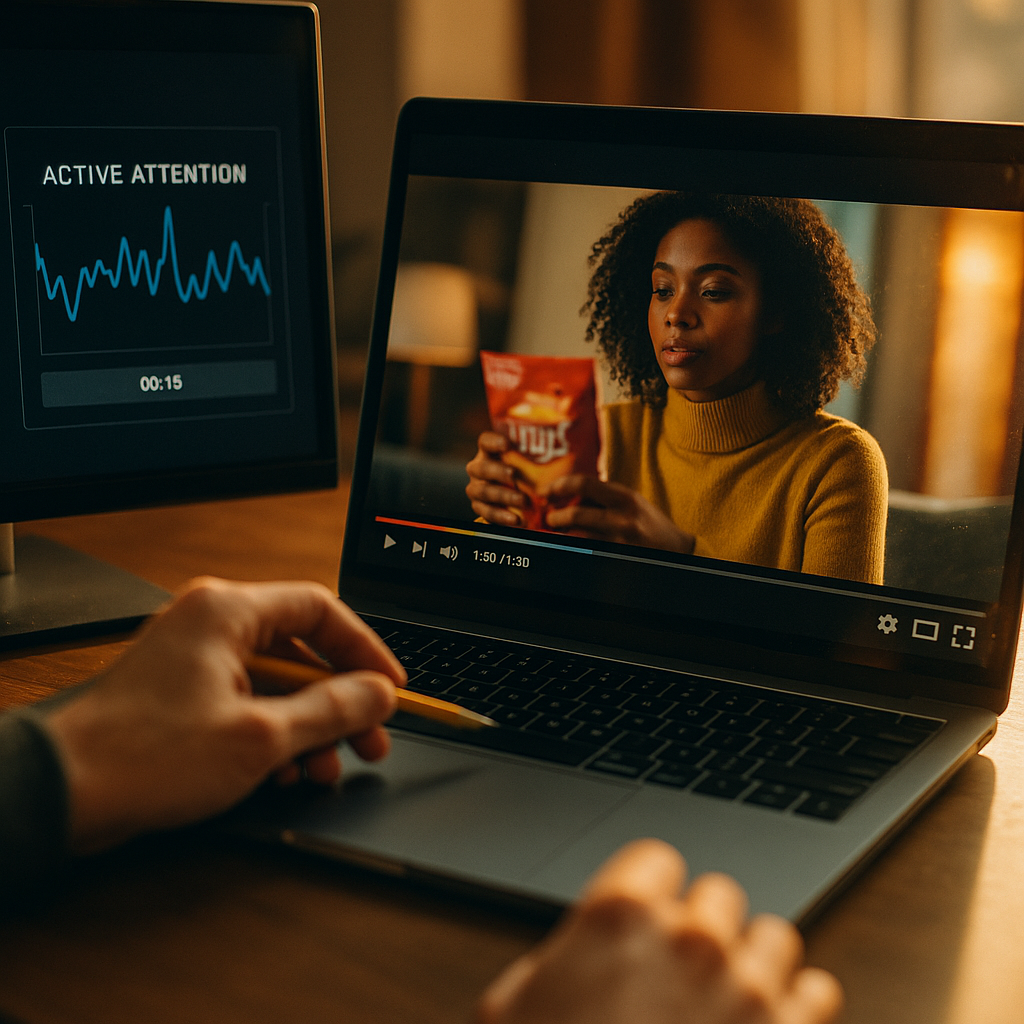
Ninety percent of a video’s “views” might involve zero actual attention. Screens are on, eyes are elsewhere — scrolling a second phone, half-watching while cooking, tab open in the background. Yet brands keep reporting watch time like it’s gospel. Active attention is quickly becoming the metric that separates campaigns that convert from campaigns that just look good in a deck.
If your media plan still leans on completion rate or average view duration as the north star, you’re optimizing for a number that has an increasingly loose relationship with outcomes. It’s time to talk about what actually deserves credit for driving sales, recall, and trust.
Watch Time Was Always a Proxy, Not a Truth
Watch time made sense when platforms needed a simple way to rank content and sell ad inventory. It’s easy to measure, easy to report, and easy to compare across campaigns. The problem: it measures presence, not engagement. A video can autoplay in a muted feed for 30 seconds while the viewer reads a text message. That counts as watch time. It counts as nothing else.
Attention measurement companies have been chipping away at this illusion for years. Research from firms like Lumen and Adelaide has repeatedly shown that a huge share of “viewable” impressions never receive actual human eye contact. Add in split-screening, multi-device usage, and background tab behavior, and the gap between what’s reported and what’s actually absorbed keeps widening.
Attention isn’t a nice-to-have metric layered on top of reach. It’s the variable that determines whether reach means anything at all.
This isn’t just an academic distinction. Brands have been building media mix models, creator rate cards, and platform allocation decisions on top of a metric that was never designed to predict business outcomes. That’s a real budget risk, not a theoretical one.
What “Active Attention” Actually Measures
Active attention combines several signals that, together, approximate genuine human engagement rather than passive exposure:
- Eye-tracking and gaze data — used in research panels and increasingly in ad tech partnerships to confirm actual visual focus.
- Audio-on behavior — sound-on view rates correlate far more strongly with message retention than silent autoplay.
- Interaction depth — comments, shares, saves, replays, and dwell-past-hook behavior.
- Second-screen detection — some measurement partners now flag when a device is active but a different app has focus.
- Cognitive load proxies — pupil dilation and micro-engagement data used in more advanced neuromarketing studies.
None of these are perfect in isolation. Together, they paint a far more honest picture than “did the video play for X seconds.” Platforms and measurement vendors are racing to build composite “attention scores” for exactly this reason — because clients are starting to ask for them.
Why Brands Are Waking Up to This Now
Three forces are converging. First, budgets are tighter, and CFOs want proof that creator and video spend drives outcomes, not just impressions. Second, creator spend has become a core line item in media budgets rather than a test-and-learn afterthought, which means it’s getting scrutinized the way TV and paid social always have. Third, platforms themselves are shipping better attention signals because advertisers are demanding them.
eMarketer and similar research houses have flagged attention metrics as one of the fastest-growing categories in ad measurement spend. That’s not a coincidence. Marketers who’ve been burned by high-view, low-conversion campaigns are done trusting a number that can be inflated by autoplay defaults and feed design.
There’s also a creative-quality angle here. Storytelling-driven creator content already outperforms algorithm-chasing formats on watch time. Attention metrics take that finding one step further: they show whether that longer watch time actually translates into someone processing the message, not just leaving the video open.
The ROI Case: Attention Predicts Outcomes Better Than Reach
Here’s the part that should matter most to anyone holding a budget. Studies from attention-measurement pioneers like Karen Nelson-Field’s Amplified Intelligence have found that attention-weighted metrics correlate more strongly with brand lift, purchase intent, and sales than standard viewability or completion metrics. In some category tests, doubling attention seconds produced measurable lift in recall even when total impressions stayed flat.
Translate that into media planning terms: a smaller audience that’s genuinely paying attention can outperform a much larger audience that’s passively scrolling past your content. That’s an uncomfortable finding for anyone whose job is justifying reach-based buys, but it’s also an opportunity. Brands that shift budget toward attention-optimized placements and creators can often do more with less.
A 200,000-view video with high attention density can outperform a two-million-view video where most of the audience never really looked.
This also reshapes how agencies should think about integrated versus dedicated creator content and where to weight spend across funnel-stage budget allocation. A dedicated video that earns real attention in the first three seconds is worth more than an integrated mention lost in a longer format, even if the raw view count says otherwise.
Platform-by-Platform: Where Attention Diverges from Watch Time
Not all platforms lie about attention equally. Some are worse offenders than others, and knowing the gap helps you weight your media mix.
- TikTok — high completion rates, but the swipe-away mechanic means a huge share of “full watches” are near-passive loops. Attention density tends to be front-loaded in the first two seconds.
- YouTube — generally stronger attention retention because of intent-driven search and discovery behavior. This lines up with findings on YouTube’s longer content shelf life outperforming short-form in mid-funnel consideration.
- Instagram Reels — autoplay-heavy feed, moderate attention decay, but Stories and Close Friends content tend to score higher on genuine engagement.
- Connected TV — high viewability numbers, notoriously low active attention due to second-screen habits during ad breaks.
If you’re running a multi-channel rollout, this divergence matters for sequencing. A multi-channel video strategy should weight creative differently per platform based on expected attention decay, not just repurpose the same cut everywhere and hope watch time holds steady.
How Do You Actually Measure This Without a Neuromarketing Lab?
Fair question — most brands don’t have eye-tracking budgets. The practical path is a layered proxy approach:
- Prioritize sound-on view rate over raw completion rate in reporting dashboards.
- Track replay and save rates as attention signals — people don’t re-watch or bookmark content they weren’t paying attention to.
- Use platform-native attention products where available (Meta and TikTok have both piloted attention-adjacent measurement tools for advertisers).
- Partner with third-party attention measurement vendors for high-spend campaigns where the budget justifies the investment.
- Weight creator performance reviews toward comment quality and sentiment, not just view count.
None of this requires ripping up your entire measurement stack overnight. It requires adding a second layer of scrutiny to metrics you’ve probably been reporting uncritically for years.
What This Means for Creator Contracts and Rate Cards
If attention becomes the currency that matters, rate cards need to evolve with it. Right now, most creator deals are still priced on reach and impressions, occasionally with an engagement-rate kicker. That pricing model rewards creators who game algorithms for view count, not creators who hold genuine attention.
Expect more brands to build attention-adjusted bonuses into contracts, similar to how UGC standardization has turned CTAs into contract terms. It’s a logical next step: if you can standardize a call-to-action clause, you can standardize a minimum attention-retention benchmark too.
This also intersects with the ongoing shift in dedicated video pricing versus integrated placements. Dedicated content tends to earn higher attention density because there’s no competing brand message diluting focus. That’s worth reflecting in what you’re willing to pay.
Risk and Compliance: Don’t Let Attention Become the Next Vanity Metric
A word of caution. Attention metrics are still young, vendor definitions vary wildly, and there’s no industry-wide standard yet — no IAB-style certification everyone agrees on. Treat vendor-reported “attention scores” the way you’d treat any unaudited metric: ask for methodology, ask for third-party verification, and don’t let a single number replace a full measurement framework.
There’s also a data privacy dimension. Eye-tracking and gaze-based measurement raise real questions about consent and data collection, particularly in markets covered by GDPR-style regulation. Check vendor compliance against guidance from bodies like the ICO and the FTC before rolling out anything that touches biometric-adjacent data, even indirectly. This connects to broader brand trust concerns already surfacing around consumer willingness to share data for personalization — attention measurement isn’t exempt from that skepticism.
For deeper methodology background, resources from eMarketer and Statista track the growing adoption of attention metrics across the ad tech landscape, useful for benchmarking against your own vendor’s claims.
Building an Attention-First Measurement Framework
Practically, here’s how forward-leaning marketing teams are restructuring their dashboards:
- Demote completion rate from headline KPI to supporting metric.
- Elevate sound-on rate, replay rate, and save rate as primary engagement signals.
- Require creator and platform partners to disclose measurement methodology, not just final numbers.
- Run quarterly attention-versus-conversion correlation checks specific to your own category and audience — benchmarks from other verticals won’t map cleanly onto yours.
- Pilot attention-weighted bidding or creator selection on a limited budget before rolling it out account-wide.
This isn’t about throwing out watch time entirely. It’s about refusing to let it sit alone at the top of the reporting hierarchy where it’s been for the better part of a decade.
Next step: Pick one active campaign and pull sound-on view rate, replay rate, and save rate alongside your standard watch-time report. Compare which metric actually correlates with last quarter’s conversion data — that gap is your evidence for shifting budget and rate-card terms toward attention next cycle.
Frequently Asked Questions
What is active attention in marketing measurement?
Active attention refers to metrics that confirm a viewer is genuinely focused on content, using signals like sound-on viewing, eye-tracking, replay behavior, and interaction depth, rather than simply measuring whether a video played on screen.
How is active attention different from watch time?
Watch time measures how long a video plays regardless of whether anyone is actually looking at it. Active attention filters for genuine human focus, accounting for autoplay, second-screen behavior, and passive scrolling that inflate watch-time numbers without reflecting real engagement.
Why should brands care about attention metrics over reach?
Research from attention-measurement firms has found that attention-weighted metrics correlate more strongly with brand lift, recall, and purchase intent than reach or completion rate alone, meaning smaller but attentive audiences can outperform larger passive ones.
Can attention metrics be gamed like watch time?
To a lesser degree. Signals like sound-on rate, replays, and saves are harder to fake than autoplay-driven completion rates, but vendor methodology still varies, so brands should ask for transparency before treating any single attention score as definitive.
How can a brand start tracking active attention without a big budget?
Start with existing platform data: prioritize sound-on view rate, replay rate, and save rate over completion rate, then compare those signals against actual conversion data to see which metrics genuinely predict results for your category.
Does active attention measurement raise privacy concerns?
Yes, particularly with eye-tracking and gaze-based methods, which can touch on biometric-adjacent data. Brands should verify vendor compliance with data protection guidance from regulators like the ICO and FTC before adoption.
Top Influencer Marketing Agencies
The leading agencies shaping influencer marketing in 2026
Agencies ranked by campaign performance, client diversity, platform expertise, proven ROI, industry recognition, and client satisfaction. Assessed through verified case studies, reviews, and industry consultations.
Moburst

-
2

The Shelf
Boutique Beauty & Lifestyle Influencer AgencyA data-driven boutique agency specializing exclusively in beauty, wellness, and lifestyle influencer campaigns on Instagram and TikTok. Best for brands already focused on the beauty/personal care space that need curated, aesthetic-driven content.Clients: Pepsi, The Honest Company, Hims, Elf Cosmetics, Pure LeafVisit The Shelf → -
3

Audiencly
Niche Gaming & Esports Influencer AgencyA specialized agency focused exclusively on gaming and esports creators on YouTube, Twitch, and TikTok. Ideal if your campaign is 100% gaming-focused — from game launches to hardware and esports events.Clients: Epic Games, NordVPN, Ubisoft, Wargaming, Tencent GamesVisit Audiencly → -
4

Viral Nation
Global Influencer Marketing & Talent AgencyA dual talent management and marketing agency with proprietary brand safety tools and a global creator network spanning nano-influencers to celebrities across all major platforms.Clients: Meta, Activision Blizzard, Energizer, Aston Martin, WalmartVisit Viral Nation → -
5

The Influencer Marketing Factory
TikTok, Instagram & YouTube CampaignsA full-service agency with strong TikTok expertise, offering end-to-end campaign management from influencer discovery through performance reporting with a focus on platform-native content.Clients: Google, Snapchat, Universal Music, Bumble, YelpVisit TIMF → -
6

NeoReach
Enterprise Analytics & Influencer CampaignsAn enterprise-focused agency combining managed campaigns with a powerful self-service data platform for influencer search, audience analytics, and attribution modeling.Clients: Amazon, Airbnb, Netflix, Honda, The New York TimesVisit NeoReach → -
7

Ubiquitous
Creator-First Marketing PlatformA tech-driven platform combining self-service tools with managed campaign options, emphasizing speed and scalability for brands managing multiple influencer relationships.Clients: Lyft, Disney, Target, American Eagle, NetflixVisit Ubiquitous → -
8

Obviously
Scalable Enterprise Influencer CampaignsA tech-enabled agency built for high-volume campaigns, coordinating hundreds of creators simultaneously with end-to-end logistics, content rights management, and product seeding.Clients: Google, Ulta Beauty, Converse, AmazonVisit Obviously →