


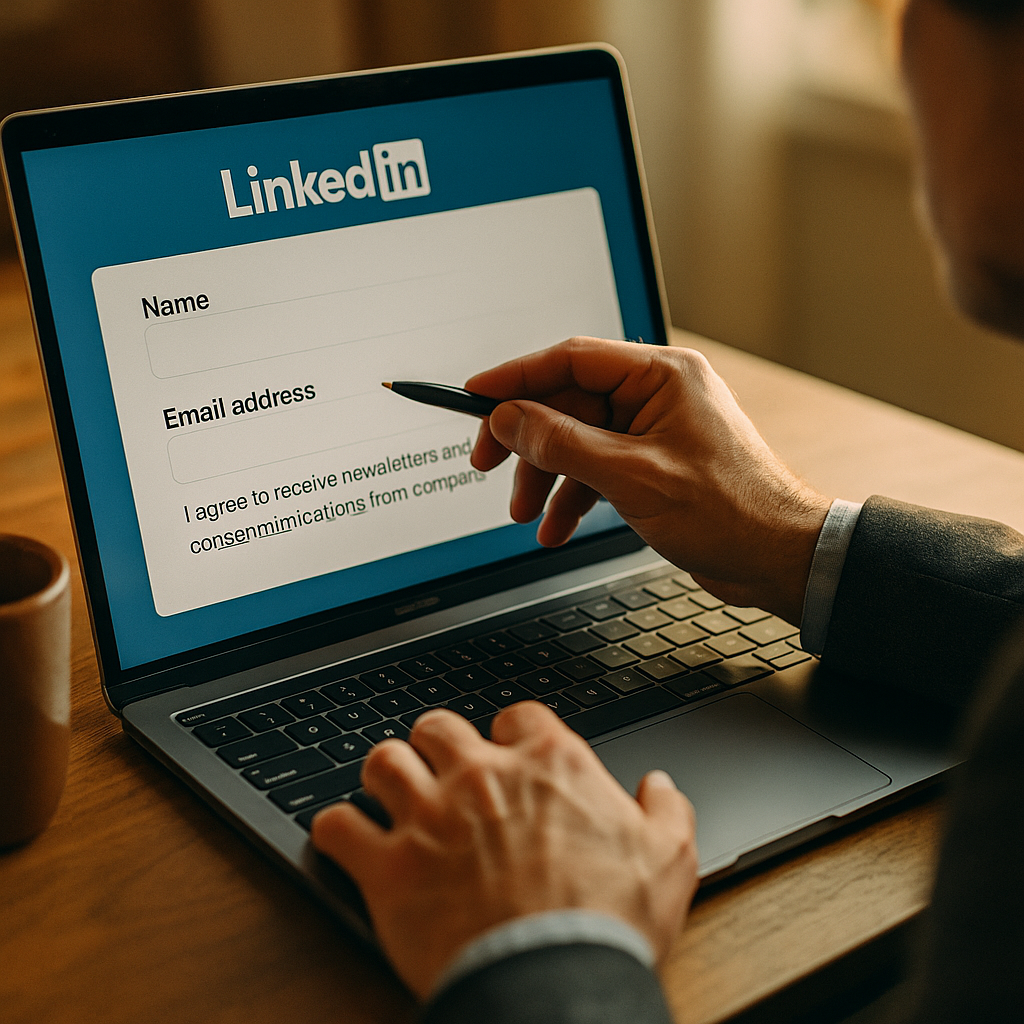
Roughly 80% of B2B marketers running LinkedIn Lead Gen Forms have never rewritten their consent language since setting up the campaign. That’s a problem, because the pre-checked box that used to do the compliance heavy lifting is disappearing. When LinkedIn’s default checkbox removal takes full effect, every form running purpose-specific consent language that was vague, bundled, or borrowed from a template three years ago becomes a liability sitting in your ad account.
This isn’t a minor UI tweak. It’s a shift in who owns the compliance burden — and right now, that’s you.
Why This Matters More Than It Looks
LinkedIn Lead Gen Forms have long been the easy button for B2B demand gen. Pre-filled fields, native mobile experience, frictionless conversion. The trade-off was a default consent checkbox that many advertisers treated as a compliance guarantee rather than a starting point. That assumption was always shaky under GDPR, and now LinkedIn is removing the crutch entirely.
Our sister analysis, LinkedIn Killed the EU Consent Checkbox, Here’s the Fix, covers the mechanics of what’s changing at the platform level. This piece goes further: it’s the audit brands need to run internally, form by form, before enforcement stops being theoretical.
Under GDPR, consent must be freely given, specific, informed, and unambiguous. A pre-checked box has never satisfied “freely given” — regulators have said so since 2018. LinkedIn removing the default doesn’t create new risk. It removes the platform-level cover that was masking risk you already had.
The EU’s ICO guidance on consent has been consistent on this point for years: consent bundled into a single opt-in for marketing, lead-sharing, and third-party disclosure isn’t specific consent. It’s one box doing three jobs. That’s exactly the pattern baked into most legacy LinkedIn forms.
What “Purpose-Specific” Actually Requires
Purpose-specific consent means the person filling out your form knows, at the point of submission, exactly what happens to their data and why. Not a general “I agree to be contacted.” Each distinct use — email nurture, sales outreach, data sharing with a co-sponsor, retargeting — needs its own clear, separable consent signal.
Most LinkedIn forms fail this in one of three ways:
- Bundled consent: One checkbox covers newsletter signup, sales contact, and partner data sharing simultaneously.
- Vague language: “We may use your information to improve our services” tells a regulator nothing about actual purpose.
- Mismatched scope: The privacy policy linked from the form describes uses the form itself never mentions.
If your legal team hasn’t reviewed lead-gen copy since the campaign launched, assume at least one of these applies. It usually does.
The Co-Sponsorship Trap
Webinars and gated content run with a partner brand are especially exposed. If a lead fills out a form for a joint webinar, does the consent language clearly separate “share data with Brand A” from “share data with Brand B”? Most joint campaigns don’t. They run one form, one checkbox, one blanket consent — and two companies now processing data on a legal basis that won’t hold up if challenged.
This is the same structural issue we’ve flagged in retail media contexts, where data processing addendum language has to specify exactly which party does what with shared data. Lead-gen forms need the same discipline, just applied to consent capture instead of downstream processing.
The Audit: Six Things to Check Before Enforcement Hits
Don’t wait for a complaint or a DPA inquiry to find out your forms are weak. Run this audit now, across every active and dormant LinkedIn Lead Gen campaign.
- Pull a full inventory of live and paused forms. Many brands have dozens of forms running under different campaign managers, some abandoned but still technically live. Each one is a compliance surface.
- Check whether consent language is separated by purpose. Email marketing, sales follow-up, third-party sharing, and retargeting should each have distinct, unchecked opt-ins — not one combined statement.
- Verify the privacy policy link actually matches current practice. If the linked policy was written before your CRM changed vendors, it’s referencing a data flow that no longer exists.
- Confirm consent records are timestamped and retrievable. GDPR’s accountability principle means you need to prove what someone agreed to, not just that they agreed. If your CRM doesn’t log the exact consent text shown at submission time, that’s a gap.
- Test the mobile rendering. LinkedIn forms render differently across devices, and consent text that’s fully visible on desktop sometimes truncates or requires scrolling on mobile. Truncated consent isn’t informed consent.
- Map data retention against stated purpose. If your form says data is collected for “this webinar” but leads sit in a nurture sequence eighteen months later, purpose limitation has already been breached.
Run this across every market too — GDPR applies to any EU resident’s data regardless of where your company is headquartered, and the UK GDPR regime under the ICO runs parallel but not identical rules.
Who Should Own This Audit?
This is the part brands consistently get wrong: they treat it as a legal problem, hand it to counsel, and expect a memo back in six weeks. That’s too slow, and it misses the operational reality that marketing ops teams are the ones actually building and launching these forms.
The better model is a joint sprint: legal defines the consent standard, marketing ops audits the live forms against it, and a single owner — usually a demand gen lead or growth marketing manager — is accountable for closing gaps within a set window. Give it two weeks, not two quarters. LinkedIn’s rollout timeline doesn’t leave room for a leisurely review cycle.
Every week a non-compliant form stays live is another batch of leads captured under consent that won’t survive scrutiny. Those leads become unusable for the exact campaigns you built them for.
This mirrors a pattern we’ve seen across other compliance flashpoints in the creator and B2B marketing space — from AI-driven lead qualification workflows needing their own compliance checklist, to data minimization clauses in creator contracts. The throughline is the same: consent and data collection can’t be an afterthought bolted onto a growth tactic. It has to be designed in from the start.
Fixing Forms Without Killing Conversion
The pushback from growth teams is predictable: won’t unchecked, purpose-specific consent boxes tank conversion rates? Probably, a little. LinkedIn’s own Lead Gen Forms documentation has always positioned the pre-fill and frictionless submission as the core value proposition, and adding explicit opt-in steps adds friction by design.
But here’s the reframe: a smaller list of leads who gave real, specific consent converts better downstream than a bloated list you can’t legally email. HubSpot’s research on lead quality consistently shows that consent-clean, intent-driven leads outperform volume-driven lists on every metric that matters to sales — response rate, deal velocity, close rate. Compliance and lead quality aren’t opposing goals here. They’re the same goal.
Practical fixes that don’t tank performance:
- Split one bundled checkbox into two clearly labeled, unchecked opt-ins — one for the requested content, one for ongoing marketing contact.
- Move consent language above the fold in the form preview, not buried in a footer link.
- Use plain language over legal jargon. “We’ll email you about related products” beats “we may process your data for legitimate marketing interests” every time, for both compliance clarity and conversion.
- A/B test the new consent structure against a control group before rolling it out account-wide, so you have real data instead of assumptions when leadership asks about the conversion hit.
What Happens If You Don’t Fix It
Enforcement doesn’t require a data breach. A single complaint from a lead who feels misled about how their data was used is enough to trigger a DPA inquiry. Fines under GDPR can reach up to 4% of global annual turnover or €20 million, whichever is higher — and regulators have shown increasing willingness to act on B2B marketing complaints, not just consumer-facing cases.
Beyond fines, there’s the reputational cost that’s harder to quantify but arguably worse for a B2B brand: getting named publicly in a regulatory action erodes trust with exactly the enterprise buyers you’re trying to convert through those lead forms. Not a great look when your product pitch involves trust and data stewardship.
Next Step
Pull every live LinkedIn Lead Gen Form this week, run it against the six-point audit above, and assign one owner to close gaps before the default checkbox disappears entirely. Waiting for enforcement to force the issue means fixing it under a regulator’s clock, not yours.
FAQs
What is changing with LinkedIn’s default consent checkbox?
LinkedIn is removing the pre-checked consent box that previously appeared on Lead Gen Forms by default, shifting the responsibility for building compliant, purpose-specific consent language entirely onto advertisers rather than relying on a platform-provided default.
Does GDPR require separate consent for each type of data use?
Yes. GDPR’s specificity requirement means consent must be granular enough that a person can agree to one use, such as receiving a requested asset, without automatically consenting to others, like ongoing sales outreach or third-party data sharing.
How long do brands have before enforcement takes effect?
LinkedIn has communicated a rollout timeline for the checkbox removal, but brands should treat any transition window as short. Regulatory risk exists as soon as non-compliant forms are live and collecting data, regardless of the platform’s own deployment schedule.
Will adding unchecked consent boxes reduce lead volume?
Likely yes, in raw volume terms. However, leads captured under clear, specific consent tend to convert better downstream because they represent genuine intent rather than passive default agreement, offsetting the volume drop with improved lead quality.
Who should be responsible for auditing lead-gen consent language?
A joint effort works best: legal or privacy counsel sets the compliance standard, marketing operations audits existing forms against it, and a single accountable owner, typically in demand generation, drives the fixes on a short timeline.
Does this apply to brands outside the EU?
Yes. GDPR applies based on the data subject’s location, not the advertiser’s headquarters. Any brand collecting leads from EU or UK residents through LinkedIn forms needs compliant consent language regardless of where the company itself is based.
Top Influencer Marketing Agencies
The leading agencies shaping influencer marketing in 2026
Agencies ranked by campaign performance, client diversity, platform expertise, proven ROI, industry recognition, and client satisfaction. Assessed through verified case studies, reviews, and industry consultations.
Moburst

-
2

The Shelf
Boutique Beauty & Lifestyle Influencer AgencyA data-driven boutique agency specializing exclusively in beauty, wellness, and lifestyle influencer campaigns on Instagram and TikTok. Best for brands already focused on the beauty/personal care space that need curated, aesthetic-driven content.Clients: Pepsi, The Honest Company, Hims, Elf Cosmetics, Pure LeafVisit The Shelf → -
3

Audiencly
Niche Gaming & Esports Influencer AgencyA specialized agency focused exclusively on gaming and esports creators on YouTube, Twitch, and TikTok. Ideal if your campaign is 100% gaming-focused — from game launches to hardware and esports events.Clients: Epic Games, NordVPN, Ubisoft, Wargaming, Tencent GamesVisit Audiencly → -
4

Viral Nation
Global Influencer Marketing & Talent AgencyA dual talent management and marketing agency with proprietary brand safety tools and a global creator network spanning nano-influencers to celebrities across all major platforms.Clients: Meta, Activision Blizzard, Energizer, Aston Martin, WalmartVisit Viral Nation → -
5

The Influencer Marketing Factory
TikTok, Instagram & YouTube CampaignsA full-service agency with strong TikTok expertise, offering end-to-end campaign management from influencer discovery through performance reporting with a focus on platform-native content.Clients: Google, Snapchat, Universal Music, Bumble, YelpVisit TIMF → -
6

NeoReach
Enterprise Analytics & Influencer CampaignsAn enterprise-focused agency combining managed campaigns with a powerful self-service data platform for influencer search, audience analytics, and attribution modeling.Clients: Amazon, Airbnb, Netflix, Honda, The New York TimesVisit NeoReach → -
7

Ubiquitous
Creator-First Marketing PlatformA tech-driven platform combining self-service tools with managed campaign options, emphasizing speed and scalability for brands managing multiple influencer relationships.Clients: Lyft, Disney, Target, American Eagle, NetflixVisit Ubiquitous → -
8

Obviously
Scalable Enterprise Influencer CampaignsA tech-enabled agency built for high-volume campaigns, coordinating hundreds of creators simultaneously with end-to-end logistics, content rights management, and product seeding.Clients: Google, Ulta Beauty, Converse, AmazonVisit Obviously →