


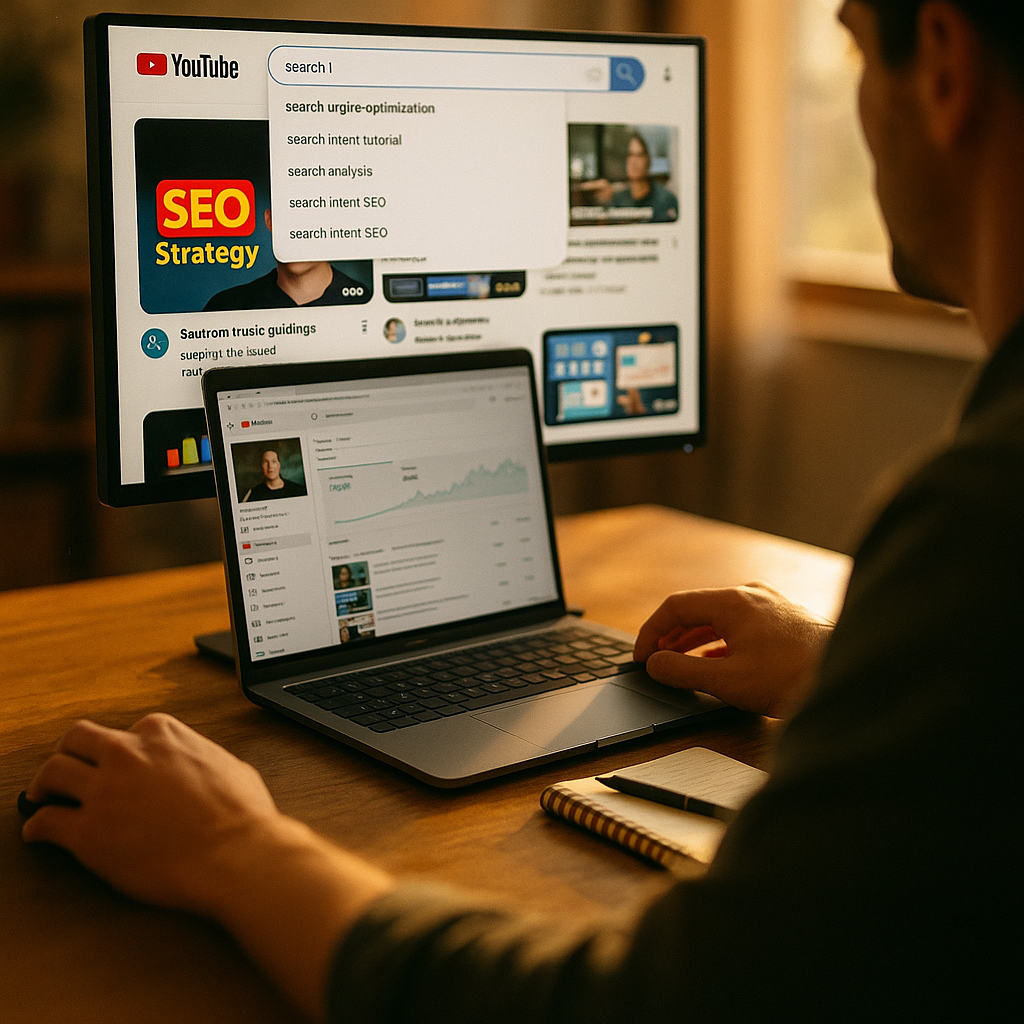
Google’s own data shows more than half of YouTube searches now trigger an AI Overview or Gemini-powered summary before a viewer ever clicks play. So the question isn’t whether your video ranks anymore. It’s whether an AI system can understand it well enough to recommend it. YouTube Creator Studio’s new search-intent tools just changed the rules for anyone running long-form video strategy at scale.
If you’re a brand or agency still optimizing titles and tags like it’s 2019, you’re leaving discovery on the table. This playbook breaks down what the new tools actually do, and how to rebuild your long-form workflow around dual optimization: human viewers and AI retrieval systems, at the same time.
What Actually Changed in Creator Studio
YouTube quietly rolled out a search-intent module inside Creator Studio’s analytics suite. It’s not a cosmetic update. The tool surfaces the actual query clusters driving impressions to a video, not just keywords, but intent categories: “comparison,” “how-to,” “review before purchase,” “troubleshooting.” Previously, creators got vague search term data buried in the analytics tab. Now they get intent-mapped demand signals, refreshed weekly.
For brands, this is the first time YouTube has explicitly told you *why* someone searched, not just *what* they typed.
The second piece is arguably more important: a transcript-optimization scorer. It evaluates whether your video’s spoken content, captions, and chapter markers align with the query intents Google’s systems are matching to your content. Think of it as a readability score, but for machine comprehension rather than human reading level.
YouTube is no longer just a search engine you optimize for. It’s an ingestion layer that AI Overviews, Gemini, and third-party LLMs pull from directly, which means transcript quality is now a ranking factor, not an accessibility afterthought.
Why This Matters More for Long-Form Than Shorts
Short-form video is built for immediate engagement, not deep retrieval. Long-form is different. A 14-minute product breakdown or a 20-minute founder interview carries enough spoken content for AI systems to extract structured answers, timestamps, comparisons, specific claims. That’s exactly what generative search wants to pull.
This is why the brand calculus around long-form video budget allocation needs revisiting. Shorts still win on reach velocity. But long-form is where AI discovery, and the trust it builds, actually compounds.
Supplement, finance, and B2B software brands have known this for a while. Deep-dive content builds credibility that a 30-second clip can’t replicate. That’s part of why long-form video builds trust for supplement brands specifically: viewers researching ingredient safety or dosage want depth, not a hook-and-cut format.
The Search-Intent Categories Worth Prioritizing
- Comparison intent — “X vs Y” queries where AI Overviews often synthesize multiple videos into one answer box. Structure your video to name competitors and alternatives explicitly, on camera, not just in the description.
- Pre-purchase validation — viewers who’ve already narrowed to 2-3 options and want a tiebreaker. This is high commercial intent and underweighted by most brand channels.
- Troubleshooting/how-to — evergreen, compounding traffic. These videos age like fine wine if the transcript is clean and chaptered well.
- Category education — top-of-funnel, lower conversion but high AI-citation potential since generative engines love authoritative explainer content.
Run your last ten long-form uploads through the new intent module. Most brand channels discover they’re heavily skewed toward one category (usually category education) and starving the other three. That imbalance is costing you AI Overview citations you didn’t know you were missing.
Optimizing for Machines Without Sounding Like One
Here’s the tension every content lead is wrestling with right now: write for AI parsing, and you risk sounding robotic. Write purely for human warmth, and machines struggle to extract clean answers. You don’t have to choose.
The fix is structural, not stylistic. Keep your talent’s natural delivery, humor, tangents, personality, but build a spoken scaffolding underneath it: state the question you’re answering near the top, restate key claims in plain declarative sentences, and use chapter markers that mirror actual search phrasing.
For example, instead of a chapter titled “The Breakdown,” title it “Is [Product] Worth It in 2026?” Yes, that’s more literal. It’s also exactly the phrase AI systems are trying to match against user queries. Literal beats clever when machines are doing the reading.
This mirrors a pattern we’ve seen across other platforms too. When TikTok shifted its algorithm to favor human video signals over AI-generated content, the winning brands didn’t abandon structure, they doubled down on making structure feel native to the creator’s voice. Same principle applies here, just inverted: YouTube wants machine-readable structure wrapped in human delivery.
Transcripts Are Now a Content Asset, Not a Compliance Checkbox
Most brand teams treat closed captions as an accessibility requirement and nothing more. That’s a mistake in 2026. YouTube’s transcript-optimization scorer explicitly rewards videos where the auto-generated transcript contains natural-language answers to identifiable questions.
Practically, this means your scriptwriting process needs a pass specifically for spoken clarity: fewer pronouns without antecedents, fewer “as I mentioned before” callbacks that make no sense out of context, more explicit product names and category terms repeated naturally throughout, not just in the intro.
Agencies briefing creators should add a transcript-clarity checklist to standard deliverables. It costs nothing extra to implement and it’s the single highest-leverage lever in this whole update.
Does This Replace Traditional SEO Titles and Tags?
No. Titles, thumbnails, and tags still drive the initial click-through and remain critical for YouTube’s traditional ranking signals, according to Google’s own creator support documentation. What’s changed is that title optimization is no longer sufficient on its own. Search-intent tools are an additional layer sitting on top of, not replacing, foundational metadata work.
Think of it as two ranking systems running in parallel: the classic click-through-rate-driven algorithm, and the newer AI-retrieval layer that cares more about whether your content actually answers the question cleanly. Winning both requires separate optimization passes.
Operationalizing This Across a Creator Program
If you’re managing dozens or hundreds of creator partnerships, you can’t manually audit intent alignment for every long-form upload. Here’s how mature programs are structuring it:
- Brief-stage intent mapping — before a creator shoots, define which of the four intent categories the video is targeting. This should live in the brief alongside the usual talking points, the way discovery-focused briefs have restructured TikTok content planning.
- Post-upload transcript QA — a lightweight review step, ideally within 48 hours of publish, checking the transcript-optimization score and flagging videos scoring below whatever threshold your team sets.
- Quarterly intent-gap audits — pull the full channel’s intent distribution and compare it against your funnel goals. If 80% of content is category education but your sales team says pre-purchase validation content converts best, that’s a resourcing problem, not a content problem.
- Chapter marker standardization — build a template library of chapter phrasing patterns that mirror common query structures for your category, so creators aren’t reinventing this every video.
According to eMarketer’s ongoing tracking of creator economy spend, brands are increasingly measuring content ROI by discovery efficiency, not just view count, which makes this kind of structural audit a budget justification tool, not just an SEO nicety.
What About Watch-Time and Retention Signals?
Search-intent alignment doesn’t override watch-time and retention as ranking inputs, it works alongside them. A perfectly intent-matched video that loses 70% of viewers in the first 90 seconds still underperforms. If your team hasn’t already adjusted briefs around the platform’s evolving retention math, it’s worth reviewing how watch-time equivalence changes creator brief structure, since pacing and intent optimization need to work in tandem, not compete for the same seven seconds of hook.
Risk and Compliance Angle: Don’t Overclaim to Chase Citations
There’s a temptation, once you realize AI Overviews are citing your videos, to over-engineer transcripts toward maximum extractability, sometimes at the cost of accuracy or nuance. Resist it. If your transcript states a claim more definitively than your legal or regulatory team would approve for a written ad, that’s a problem, because AI systems will happily lift that exact phrasing into a summary shown to millions.
This is the same discipline brands have had to apply to livestream urgency language and countdown scripts under FTC scrutiny, where scarcity claims require careful wording to avoid regulatory exposure. Long-form video transcripts deserve the same review pass, since they’re now functionally structured data feeding third-party AI systems, not just casual spoken content. Check current guidance from the Federal Trade Commission before greenlighting any claim-heavy long-form script.
The Bottom Line for Brand Teams
YouTube’s search-intent tools aren’t a minor analytics update. They’re a signal that the platform is positioning long-form video as the primary raw material for AI-driven discovery, and brands that treat transcripts, chapters, and intent mapping as core production steps, not afterthoughts, will own a disproportionate share of both human clicks and AI citations over the next several quarters.
Pull your intent-distribution report this week, identify your most underserved category, and brief one long-form piece specifically to fill that gap before your competitors do.
FAQs
What are YouTube’s new search-intent tools in Creator Studio?
They’re an analytics module that maps viewer queries to intent categories like comparison, pre-purchase validation, troubleshooting, and category education, paired with a transcript-optimization scorer that evaluates how well spoken content and captions match those intents.
Do these tools affect Shorts as well as long-form video?
The intent-mapping data applies across formats, but the transcript-optimization scoring has far more impact on long-form video, since Shorts rarely contain enough spoken content for AI systems to extract structured answers.
Will optimizing for AI discovery hurt engagement with human viewers?
Not if done correctly. The goal is structural clarity, clear chapter markers, explicit claims, natural repetition of key terms, layered under a creator’s normal delivery style, not scripted robotic narration.
How often should brands audit their intent distribution?
Quarterly is a reasonable cadence for most brand channels, with a lighter transcript-quality check on every individual upload within 48 hours of publishing.
Does this replace the need for strong titles and thumbnails?
No. Titles and thumbnails still drive click-through and remain core to YouTube’s traditional ranking algorithm. Search-intent optimization is an additional layer for AI retrieval, not a replacement for foundational metadata work.
Top Influencer Marketing Agencies
The leading agencies shaping influencer marketing in 2026
Agencies ranked by campaign performance, client diversity, platform expertise, proven ROI, industry recognition, and client satisfaction. Assessed through verified case studies, reviews, and industry consultations.
Moburst

-
2

The Shelf
Boutique Beauty & Lifestyle Influencer AgencyA data-driven boutique agency specializing exclusively in beauty, wellness, and lifestyle influencer campaigns on Instagram and TikTok. Best for brands already focused on the beauty/personal care space that need curated, aesthetic-driven content.Clients: Pepsi, The Honest Company, Hims, Elf Cosmetics, Pure LeafVisit The Shelf → -
3

Audiencly
Niche Gaming & Esports Influencer AgencyA specialized agency focused exclusively on gaming and esports creators on YouTube, Twitch, and TikTok. Ideal if your campaign is 100% gaming-focused — from game launches to hardware and esports events.Clients: Epic Games, NordVPN, Ubisoft, Wargaming, Tencent GamesVisit Audiencly → -
4

Viral Nation
Global Influencer Marketing & Talent AgencyA dual talent management and marketing agency with proprietary brand safety tools and a global creator network spanning nano-influencers to celebrities across all major platforms.Clients: Meta, Activision Blizzard, Energizer, Aston Martin, WalmartVisit Viral Nation → -
5

The Influencer Marketing Factory
TikTok, Instagram & YouTube CampaignsA full-service agency with strong TikTok expertise, offering end-to-end campaign management from influencer discovery through performance reporting with a focus on platform-native content.Clients: Google, Snapchat, Universal Music, Bumble, YelpVisit TIMF → -
6

NeoReach
Enterprise Analytics & Influencer CampaignsAn enterprise-focused agency combining managed campaigns with a powerful self-service data platform for influencer search, audience analytics, and attribution modeling.Clients: Amazon, Airbnb, Netflix, Honda, The New York TimesVisit NeoReach → -
7

Ubiquitous
Creator-First Marketing PlatformA tech-driven platform combining self-service tools with managed campaign options, emphasizing speed and scalability for brands managing multiple influencer relationships.Clients: Lyft, Disney, Target, American Eagle, NetflixVisit Ubiquitous → -
8

Obviously
Scalable Enterprise Influencer CampaignsA tech-enabled agency built for high-volume campaigns, coordinating hundreds of creators simultaneously with end-to-end logistics, content rights management, and product seeding.Clients: Google, Ulta Beauty, Converse, AmazonVisit Obviously →