


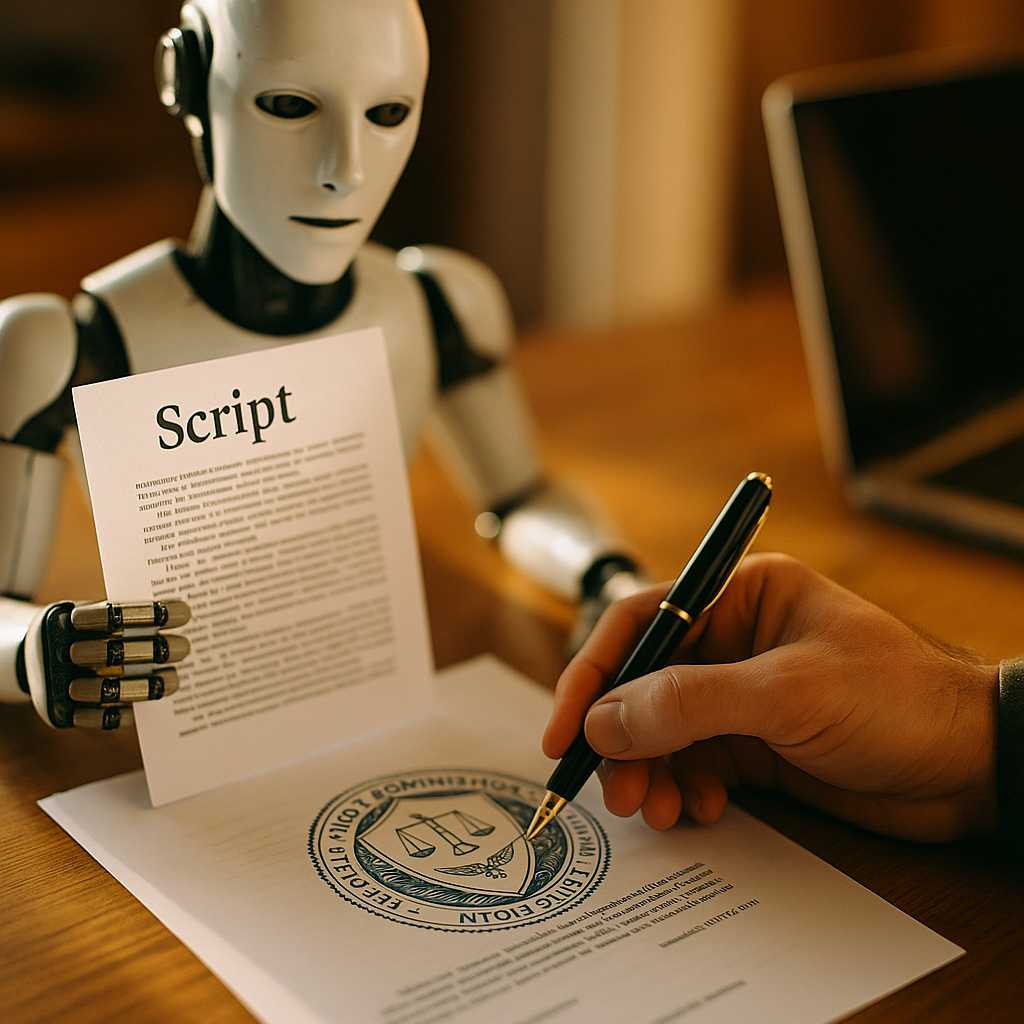
Seventy-two percent of marketers now use generative AI somewhere in their creator workflows, according to recent industry surveys. Here’s the uncomfortable question nobody’s legal team wants to answer: if an AI tool auto-generates a creator’s script and nobody reviews it before it goes live, who does the FTC come after? Spoiler: it’s not the chatbot. The FTC’s expanding definition of brand-directed liability means the answer is almost always “you.”
This isn’t a hypothetical for some future enforcement cycle. It’s happening now, quietly, inside brand marketing teams that adopted AI script generators to scale creator briefs faster than a human copywriter ever could. The tools work. The risk is that “working fast” and “working compliant” are not the same thing.
The Liability Shift Nobody Budgeted For
For years, brand legal teams treated influencer compliance as a contract problem: get the disclosure language in the agreement, require #ad tags, done. The FTC has steadily moved away from that narrow view. Its enforcement actions and guidance updates increasingly hold brands responsible not just for what creators post, but for the systems and processes brands use to produce that content — including automated ones.
That’s the crux of brand-directed liability. The FTC doesn’t ask “who typed the words.” It asks “who controlled the process that generated the claim, and did they have a reasonable system to catch problems before publication?” When a brand’s AI tool spits out a script claiming a supplement “cures inflammation” or a skincare product “eliminates wrinkles in 48 hours,” the absence of a human reviewer isn’t a defense. It’s evidence of negligence.
An AI tool doesn’t get named in an FTC complaint. The brand that deployed it without a review gate does.
The agency has made clear in prior guidance around endorsements and testimonials that advertisers bear responsibility for substantiating claims made in sponsored content, regardless of who — or what — authored them. Automating the drafting process doesn’t automate away the legal duty. If anything, it concentrates it. One flawed prompt template can generate the same unsubstantiated claim across fifty creator scripts in an afternoon.
Why AI-Generated Scripts Are a Different Risk Category
Human copywriters make mistakes too. So why treat AI-generated scripts differently? Three reasons.
- Scale multiplies exposure. A junior copywriter might draft five scripts a day. An AI tool can generate five hundred. If there’s a systemic flaw — an overstated health claim, a missing disclosure cue, a comparative claim with no backing data — it replicates instantly across every creator relationship touching that campaign.
- Training data introduces claims nobody approved. Generative models trained on marketing copy, competitor ads, or scraped product reviews can reproduce claims that were never vetted by your legal or regulatory team. The AI isn’t lying. It’s pattern-matching from data that included exaggeration, unsubstantiated efficacy claims, or outdated regulatory language.
- Disclosure logic gets lost in generation. A human writer briefed on FTC disclosure rules will typically remember to flag “this needs a #ad tag” or “this is a paid partnership.” An AI tool prompted only to “write an engaging 30-second script” has no inherent understanding of when disclosure triggers apply, especially in edge cases like affiliate links, gifted product, or long-term ambassador deals.
This is why the FTC’s evolving posture matters so much for brands leaning on AI copy tools for creator briefs. The agency isn’t just asking whether disclosure happened. It’s asking whether the process that produced the content was reasonably designed to prevent violations in the first place. No human-in-the-loop step is, functionally, no reasonable process.
What “Reasonable Review” Actually Looks Like
Brands often ask: how much human review is enough? There’s no bright-line rule, but the FTC’s general standard for advertising substantiation and endorsement compliance implies a few baseline expectations.
Reasonable review typically means someone with authority to reject or edit content actually reads the script before it’s briefed to a creator or before a creator’s finished content goes live. It means claims about efficacy, safety, or performance are checked against existing substantiation — not generated on the fly by a language model with no access to your clinical data or product testing. And it means disclosure requirements are confirmed as part of the sign-off, not assumed to be baked into the AI’s output.
Compare that to how many brands actually operate today: marketing ops teams feed a product brief into an AI tool, get back ten script variations, and forward them straight to creators via a briefing platform. Nobody flags the claim about “clinically proven results” because nobody read that line closely. That’s the gap the FTC is now watching.
For brands already building compliance frameworks around health and performance claim disclaimers, the same rigor needs to extend upstream — to the AI tools generating the initial draft, not just the final creator post.
The Agentic AI Problem Makes This Worse
Script generation is just the entry point. Brands are increasingly deploying agentic AI systems that handle creator briefing, content approval routing, and even publishing schedules with minimal human touchpoints. Each additional automated step is another place where a compliance gap can open and go unnoticed until a regulator — or a competitor’s legal team — flags it.
This is precisely why frameworks like the one outlined in our agentic AI marketing governance charter exist: brands need documented, auditable checkpoints for every stage where AI makes a decision that touches consumer-facing claims. Governance isn’t paperwork for its own sake. It’s the evidence you’ll need if the FTC ever asks, “what was your process?”
If your answer to “what’s your AI review process” is “we trust the tool,” you don’t have a process. You have exposure.
Disclosure Gaps Compound the Risk
AI-generated scripts create a second-order problem: disclosure timing and placement. The FTC has been explicit that disclosures need to be clear, conspicuous, and hard to miss — not buried three lines into a caption or mentioned once in a fast-talking script intro.
When scripts are auto-generated at scale, disclosure language often becomes an afterthought bolted on by the creator, if it happens at all. That’s a problem brands have already had to reckon with on platforms like TikTok Shop, where timing and placement rules are notoriously strict. Our TikTok Shop disclosure timing framework lays out how brands should structure disclosure requirements contractually — the same logic needs to apply to whatever AI tool is drafting the script the creator will read from.
It’s also worth remembering that brand liability doesn’t stop at the script. If a creator paraphrases an AI-generated draft on camera and drops the disclosure in the process, that’s still traceable back to a brand process that didn’t build in a verification step. Tools like the ones described in our video transcript audit system guide exist precisely because scripts and final content diverge, and brands need a way to catch it after the fact if they missed it before publication.
Contract Language Hasn’t Caught Up
Most creator contracts were written assuming a human on the brand side drafted or approved the brief. Few include specific language addressing AI-generated content, who’s responsible for reviewing it, or what happens if an AI tool’s output creates legal exposure for the creator, the brand, or both.
This gap shows up most starkly in indemnification clauses. If an AI-drafted script leads to an FTC complaint or a consumer lawsuit, does the brand’s indemnification language cover content the brand itself generated via automation? Many contracts are silent on this, which usually means the brand — not the creator — absorbs the risk. It’s the same logic playing out in emerging indemnification clauses for AI shopping agent liability, where brands are having to explicitly define who’s on the hook when an automated system, not a person, generates the problematic content.
Brands renegotiating creator agreements in the coming year should treat AI-script review as its own contract clause: who reviews AI output, what the sign-off process looks like, and what recourse exists if a script slips through without review.
A Practical Compliance Checklist
Given where enforcement is heading, brands using AI for creator script generation should build in the following, at minimum:
- Mandatory human sign-off before any AI-generated script is briefed to a creator or approved for publication, with a named reviewer on record.
- A claims library that AI tools are restricted to pulling from, so efficacy and comparative claims are pre-substantiated rather than generated freely.
- Disclosure logic checks built into the review step, confirming every script flags where and how disclosure should appear on the final platform.
- Version tracking between the AI-generated script, the brand-approved version, and the creator’s final published content, so discrepancies are catchable.
- Updated indemnification language in creator contracts that accounts for AI-originated content specifically.
None of this is exotic. It’s the same discipline brands already apply to legal review of traditional ad copy, extended to a new production method. The FTC’s own guidance has repeatedly emphasized that the mechanism of content creation doesn’t change the underlying duty to avoid deceptive or unsubstantiated claims.
Marketing teams evaluating AI script tools should also look at how platforms like Sprout Social and workflow platforms integrate approval gates, since built-in review steps are becoming a genuine differentiator in vendor selection, not just a nice-to-have feature.
Where This Is Headed
Expect FTC scrutiny of AI-generated marketing content to intensify, not ease off, as adoption grows. Industry data from eMarketer shows AI tool usage in content production climbing sharply year over year, which means the volume of unreviewed AI output flowing into creator campaigns is climbing right alongside it. Regulators tend to focus enforcement energy where risk is scaling fastest. Right now, that’s here.
Brands that get ahead of this won’t be the ones with the most sophisticated AI stack. They’ll be the ones who can prove, with documentation, that a human checked the work before it reached a consumer.
Frequently Asked Questions
Does the FTC treat AI-generated creator scripts differently from human-written ones?
Not fundamentally. The FTC’s standard focuses on whether claims are substantiated and disclosures are clear, regardless of how content was produced. However, the absence of human review over AI output is increasingly viewed as a sign of an inadequate compliance process, which can strengthen a case against the brand.
Can a brand be held liable if a creator, not the brand, used an AI tool to write their own script?
Yes, in many cases. If the brand directed, approved, or reasonably should have reviewed the content before publication, liability can still attach to the brand under existing endorsement guidance, especially if the brand supplied talking points, claims, or a creative brief the AI tool expanded on.
What counts as “reasonable human review” for AI-generated scripts?
At minimum, a designated reviewer with authority to edit or reject content should check scripts for unsubstantiated claims, missing or unclear disclosures, and alignment with existing product substantiation before the script is briefed to a creator or published.
Should brands update creator contracts to address AI-generated content specifically?
Yes. Most existing contracts don’t address who’s responsible for reviewing AI-drafted scripts or how indemnification applies when automation, not a person, generates problematic claims. This gap should be closed in upcoming contract renewals.
Are there tools that can help catch compliance gaps after content is published?
Yes. Transcript and content audit tools can compare published creator content against approved scripts and flag missing disclosures or claim discrepancies after the fact, which is useful as a backstop even when pre-publication review is in place.
Bottom line: audit every AI tool touching creator scripts this quarter, insert a mandatory human sign-off before briefs go out, and update indemnification language before your next contract renewal cycle — not after an FTC inquiry forces the issue.
Frequently Asked Questions
Does the FTC treat AI-generated creator scripts differently from human-written ones?
Not fundamentally. The FTC’s standard focuses on whether claims are substantiated and disclosures are clear, regardless of how content was produced. However, the absence of human review over AI output is increasingly viewed as a sign of an inadequate compliance process, which can strengthen a case against the brand.
Can a brand be held liable if a creator, not the brand, used an AI tool to write their own script?
Yes, in many cases. If the brand directed, approved, or reasonably should have reviewed the content before publication, liability can still attach to the brand under existing endorsement guidance, especially if the brand supplied talking points, claims, or a creative brief the AI tool expanded on.
What counts as “reasonable human review” for AI-generated scripts?
At minimum, a designated reviewer with authority to edit or reject content should check scripts for unsubstantiated claims, missing or unclear disclosures, and alignment with existing product substantiation before the script is briefed to a creator or published.
Should brands update creator contracts to address AI-generated content specifically?
Yes. Most existing contracts don’t address who’s responsible for reviewing AI-drafted scripts or how indemnification applies when automation, not a person, generates problematic claims. This gap should be closed in upcoming contract renewals.
Are there tools that can help catch compliance gaps after content is published?
Yes. Transcript and content audit tools can compare published creator content against approved scripts and flag missing disclosures or claim discrepancies after the fact, which is useful as a backstop even when pre-publication review is in place.
Top Influencer Marketing Agencies
The leading agencies shaping influencer marketing in 2026
Agencies ranked by campaign performance, client diversity, platform expertise, proven ROI, industry recognition, and client satisfaction. Assessed through verified case studies, reviews, and industry consultations.
Moburst

-
2

The Shelf
Boutique Beauty & Lifestyle Influencer AgencyA data-driven boutique agency specializing exclusively in beauty, wellness, and lifestyle influencer campaigns on Instagram and TikTok. Best for brands already focused on the beauty/personal care space that need curated, aesthetic-driven content.Clients: Pepsi, The Honest Company, Hims, Elf Cosmetics, Pure LeafVisit The Shelf → -
3

Audiencly
Niche Gaming & Esports Influencer AgencyA specialized agency focused exclusively on gaming and esports creators on YouTube, Twitch, and TikTok. Ideal if your campaign is 100% gaming-focused — from game launches to hardware and esports events.Clients: Epic Games, NordVPN, Ubisoft, Wargaming, Tencent GamesVisit Audiencly → -
4

Viral Nation
Global Influencer Marketing & Talent AgencyA dual talent management and marketing agency with proprietary brand safety tools and a global creator network spanning nano-influencers to celebrities across all major platforms.Clients: Meta, Activision Blizzard, Energizer, Aston Martin, WalmartVisit Viral Nation → -
5

The Influencer Marketing Factory
TikTok, Instagram & YouTube CampaignsA full-service agency with strong TikTok expertise, offering end-to-end campaign management from influencer discovery through performance reporting with a focus on platform-native content.Clients: Google, Snapchat, Universal Music, Bumble, YelpVisit TIMF → -
6

NeoReach
Enterprise Analytics & Influencer CampaignsAn enterprise-focused agency combining managed campaigns with a powerful self-service data platform for influencer search, audience analytics, and attribution modeling.Clients: Amazon, Airbnb, Netflix, Honda, The New York TimesVisit NeoReach → -
7

Ubiquitous
Creator-First Marketing PlatformA tech-driven platform combining self-service tools with managed campaign options, emphasizing speed and scalability for brands managing multiple influencer relationships.Clients: Lyft, Disney, Target, American Eagle, NetflixVisit Ubiquitous → -
8

Obviously
Scalable Enterprise Influencer CampaignsA tech-enabled agency built for high-volume campaigns, coordinating hundreds of creators simultaneously with end-to-end logistics, content rights management, and product seeding.Clients: Google, Ulta Beauty, Converse, AmazonVisit Obviously →