


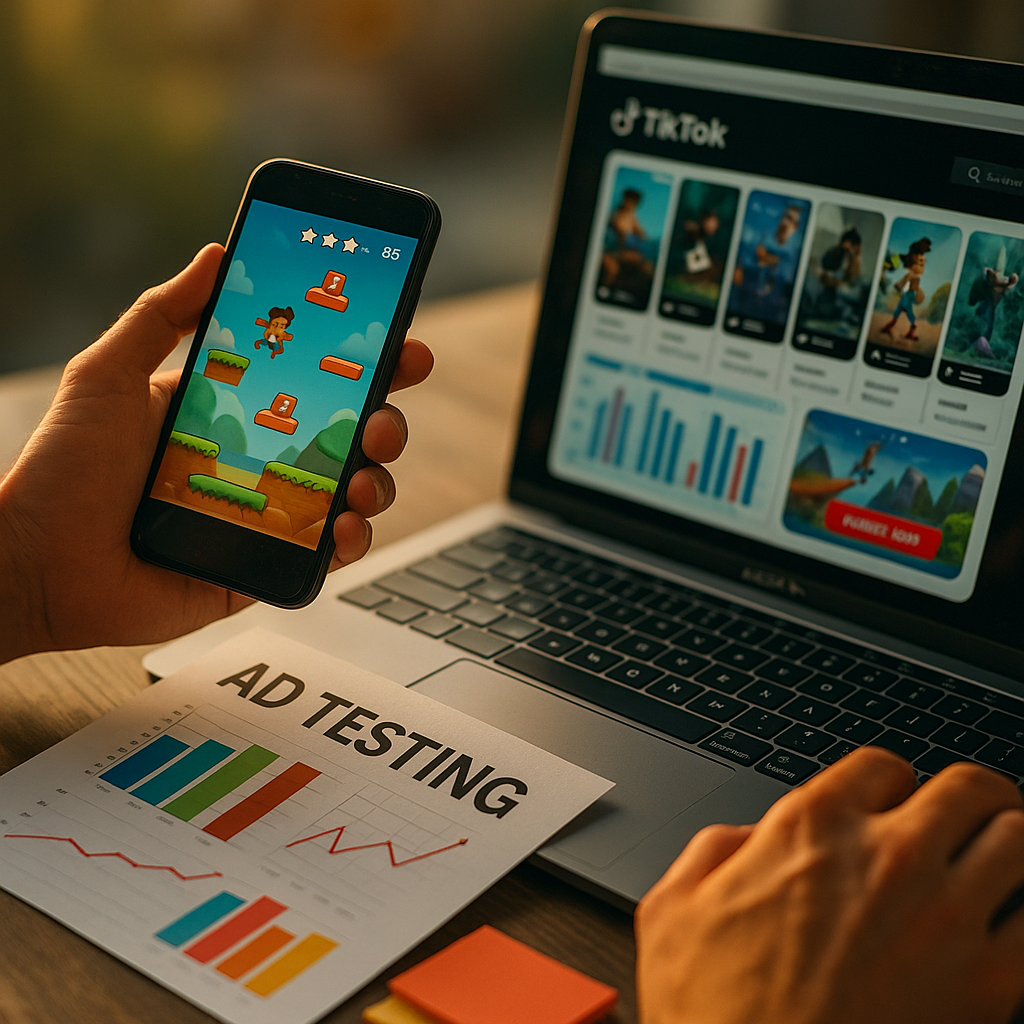
One mobile gaming studio tested 214 video ad variants in six weeks and dropped its cost-per-install by 41% while tripling daily spend. That’s not a fluke. It’s what happens when you treat TikTok creative like a live experiment instead of a finished product. This case study breaks down how the team built a rapid video-ad iteration engine on TikTok, why most gaming apps get iteration speed wrong, and what other verticals can steal from the playbook.
The Problem: Rising CPIs and a Creative Bottleneck
The studio, a mid-size developer behind a casual puzzle-strategy title, had a familiar problem. Its user acquisition team was spending roughly $180,000 a month on TikTok, but cost-per-install (CPI) had crept up from $2.10 to $3.40 over four months. The account manager flagged the usual culprits: creative fatigue, rising auction competition, and a shrinking pool of top-performing ads carrying too much budget weight.
Here’s the uncomfortable truth most UA teams avoid saying out loud: the bottleneck wasn’t the algorithm. It was production speed. The studio was producing 8-10 new ad concepts per month, using a traditional agency workflow that involved briefs, storyboards, external editors, and a two-week turnaround. By the time a winning concept reached scale, TikTok’s audience had already seen it enough times to tune it out.
TikTok’s own advertising guidance has said for years that creative refresh cadence is one of the strongest levers against fatigue-driven CPI increases, more influential than bid strategy or audience targeting tweaks in many verticals (TikTok for Business). The gaming vertical is especially punishing here because install intent is impulsive. If the hook doesn’t land in the first two seconds, the spend is wasted.
Building the Rapid Iteration System
The UA and creative teams scrapped the agency pipeline and rebuilt around three principles: smaller batches, faster feedback loops, and modular editing.
- Modular creative templates. Instead of producing whole ads from scratch, the team built a library of interchangeable components: hooks, gameplay clips, UGC-style voiceovers, and CTA overlays. A new “ad” often meant swapping one hook onto an existing gameplay sequence.
- Daily creative drops. Rather than monthly batches of 8-10 ads, the team shipped 5-7 new variants every single day, drawing from a rotating pool of freelance editors and an in-house creator who filmed raw gameplay reactions.
- 48-hour kill criteria. Any ad that didn’t hit a minimum hook rate (3-second view rate) or thumb-stop ratio within 48 hours of a $50-100 test spend was killed immediately. No sentimentality, no “let’s give it another day.”
This is a sharp departure from how most gaming studios approach paid social. Many still treat creative as a quarterly production cycle. That cadence might work for brand campaigns. It’s a liability for performance-driven install campaigns where TikTok’s algorithm rewards accounts that keep feeding it fresh signals.
The studio’s iteration velocity, not its budget size, was the single biggest predictor of CPI improvement. Accounts that shipped more test variants per week saw CPI drop faster than accounts that simply increased daily budget.
What the Winning Ads Actually Looked Like
Nobody wants a case study without specifics, so here’s what worked.
The single highest-performing hook format was what the team internally called “fake fail” — a UGC-style clip showing someone apparently losing a level, followed by a quick cut revealing an obvious, satisfying solution. It leaned into TikTok’s native comment-bait behavior: users wanted to correct the “wrong” move in the comments, which boosted engagement and, indirectly, delivery.
Other patterns that consistently outperformed the account average:
- Raw phone-recorded gameplay footage beat polished screen recordings by a wide margin — authenticity signals mattered more than production value.
- Text overlays framed as questions (“wait, is this even possible?”) outperformed statement-style overlays by roughly 20% on hook rate.
- Ads under 9 seconds had higher completion rates than 15-30 second versions, even though the latter theoretically had more room to showcase gameplay depth.
None of this was obvious going in. That’s the point of rapid iteration: you’re not trying to guess the winner, you’re trying to shrink the cost and time of finding out. This mirrors what other creator-led brands have learned about repurposing raw content instead of over-producing it — see how Duolingo’s TikTok repurposing system applies a similar logic to owned content at scale.
Scaling Spend Without Breaking CPI
The riskiest part of any UA scaling story is what happens when you increase budget. Spend more, and CPI often rises because you’re forced deeper into the auction, reaching lower-intent users. The studio avoided this by scaling in parallel with creative supply, not ahead of it.
Their rule of thumb: never increase daily budget by more than 20% without first confirming at least three fresh winning variants were in active rotation. This kept the algorithm’s optimization signals diverse enough to avoid frequency-driven decay. TikTok’s ad platform, like Meta’s, tends to reward accounts that avoid over-serving the same creative to the same audience segment (Meta for Business documents similar fatigue curves, for context on cross-platform patterns).
Over six weeks, the account moved from $180K to roughly $540K in monthly spend. CPI didn’t just hold, it dropped from $3.40 to $2.00. That’s a 41% reduction while tripling budget, a combination most performance marketers will tell you almost never happens without either a product change or a creative overhaul. In this case, it was purely a process change.
Why This Isn’t Just a Gaming Story
Mobile gaming has unique dynamics: short consideration windows, high app-install competition, and audiences trained to skip anything that smells like an ad. But the underlying lesson applies far beyond gaming apps.
Any brand running performance campaigns on TikTok is fighting the same fatigue curve. eMarketer has repeatedly noted that TikTok ad costs are rising faster than most other platforms as advertiser demand outpaces inventory growth (eMarketer). In that environment, creative velocity becomes a genuine cost-control lever, not just a nice-to-have.
Compare this to how skincare and DTC brands have approached similar fatigue problems. One skincare brand fixed a completely different bottleneck — post-click drop-off — by pairing TikTok Shop traffic with YouTube content to rebuild trust before purchase. Different funnel stage, same underlying principle: don’t rely on a single format or platform to carry the whole weight of performance.
Auto marketers have found comparable gains by leaning into personalization speed rather than polish. The approach detailed in how AI-personalized ad creative cut dealer cost-per-lead shares the same DNA: faster creative cycles beat bigger budgets when the algorithm is the real audience you’re optimizing for.
The Operational Playbook, Simplified
If you’re a UA lead or brand strategist trying to replicate this without a six-figure production budget, here’s the condensed version:
- Build a modular creative library (hooks, footage, CTAs) instead of finished ads. Recombine, don’t recreate.
- Set a hard kill window (24-48 hours) with a defined performance threshold. Remove emotion from the decision.
- Ship daily or near-daily, even if volume is small. Cadence beats batch size.
- Scale budget only in step with fresh creative supply, not ahead of it.
- Track hook rate and 3-second view rate as leading indicators, not just final CPI.
None of this requires an enormous team. The gaming studio in this case study ran the entire system with two in-house editors and a rotating pool of three freelancers. What mattered was the process discipline, not headcount.
Creative fatigue isn’t solved by better creative. It’s solved by faster creative cycles that make fatigue irrelevant before it sets in.
It’s also worth noting the compliance angle here, since gaming apps targeting younger demographics face scrutiny. Any UGC-style testimonial content, even performance-driven variants, should follow FTC disclosure guidance if creators are compensated (FTC.gov outlines current endorsement rules). Rapid iteration doesn’t mean cutting corners on disclosure, it just means moving fast within a clean framework.
Frequently Asked Questions
FAQs
What is rapid video-ad iteration and why does it matter for TikTok UA campaigns?
Rapid video-ad iteration means producing and testing many small creative variants quickly, then killing underperformers within a short window (often 24-48 hours). It matters on TikTok because the platform’s algorithm rewards fresh creative signals, and audiences fatigue on repeated ads faster than on other platforms.
How many ad variants should a brand test per week to see meaningful CPI improvement?
There’s no universal number, but the case study team shipped 5-7 new variants daily. Smaller advertisers can start with 5-10 per week, focusing on swapping hooks and CTAs on existing footage rather than producing entirely new content each time.
Does scaling ad spend on TikTok always increase cost-per-install?
Not necessarily. CPI tends to rise when spend outpaces creative supply, forcing the algorithm to reach lower-intent audiences with fatigued ads. Scaling spend alongside a steady stream of fresh creative variants can hold or even lower CPI, as shown in this case study.
What metrics should teams track beyond final cost-per-install?
Leading indicators like 3-second hook rate, thumb-stop ratio, and completion rate reveal creative performance before CPI fully reflects it. Waiting only on CPI data means reacting too late to fatigue.
Can smaller teams without big budgets run this kind of iteration system?
Yes. The case study studio ran its entire system with two in-house editors and three freelancers, relying on modular creative templates instead of full agency production cycles. Process discipline matters more than headcount or budget size.
Next step: Audit your current creative cadence this week. If you’re shipping fewer than five new ad variants per week on TikTok, that’s likely costing you more than your bid strategy ever will.
Top Influencer Marketing Agencies
The leading agencies shaping influencer marketing in 2026
Agencies ranked by campaign performance, client diversity, platform expertise, proven ROI, industry recognition, and client satisfaction. Assessed through verified case studies, reviews, and industry consultations.
Moburst

-
2

The Shelf
Boutique Beauty & Lifestyle Influencer AgencyA data-driven boutique agency specializing exclusively in beauty, wellness, and lifestyle influencer campaigns on Instagram and TikTok. Best for brands already focused on the beauty/personal care space that need curated, aesthetic-driven content.Clients: Pepsi, The Honest Company, Hims, Elf Cosmetics, Pure LeafVisit The Shelf → -
3

Audiencly
Niche Gaming & Esports Influencer AgencyA specialized agency focused exclusively on gaming and esports creators on YouTube, Twitch, and TikTok. Ideal if your campaign is 100% gaming-focused — from game launches to hardware and esports events.Clients: Epic Games, NordVPN, Ubisoft, Wargaming, Tencent GamesVisit Audiencly → -
4

Viral Nation
Global Influencer Marketing & Talent AgencyA dual talent management and marketing agency with proprietary brand safety tools and a global creator network spanning nano-influencers to celebrities across all major platforms.Clients: Meta, Activision Blizzard, Energizer, Aston Martin, WalmartVisit Viral Nation → -
5

The Influencer Marketing Factory
TikTok, Instagram & YouTube CampaignsA full-service agency with strong TikTok expertise, offering end-to-end campaign management from influencer discovery through performance reporting with a focus on platform-native content.Clients: Google, Snapchat, Universal Music, Bumble, YelpVisit TIMF → -
6

NeoReach
Enterprise Analytics & Influencer CampaignsAn enterprise-focused agency combining managed campaigns with a powerful self-service data platform for influencer search, audience analytics, and attribution modeling.Clients: Amazon, Airbnb, Netflix, Honda, The New York TimesVisit NeoReach → -
7

Ubiquitous
Creator-First Marketing PlatformA tech-driven platform combining self-service tools with managed campaign options, emphasizing speed and scalability for brands managing multiple influencer relationships.Clients: Lyft, Disney, Target, American Eagle, NetflixVisit Ubiquitous → -
8

Obviously
Scalable Enterprise Influencer CampaignsA tech-enabled agency built for high-volume campaigns, coordinating hundreds of creators simultaneously with end-to-end logistics, content rights management, and product seeding.Clients: Google, Ulta Beauty, Converse, AmazonVisit Obviously →