


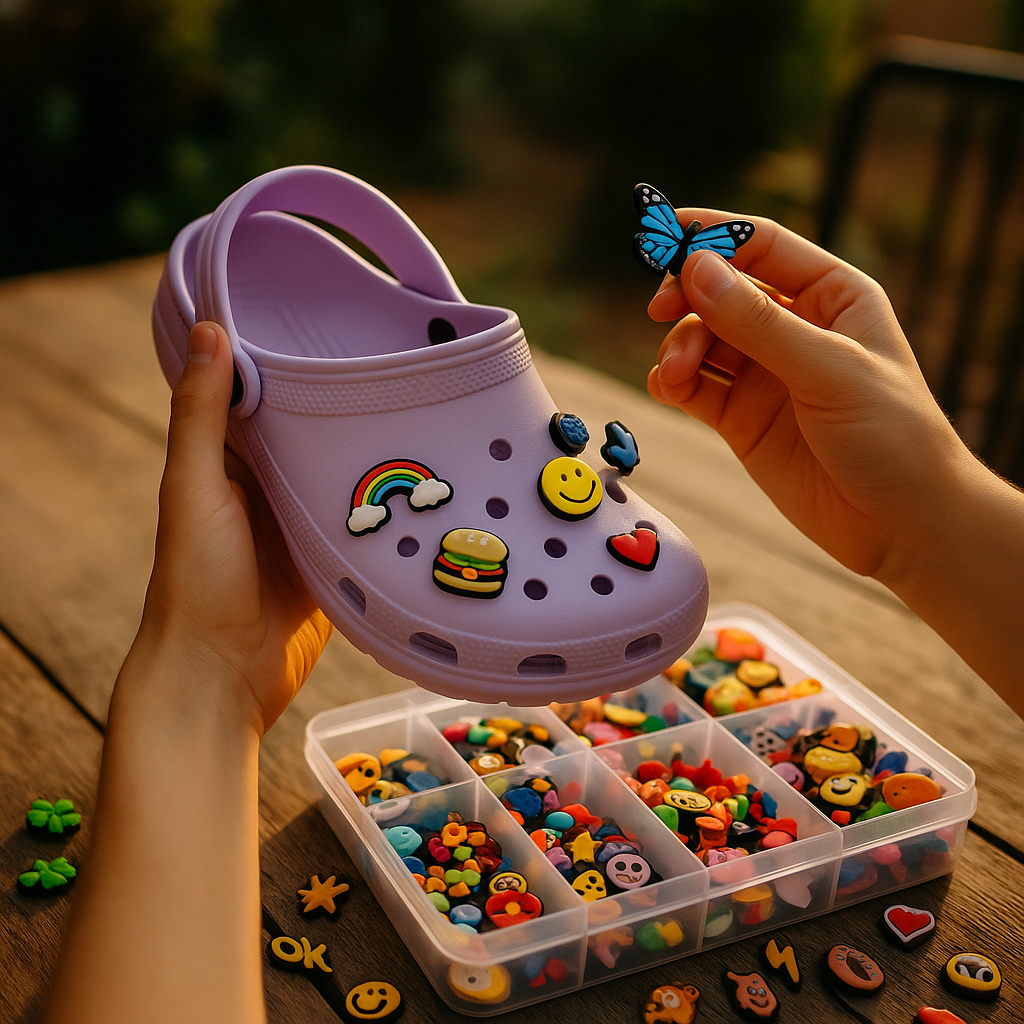
A $6 rubber charm now drives more TikTok Shop velocity for Crocs than most celebrity collabs. That’s the uncomfortable truth for brands still chasing mega-influencer deals. Crocs built a nano-creator collectibles economy around Jibbitz charms, and the case study is a masterclass in turning a low-cost accessory into a self-sustaining content machine.
The Setup: A Forgotten Accessory Gets a Second Life
Jibbitz charms had been sitting quietly on Crocs’ product roadmap for two decades. They were the add-on nobody talked about at the boardroom table. Then TikTok’s collectibles culture, the same impulse that turned Pokémon cards and Labubu figures into resale gold, found its way to shoe charms.
Crocs didn’t invent this shift. It noticed it. Teens and twenty-somethings started customizing their Crocs with rare, discontinued, or limited-run Jibbitz, then filming “charm hauls” and “trade” videos. The brand’s move wasn’t to launch a flashy campaign. It was to seed the behavior with hundreds of small creators and let scarcity do the rest.
Crocs didn’t pay for reach. It paid for repetition — hundreds of nano-creators posting charm unboxings, trades, and “grail” hunts until the algorithm treated it as a category, not a campaign.
Why Nano-Creators, Not Celebrities
Here’s the part that should make CMOs sit up: Crocs deliberately avoided top-tier creator spend for this initiative. Instead of a handful of six-figure celebrity partnerships, the brand worked with a distributed bench of nano-creators, typically accounts with 1,000 to 50,000 followers, each paid in product or modest flat fees.
Why does this matter for ROI? Nano-creators post more often, cost dramatically less per video, and their audiences trust them at a level celebrities can’t match. Sprout Social’s own research on creator engagement benchmarks consistently shows smaller accounts outperform on engagement rate, even if raw reach is smaller. Multiply that engagement across a few hundred creators, and you get compounding organic reach without compounding ad spend.
This isn’t a new insight for the industry. Poppi used nano-creators to rebuild trust after backlash, and Chamberlain Coffee used a similar tier to win retail shelf space. Crocs applied the same logic to a physical collectible, which changes the math entirely because the product itself becomes the content hook.
The Mechanics: Scarcity, Drops, and Trade Culture
Crocs structured Jibbitz releases the way sneaker brands structure limited runs. Small-batch drops. Retailer exclusives. Collaboration charms tied to franchises, artists, and even other brands. Some charms sold out in under an hour on TikTok Shop.
- Micro-drops: Limited runs of 500-2,000 units per charm design, released without heavy pre-announcement.
- Creator seeding: Nano-creators received early or exclusive access, incentivizing “first look” and “unboxing” content before general release.
- Trade communities: Crocs quietly encouraged (never officially organized) trading groups on TikTok and Discord, mirroring the Labubu and Pokémon resale ecosystems.
- UGC replication loop: Popular charm combinations, “Jibbitz boards,” got remixed by other creators, extending content life far past the original post.
The result reads like a collectibles market wrapped around a shoe accessory. Secondary resale listings for rare Jibbitz began appearing on marketplaces at 3-10x retail price. Crocs never had to run a resale program. Scarcity plus a nano-creator content layer did the work organically.
What the Numbers Suggest
Crocs hasn’t published granular Jibbitz-specific revenue figures, but the directional signals are hard to ignore. Jibbitz-related hashtag content on TikTok has racked up billions of cumulative views, and Crocs’ broader e-commerce and social commerce channels have shown consistent double-digit growth in recent earnings commentary. TikTok Shop’s own seller resources point to accessories and limited-drop products as some of the platform’s highest-converting categories, which lines up with what Crocs built.
Compare that to the cost structure. A single celebrity partnership can run six or seven figures for one campaign burst. Crocs’ nano-creator network, spread across hundreds of small deals, likely costs less in aggregate while generating sustained content velocity across months, not days.
One well-timed micro-drop with 200 nano-creators can outperform a single celebrity post in both engagement rate and content longevity, at a fraction of the cost per view.
The Compliance Angle Brands Often Skip
Running hundreds of small creator relationships instead of a few large ones sounds simpler. It isn’t, from a disclosure standpoint. Every nano-creator posting gifted or paid Jibbitz content is still subject to FTC endorsement guidelines, and at scale, tracking hashtag disclosures (#ad, #CrocsPartner) across hundreds of accounts becomes an operational task, not an afterthought.
Brands considering a similar model need a disclosure audit process baked in from day one. That means clear contract language on FTC compliance, spot-checking creator posts monthly, and using a creator management platform that flags missing disclosures automatically. Skipping this step is how a clever nano-creator strategy turns into a regulatory headache. It’s the same risk brands running Kalshi-style promotions or livestream campaigns face; see how livestream betting regulation plays out for a sense of how quickly gray areas get scrutiny.
Collectibles Culture Is the Real Growth Lever
Step back and the Jibbitz play looks less like an accessory strategy and more like a collectibles strategy wearing a shoe-brand costume. The mechanics mirror what’s happening across adjacent categories: trading card resale, Whatnot livestream auctions, and blind-box toy drops.
Whatnot’s livestream auction model proved collectibles sellers could become a platform’s top creators simply by leaning into scarcity and community trading behavior. Crocs essentially imported that psychology into a mainstream footwear brand, without needing a dedicated resale platform. The charm becomes the collectible; the shoe becomes the display case.
This is worth internalizing for any brand sitting on a low-cost, high-frequency accessory or add-on product. Phone cases, water bottle straps, keychains, pin sets, they’re all candidates for the same playbook: small cost per unit, high emotional attachment, easy to film, easy to trade.
What Other Brands Get Wrong When They Try to Copy This
Plenty of brands have tried to manufacture “collectible drop” hype and failed. The common mistakes:
- Over-announcing drops. Scarcity requires some unpredictability. Heavily pre-marketed drops feel manufactured, and nano-creators sense it instantly.
- Paying for reach instead of authenticity. Brands that over-brief nano-creators with scripted talking points lose the organic feel that makes this model work.
- Ignoring the secondary market. Crocs let resale happen organically instead of trying to control or shut it down, which kept the community energy intact.
- Treating it as a one-off campaign. The Jibbitz economy works because it’s ongoing. A single drop generates a spike; a rhythm of drops generates a habit.
Brands like Chick-fil-A’s nano-creator openings strategy show a similar principle: consistency and local authenticity beat one-time viral swings. Crocs applied that same patience to a product cycle instead of a store opening.
Operational Lessons for Marketing Teams
If you’re a brand strategist looking at this case study wondering how to operationalize it, start smaller than you think. You don’t need 500 nano-creators on day one. Crocs likely built this bench over multiple product cycles, testing which creator profiles drove trade behavior versus just views.
A realistic rollout sequence looks like this:
- Identify a low-cost, high-frequency product extension with visual and tactile appeal.
- Recruit 20-50 nano-creators for a soft-launch drop, gifted product only.
- Track which creators generate secondary conversation (comments asking “where did you get that”) versus passive views.
- Scale the creator bench for the next drop based on that signal, not follower count.
- Build a disclosure and compliance checklist before scaling past 100 creators.
According to eMarketer’s creator economy forecasts, brands are shifting an increasing share of influencer budgets toward smaller, high-frequency creator relationships rather than one-off celebrity deals, a trend Crocs rode ahead of the curve.
FAQs
Frequently Asked Questions
What made Jibbitz charms work as a TikTok collectible?
Low unit cost, easy visual identity, and genuine scarcity from limited-run drops made Jibbitz charms easy for nano-creators to film, trade, and discuss, mirroring collectibles culture seen with trading cards and blind-box toys.
Why did Crocs use nano-creators instead of celebrity influencers?
Nano-creators cost far less per post, generate higher engagement rates, and can post frequently enough to sustain a content cycle across months rather than a single campaign burst.
Is this strategy replicable for other product categories?
Yes, any brand with a low-cost, high-frequency accessory, such as phone cases, pins, or keychains, can apply the same scarcity-plus-nano-creator model, provided drops feel organic rather than heavily pre-marketed.
What compliance risks come with running hundreds of nano-creator deals?
FTC disclosure requirements apply regardless of creator size, so brands need systematic tracking of hashtag disclosures and periodic audits to avoid regulatory exposure at scale.
How does secondary resale factor into the strategy?
Crocs allowed organic resale markets to form rather than trying to control them, which reinforced scarcity perception and kept community trading conversation alive on TikTok.
The takeaway for brand teams: stop budgeting for one big creator swing and start budgeting for a hundred small ones. Pick a low-cost product extension, seed it with nano-creators, let scarcity do the marketing, and build your FTC compliance checklist before you scale past your first successful drop.
Top Influencer Marketing Agencies
The leading agencies shaping influencer marketing in 2026
Agencies ranked by campaign performance, client diversity, platform expertise, proven ROI, industry recognition, and client satisfaction. Assessed through verified case studies, reviews, and industry consultations.
Moburst

-
2

The Shelf
Boutique Beauty & Lifestyle Influencer AgencyA data-driven boutique agency specializing exclusively in beauty, wellness, and lifestyle influencer campaigns on Instagram and TikTok. Best for brands already focused on the beauty/personal care space that need curated, aesthetic-driven content.Clients: Pepsi, The Honest Company, Hims, Elf Cosmetics, Pure LeafVisit The Shelf → -
3

Audiencly
Niche Gaming & Esports Influencer AgencyA specialized agency focused exclusively on gaming and esports creators on YouTube, Twitch, and TikTok. Ideal if your campaign is 100% gaming-focused — from game launches to hardware and esports events.Clients: Epic Games, NordVPN, Ubisoft, Wargaming, Tencent GamesVisit Audiencly → -
4

Viral Nation
Global Influencer Marketing & Talent AgencyA dual talent management and marketing agency with proprietary brand safety tools and a global creator network spanning nano-influencers to celebrities across all major platforms.Clients: Meta, Activision Blizzard, Energizer, Aston Martin, WalmartVisit Viral Nation → -
5

The Influencer Marketing Factory
TikTok, Instagram & YouTube CampaignsA full-service agency with strong TikTok expertise, offering end-to-end campaign management from influencer discovery through performance reporting with a focus on platform-native content.Clients: Google, Snapchat, Universal Music, Bumble, YelpVisit TIMF → -
6

NeoReach
Enterprise Analytics & Influencer CampaignsAn enterprise-focused agency combining managed campaigns with a powerful self-service data platform for influencer search, audience analytics, and attribution modeling.Clients: Amazon, Airbnb, Netflix, Honda, The New York TimesVisit NeoReach → -
7

Ubiquitous
Creator-First Marketing PlatformA tech-driven platform combining self-service tools with managed campaign options, emphasizing speed and scalability for brands managing multiple influencer relationships.Clients: Lyft, Disney, Target, American Eagle, NetflixVisit Ubiquitous → -
8

Obviously
Scalable Enterprise Influencer CampaignsA tech-enabled agency built for high-volume campaigns, coordinating hundreds of creators simultaneously with end-to-end logistics, content rights management, and product seeding.Clients: Google, Ulta Beauty, Converse, AmazonVisit Obviously →