


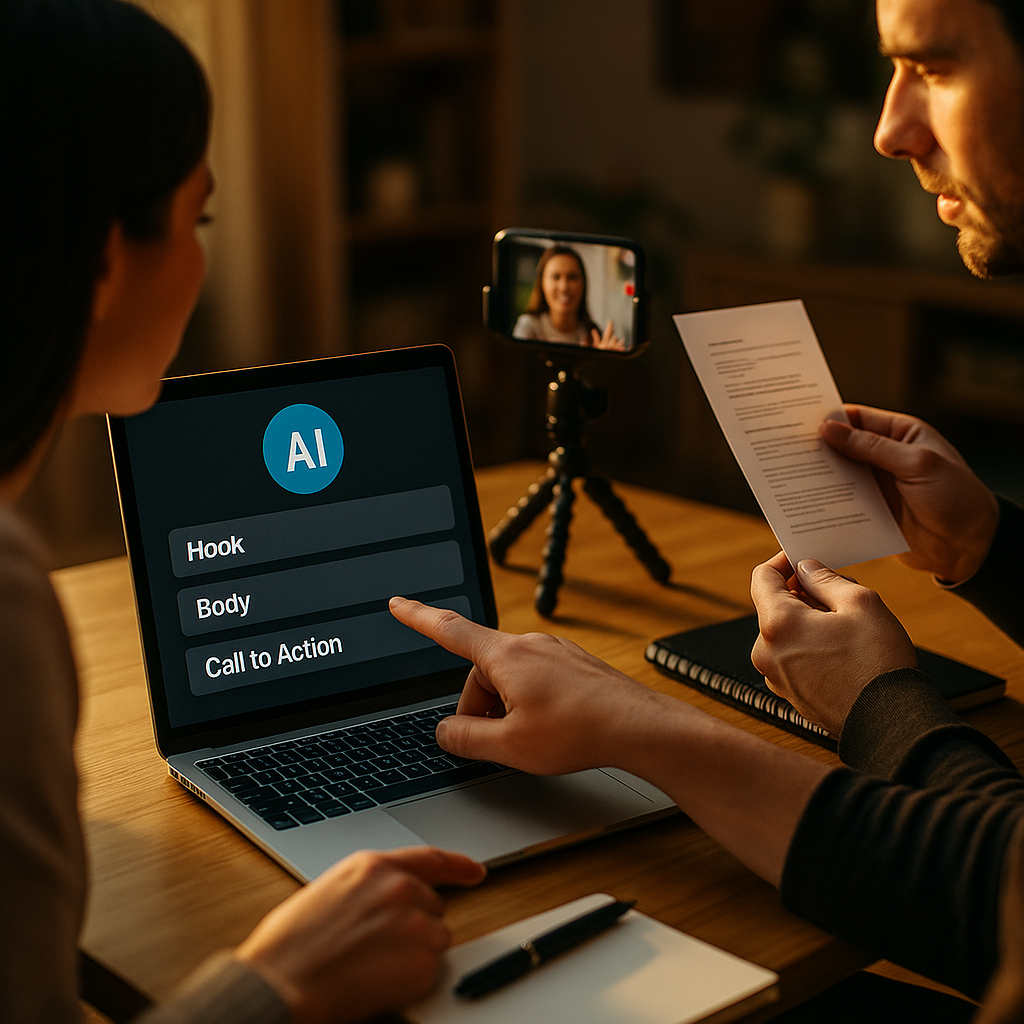
Creators using AI-generated hooks see up to 40% higher retention in the first three seconds, according to internal benchmarks from tools now flooding creator workflows. That number alone should make every brand marketer rethink how they brief talent. The AI hook-structure brief isn’t a fringe tactic anymore. It’s becoming the default way sophisticated brands direct creators, and if your team is still writing loose “be authentic” briefs, you’re leaving retention on the table.
What Is an AI Hook-Structure Brief, Exactly?
Strip away the jargon and it’s simple: a brief that specifies not just what the creator says, but the persuasion architecture behind the first 3-8 seconds of content. Tools like GetHookd analyze thousands of top-performing hooks, categorize them into frameworks (curiosity gap, pattern interrupt, controversial claim, direct callout), and generate scripts or hook variations brands can hand directly to creators.
This is different from a traditional creative brief. A traditional brief says “highlight the product’s durability.” A hook-structure brief says “open with a pattern-interrupt hook using a false-start technique, then pivot to a curiosity gap by withholding the product reveal for 4 seconds.” That’s a meaningful shift in specificity, and it changes the entire dynamic between brand and creator.
The best-performing branded content in 2026 isn’t necessarily more creative. It’s more structurally disciplined about the first eight seconds, and that discipline is now automatable.
Why Brands Are Suddenly Obsessed With Hooks
Attention is the scarce resource. Everyone knows this. But what’s changed is the tooling available to actually engineer for it at scale. Platforms have trained creators (and their audiences) to scroll past anything that doesn’t earn its keep in the opening seconds. TikTok’s own creative guidance has long emphasized front-loading value, and TikTok’s advertising resources reinforce that hook strength correlates directly with watch-through rate.
Brands running influencer programs at volume — think 50, 100, 200 creator deals per quarter — can’t manually A/B test hook psychology for every single deliverable. That’s where automation earns its place. GetHookd and similar tools ingest performance data across verticals and spit out hook templates ranked by predicted retention lift. It’s not creative genius. It’s pattern recognition applied at scale, and it works often enough that ignoring it is now the riskier move.
Data from eMarketer continues to show that short-form video consumption keeps climbing while average watch time per video keeps shrinking. That combination — more competition, less patience — is exactly why hook engineering has become a boardroom conversation instead of a creative-team footnote.
The Persuasion Frameworks Brands Should Actually Know
You don’t need a psychology degree to direct creators well, but you do need working knowledge of the frameworks these tools automate. Here are the ones showing up most in high-performing briefs right now:
- Pattern Interrupt: Open with something visually or verbally unexpected that breaks the scroll reflex. Think a creator holding a product upside down or starting mid-sentence.
- Curiosity Gap: Tease an outcome or reveal without giving it away immediately. “I returned this three times before I figured out why it actually works.”
- Controversial Claim: A bold, slightly polarizing statement that invites disagreement or curiosity. Use carefully — this is where brand safety reviews matter most.
- Direct Callout: Speaking straight to a specific audience segment (“If you have oily skin and hate primer, watch this”). High specificity, high relevance signal.
- False Start / Fake Out: Setting up an expectation, then subverting it within the first few seconds.
None of these are new. Direct-response marketers have used variations of these frameworks for decades. What’s new is the speed at which they’re being matched to creator content and tested against real engagement data, rather than gut instinct.
How to Actually Brief a Creator on Hook Structure
Here’s where most brands get it wrong: they hand creators an AI-generated hook script verbatim and expect it to perform like the benchmark data promised. It won’t. Creators aren’t interchangeable delivery mechanisms. A hook framework needs translation into the creator’s actual voice, or it reads as stiff and scripted — which kills the exact authenticity signal that made influencer marketing work in the first place.
A better approach treats the AI output as scaffolding, not scripture. Give creators the framework and the psychological mechanism behind it, then let them fill in the specific language. For example: “Use a curiosity gap. Don’t reveal the product for the first 5 seconds. Tease a transformation or problem instead.” That’s directive enough to be useful, loose enough to preserve voice.
This mirrors what we’ve covered in retention-focused comedy briefs — the format matters less than the underlying mechanic driving the retention curve. Hooks are just the most compressed version of that principle.
Brief Structure That Works
- Specify the framework (curiosity gap, pattern interrupt, etc.) — not the exact script.
- Provide 2-3 reference examples from the vertical, not competitors’ exact hooks.
- Set a hard time constraint for the hook window (typically 3-6 seconds).
- Flag any claims requiring compliance review before the creator films.
- Leave room for creator language, slang, and pacing preferences.
The Compliance Blind Spot Nobody’s Talking About
Here’s the uncomfortable part. Persuasion frameworks optimized purely for retention can drift into misleading territory fast, especially the controversial claim and curiosity gap categories. A hook that implies a health outcome, financial result, or product capability without substantiation isn’t just a creative risk. It’s an FTC risk.
The FTC’s endorsement guidance doesn’t care whether the hook was written by a human or generated by an AI tool. If it’s deceptive, the brand is liable, and increasingly the creator is too. Brands automating hook creation need a compliance checkpoint built into the workflow, not bolted on after the content is filmed. This is the same discipline we’ve recommended for urgency-based formats in restock countdown campaigns — the persuasion mechanic and the legal review need to move together, not sequentially.
An AI tool optimizing for watch-time has zero incentive to flag legal risk. That job still belongs to your compliance team, and no automation replaces it.
Practically, this means every hook framework in your brief library should have an approved/flagged list of claim types. “Curiosity gap around a mystery ingredient” — fine. “Curiosity gap implying a medical benefit” — needs substantiation on file before it ships. Build this into your brief template once, and you save a dozen back-and-forth email threads per campaign later.
Does Automation Kill Creator Authenticity?
This is the fear every brand strategist has, and it’s a fair one. If every creator is briefed with the same GetHookd-generated pattern-interrupt structure, does content start sounding identical across the platform? Somewhat, yes — audiences are already noticing certain hook patterns becoming clichés (the “wait for it” trope, the fake product-fail opener). Overused frameworks lose potency fast.
The fix isn’t abandoning structure. It’s rotating frameworks deliberately and giving creators enough latitude to make the mechanic their own. Brands running cross-platform amplification briefs already understand this tension — the same core message needs different execution per platform and per creator personality. Hook structure is no different. Treat it as a variable to test, not a formula to lock in permanently.
Smaller creators, in particular, tend to have finely tuned instincts about what feels natural to their audience. Override that instinct completely with a rigid AI-generated script, and engagement often drops even if the “framework” is theoretically sound. The best briefs give creators the why behind the hook, not just the what.
Measuring Whether It’s Actually Working
Retention rate in the first 3-5 seconds is the obvious metric, but don’t stop there. Track completion rate, comment sentiment, and — critically — whether the hook framework correlates with actual conversion downstream, not just watch time. A curiosity gap might spike retention while doing nothing for click-through if the payoff disappoints viewers who feel baited.
Run this like any other testing program: track hook framework as a variable in your reporting, not just creative theme or platform. Tools like Sprout Social and native platform analytics can help segment this data if your team tags content consistently at the brief stage. Consistency in tagging is the unglamorous part nobody wants to do, and it’s exactly why most brands can’t actually prove which hook framework drives their best ROI.
For teams managing usage rights and repurposing content across formats, this data becomes even more valuable. Understanding which hook structures survive the transition from vertical short-form to other formats is worth building into your usage-rights-ready video briefs from the start, so you’re not re-testing hooks every time content gets repurposed.
Where This Goes Next
Expect hook-structure automation to get more granular, not less. Tools will likely start segmenting recommendations by platform, vertical, and even creator follower tier, since a hook that works for a 2-million-follower lifestyle account won’t necessarily translate to a niche 40,000-follower finance creator. Brands that build internal hook libraries now, tagged by performance and compliance status, will move faster than competitors starting from scratch each quarter.
Start small. Pick one active campaign, brief three creators using a specific persuasion framework instead of an open-ended prompt, and measure the retention delta against your historical baseline before rolling it out program-wide.
Frequently Asked Questions
What is an AI hook-structure brief?
It’s a creative brief that directs creators using a specific persuasion framework — like curiosity gap or pattern interrupt — generated or informed by AI tools that analyze top-performing content hooks, rather than giving open-ended creative direction.
Are tools like GetHookd replacing creative strategists?
No. They’re automating pattern recognition across large datasets of hooks, but translating that framework into a brand-safe, creator-authentic script still requires human judgment, especially around compliance and voice matching.
Is using AI-generated hooks a legal risk?
It can be, if the framework encourages exaggerated or unsubstantiated claims. Brands remain responsible for FTC compliance regardless of whether a hook was human-written or AI-generated, so claims still need review before content ships.
How specific should a hook brief be without stifling creator authenticity?
Specify the persuasion mechanic and timing constraints, but leave the actual language, tone, and delivery to the creator. Overly scripted hooks tend to underperform because audiences can sense when content feels forced.
How do I measure if a hook framework is actually working?
Track first-5-second retention rate alongside completion rate and downstream conversion, and tag content by hook framework in your reporting so you can compare performance across campaigns over time.
Frequently Asked Questions
What is an AI hook-structure brief?
It’s a creative brief that directs creators using a specific persuasion framework — like curiosity gap or pattern interrupt — generated or informed by AI tools that analyze top-performing content hooks, rather than giving open-ended creative direction.
Are tools like GetHookd replacing creative strategists?
No. They’re automating pattern recognition across large datasets of hooks, but translating that framework into a brand-safe, creator-authentic script still requires human judgment, especially around compliance and voice matching.
Is using AI-generated hooks a legal risk?
It can be, if the framework encourages exaggerated or unsubstantiated claims. Brands remain responsible for FTC compliance regardless of whether a hook was human-written or AI-generated, so claims still need review before content ships.
How specific should a hook brief be without stifling creator authenticity?
Specify the persuasion mechanic and timing constraints, but leave the actual language, tone, and delivery to the creator. Overly scripted hooks tend to underperform because audiences can sense when content feels forced.
How do I measure if a hook framework is actually working?
Track first-5-second retention rate alongside completion rate and downstream conversion, and tag content by hook framework in your reporting so you can compare performance across campaigns over time.
Top Influencer Marketing Agencies
The leading agencies shaping influencer marketing in 2026
Agencies ranked by campaign performance, client diversity, platform expertise, proven ROI, industry recognition, and client satisfaction. Assessed through verified case studies, reviews, and industry consultations.
Moburst

-
2

The Shelf
Boutique Beauty & Lifestyle Influencer AgencyA data-driven boutique agency specializing exclusively in beauty, wellness, and lifestyle influencer campaigns on Instagram and TikTok. Best for brands already focused on the beauty/personal care space that need curated, aesthetic-driven content.Clients: Pepsi, The Honest Company, Hims, Elf Cosmetics, Pure LeafVisit The Shelf → -
3

Audiencly
Niche Gaming & Esports Influencer AgencyA specialized agency focused exclusively on gaming and esports creators on YouTube, Twitch, and TikTok. Ideal if your campaign is 100% gaming-focused — from game launches to hardware and esports events.Clients: Epic Games, NordVPN, Ubisoft, Wargaming, Tencent GamesVisit Audiencly → -
4

Viral Nation
Global Influencer Marketing & Talent AgencyA dual talent management and marketing agency with proprietary brand safety tools and a global creator network spanning nano-influencers to celebrities across all major platforms.Clients: Meta, Activision Blizzard, Energizer, Aston Martin, WalmartVisit Viral Nation → -
5

The Influencer Marketing Factory
TikTok, Instagram & YouTube CampaignsA full-service agency with strong TikTok expertise, offering end-to-end campaign management from influencer discovery through performance reporting with a focus on platform-native content.Clients: Google, Snapchat, Universal Music, Bumble, YelpVisit TIMF → -
6

NeoReach
Enterprise Analytics & Influencer CampaignsAn enterprise-focused agency combining managed campaigns with a powerful self-service data platform for influencer search, audience analytics, and attribution modeling.Clients: Amazon, Airbnb, Netflix, Honda, The New York TimesVisit NeoReach → -
7

Ubiquitous
Creator-First Marketing PlatformA tech-driven platform combining self-service tools with managed campaign options, emphasizing speed and scalability for brands managing multiple influencer relationships.Clients: Lyft, Disney, Target, American Eagle, NetflixVisit Ubiquitous → -
8

Obviously
Scalable Enterprise Influencer CampaignsA tech-enabled agency built for high-volume campaigns, coordinating hundreds of creators simultaneously with end-to-end logistics, content rights management, and product seeding.Clients: Google, Ulta Beauty, Converse, AmazonVisit Obviously →