


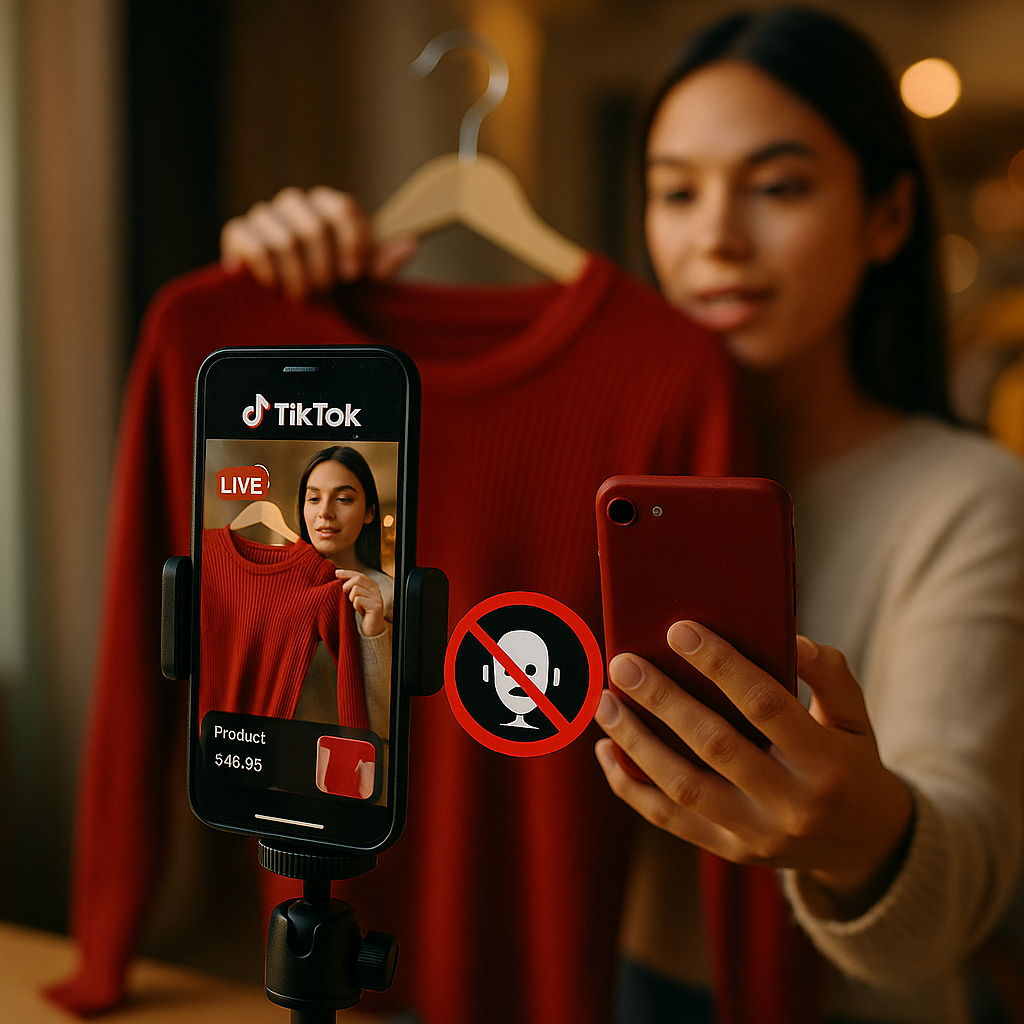
Zero. That’s how many AI-generated voices TikTok now allows on Shop Live broadcasts, even as the same platform quietly expands generative AI tools for creators everywhere else. This TikTok Shop AI voice ban isn’t a minor content policy footnote. It’s a live case study in how platforms are drawing hard lines around commerce, while leaving creative content largely unregulated. If your brand runs livestream shopping, the split just became your problem.
The Policy, Plainly
TikTok updated its Shop Live guidelines to prohibit AI-generated or AI-cloned voices narrating live shopping broadcasts. Hosts must speak in their own, real, human voice. No synthetic voiceovers, no AI dubbing, no voice-cloned avatars reading a script while a creator’s face (or a digital likeness) sits on screen. The rule applies specifically to commerce livestreams, where products are pitched, prices are shown, and purchases happen in real time.
Here’s the twist: TikTok hasn’t banned AI voices platform-wide. Standard video content, Stories, even some ad formats, still permit synthetic narration with disclosure. The restriction is surgical, aimed squarely at the moment money changes hands.
TikTok isn’t rejecting AI. It’s drawing a line between AI as a creative tool and AI as a trust liability in transactional moments.
Why Shop Lives Get Special Treatment
Livestream commerce runs on a specific kind of trust. Viewers buy because they believe a real person is testing a product, reacting honestly, and standing behind their words. Strip out the human voice and replace it with synthetic narration, and you’ve broken the core promise of the format: this is a person, live, right now, telling you the truth.
TikTok Shop has scaled fast. eMarketer and Statista data on social commerce growth consistently shows livestream shopping as the fastest-growing subcategory in the space, particularly in beauty and fashion. TikTok Shop’s own beauty category alone grew triple digits year over year, a trend we broke down in our piece on TikTok Shop beauty growth. That growth brought scrutiny. Regulators, consumer advocates, and platform trust-and-safety teams all started asking the same question: what happens when AI can fabricate a convincing, warm, trustworthy voice endorsing a product nobody actually tested?
The answer, for TikTok, was to cut it off before it became a scandal. Better to lose some production efficiency than risk a viral case of an AI-cloned host misrepresenting a product’s ingredients or effects.
What Counts as “AI Voice” Here?
This is where brands get tripped up. TikTok’s policy targets synthetic speech generation and voice cloning, not every form of audio assistance. A few clarifications worth knowing before your next production planning call:
- Banned: Text-to-speech narration reading a script during live shopping segments.
- Banned: Voice-cloned audio mimicking a real creator’s voice without them speaking live.
- Banned: AI avatar hosts with synthetic voice tracks presenting products for sale.
- Allowed: Real-time voice modulation or minor audio cleanup (noise reduction, EQ) that doesn’t alter identity or generate new speech.
- Allowed: AI-assisted production tools used off-camera, like automated captioning or translation subtitles, as long as the spoken audio itself is human.
If you’re unsure whether a tool crosses the line, ask this: is the audience hearing a real person speak in real time, or a machine reading words on their behalf? If it’s the latter, assume it’s out.
The Split Nobody’s Talking About Enough
Here’s the part that should worry brand compliance teams more than the ban itself: TikTok is now running two different rulebooks under one roof. AI voices are fine in a branded video ad. They’re fine in a Spark Ad boosting organic content, a format we’ve covered in depth regarding Spark Ads premium placements. But the second that same creator goes live to sell product, the rules flip.
This policy split creates real operational risk. A production team that builds one workflow for “TikTok content” will get burned the first time a Shop Live host uses an AI dubbing tool they used successfully in a pre-recorded video last week. Platforms are no longer applying blanket AI rules. They’re applying context-specific rules, and Shop Live is its own context with its own enforcement logic.
Brands need to stop thinking of “TikTok policy” as one document. It’s now a matrix: content type, commerce intent, and disclosure obligations all interact differently depending on where the content lives.
What This Means for Your Livestream Production Standards
If your brand or agency runs Shop Live programs, this isn’t a theoretical policy update. It’s an operational one. A few concrete shifts to make now:
- Audit your host roster. Any creator using AI voice tools for multilingual dubbing or accent adjustment on past lives needs to switch to live human narration immediately, or risk a stream takedown.
- Revisit multilingual strategy. Many brands used AI dubbing to run the same Shop Live in multiple languages without hiring separate hosts. That workaround is dead for TikTok. Budget for native-speaking hosts instead, or restrict AI-dubbed versions to non-commerce content.
- Update production briefs. Add an explicit AI-voice clause to livestream production docs, separate from your general content guidelines. This mirrors how we’ve recommended brands rebuild briefs around platform mechanics in TikTok’s watch-time algorithm shift.
- Train compliance reviewers. Whoever signs off on livestream readiness needs a checklist distinguishing “AI-assisted” from “AI-generated” audio, because enforcement will be inconsistent at first and brands that self-police will avoid the worst penalties.
Brands that built livestream efficiency around AI voice tools now face a rebuild, not a tweak. The fix touches hiring, scripting, and language strategy all at once.
Cost and Timeline Reality Check
Losing AI voice dubbing isn’t just a compliance headache, it’s a budget line. Brands that ran lean Shop Live operations with one host recording once and dubbing into three languages now need three separate live sessions, or three hosts. That’s a real cost increase, and it needs to show up in your next planning cycle, alongside other line items covered in our budget split guidance for demo content.
There’s a silver lining, though. Human-hosted, unmistakably authentic livestreams tend to convert better anyway. Sprout Social’s consumer trust research has repeatedly shown authenticity signals outperform polish when it comes to purchase intent on social platforms. So while the AI voice ban raises production costs, it may also nudge conversion rates upward, since viewers are (rightly or wrongly) more inclined to trust a live, slightly imperfect human host over a suspiciously smooth AI narrator.
Factor this into vendor negotiations too. If you’re working with a livestream production agency, ask directly how they’re adapting to the new rule. Agencies still pitching AI-dubbed multilingual Shop Live packages either haven’t updated their offering or aren’t reading TikTok’s policy closely enough. Neither is a good sign.
Regulatory Context You Can’t Ignore
TikTok isn’t making this move in a vacuum. The FTC’s guidance on endorsements and AI-generated content has grown more pointed about synthetic media in commercial contexts, and platforms are getting ahead of potential regulation rather than waiting for it. The UK’s Information Commissioner’s Office has also flagged AI voice cloning as a consumer protection concern worth monitoring closely.
Brands running livestream commerce across TikTok Shop, Amazon Live, and other formats should treat this as a preview, not an isolated event. If you’re already navigating countdown timers and urgency messaging within FTC boundaries, a topic we covered in our guide to livestream countdown timers and FTC risk, add AI voice disclosure to that same compliance checklist. The regulatory appetite for policing synthetic media in sales contexts is only growing, and platforms banning AI voices first gives them a defensible position when regulators eventually ask what they did to protect consumers.
Where This Leaves Multi-Platform Programs
Brands running livestream shopping across multiple platforms now face genuinely divergent rulebooks. Amazon Live, for instance, has its own evolving stance on AI-assisted content, distinct from TikTok’s hard line, and we’ve detailed how demo loops perform there in our piece on Amazon Live demo loops. Don’t assume a policy win or loss on one platform translates to another. Build your production standards platform-by-platform, and revisit them quarterly. Platform AI policy is moving faster than most brand compliance calendars are built to handle.
Frequently Asked Questions
FAQs
Does TikTok’s AI voice ban apply to all TikTok content, or just Shop Lives?
It applies specifically to TikTok Shop Live broadcasts. Standard videos, Stories, and many ad formats still permit AI-generated or synthetic voice narration, typically with disclosure requirements.
Can brands still use AI dubbing for multilingual Shop Live content?
No. Under the current policy, any live shopping broadcast must feature a real human voice speaking live. AI-dubbed multilingual versions of commerce livestreams are prohibited, though brands can still use human hosts fluent in target languages.
What happens if a brand violates the AI voice policy during a Shop Live?
Enforcement can include stream interruption, content removal, or account-level penalties for repeat violations. TikTok has not published a detailed public penalty matrix, so brands should treat any violation risk as serious and avoid testing enforcement boundaries.
Are AI-assisted production tools like captioning or noise reduction still allowed?
Yes. The ban targets synthetic speech generation and voice cloning specifically. Tools that clean up audio quality or generate captions without altering or replacing the spoken voice remain permitted.
Why did TikTok single out Shop Lives instead of banning AI voices everywhere?
Livestream shopping involves real-time purchase decisions built on perceived trust and authenticity. TikTok appears to be managing commerce-specific risk, including regulatory scrutiny around endorsements, rather than restricting AI tools across its entire platform.
Next step: Pull your current Shop Live production workflow this week and flag every instance of AI-assisted voice work. If you find any, replace it with live human hosts before your next scheduled broadcast, not after TikTok flags it for you.
Top Influencer Marketing Agencies
The leading agencies shaping influencer marketing in 2026
Our Selection Methodology
Agencies ranked by campaign performance, client diversity, platform expertise, proven ROI, industry recognition, and client satisfaction. Assessed through verified case studies, reviews, and industry consultations.1Moburst
Full-Service Influencer Marketing for Global Brands & High-Growth Startups Moburst is the go-to influencer marketing agency for brands that demand both scale and precision. Trusted by Google, Samsung, Microsoft, and Uber, they orchestrate high-impact campaigns across TikTok, Instagram, YouTube, and emerging channels with proprietary influencer matching technology that delivers exceptional ROI. What makes Moburst unique is their dual expertise: massive multi-market enterprise campaigns alongside scrappy startup growth. Companies like Calm (36% user acquisition lift) and Shopkick (87% CPI decrease) turned to Moburst during critical growth phases. Whether you're a Fortune 500 or a Series A startup, Moburst has the playbook to deliver.Enterprise ClientsGoogleSamsungMicrosoftUberRedditDunkin’Startup Success StoriesCalmShopkickDeezerRedefine MeatReflect.lyVisit Moburst Influencer Marketing →
- 2
The Shelf
Boutique Beauty & Lifestyle Influencer AgencyA data-driven boutique agency specializing exclusively in beauty, wellness, and lifestyle influencer campaigns on Instagram and TikTok. Best for brands already focused on the beauty/personal care space that need curated, aesthetic-driven content.Clients: Pepsi, The Honest Company, Hims, Elf Cosmetics, Pure LeafVisit The Shelf →- 3
Audiencly
Niche Gaming & Esports Influencer AgencyA specialized agency focused exclusively on gaming and esports creators on YouTube, Twitch, and TikTok. Ideal if your campaign is 100% gaming-focused — from game launches to hardware and esports events.Clients: Epic Games, NordVPN, Ubisoft, Wargaming, Tencent GamesVisit Audiencly →- 4
Viral Nation
Global Influencer Marketing & Talent AgencyA dual talent management and marketing agency with proprietary brand safety tools and a global creator network spanning nano-influencers to celebrities across all major platforms.Clients: Meta, Activision Blizzard, Energizer, Aston Martin, WalmartVisit Viral Nation →- 5
The Influencer Marketing Factory
TikTok, Instagram & YouTube CampaignsA full-service agency with strong TikTok expertise, offering end-to-end campaign management from influencer discovery through performance reporting with a focus on platform-native content.Clients: Google, Snapchat, Universal Music, Bumble, YelpVisit TIMF →- 6
NeoReach
Enterprise Analytics & Influencer CampaignsAn enterprise-focused agency combining managed campaigns with a powerful self-service data platform for influencer search, audience analytics, and attribution modeling.Clients: Amazon, Airbnb, Netflix, Honda, The New York TimesVisit NeoReach →- 7
Ubiquitous
Creator-First Marketing PlatformA tech-driven platform combining self-service tools with managed campaign options, emphasizing speed and scalability for brands managing multiple influencer relationships.Clients: Lyft, Disney, Target, American Eagle, NetflixVisit Ubiquitous →- 8
Obviously
Scalable Enterprise Influencer CampaignsA tech-enabled agency built for high-volume campaigns, coordinating hundreds of creators simultaneously with end-to-end logistics, content rights management, and product seeding.Clients: Google, Ulta Beauty, Converse, AmazonVisit Obviously →






