


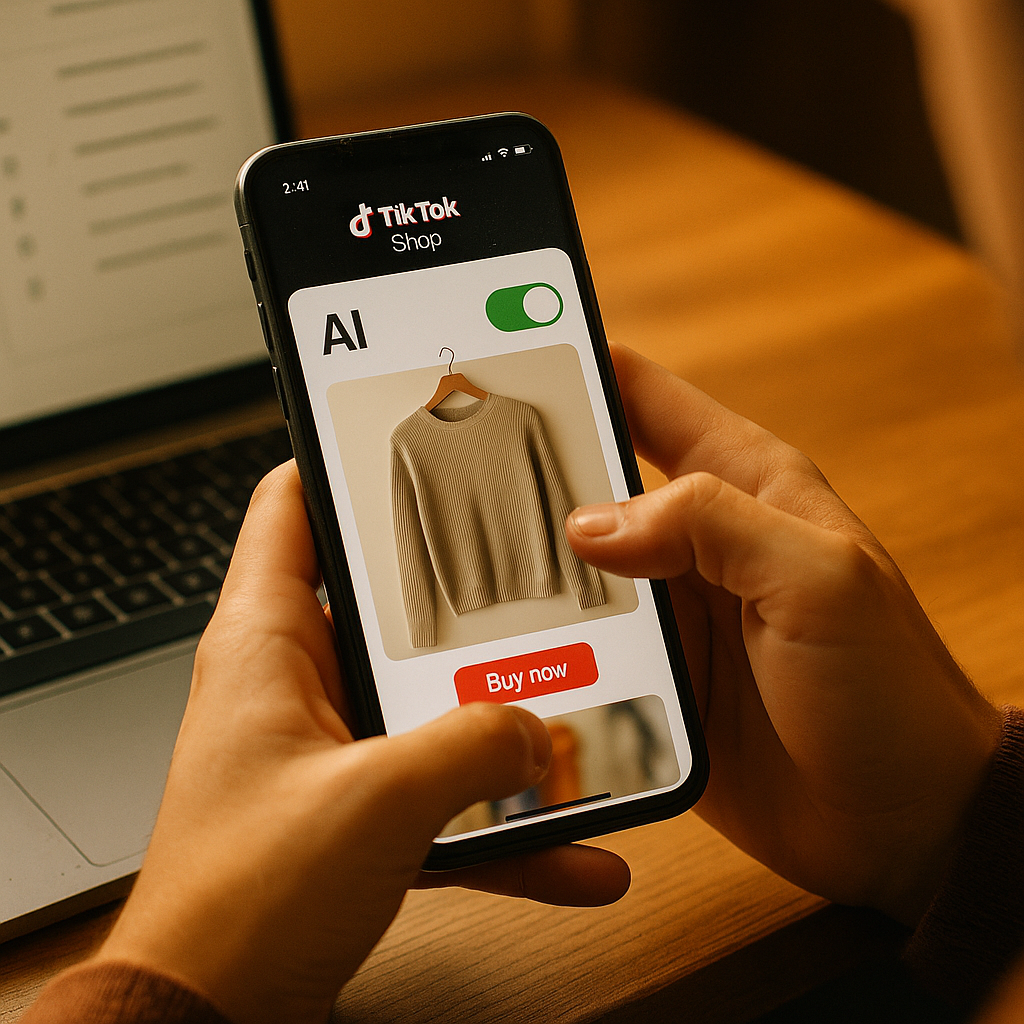
One mislabeled AI avatar in a product video can trigger a shop-wide suspension. TikTok’s Shop Seller Center AI toggle now sits at the center of that risk, and most merchants still treat it like a checkbox instead of a compliance control. If your team ships synthetic voiceovers, AI avatars, or generated product visuals through TikTok Shop, the toggle isn’t cosmetic. It’s the paper trail regulators and TikTok’s trust and safety team will ask for first.
Why This Toggle Exists Now
TikTok didn’t add AI disclosure controls out of goodwill. Synthetic content flooded Shop listings faster than moderation teams could review it, and regulators noticed. The FTC has been explicit about endorsement guidelines applying to AI-generated spokespeople the same way they apply to human ones. Meanwhile TikTok already drew a hard line on synthetic voices in live shopping, a move we covered in detail when TikTok banned AI voices on Shop Lives while leaving them permitted elsewhere on the platform.
The Seller Center toggle extends that logic into static and recorded content. It asks a simple question at upload: is any part of this asset AI-generated or AI-modified? Answer wrong, or skip it, and you’re not just risking a content strike. You’re risking your entire catalog’s visibility.
Platforms are shifting disclosure burden onto sellers before regulators force the issue. Merchants who treat the AI toggle as a formality are building compliance debt they’ll pay off during an audit, not before one.
What the AI Toggle Actually Covers
The toggle isn’t a single switch. It’s a tiered disclosure system baked into the content upload flow for product videos, image listings, and livestream clips. Understanding the tiers matters because misclassification is the most common compliance failure we’re seeing across merchant accounts.
- Fully synthetic content: AI avatars, voice clones, or fully generated product demos with no human talent involved.
- AI-modified content: Real footage with AI-enhanced elements — background swaps, voice dubbing, upscaling, or generative fill on product shots.
- AI-assisted editing: Minor touch-ups like color correction or noise reduction, which currently fall below the disclosure threshold but may not stay there.
Here’s the catch: TikTok’s classification guidance is vague on where “assisted” ends and “modified” begins. Merchants using tools like CapCut’s AI features or third-party generative editors need internal rules, because TikTok isn’t going to draw that line for you consistently.
The Real Cost of Getting It Wrong
Compliance teams love to talk about fines. In influencer and Shop commerce, the more immediate cost is algorithmic. Mislabeled or undisclosed synthetic content gets deprioritized in the For You feed, and repeat violations can trigger shop-level restrictions on Spark Ads eligibility and livestream access.
That’s a revenue problem before it’s a legal one. Consider the parallel with TikTok Shop’s IP verification freeze last year — merchants who lacked documentation got locked out of selling for weeks while they scrambled to prove compliance retroactively. AI disclosure is shaping up to be the same pattern: reactive scrambling versus proactive documentation.
There’s also a brand trust dimension. According to eMarketer research on consumer trust in digital content, a majority of shoppers say they’d stop buying from a brand that used undisclosed AI-generated endorsements. In influencer marketing specifically, that trust erosion compounds — creators who partner with a flagged merchant inherit reputational risk they didn’t sign up for.
Building the Compliance Playbook
Treat this like any other regulatory control, not a one-time settings change. Here’s the operational structure that’s working for merchants managing high SKU volume and multiple creator partnerships.
1. Audit your content pipeline before you audit the toggle
Map every tool in your content stack that touches AI. Video editing suites, voice synthesis for dubbing, product photography upscalers, even AI-assisted caption generation. If you can’t list every AI touchpoint in your production process, you can’t accurately disclose anything downstream.
2. Assign disclosure ownership, not just upload responsibility
Most merchant teams have someone who uploads Shop content. Few have someone accountable for verifying the AI toggle is set correctly before publish. Separate those roles. The uploader shouldn’t be the sole compliance checkpoint, especially when agencies or freelance editors are producing assets.
3. Standardize disclosure language across creator briefs
If you work with affiliate creators or paid partners producing Shop content on your behalf, your briefs need explicit AI disclosure requirements. This mirrors what smart merchants already do for livestream compliance, as outlined in our livestream FTC risk playbook. Don’t leave synthetic content classification to creator judgment. Give them a decision tree.
4. Log every toggle decision with a timestamp and rationale
This is the part most teams skip. When TikTok or a regulator asks why a piece of content was or wasn’t flagged as AI-generated, “we forgot” is not a defensible answer. Build a lightweight log — even a shared spreadsheet works initially — that records the asset ID, the toggle setting, who set it, and why.
A documented, wrong decision is more defensible than an undocumented right one. Auditors and platform trust teams care about process consistency as much as outcomes.
5. Reconcile monthly against Shop performance data
Pull your content performance reports and cross-reference against toggle status. Are AI-disclosed assets underperforming disproportionately? That’s useful intel for creative strategy, not just compliance. It also gives you an early warning system if TikTok’s algorithm starts suppressing disclosed content more aggressively, which is a real possibility as the platform tunes its ranking signals.
Where Merchants Get Tripped Up
A few recurring mistakes show up across the merchant accounts we’ve reviewed for this piece:
- Assuming AI voiceover tools for dubbing are exempt. They’re not. If you’re localizing product videos with synthetic voice for international Shop storefronts, that requires disclosure under current guidance.
- Treating the toggle as set-and-forget at the account level. Disclosure is asset-specific. Every upload needs its own assessment.
- Ignoring livestream replays. A live session that used a permitted AI feature during broadcast may still require disclosure when the replay clip gets repurposed into Shop product pages.
- Outsourcing compliance to agencies without oversight. If your agency handles content production, get toggle-setting rights and logs written into the contract. You’re liable for what publishes under your Shop account, not them.
None of this is TikTok-specific paranoia, either. The broader platform environment is converging on synthetic content transparency. The ICO has flagged AI-generated marketing content as an emerging enforcement area in the UK, and HubSpot‘s marketing trend research shows brand teams ranking AI disclosure compliance among their top operational concerns heading into next year.
How This Fits Your Broader Content Strategy
Compliance shouldn’t operate in a silo from your creative planning. If you’re building tutorial and demo content across TikTok, Instagram, and YouTube, your cross-platform budget split should already account for the extra production review time synthetic content disclosure adds. Factor it into timelines now, not after your first content strike.
Same logic applies to livestream strategy. If countdown timers, AI hosts, or synthetic overlays are part of your Shop Live playbook, disclosure requirements intersect directly with the FTC risk considerations merchants are already navigating.
The merchants handling this well aren’t the ones with the most sophisticated AI tools. They’re the ones with the most boring, consistent internal process for flagging what those tools touch.
Next Step
Pull your last 30 days of Shop uploads and run a manual AI-touchpoint audit before TikTok runs one for you. If you find even three mislabeled assets, that’s your signal to build the disclosure log now, not after your first enforcement notice.
Frequently Asked Questions
What is the TikTok Shop Seller Center AI toggle?
It’s a disclosure control in TikTok Shop’s content upload flow that requires sellers to flag whether product videos, images, or livestream clips contain fully synthetic, AI-modified, or AI-assisted elements before publishing.
Does the AI toggle apply to voiceovers used for dubbing?
Yes. Synthetic voice used for localization or dubbing on Shop product content falls under disclosure requirements, even if the original footage featured a real human presenter.
What happens if a merchant mislabels AI content on TikTok Shop?
Consequences range from reduced content distribution and Spark Ads eligibility restrictions to shop-level penalties for repeat violations. It mirrors the operational risk merchants faced during TikTok’s prior IP verification enforcement wave.
Are agencies or third-party editors responsible for disclosure accuracy?
Legally and operationally, the Shop account owner is responsible for what publishes, regardless of who produced the content. Merchants should build toggle-setting oversight and documentation requirements into agency contracts.
Is minor AI-assisted editing, like color correction, subject to disclosure?
Current guidance places light editing below the disclosure threshold, but TikTok’s classification criteria remain vague between “assisted” and “modified.” Merchants should set conservative internal standards rather than relying on ambiguous platform definitions.
Top Influencer Marketing Agencies
The leading agencies shaping influencer marketing in 2026
Agencies ranked by campaign performance, client diversity, platform expertise, proven ROI, industry recognition, and client satisfaction. Assessed through verified case studies, reviews, and industry consultations.
Moburst

-
2

The Shelf
Boutique Beauty & Lifestyle Influencer AgencyA data-driven boutique agency specializing exclusively in beauty, wellness, and lifestyle influencer campaigns on Instagram and TikTok. Best for brands already focused on the beauty/personal care space that need curated, aesthetic-driven content.Clients: Pepsi, The Honest Company, Hims, Elf Cosmetics, Pure LeafVisit The Shelf → -
3

Audiencly
Niche Gaming & Esports Influencer AgencyA specialized agency focused exclusively on gaming and esports creators on YouTube, Twitch, and TikTok. Ideal if your campaign is 100% gaming-focused — from game launches to hardware and esports events.Clients: Epic Games, NordVPN, Ubisoft, Wargaming, Tencent GamesVisit Audiencly → -
4

Viral Nation
Global Influencer Marketing & Talent AgencyA dual talent management and marketing agency with proprietary brand safety tools and a global creator network spanning nano-influencers to celebrities across all major platforms.Clients: Meta, Activision Blizzard, Energizer, Aston Martin, WalmartVisit Viral Nation → -
5

The Influencer Marketing Factory
TikTok, Instagram & YouTube CampaignsA full-service agency with strong TikTok expertise, offering end-to-end campaign management from influencer discovery through performance reporting with a focus on platform-native content.Clients: Google, Snapchat, Universal Music, Bumble, YelpVisit TIMF → -
6

NeoReach
Enterprise Analytics & Influencer CampaignsAn enterprise-focused agency combining managed campaigns with a powerful self-service data platform for influencer search, audience analytics, and attribution modeling.Clients: Amazon, Airbnb, Netflix, Honda, The New York TimesVisit NeoReach → -
7

Ubiquitous
Creator-First Marketing PlatformA tech-driven platform combining self-service tools with managed campaign options, emphasizing speed and scalability for brands managing multiple influencer relationships.Clients: Lyft, Disney, Target, American Eagle, NetflixVisit Ubiquitous → -
8

Obviously
Scalable Enterprise Influencer CampaignsA tech-enabled agency built for high-volume campaigns, coordinating hundreds of creators simultaneously with end-to-end logistics, content rights management, and product seeding.Clients: Google, Ulta Beauty, Converse, AmazonVisit Obviously →