


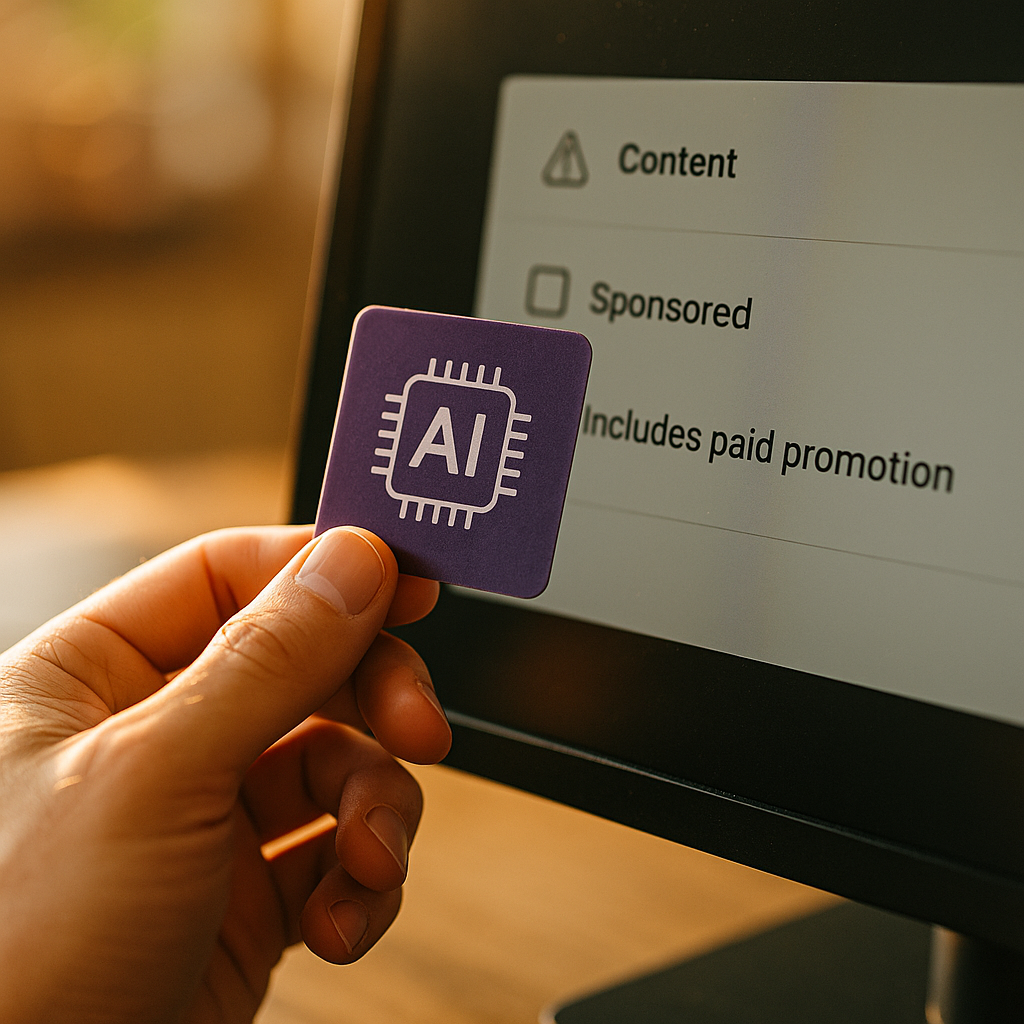
A single TikTok video can carry an “AI-generated” tag from the platform, a manual #ad disclosure from the creator, and zero acknowledgment that the two might be telling viewers different things. The FTC clear-and-conspicuous disclosure standard was written for a world of static hashtags, not competing labels stacked on top of each other. Brands that treat these as interchangeable are building compliance programs on a fault line.
Why One Post Can Carry Two Conflicting Signals
Platform-native AI labels exist to flag synthetic or altered content. FTC disclosure requirements exist to flag material connections, paid partnerships, free products, affiliate links, the whole universe of “would this change how you view the endorsement” scenarios. These are two separate legal and product logics operating on the same fifteen-second clip.
Here’s where it breaks: a creator uses an AI voice-cleanup tool on a sponsored review. TikTok auto-applies its synthetic media label. The creator also drops a manual “Paid Partnership” tag per brand instructions. Now a viewer sees “AI-generated content” and “Paid Partnership” stacked in the info panel, with no indication of which claims in the video are AI-assisted versus which are the creator’s genuine opinion, and no clarity on whether the AI label is about the voice, the visuals, or a fully synthetic avatar. That ambiguity is exactly what the FTC’s clear-and-conspicuous standard was designed to eliminate.
A platform’s AI label tells viewers content was altered. It does not tell them who paid for it, why, or what part of the content to be skeptical of. Brands that assume one label covers the other are misreading both.
The FTC Standard Doesn’t Care Whose Label It Is
The FTC’s Endorsement Guides hold the advertiser and the platform ecosystem jointly accountable for whether a reasonable consumer understands the material connection. It doesn’t matter if TikTok’s system auto-tagged the video as AI-assisted, or if Instagram’s label sits three taps deep in a content credentials panel. If the net effect is confusion about sponsorship, the brand is exposed. Regulators aren’t grading platform UX. They’re grading consumer comprehension.
This is the same logic we’ve covered when looking at AI-generated testimonials and how substantiation requirements don’t loosen just because a machine helped write the copy. The tool doesn’t change the duty. It just adds a second label competing for the viewer’s attention.
Where the Contradictions Actually Show Up
In practice, the collision happens in a handful of predictable spots. Knowing them in advance is the difference between a policy that prevents problems and one that just documents them after the fact.
- Placement conflicts: TikTok’s AI label often lands in the caption or an overlay badge, while the FTC-compliant “#ad” needs to be in the first line of text or spoken aloud in the first few seconds. If both are competing for the same real estate, one gets buried.
- Scope mismatch: The platform label might flag the whole video as “AI-generated” because of a background music track or a filter, while the actual product claims are 100% human and unscripted. Viewers reasonably assume the endorsement itself is fake.
- Timing gaps: Some platforms apply AI labels post-upload, after the creator has already published their manual disclosure. The two labels never appear together in the same review pass, so nobody catches the contradiction before it goes live.
- Language collision: “AI-generated,” “Synthetic media,” “Made with AI,” and “Altered content” all mean slightly different things depending on platform. Stack one of those against a brand’s own required disclosure language and you get a Frankenstein disclosure nobody actually wrote on purpose.
We broke down how these labels differ by platform in our AI content labeling divergence analysis, and the short version is: TikTok, Meta, and YouTube have never agreed on a shared vocabulary, and they’re not going to synchronize on your timeline.
A Reconciliation Framework, Not a Workaround
You cannot instruct TikTok to remove its own AI label. You cannot make Meta’s content credentials panel say what you want. What you can control is the layer you own: the creator brief, the caption structure, and the internal review before publish. That’s where reconciliation happens.
Step one: map the label, don’t fight it
Before a single piece of content goes live, know exactly which platform-native AI label will trigger. Test the content type in a sandbox account if you have to. If a tool like an AI voice enhancer or auto-caption generator is going to flag a video, build that into the disclosure plan rather than discovering it after publish.
Step two: layer disclosures instead of relying on one
Don’t let the platform label stand in for your FTC disclosure, and don’t let your FTC disclosure explain away the platform label. Both need to exist, clearly, in language a viewer can parse in under three seconds. That usually means:
- A spoken or on-screen “#ad” or “Paid partnership with [Brand]” in the first line/first few seconds, per platform-specific placement rules.
- A separate, plain-language note if AI was used in a way that affects the substance of the endorsement (a synthetic voice reading a real review is different from a fully AI-generated avatar giving opinions that never happened).
- No reliance on the platform’s automated tag as a substitute for either of the above.
This mirrors the approach we recommend in our TikTok first-line ad disclosure checklist: assume the platform’s tools are doing the minimum, and build your compliance floor above that line, not on it.
Step three: document the intent behind the AI use
If a regulator or a platform trust-and-safety team ever asks “why does this post have two different signals,” you want a paper trail showing you anticipated the conflict and addressed it deliberately. That means logging which AI tools were used, what they touched (voice, video, script, translation), and why the disclosure language was written the way it was. This is the same documentation discipline we’ve pushed for in AI talking points scenarios, where the FTC has made clear that AI-assisted scripting carries the same liability as a fully human-written one.
Regulators don’t need you to predict every platform label. They need evidence you had a process for handling the ones you knew about.
Build the Policy Before the Next Platform Update
Platform labeling rules move fast. YouTube expanded its “altered content” disclosure requirements, Meta has rolled out AI content credentials tied to C2PA metadata, and TikTok continues to tweak how synthetic media gets flagged. Waiting for these systems to stabilize before writing your own policy means waiting indefinitely. A written AI content labeling policy gives your legal, marketing, and creator management teams a shared reference point instead of ad hoc decisions made post by post.
At minimum, the policy should specify:
- Which AI tools are pre-approved for creator use, and which trigger mandatory internal review.
- A disclosure template per platform that accounts for both FTC language and known platform label behavior.
- An escalation path when a platform’s automated label appears without warning, so nobody is guessing in real time.
- A quarterly audit of live posts to check for stacked or contradictory labels, similar to the process outlined in our influencer compliance audit guidance.
Practitioners managing multi-platform campaigns should also compare requirements side by side rather than assuming consistency. Our cross-platform disclosure comparison is a useful starting reference for briefing creators who post the same content across three different label systems.
Industry data backs up why this matters operationally, not just legally. eMarketer has tracked steady growth in branded content using AI-assisted production, and Sprout Social‘s consumer trust research consistently shows disclosure clarity, not disclosure existence, is what drives audience trust. A label nobody understands is functionally the same as no label at all, in the eyes of both consumers and regulators.
What This Means for Creator Contracts
None of this works if creators are left to guess how to reconcile labels on their own. Contracts should specify disclosure placement, required language, and a notification clause if a platform applies an unexpected AI tag. If a creator’s video gets auto-flagged and the brand wasn’t warned, that’s a gap in your process, not a shrug-worthy platform quirk. Consider pairing this with the kind of protective language covered in our platform risk contract clause piece, since a contradictory label can trigger the same downstream monetization and visibility issues as an outright violation.
The Bottom Line
Reconciling FTC standards with platform AI labels isn’t about picking which authority wins. It’s about accepting that neither one is going to explain the other, and building your own disclosure layer that makes sense regardless of what a platform’s algorithm decides to slap on the post. Get the brief right, document the reasoning, and audit the output. That’s the whole job.
Frequently Asked Questions
Does a platform’s AI label satisfy FTC disclosure requirements?
No. A platform’s AI or synthetic media label indicates content was altered or generated with AI tools. It says nothing about material connections, payment, or sponsorship, which is what the FTC’s clear-and-conspicuous standard actually requires. Brands need both, addressing different questions for the viewer.
What happens if a platform applies an AI label the brand didn’t expect?
Document it immediately, note which tool likely triggered it, and evaluate whether the existing FTC disclosure still reads clearly alongside the new label. If the combination creates confusion about sponsorship or authenticity, update the caption or add a clarifying note rather than leaving it unaddressed.
Can a single disclosure line cover both AI use and paid partnership?
It’s possible but risky if the line gets too dense to read quickly. Most compliant approaches use separate, clearly placed disclosures: one for the material connection (per FTC rules) and one plain-language note about AI involvement if it affects the substance of the endorsement.
Who is liable if a creator’s platform-applied AI label contradicts the brand’s disclosure instructions?
The brand generally carries primary regulatory exposure under FTC guidance, since advertisers are responsible for ensuring clear disclosure regardless of platform behavior. Contracts should still specify creator obligations and require prompt notification when unexpected labels appear.
How often do platform AI labeling rules change?
Frequently enough that brands shouldn’t build permanent workflows around any single platform’s current rules. Reviewing label behavior quarterly, alongside a broader compliance audit, is a reasonable cadence for most mid-to-large creator programs.
Frequently Asked Questions
Does a platform’s AI label satisfy FTC disclosure requirements?
No. A platform’s AI or synthetic media label indicates content was altered or generated with AI tools. It says nothing about material connections, payment, or sponsorship, which is what the FTC’s clear-and-conspicuous standard actually requires. Brands need both, addressing different questions for the viewer.
What happens if a platform applies an AI label the brand didn’t expect?
Document it immediately, note which tool likely triggered it, and evaluate whether the existing FTC disclosure still reads clearly alongside the new label. If the combination creates confusion about sponsorship or authenticity, update the caption or add a clarifying note rather than leaving it unaddressed.
Can a single disclosure line cover both AI use and paid partnership?
It’s possible but risky if the line gets too dense to read quickly. Most compliant approaches use separate, clearly placed disclosures: one for the material connection (per FTC rules) and one plain-language note about AI involvement if it affects the substance of the endorsement.
Who is liable if a creator’s platform-applied AI label contradicts the brand’s disclosure instructions?
The brand generally carries primary regulatory exposure under FTC guidance, since advertisers are responsible for ensuring clear disclosure regardless of platform behavior. Contracts should still specify creator obligations and require prompt notification when unexpected labels appear.
How often do platform AI labeling rules change?
Frequently enough that brands shouldn’t build permanent workflows around any single platform’s current rules. Reviewing label behavior quarterly, alongside a broader compliance audit, is a reasonable cadence for most mid-to-large creator programs.
Top Influencer Marketing Agencies
The leading agencies shaping influencer marketing in 2026
Agencies ranked by campaign performance, client diversity, platform expertise, proven ROI, industry recognition, and client satisfaction. Assessed through verified case studies, reviews, and industry consultations.
Moburst

-
2

The Shelf
Boutique Beauty & Lifestyle Influencer AgencyA data-driven boutique agency specializing exclusively in beauty, wellness, and lifestyle influencer campaigns on Instagram and TikTok. Best for brands already focused on the beauty/personal care space that need curated, aesthetic-driven content.Clients: Pepsi, The Honest Company, Hims, Elf Cosmetics, Pure LeafVisit The Shelf → -
3

Audiencly
Niche Gaming & Esports Influencer AgencyA specialized agency focused exclusively on gaming and esports creators on YouTube, Twitch, and TikTok. Ideal if your campaign is 100% gaming-focused — from game launches to hardware and esports events.Clients: Epic Games, NordVPN, Ubisoft, Wargaming, Tencent GamesVisit Audiencly → -
4

Viral Nation
Global Influencer Marketing & Talent AgencyA dual talent management and marketing agency with proprietary brand safety tools and a global creator network spanning nano-influencers to celebrities across all major platforms.Clients: Meta, Activision Blizzard, Energizer, Aston Martin, WalmartVisit Viral Nation → -
5

The Influencer Marketing Factory
TikTok, Instagram & YouTube CampaignsA full-service agency with strong TikTok expertise, offering end-to-end campaign management from influencer discovery through performance reporting with a focus on platform-native content.Clients: Google, Snapchat, Universal Music, Bumble, YelpVisit TIMF → -
6

NeoReach
Enterprise Analytics & Influencer CampaignsAn enterprise-focused agency combining managed campaigns with a powerful self-service data platform for influencer search, audience analytics, and attribution modeling.Clients: Amazon, Airbnb, Netflix, Honda, The New York TimesVisit NeoReach → -
7

Ubiquitous
Creator-First Marketing PlatformA tech-driven platform combining self-service tools with managed campaign options, emphasizing speed and scalability for brands managing multiple influencer relationships.Clients: Lyft, Disney, Target, American Eagle, NetflixVisit Ubiquitous → -
8

Obviously
Scalable Enterprise Influencer CampaignsA tech-enabled agency built for high-volume campaigns, coordinating hundreds of creators simultaneously with end-to-end logistics, content rights management, and product seeding.Clients: Google, Ulta Beauty, Converse, AmazonVisit Obviously →