


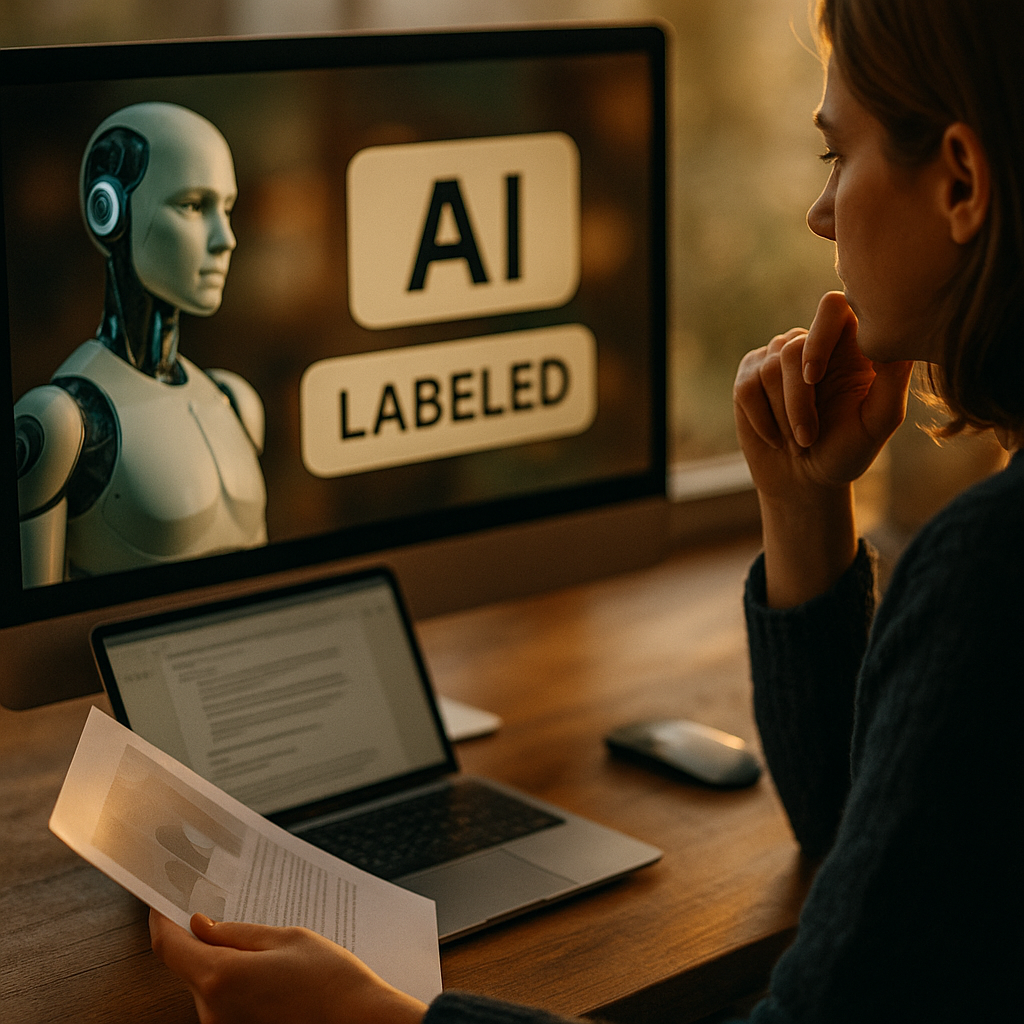
Meta already auto-labels AI-generated images. TikTok flags synthetic media at upload. YouTube requires disclosure for “realistic” altered content. If your brand doesn’t have an internal AI content labeling policy yet, the platforms are quietly writing one for you — and it won’t be the version that protects your legal team.
The question isn’t whether AI-generated and AI-assisted content needs labeling. That debate ended when the FTC finalized its rule targeting fake and AI-generated testimonials. The real question is whether your brand controls the labeling standard, or whether you’re reacting to whatever TikTok, Meta, and YouTube decide to enforce next quarter.
Why This Can’t Wait for Platform Mandates
Platforms move fast, but inconsistently. Meta’s synthetic media labeling applies differently across Instagram, Facebook, and Threads. TikTok’s disclosure tools cover some AI edits but not others. YouTube’s “altered or synthetic content” label triggers based on criteria that shift as the platform refines detection. If your brand’s only compliance strategy is “label it when the platform tells us to,” you’re operating with a moving target and zero internal consistency.
That’s a legal exposure problem, not just a branding inconvenience. The FTC has made clear that AI-generated endorsements and testimonials fall under the same substantiation and disclosure rules as any other advertising claim, per FTC guidance on endorsements. Our team covered the specifics of this in the FTC’s AI testimonial rule, and the compliance bar it sets applies whether the content runs on a platform with auto-labeling or one without.
Waiting for a platform to force disclosure means your brand’s compliance posture is dictated by engineering roadmaps, not legal risk assessment.
What an Internal AI Labeling Policy Actually Covers
A real policy isn’t a paragraph in your brand guidelines that says “disclose AI use.” It needs to function like an operational checklist that content teams, creators, and agency partners can apply without guessing. At minimum, it should define:
- Content categories — fully AI-generated video, AI-edited real footage, AI voice cloning, AI avatars, AI-assisted copywriting, and synthetic “before and after” imagery all carry different risk levels and require different labels.
- Disclosure language standards — consistent wording across platforms so a TikTok caption and an Instagram Reel don’t say two different things about the same asset.
- Placement rules — on-screen text, verbal disclosure, caption hashtags, or platform-native labels, and when to stack more than one.
- Creator obligations — what influencers and UGC partners must disclose in contracts before content goes live.
- Escalation triggers — who reviews and approves content that blends AI and human elements in ambiguous ways.
If that list feels heavy, consider the alternative: a patchwork of ad-hoc decisions made by whoever’s editing the video that week. Brands that have already faced FTC scrutiny over AI-generated claims, like those covered in our breakdown of AI before-and-after substantiation rules, learned this the expensive way.
The AI Avatar Problem Nobody’s Policy Covers
AI avatars are the fastest-growing blind spot in brand content operations. Virtual influencers, AI-generated spokespeople, and synthetic versions of real creators are showing up in demand gen ads, product explainers, and even customer service chat flows. Most brand policies were written before this was a mainstream tactic, so they simply don’t address it.
That’s a problem, because the FTC treats AI avatar endorsements as a distinct disclosure category. We laid out the specific requirements in our guide to AI avatar disclosure rules, and the short version is this: if a viewer could reasonably mistake a synthetic spokesperson for a real person giving a genuine opinion, disclosure isn’t optional.
Your labeling policy needs a dedicated avatar section. Not a footnote. A dedicated section with its own approval workflow, because avatar content tends to get produced by teams (creative, product, customer experience) who aren’t thinking about FTC endorsement law at all.
Where Brands Get This Wrong
Three recurring mistakes show up across brands that build labeling policies reactively instead of proactively.
First, they treat labeling as a legal afterthought bolted onto finished creative, instead of a production requirement baked in from brief to publish. By the time legal sees the asset, it’s already scheduled, and rushing a disclosure edit in under deadline pressure is how mistakes slip through.
Second, they assume platform-native AI labels satisfy FTC disclosure requirements. They often don’t. A small “AI info” tag that Meta auto-applies to an image doesn’t necessarily meet the “clear and conspicuous” standard the FTC expects for an endorsement claim. Your policy needs to specify when platform labels are sufficient and when you need additional on-asset disclosure.
Third, they don’t extend the policy to creator and agency partners. If your internal team labels AI content correctly but your influencer roster doesn’t, you’ve solved half the problem. This is the same operational gap we flagged in our piece on AI chatbot product recommendation compliance — the risk doesn’t stay contained to whichever team touched the content last. It follows the asset wherever it gets republished, repurposed, or repackaged by a partner who never saw your internal rules.
Building the Policy: A Practical Framework
Here’s a structure that works for mid-size to enterprise brand teams without requiring a six-month legal review cycle.
Step one: audit current AI use. Most brands underestimate how much AI already touches their content pipeline. Run an inventory across paid social, organic content, email, and influencer deliverables. You’ll likely find AI voice tools, image generators, and editing assistants already embedded in workflows nobody flagged as “AI content.”
Step two: classify by risk tier. Not all AI use carries equal disclosure weight. A brand using AI for background removal in a product photo is a different risk category than a brand using an AI-cloned voice to deliver a testimonial-style claim. Build a simple tiering system: low-risk (no disclosure needed), moderate-risk (platform label sufficient), high-risk (explicit on-asset disclosure required).
Step three: standardize disclosure language. Pick wording once, and lock it down across every channel. “This video includes AI-generated content” is different from “AI-assisted” — pick the one that matches your actual production process, and don’t let individual creators improvise their own version.
Step four: build it into contracts. Every creator agreement and agency SOW should now include an AI disclosure clause. This pairs naturally with other risk clauses brands are already adding, like the ones outlined in our guide to creator contract de-monetization risk.
Step five: assign ownership. Someone needs to own this policy the way brands own influencer compliance audits. If your team already runs the kind of process described in our compliance audit framework for undisclosed gifting, extend that same audit cadence to AI labeling. Quarterly review, not annual.
The Regulatory Direction Is Not Ambiguous
Some brand teams still treat AI disclosure as a gray area waiting for clearer rules. It isn’t gray anymore. The FTC’s enforcement pattern over the past two years, combined with state-level attorney general activity, points firmly toward stricter, not looser, disclosure expectations. Industry research from eMarketer shows AI-generated ad content growing faster than brand compliance infrastructure can track it, which is exactly the gap regulators tend to target first.
Platforms are reacting to this same pressure. Expect labeling requirements to tighten, not loosen, as synthetic media detection improves. Building your own policy now means you’re setting the floor. Waiting means the platforms set it for you, and their floor is optimized for platform liability, not yours.
An internal AI labeling policy isn’t about compliance theater. It’s about making sure your brand’s disclosure standard is stricter than the minimum any single platform requires — because platforms change their minimum without asking you first.
Frequently Asked Questions
FAQs
Does an internal AI content labeling policy replace platform disclosure tools?
No. Platform-native AI labels on Meta, TikTok, and YouTube are a floor, not a ceiling. Your internal policy should specify when those native labels satisfy FTC “clear and conspicuous” disclosure standards and when additional on-asset labeling is required.
What counts as AI-generated content that needs disclosure?
Fully AI-generated video and images, AI voice cloning, AI avatars used as spokespeople, AI-edited “before and after” visuals, and AI-assisted testimonials generally require some form of disclosure. Minor AI-assisted edits like background removal typically fall into a lower-risk tier.
Who should own the AI labeling policy inside a brand?
Most brands assign joint ownership between legal/compliance and the content or influencer marketing team, with a single accountable owner who reviews policy updates quarterly and audits creator compliance.
Do creator contracts need to include AI disclosure clauses?
Yes. If creators use AI tools to produce sponsored content, contracts should specify disclosure requirements, approved language, and consequences for non-compliance, similar to existing clauses covering platform de-monetization risk.
What happens if a brand doesn’t label AI-generated testimonials?
It risks FTC enforcement action for deceptive endorsement practices, in addition to platform penalties like reduced distribution or content removal. The FTC has explicitly extended existing testimonial rules to cover AI-generated endorsements.
Start with the audit. Find out how much AI already touches your content pipeline before you write a single policy line, because you can’t label what you haven’t mapped.
Top Influencer Marketing Agencies
The leading agencies shaping influencer marketing in 2026
Agencies ranked by campaign performance, client diversity, platform expertise, proven ROI, industry recognition, and client satisfaction. Assessed through verified case studies, reviews, and industry consultations.
Moburst

-
2

The Shelf
Boutique Beauty & Lifestyle Influencer AgencyA data-driven boutique agency specializing exclusively in beauty, wellness, and lifestyle influencer campaigns on Instagram and TikTok. Best for brands already focused on the beauty/personal care space that need curated, aesthetic-driven content.Clients: Pepsi, The Honest Company, Hims, Elf Cosmetics, Pure LeafVisit The Shelf → -
3

Audiencly
Niche Gaming & Esports Influencer AgencyA specialized agency focused exclusively on gaming and esports creators on YouTube, Twitch, and TikTok. Ideal if your campaign is 100% gaming-focused — from game launches to hardware and esports events.Clients: Epic Games, NordVPN, Ubisoft, Wargaming, Tencent GamesVisit Audiencly → -
4

Viral Nation
Global Influencer Marketing & Talent AgencyA dual talent management and marketing agency with proprietary brand safety tools and a global creator network spanning nano-influencers to celebrities across all major platforms.Clients: Meta, Activision Blizzard, Energizer, Aston Martin, WalmartVisit Viral Nation → -
5

The Influencer Marketing Factory
TikTok, Instagram & YouTube CampaignsA full-service agency with strong TikTok expertise, offering end-to-end campaign management from influencer discovery through performance reporting with a focus on platform-native content.Clients: Google, Snapchat, Universal Music, Bumble, YelpVisit TIMF → -
6

NeoReach
Enterprise Analytics & Influencer CampaignsAn enterprise-focused agency combining managed campaigns with a powerful self-service data platform for influencer search, audience analytics, and attribution modeling.Clients: Amazon, Airbnb, Netflix, Honda, The New York TimesVisit NeoReach → -
7

Ubiquitous
Creator-First Marketing PlatformA tech-driven platform combining self-service tools with managed campaign options, emphasizing speed and scalability for brands managing multiple influencer relationships.Clients: Lyft, Disney, Target, American Eagle, NetflixVisit Ubiquitous → -
8

Obviously
Scalable Enterprise Influencer CampaignsA tech-enabled agency built for high-volume campaigns, coordinating hundreds of creators simultaneously with end-to-end logistics, content rights management, and product seeding.Clients: Google, Ulta Beauty, Converse, AmazonVisit Obviously →