


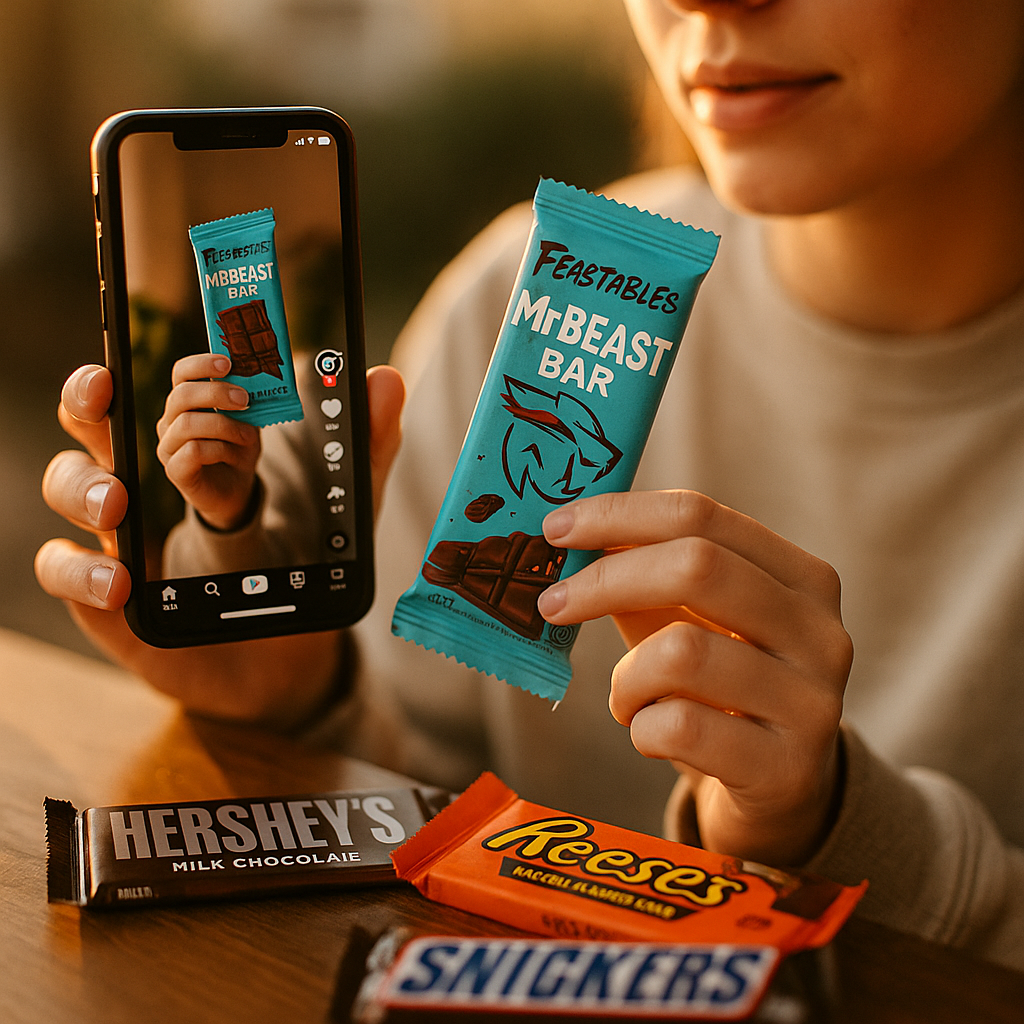
Legacy candy brands spend decades building shelf space. Feastables built a TikTok Shop weekly nano-creator taste-off ritual and outsold category giants in a fraction of the time, one recurring video format at a time. No celebrity drop, no Super Bowl spot, just a repeatable content system that turned dozens of small creators into a standing distribution channel.
The Problem: Candy Is a Trust Category, Not a Discovery Category
Candy buyers are creatures of habit. Snickers, Reese’s, and Hershey have owned checkout-aisle real estate since before most TikTok Shop shoppers were born. Ranking against that kind of shelf presence with a paid media blitz is expensive and, frankly, inefficient. Feastables, the chocolate brand founded by MrBeast, faced a specific problem: strong brand awareness thanks to its founder’s reach, but a much harder job convincing shoppers the product actually tastes good enough to switch from a habit purchase.
That is a taste objection, not an awareness objection. And you don’t solve a taste objection with a single hero ad. You solve it with repeated, believable, third-party proof that shows up in the feed often enough to feel like consensus.
Why a Ritual Beats a Campaign
Most brands run influencer marketing as a campaign: a flight of content tied to a launch window, then silence until the next drop. Feastables instead built a ritual, a standing weekly taste-off format featuring nano-creators (typically under 10,000 followers) comparing Feastables bars against legacy competitors on camera, unscripted reactions included.
A ritual format compounds. A campaign format resets to zero every time. That difference is the entire reason nano-creator programs outperform one-off influencer bursts on TikTok Shop.
The weekly cadence did three things a campaign burst can’t. It trained the algorithm to expect and surface the content type. It gave shoppers a reason to check back. And it let the brand iterate on hooks, product pairings, and creator selection every single week instead of waiting for a quarterly refresh.
How the Taste-Off Format Actually Worked
The mechanics were deliberately simple, which is precisely why they scaled. Each week, Feastables’ creator team recruited a fresh batch of nano-creators, mostly food and lifestyle accounts with tight, high-trust niche audiences, and shipped them a Feastables bar alongside a competing candy bar (Hershey’s, Snickers, Twix, whatever fit that week’s theme).
- Creators filmed a blind or semi-blind taste comparison, reacting in real time.
- Videos linked directly to the Feastables TikTok Shop storefront using native shoppable tags.
- Winners were rarely scripted to be Feastables every time, which preserved credibility.
- Content followed a near-identical structure week to week: unbox, taste, react, rank.
That last point matters more than it sounds. A recognizable structure lets viewers process the content faster, and TikTok’s recommendation system rewards formats that hold attention through a familiar arc. It’s the same logic behind Duolingo’s recurring owl-mascot bits, where format consistency, not novelty, is what built compounding reach. Our earlier breakdown of owl mascot meets micro-creators covers the same principle from a different vertical.
Why Nano-Creators, Specifically?
Feastables could have paid mid-tier or macro creators for a bigger single splash. It chose nano instead, and the reasoning is worth unpacking for any brand comparing tiers.
Nano-creators cost less per video, which means a brand can run dozens per week instead of two or three. That volume creates something legacy candy brands structurally can’t replicate quickly: a feed saturated with what looks like organic, ordinary people trying the product and reacting honestly. Audiences under 10,000 followers also tend to have higher engagement rates and tighter parasocial trust than macro accounts, according to data from Sprout Social’s creator engagement benchmarks. When a nano-creator says a candy bar tastes better than Snickers, followers believe it because the creator has no obvious incentive to lie to an audience of 4,000 people they actually know.
This isn’t a new insight for readers who followed how Stanley’s micro-creator waves built the Quencher or how a skincare brand used the same tier to drive a 9x sales increase. The nano tier keeps showing up as the highest-efficiency layer for trust-building categories, and candy, it turns out, is very much a trust-building category.
The Operational Backbone Nobody Talks About
Here’s the part that separates a sustainable weekly ritual from a one-time stunt: logistics. Running 30 to 50 nano-creator taste-offs every single week requires a fulfillment and briefing engine most in-house teams aren’t built for.
Feastables’ team reportedly leaned on a tight brief template (one page, non-negotiable structure, optional flavor pairing suggestions) paired with a rolling recruitment pipeline that refreshed the creator roster constantly. Recruiting the same 40 creators every week burns out the format fast. Audiences notice repetition, and TikTok’s algorithm deprioritizes stale creator-brand pairings over time.
Brands attempting a similar model should budget for three operational pressure points:
- Shipping and sampling logistics at a weekly, not quarterly, cadence.
- Creator vetting at scale, since nano accounts churn faster and vary more in quality than established mid-tier rosters.
- Rights and usage clearance for whitelisting the best-performing taste-off videos as paid spark ads.
That third point is where the real ROI shows up. Organic nano-creator content is cheap to produce, but the top 10 percent of weekly videos, the ones with unusually high watch time or share rate, get pulled into paid distribution. That’s the same amplification logic covered in our piece on how a QSR brand used AI-generated storyboards to cut turnaround to keep pace with a similarly aggressive content cadence.
What the Numbers Suggest
Feastables hasn’t published a full breakdown of its TikTok Shop performance, but the category signals are telling. TikTok Shop’s food and beverage vertical has been one of the platform’s fastest-growing categories, and eMarketer’s social commerce forecasts consistently point to shoppable video as the primary growth driver over static product listings. Brands running weekly, high-frequency creator content in that vertical are seeing outsized share-of-voice against legacy CPG competitors who still treat influencer marketing as an occasional media buy rather than a standing operational channel.
The brands winning TikTok Shop in mature categories aren’t the ones with the biggest single campaign. They’re the ones with the most consistent weekly cadence and the tightest creator vetting loop.
That mirrors what we’ve seen play out with grocery and CPG brands using AI-assisted creator seeding to beat cost-per-sale benchmarks that legacy brands can’t match through traditional media buys.
Where Compliance Fits In
A weekly taste-off ritual involving direct product comparisons isn’t risk-free. Brands making comparative claims, even informal, on-camera “this tastes better than X” claims, need disclosure practices that hold up under FTC scrutiny. The FTC’s endorsement guidance applies regardless of creator tier or follower count, and comparative advertising carries extra sensitivity because it names a competitor directly.
Brands that have been burned by loose disclosure practices offer a useful cautionary tale here. Our coverage of Poppi’s FTC settlement and trust rebuild is required reading for any team running a high-frequency creator format that touches direct product comparisons. A weekly ritual multiplies both the upside and the compliance surface area. Every video needs the same disclosure discipline, not just the ones a legal team happens to review.
Could This Work Outside Candy?
The taste-off mechanic is category-specific, obviously, but the underlying structure travels well. Any brand competing against entrenched legacy players on a subjective quality attribute (taste, feel, scent, performance) can adapt the format: recurring cadence, nano-tier trust, consistent structure, direct comparison against the incumbent.
Coffee brands, sneaker boutiques, and beverage startups have all run versions of this playbook with strong results. The coffee brand that tripled ROAS with AI creator matching used a similar comparison-driven hook, and a sneaker boutique beat national chains on Reels using the same “small creator, high cadence, direct comparison” logic on a different platform entirely.
The format isn’t the innovation. The discipline to run it every single week, with fresh creators and tight briefs, is.
Next Step for Brands Considering This Model
Don’t try to launch a full weekly ritual on day one. Run a four-week pilot with 10 to 15 nano-creators, lock the video structure, and measure watch-through rate and TikTok Shop click-through before scaling recruitment. If the format holds attention at week four the same way it did at week one, you’ve found a repeatable channel, not a lucky viral moment.
FAQs
What is a nano-creator taste-off ritual?
It’s a recurring content format, typically weekly, in which small creators (usually under 10,000 followers) film side-by-side product comparisons against competitor brands, following a consistent structure to build audience familiarity and algorithmic momentum over time.
Why did Feastables use nano-creators instead of macro influencers?
Nano-creators cost less per video, allowing higher volume and weekly frequency, and their smaller, tighter audiences tend to trust their opinions more than they trust a paid macro-influencer endorsement, which matters for a taste-driven trust category like candy.
How often should a brand run this kind of ritual to see results?
Weekly cadence is what made the Feastables format work, since it trains both the algorithm and the audience to expect and engage with the content type. Sporadic or monthly posting loses the compounding benefit entirely.
What compliance risks come with comparative taste-off content?
Comparative claims naming a specific competitor carry extra FTC scrutiny beyond standard endorsement disclosure rules. Brands need consistent disclosure language across every creator and every video, not just spot-checked compliance on a handful of posts.
Can this model work for categories outside food and candy?
Yes. Any category with a subjective quality attribute, taste, scent, feel, or performance, can adapt the recurring comparison format. Coffee, beverage, and footwear brands have run similar nano-creator comparison rituals with strong TikTok Shop results.
Top Influencer Marketing Agencies
The leading agencies shaping influencer marketing in 2026
Agencies ranked by campaign performance, client diversity, platform expertise, proven ROI, industry recognition, and client satisfaction. Assessed through verified case studies, reviews, and industry consultations.
Moburst

-
2

The Shelf
Boutique Beauty & Lifestyle Influencer AgencyA data-driven boutique agency specializing exclusively in beauty, wellness, and lifestyle influencer campaigns on Instagram and TikTok. Best for brands already focused on the beauty/personal care space that need curated, aesthetic-driven content.Clients: Pepsi, The Honest Company, Hims, Elf Cosmetics, Pure LeafVisit The Shelf → -
3

Audiencly
Niche Gaming & Esports Influencer AgencyA specialized agency focused exclusively on gaming and esports creators on YouTube, Twitch, and TikTok. Ideal if your campaign is 100% gaming-focused — from game launches to hardware and esports events.Clients: Epic Games, NordVPN, Ubisoft, Wargaming, Tencent GamesVisit Audiencly → -
4

Viral Nation
Global Influencer Marketing & Talent AgencyA dual talent management and marketing agency with proprietary brand safety tools and a global creator network spanning nano-influencers to celebrities across all major platforms.Clients: Meta, Activision Blizzard, Energizer, Aston Martin, WalmartVisit Viral Nation → -
5

The Influencer Marketing Factory
TikTok, Instagram & YouTube CampaignsA full-service agency with strong TikTok expertise, offering end-to-end campaign management from influencer discovery through performance reporting with a focus on platform-native content.Clients: Google, Snapchat, Universal Music, Bumble, YelpVisit TIMF → -
6

NeoReach
Enterprise Analytics & Influencer CampaignsAn enterprise-focused agency combining managed campaigns with a powerful self-service data platform for influencer search, audience analytics, and attribution modeling.Clients: Amazon, Airbnb, Netflix, Honda, The New York TimesVisit NeoReach → -
7

Ubiquitous
Creator-First Marketing PlatformA tech-driven platform combining self-service tools with managed campaign options, emphasizing speed and scalability for brands managing multiple influencer relationships.Clients: Lyft, Disney, Target, American Eagle, NetflixVisit Ubiquitous → -
8

Obviously
Scalable Enterprise Influencer CampaignsA tech-enabled agency built for high-volume campaigns, coordinating hundreds of creators simultaneously with end-to-end logistics, content rights management, and product seeding.Clients: Google, Ulta Beauty, Converse, AmazonVisit Obviously →