


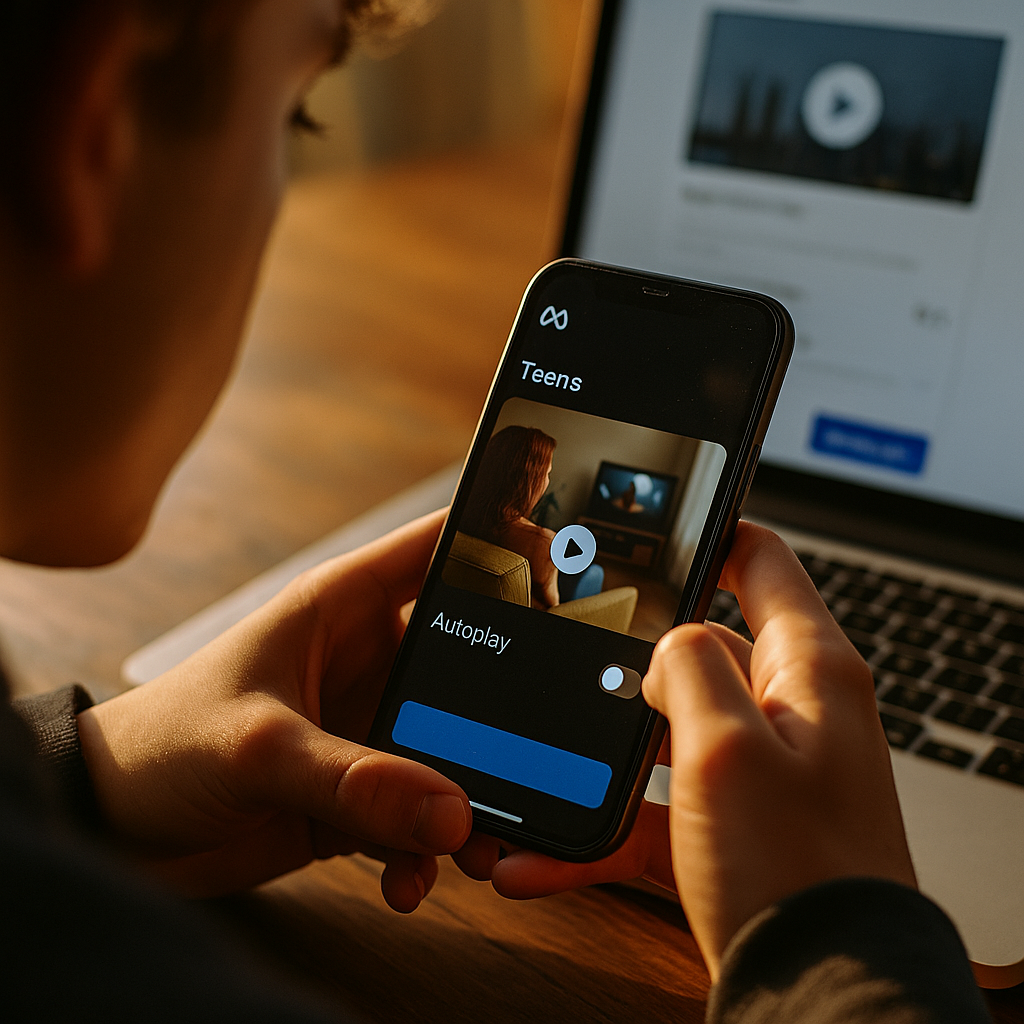
If your media plan still assumes a teenager will passively watch whatever Instagram serves next, that assumption just became a liability. Meta’s settlement ends default autoplay for younger users and imposes a two-hour daily viewing cap on teen accounts, two changes that quietly gut the reach math behind thousands of paid campaigns. This isn’t a minor UX tweak. It’s a structural correction to how impressions get counted, and brands that don’t rebuild their models now will overpay for reach that no longer exists.
What the Settlement Actually Requires
The settlement, part of a broader wave of regulatory and legal pressure over youth mental health and platform design, forces Meta to change two defaults that shaped how Instagram generates engagement among under-18 users. First, autoplay is off by default for teen accounts, meaning video no longer auto-advances into the next piece of content without a tap. Second, teen accounts now carry a hard two-hour daily viewing cap, after which the app nudges toward logoff rather than continued scrolling.
Neither change is cosmetic. Autoplay has been one of the quiet engines of Reels and Stories consumption since the format launched, and removing it as a default changes the baseline behavior every media buyer has priced against for years. Add the daily cap, and you’re looking at a hard ceiling on total teen impressions per account per day, something that simply didn’t exist before.
Autoplay Was Never Real Reach, It Just Looked Like It
Here’s the uncomfortable part: a huge share of what brands counted as “views” under autoplay were never intentional engagement. A teen scrolling past a Reel while autoplay kept it running counted as a view even if they never touched the screen. Advertisers built CPV benchmarks and frequency assumptions on top of that inflated baseline for years.
Turning off autoplay by default doesn’t just reduce impressions, it reveals how much of your historical reach was passive exposure rather than active attention, and that gap is going to show up in every post-campaign report from here forward.
This mirrors a pattern already playing out on other platforms. TikTok watch time versus Instagram autoplay has always been an apples-to-oranges comparison for exactly this reason: one platform rewards deliberate watch time, the other rewarded passive continuation. Now that Instagram’s teen segment loses that passive continuation, the two systems are converging, and brief structures need to converge with them.
Where Does the Two-Hour Cap Actually Bite?
The daily cap isn’t evenly distributed across the day. Teen usage skews heavily toward after-school hours and late evening, exactly the dayparts many brands have historically over-indexed for reach efficiency because CPMs were cheaper off-peak. If a teen hits their two-hour ceiling by 8 PM, every ad scheduled for the 9 PM to midnight window against that cohort is now competing for a shrinking, exhausted pool of remaining attention.
Practically, this means:
- Frequency capping models built on unlimited daily sessions are now obsolete for teen-targeted campaigns.
- Evening dayparting strategies need re-weighting toward earlier windows before the cap kicks in.
- Sequential ad strategies (retargeting within a single day) will see materially lower completion rates against teen segments.
We covered the targeting mechanics of this shift in detail in how brands rebuild briefs and targeting after the cap rollout, and the core takeaway holds: treat teen reach as a finite daily resource, not an elastic one.
Rebuilding Reach Assumptions, Line by Line
Start with your CPV benchmarks. If your historical baseline was built on autoplay-inflated view counts, your “normal” cost-per-view is about to look artificially cheap compared to what you’ll actually pay for genuine, tap-initiated engagement. Recalibrate against a shorter lookback window (recent weeks post-rollout, not last year’s data) and expect a 15 to 30 percent adjustment in effective CPV for teen-skewing audiences, depending on category.
Next, rework frequency caps downward. If teens can only realistically consume two hours of content daily across the entire app, your ad shouldn’t assume three or four exposure opportunities per day. One or two, tightly sequenced, is the more realistic ceiling now.
The brands that win this transition aren’t cutting teen-targeted spend, they’re redistributing it toward earlier dayparts and fewer, higher-quality exposures instead of chasing volume that no longer exists.
Third, diversify platform mix. If a meaningful chunk of your reach strategy leaned on Instagram’s teen scroll depth, it’s worth revisiting how that budget splits against alternatives. Our TikTok algorithm versus Instagram feed budget split framework is a useful starting point for reallocating spend without abandoning the platform entirely.
Creative and Briefing Changes That Follow
Reach isn’t the only thing that shifts, creative needs to adapt too. Without autoplay carrying viewers into your content passively, the first two seconds of a Reel now have to earn the tap or the swipe-stop on their own merit, not rely on momentum from whatever played before it. That’s a hook problem, not a targeting problem, and it belongs in the creative brief, not just the media plan.
Creators producing for teen-heavy audiences should be briefed to front-load value immediately: no slow builds, no context-setting before the payoff. This is the same discipline covered in turning carousels into algorithm-friendly Reels, and it applies even more urgently now that passive continuation can’t paper over a weak opening.
Discovery-style content also needs a second look. If your brand leans on Instagram for lifestyle or product discovery among younger demographics, the visual discovery playbook for lifestyle and ecommerce brands outlines how to structure content that earns attention actively rather than riding the old autoplay current.
An Operational Checklist Before Your Next Flight
Before your team locks the next campaign brief, run through this list:
- Pull the last 90 days of teen-segment view data and flag what percentage came from autoplay-initiated sessions versus intentional taps, if your reporting dashboard distinguishes them.
- Rebuild CPV benchmarks using post-rollout data only.
- Cut frequency caps for teen audiences to one to two exposures daily.
- Shift dayparting earlier to land impressions before the two-hour cap triggers fatigue.
- Brief creators on cold-open hooks that don’t depend on prior autoplay momentum.
- Cross-check platform mix against alternatives where reach hasn’t been structurally reduced.
Industry data on the broader shift toward attention-based metrics over raw impression counts is worth tracking through sources like eMarketer and Statista, both of which have been documenting the decline of passive-view benchmarks across social platforms. Meta’s own advertiser guidance, available through Meta Business, is also updating in real time as the settlement rolls out, so treat it as a living document rather than a one-time read.
Compliance Isn’t Optional Here
This settlement didn’t happen in a vacuum. Regulatory bodies including the FTC have been increasingly vocal about platform design targeting minors, and brands running campaigns that skew toward teen audiences should assume more scrutiny is coming, not less. Documenting your frequency caps, dayparting logic, and creative review process isn’t just good practice anymore, it’s a paper trail you may need.
Agencies managing multi-platform teen campaigns should also revisit format-matching fundamentals. The format-to-funnel-stage matching guide is a solid reference for making sure your Instagram spend isn’t just shrinking, it’s being redirected to where it still performs.
Next step: audit your last quarter’s teen-segment reach reports for autoplay-driven inflation, then rebuild your CPV and frequency assumptions before your next flight goes live, not after the numbers come back soft.
FAQs
What exactly did Meta’s settlement change on Instagram?
The settlement removes autoplay as a default behavior for teen accounts and introduces a two-hour daily viewing cap, both aimed at reducing passive, extended engagement among younger users.
Does the two-hour cap apply to all Instagram users?
No, it applies specifically to accounts registered as teen users under Meta’s age verification systems, not to the general adult user base.
Why does removing autoplay matter for advertisers?
Autoplay previously inflated view counts because content continued playing without active user intent. Removing it as a default means view metrics will more accurately reflect genuine engagement, which typically lowers reported reach and view volume.
How should brands adjust CPV benchmarks after this change?
Rebuild benchmarks using data collected after the rollout rather than historical averages, since pre-settlement CPV figures were calculated against an inflated, autoplay-driven baseline.
Will this affect creator content strategy too?
Yes. Without autoplay carrying viewers passively into content, creative needs stronger opening hooks to earn attention actively, particularly for content targeting teen audiences.
Should brands pull back on Instagram spend targeting teens?
Not necessarily. The more effective response is redistributing spend toward earlier dayparts, tightening frequency caps, and diversifying platform mix rather than abandoning the channel outright.
Top Influencer Marketing Agencies
The leading agencies shaping influencer marketing in 2026
Agencies ranked by campaign performance, client diversity, platform expertise, proven ROI, industry recognition, and client satisfaction. Assessed through verified case studies, reviews, and industry consultations.
Moburst

-
2

The Shelf
Boutique Beauty & Lifestyle Influencer AgencyA data-driven boutique agency specializing exclusively in beauty, wellness, and lifestyle influencer campaigns on Instagram and TikTok. Best for brands already focused on the beauty/personal care space that need curated, aesthetic-driven content.Clients: Pepsi, The Honest Company, Hims, Elf Cosmetics, Pure LeafVisit The Shelf → -
3

Audiencly
Niche Gaming & Esports Influencer AgencyA specialized agency focused exclusively on gaming and esports creators on YouTube, Twitch, and TikTok. Ideal if your campaign is 100% gaming-focused — from game launches to hardware and esports events.Clients: Epic Games, NordVPN, Ubisoft, Wargaming, Tencent GamesVisit Audiencly → -
4

Viral Nation
Global Influencer Marketing & Talent AgencyA dual talent management and marketing agency with proprietary brand safety tools and a global creator network spanning nano-influencers to celebrities across all major platforms.Clients: Meta, Activision Blizzard, Energizer, Aston Martin, WalmartVisit Viral Nation → -
5

The Influencer Marketing Factory
TikTok, Instagram & YouTube CampaignsA full-service agency with strong TikTok expertise, offering end-to-end campaign management from influencer discovery through performance reporting with a focus on platform-native content.Clients: Google, Snapchat, Universal Music, Bumble, YelpVisit TIMF → -
6

NeoReach
Enterprise Analytics & Influencer CampaignsAn enterprise-focused agency combining managed campaigns with a powerful self-service data platform for influencer search, audience analytics, and attribution modeling.Clients: Amazon, Airbnb, Netflix, Honda, The New York TimesVisit NeoReach → -
7

Ubiquitous
Creator-First Marketing PlatformA tech-driven platform combining self-service tools with managed campaign options, emphasizing speed and scalability for brands managing multiple influencer relationships.Clients: Lyft, Disney, Target, American Eagle, NetflixVisit Ubiquitous → -
8

Obviously
Scalable Enterprise Influencer CampaignsA tech-enabled agency built for high-volume campaigns, coordinating hundreds of creators simultaneously with end-to-end logistics, content rights management, and product seeding.Clients: Google, Ulta Beauty, Converse, AmazonVisit Obviously →