


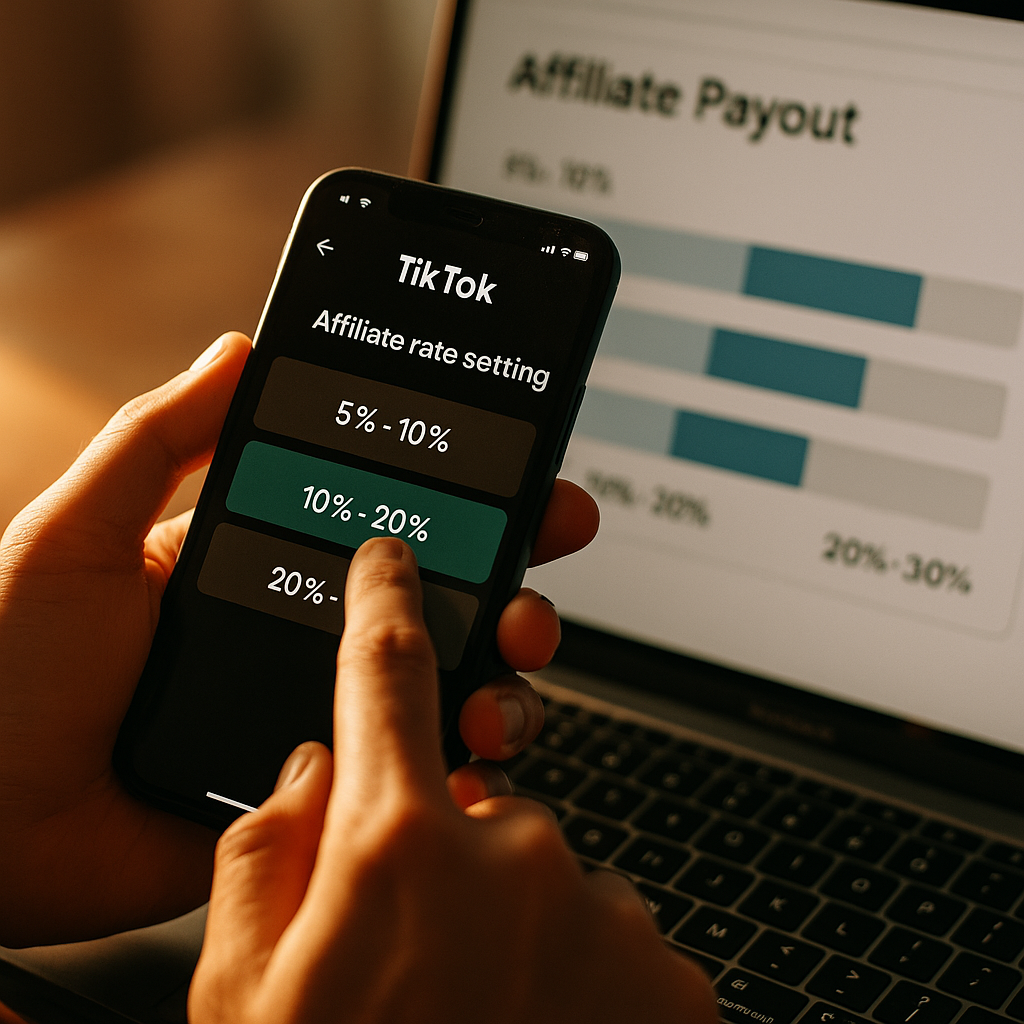
Brands running TikTok Shop affiliate programs are leaving money on the table twice: once by overpaying creators who would have promoted for less, and again by underpaying the mid-tier sellers who actually drive repeat purchases. A TikTok Shop affiliate rate-setting strategy built on gut instinct is basically a coin flip. Platforms like Levanta are pulling back the curtain on what payout bands actually convert, and the data doesn’t match what most brand managers assume.
The Rate-Setting Problem Nobody Talks About
Ask ten brand managers how they set their TikTok Shop affiliate commission and you’ll get ten different answers, most of them anchored to “what our competitor is doing” rather than any internal logic. That’s not a strategy. That’s guessing with a spreadsheet attached.
The commission structure on TikTok Shop is deceptively simple on the surface: you set a percentage, creators promote your product, you pay out on conversion. But the mechanics underneath are messy. Standard commissions, open collaboration plans, targeted plans, and live-event boosted rates all stack differently, and creators are savvy enough to shop around before committing content slots. A flat 15% across your catalog might be generous for your bestseller and criminally low for a new SKU that needs momentum.
Automated commission tools exist precisely because manual rate-setting doesn’t scale past a handful of SKUs. Levanta, for instance, aggregates performance data across thousands of affiliate relationships and lets brands test payout tiers against actual conversion lift rather than assumption.
What Automated Tools Actually Measure
The value of a platform like Levanta isn’t the automation itself, it’s the visibility into which commission bands correlate with sustained creator participation versus one-off posts. That distinction matters more than most brands realize.
- Acquisition rate: the commission needed to get a creator to post once.
- Retention rate: the commission needed to get that same creator to keep posting for eight to twelve weeks.
- Saturation ceiling: the point where raising commission stops producing proportional lift in GMV.
Most brands optimize only for the first metric. That’s the expensive mistake. A one-time 30% spike gets you a burst of content, then silence, because the creator has already extracted the value and moved to the next brand offering a similar spike.
Data pulled from mid-market TikTok Shop sellers shows that commission bands between 12% and 20% retain roughly twice as many active affiliates over a rolling 90-day window compared to bands above 25%, where creator churn spikes almost immediately after the first payout cycle.
Optimal Payout Bands, By Category and Creator Tier
There’s no universal “right” number, but the patterns across categories are consistent enough to build a framework around. Beauty and personal care SKUs tend to cluster around 15% to 20% commission for standard affiliates, climbing higher for exclusive livestream events. That tracks with what we’ve seen in beauty livestream shipping playbooks, where urgency and trust drive conversion more than raw discount depth.
Grocery and CPG, by contrast, runs leaner. Margins are thinner, so commissions in the 8% to 12% range are the norm, with brands leaning on volume rather than per-unit generosity. The grocery livestream comparison format works because creators are compensated for speed and repetition, not exclusivity.
Apparel and accessories sit somewhere in between, often 15% to 25%, with seasonal spikes tied to saturation windows. If you’ve read our breakdown of the October saturation calendar, you already know how commission strategy has to flex around calendar-driven demand rather than staying flat year-round.
Nano, Micro, Mid-Tier: One Rate Doesn’t Fit All
Here’s where most brands still get it wrong: they apply one commission rate across every creator tier and wonder why nano creators ghost after one post while mid-tier creators demand custom deals anyway.
Nano and micro creators (under 50,000 followers) respond best to flat, published rates because negotiation isn’t worth their time or yours. Mid-tier creators (50,000 to 500,000) want a base rate plus performance kickers, bonus commission tiers triggered at GMV thresholds. Top-tier creators negotiate individually regardless of what your public rate card says, so don’t waste operational energy trying to standardize them into your automated tool’s default bands.
This tiered approach also reduces the compliance headaches that come with inconsistent public offers. If your published rate says one thing but your DMs say another, you’re inviting scrutiny, and not just from creators.
Why Payout Structure Is Also a Compliance Question
Commission rates aren’t purely a finance decision. They intersect directly with disclosure obligations under FTC endorsement guidelines, because how and when a creator gets paid shapes what they’re required to disclose and how prominently. Brands that layer bonus tiers or surprise commission bumps without updating creator contracts are quietly building compliance debt.
This is where automated tools earn their keep beyond rate optimization. Levanta and similar platforms typically log payout history, which becomes useful documentation if a regulator or platform trust-and-safety team ever asks how a creator was compensated for a specific post. If you’re already thinking about documentation trails, it’s worth pairing your rate strategy with the compliance frameworks we outlined in the TikTok Shop ad syndication compliance playbook.
A commission structure that changes creator behavior without a matching update to disclosure language isn’t a growth hack, it’s a liability sitting on a spreadsheet.
Reading the Algorithm Into Your Rate Card
TikTok’s discovery mechanics reward sustained creator activity more than isolated viral spikes, which is exactly why the shift toward trust-based ranking matters for how you structure payouts. If the algorithm favors creators with consistent posting cadence and audience trust signals, your commission structure should reward exactly that: cadence and trust, not just conversion volume.
Practically, this means building in loyalty multipliers. A creator who posts weekly for eight weeks straight should earn a higher effective rate than one who posts once at a higher percentage. Some brands using automated platforms are now testing “cadence bonuses,” small commission increases tied purely to consistency metrics rather than GMV. Early data suggests this produces more stable content pipelines than pure performance-based bumps.
It also insulates your program somewhat from the infrastructure shifts happening under the hood. With TikTok’s recommendation engine migration to Oracle Cloud resetting some ranking signals, brands with loyal, consistent affiliate rosters are better positioned to weather short-term ranking volatility than those chasing one-off viral spikes.
Where Manual Rate-Setting Still Falls Short
Even with automation, plenty of brands still default to manual overrides, usually because a finance stakeholder wants a “simpler” flat rate. Resist that urge. Flat rates ignore the reality that commission elasticity varies wildly by SKU price point. A $12 item and a $120 item shouldn’t carry the same percentage if your margin structure differs even slightly between them.
According to eMarketer’s ongoing coverage of social commerce, affiliate-driven sales on shoppable platforms continue to outpace traditional influencer sponsorship deals in growth rate, which raises the stakes on getting commission math right rather than treating it as an afterthought to creative briefs.
Building Your Own Payout Band Framework
You don’t need Levanta specifically to apply this thinking, though the aggregated data helps. Here’s a simplified approach any brand can adapt:
- Segment your catalog by margin tier, not just category.
- Set a base commission per margin tier, informed by category benchmarks above.
- Layer creator-tier modifiers (nano flat rate, mid-tier performance kicker, top-tier negotiated).
- Add cadence or loyalty bonuses tied to posting consistency, not just GMV.
- Review payout data monthly against churn and retention, not just total spend.
This isn’t a set-it-and-forget-it exercise. Rate cards should be reviewed at least quarterly, especially around saturation windows or algorithm shifts that change what “consistent performance” even looks like on the platform.
For brands still deciding how to allocate spend across platforms rather than just within TikTok Shop, it’s worth revisiting how budget splits between TikTok and Instagram factor into overall affiliate economics. Commission strategy doesn’t exist in a vacuum; it competes with every other channel for the same creator’s attention.
Next step: Pull your last 90 days of TikTok Shop affiliate payout data, segment it by creator tier and cadence, and identify where you’re paying acquisition-level rates for what should be retention-level relationships. That gap is where your budget is quietly leaking.
Frequently Asked Questions
What is a good starting commission rate for TikTok Shop affiliates?
Most mid-market brands start between 10% and 20%, adjusted by category margin. Beauty and apparel typically sit higher, grocery and CPG lower, due to differing margin structures.
How does Levanta help with TikTok Shop affiliate rate-setting?
Levanta aggregates performance data across affiliate relationships, letting brands compare payout tiers against real conversion and retention metrics rather than relying on assumptions or competitor benchmarking.
Should commission rates differ by creator follower size?
Yes. Nano and micro creators generally respond to flat published rates, while mid-tier and top-tier creators expect performance kickers or individually negotiated terms.
Can higher commissions hurt an affiliate program long-term?
Yes. Very high commissions attract one-time posts rather than sustained participation, often producing spikes followed by creator churn once the initial payout is extracted.
How often should brands review their TikTok Shop commission structure?
Quarterly at minimum, with additional reviews around major saturation periods or algorithm changes that shift how creator performance is measured.
Top Influencer Marketing Agencies
The leading agencies shaping influencer marketing in 2026
Agencies ranked by campaign performance, client diversity, platform expertise, proven ROI, industry recognition, and client satisfaction. Assessed through verified case studies, reviews, and industry consultations.
Moburst

-
2

The Shelf
Boutique Beauty & Lifestyle Influencer AgencyA data-driven boutique agency specializing exclusively in beauty, wellness, and lifestyle influencer campaigns on Instagram and TikTok. Best for brands already focused on the beauty/personal care space that need curated, aesthetic-driven content.Clients: Pepsi, The Honest Company, Hims, Elf Cosmetics, Pure LeafVisit The Shelf → -
3

Audiencly
Niche Gaming & Esports Influencer AgencyA specialized agency focused exclusively on gaming and esports creators on YouTube, Twitch, and TikTok. Ideal if your campaign is 100% gaming-focused — from game launches to hardware and esports events.Clients: Epic Games, NordVPN, Ubisoft, Wargaming, Tencent GamesVisit Audiencly → -
4

Viral Nation
Global Influencer Marketing & Talent AgencyA dual talent management and marketing agency with proprietary brand safety tools and a global creator network spanning nano-influencers to celebrities across all major platforms.Clients: Meta, Activision Blizzard, Energizer, Aston Martin, WalmartVisit Viral Nation → -
5

The Influencer Marketing Factory
TikTok, Instagram & YouTube CampaignsA full-service agency with strong TikTok expertise, offering end-to-end campaign management from influencer discovery through performance reporting with a focus on platform-native content.Clients: Google, Snapchat, Universal Music, Bumble, YelpVisit TIMF → -
6

NeoReach
Enterprise Analytics & Influencer CampaignsAn enterprise-focused agency combining managed campaigns with a powerful self-service data platform for influencer search, audience analytics, and attribution modeling.Clients: Amazon, Airbnb, Netflix, Honda, The New York TimesVisit NeoReach → -
7

Ubiquitous
Creator-First Marketing PlatformA tech-driven platform combining self-service tools with managed campaign options, emphasizing speed and scalability for brands managing multiple influencer relationships.Clients: Lyft, Disney, Target, American Eagle, NetflixVisit Ubiquitous → -
8

Obviously
Scalable Enterprise Influencer CampaignsA tech-enabled agency built for high-volume campaigns, coordinating hundreds of creators simultaneously with end-to-end logistics, content rights management, and product seeding.Clients: Google, Ulta Beauty, Converse, AmazonVisit Obviously →