


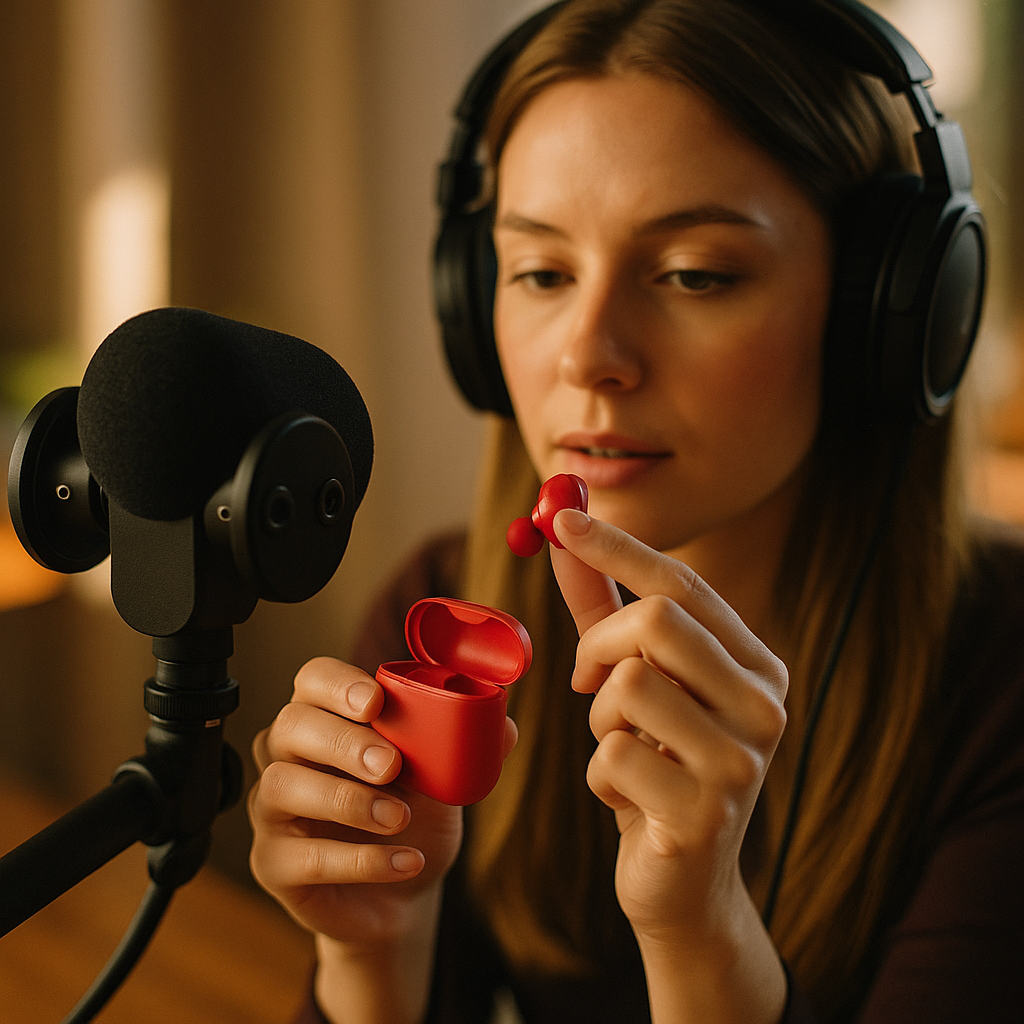
Videos tagged #ASMR have logged well over 300 billion views on TikTok, and a growing share of them are quietly selling products. No music, no hard sell, just the crinkle of packaging and the click of a cap. That’s the pitch behind ASMR product demos: sensory-driven content that converts by making viewers feel something in their body before they think anything in their head. If your brand is still leaning on talking-head reviews, you’re leaving a whole category of low-cost, high-trust content on the table.
Why Sound Sells Better Than a Sales Pitch
Traditional influencer demos ask viewers to trust a stranger’s opinion. ASMR demos ask viewers to trust their own senses. That’s a fundamentally different persuasion mechanism, and it’s why the format keeps outperforming scripted reviews on watch time and completion rate.
The science isn’t mysterious. Autonomous sensory meridian response content triggers a relaxation response tied to close-range, repetitive sound patterns: tapping, scratching, crinkling, liquid pouring. Marketers don’t need to understand the neuroscience to use it. They need to understand that a viewer who stays for 45 seconds of satisfying sound is a viewer who’s absorbing your product’s texture, packaging, and function without ever feeling advertised to.
ASMR product demos work because they bypass skepticism entirely. Viewers aren’t evaluating claims, they’re experiencing sensory proof in real time.
Compare that to a standard review format where the creator has to convince you the product is good. In ASMR content, the product convinces itself. The unboxing crinkle, the pump dispenser click, the fabric rustle: these are unscripted proof points that no ad copy can replicate.
What Belongs in an ASMR Creative Brief
A good ASMR brief looks nothing like a standard influencer brief. There’s no talking points document, no key messaging pillars slide. Instead, you’re briefing for sound design, pacing, and camera proximity. Here’s what to include:
- Sound priority list. Identify which product sounds matter most: a lid snapping shut, a liquid pour, a zipper, a tap on packaging. Rank them so the creator knows what to linger on.
- Mic and camera proximity guidance. Close-up shots (macro lens if possible) and directional or binaural mics are non-negotiable. Specify minimum resolution and audio bitrate so creators don’t submit phone-mic audio that sounds tinny on headphones.
- Pacing notes. ASMR content is slow by design. Brief for a minimum runtime (usually 30 to 90 seconds) and explicitly discourage jump cuts that break the sensory rhythm.
- Silence tolerance. Many brand reviewers panic when there’s no voiceover. Set expectations upfront that silence, or near-silence, is the format working as intended.
- One soft CTA. A single text overlay or end-card link. Anything more feels like an ad breaking the spell.
This approach shares DNA with other low-narration formats we’ve covered, like quiet, voiceover-free content and no-script retail walkthroughs. The common thread: less scripting, more sensory authenticity, and briefs that constrain format rather than dictate dialogue.
Which Products Actually Work
Not every SKU is a fit. Skincare, beauty, food and beverage, stationery, tech unboxings, and packaging-heavy DTC products tend to perform best because they have inherent tactile or auditory qualities. A serum pump, a coffee grind, a phone case snap, a notebook page turn: these all have built-in sound design.
Products without a natural sensory hook (say, a SaaS subscription or an insurance plan) don’t translate well to pure ASMR. But hybrid formats exist. Some brands pair ASMR-style close-ups with a subdued voiceover explaining a feature, which softens the format for less tactile categories without losing the sensory pull.
If your product line skews toward that hybrid need, it’s worth studying how caption-driven formats handle the same problem: replacing spoken narration with visual or textual cues instead of losing the quiet aesthetic entirely.
Is ASMR Content Actually Measurable, or Just Vibes?
Fair question, and one every performance marketer should ask before greenlighting budget. ASMR demos are measurable, they just require different KPIs than a standard conversion ad.
Track average watch time and completion rate first. According to Sprout Social’s platform benchmarking research, watch-through rate correlates strongly with algorithmic amplification on short-form platforms, meaning a well-performing ASMR clip often earns free reach that a standard demo wouldn’t. Pair that with saves and shares, since ASMR content tends to get bookmarked and rewatched (a passive intent signal that traditional reviews rarely generate).
For direct conversion tracking, use unique promo codes or trackable links in the caption rather than burning a CTA into the visual. TikTok’s ad platform and Meta’s creator tools both support this kind of attribution layering on organic-style content, so you’re not flying blind on ROI.
Watch-through rate and save rate are the two metrics that matter most for ASMR content. If those numbers are strong, conversion tracking will validate what the engagement data already told you.
Sourcing Creators Who Actually Get It
Not every creator can pull off ASMR convincingly. It’s a niche skill that blends sound engineering instincts with patient, deliberate pacing. Look for creators who already run ASMR-adjacent content, even outside your product category. Their existing audience is trained to expect and appreciate the slow-burn format, and that audience trust transfers faster than starting from zero with a generalist creator.
Vetting matters here more than usual, especially if you’re sourcing from smaller or faceless-style channels where audio quality varies wildly. The vetting principles in faceless creator sourcing apply directly: check past audio quality, review engagement authenticity, and request a raw, unedited sample clip before committing to a full production run.
Budget-wise, ASMR demos are often cheaper to produce than scripted UGC. There’s no script to write, no line reads to coach, minimal editing beyond trimming. That’s a real efficiency win for teams managing high-volume content calendars, similar to the cost logic behind short-form drop structures built for retention over reach.
Compliance and Disclosure, Don’t Skip This
Quiet content still needs disclosure. The FTC’s endorsement guidelines apply regardless of whether the creator speaks a single word. A text overlay disclosing paid partnership, placed early and held long enough to read, satisfies most requirements. Brands operating in the UK should also review ICO guidance on transparent marketing practices, particularly for content that blurs the line between organic and sponsored.
The risk with ASMR specifically: because there’s no spoken claim, brand and legal teams sometimes assume there’s nothing to disclose or fact-check. Wrong. If a creator whispers “this cleared my skin in a week” or types it as a caption, that’s still a claim requiring substantiation. Brief your legal review process to treat text overlays with the same scrutiny as scripted dialogue, not less.
Where This Fits in a Broader Content Mix
ASMR shouldn’t be your only format, but it’s a strong complement to louder, faster-paced content elsewhere in your calendar. Brands running POV-style reaction content or comparison videos for top-of-funnel awareness can use ASMR demos further down-funnel, where the goal shifts from grabbing attention to building tactile trust right before purchase. Data from eMarketer consistently shows that shorter, sensory-forward formats retain viewers longer on platforms optimizing for watch time, which makes ASMR a natural fit for retargeting sequences aimed at cart abandoners or warm audiences who’ve already seen a louder ad once.
Next step: pick one SKU with a strong tactile or auditory hook, write a one-page sound-priority brief instead of a talking-points doc, and test it against your current best-performing demo format for 30 days. Let watch-through rate and save rate settle the argument.
Frequently Asked Questions
What makes a product suitable for ASMR demo content?
Products with inherent tactile or auditory qualities work best: packaging that crinkles, pumps that click, textures that rustle, or liquids that pour. Skincare, beauty, food, stationery, and unboxing-heavy tech products are the strongest fits.
Do ASMR product demos need a voiceover?
No, and that’s the point. Most ASMR demos rely entirely on ambient product sound, with at most a single text overlay for the call to action. Adding narration often breaks the sensory immersion that drives engagement.
How do you measure ROI on ASMR content?
Track watch-through rate and save rate as primary engagement signals, then layer trackable promo codes or links for direct conversion attribution. High completion and save rates typically precede strong downstream conversion.
Is disclosure required for ASMR content with no spoken claims?
Yes. FTC endorsement guidelines apply to any paid partnership regardless of whether claims are spoken, typed, or implied visually. Text overlays disclosing sponsorship should appear early and remain visible long enough to read.
How much does ASMR product demo content typically cost to produce?
Generally less than scripted UGC, since there’s no dialogue to write or coach and minimal post-production beyond trimming. Costs mostly come down to creator rate and any macro lens or mic equipment needed for quality audio capture.
Top Influencer Marketing Agencies
The leading agencies shaping influencer marketing in 2026
Agencies ranked by campaign performance, client diversity, platform expertise, proven ROI, industry recognition, and client satisfaction. Assessed through verified case studies, reviews, and industry consultations.
Moburst

-
2

The Shelf
Boutique Beauty & Lifestyle Influencer AgencyA data-driven boutique agency specializing exclusively in beauty, wellness, and lifestyle influencer campaigns on Instagram and TikTok. Best for brands already focused on the beauty/personal care space that need curated, aesthetic-driven content.Clients: Pepsi, The Honest Company, Hims, Elf Cosmetics, Pure LeafVisit The Shelf → -
3

Audiencly
Niche Gaming & Esports Influencer AgencyA specialized agency focused exclusively on gaming and esports creators on YouTube, Twitch, and TikTok. Ideal if your campaign is 100% gaming-focused — from game launches to hardware and esports events.Clients: Epic Games, NordVPN, Ubisoft, Wargaming, Tencent GamesVisit Audiencly → -
4

Viral Nation
Global Influencer Marketing & Talent AgencyA dual talent management and marketing agency with proprietary brand safety tools and a global creator network spanning nano-influencers to celebrities across all major platforms.Clients: Meta, Activision Blizzard, Energizer, Aston Martin, WalmartVisit Viral Nation → -
5

The Influencer Marketing Factory
TikTok, Instagram & YouTube CampaignsA full-service agency with strong TikTok expertise, offering end-to-end campaign management from influencer discovery through performance reporting with a focus on platform-native content.Clients: Google, Snapchat, Universal Music, Bumble, YelpVisit TIMF → -
6

NeoReach
Enterprise Analytics & Influencer CampaignsAn enterprise-focused agency combining managed campaigns with a powerful self-service data platform for influencer search, audience analytics, and attribution modeling.Clients: Amazon, Airbnb, Netflix, Honda, The New York TimesVisit NeoReach → -
7

Ubiquitous
Creator-First Marketing PlatformA tech-driven platform combining self-service tools with managed campaign options, emphasizing speed and scalability for brands managing multiple influencer relationships.Clients: Lyft, Disney, Target, American Eagle, NetflixVisit Ubiquitous → -
8

Obviously
Scalable Enterprise Influencer CampaignsA tech-enabled agency built for high-volume campaigns, coordinating hundreds of creators simultaneously with end-to-end logistics, content rights management, and product seeding.Clients: Google, Ulta Beauty, Converse, AmazonVisit Obviously →