


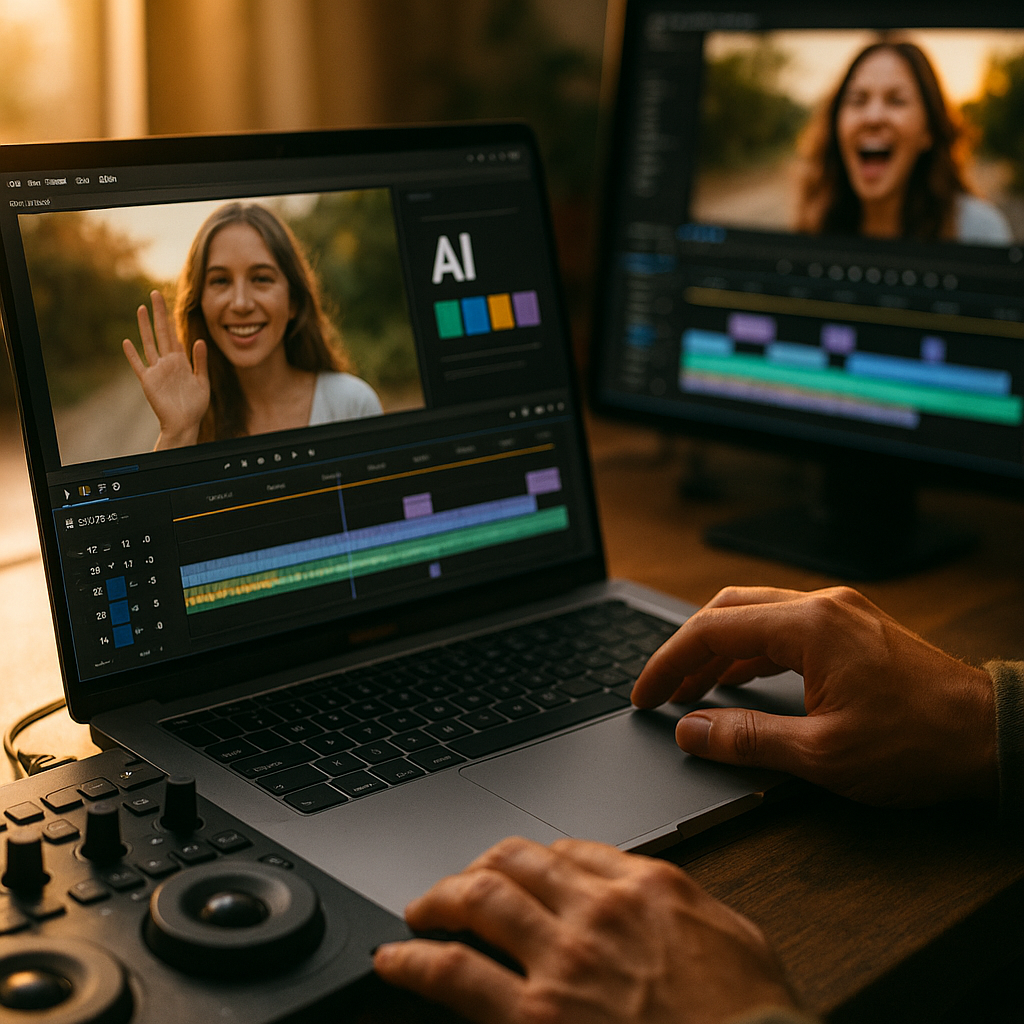
Seventy percent of a short reel’s audience decides whether to keep watching within the first three seconds. That single number explains why AI-enhanced short reel tools have become the most fought-over line item in creator content budgets. Every vendor claims their editor “boosts retention.” Few can prove it. This piece separates the features that genuinely lift completion rates from the ones that just look impressive in a sales demo.
Why Completion Rate Beats Every Other Vanity Metric
Views are cheap. Likes are cheaper. Completion rate, the percentage of viewers who watch a reel to the end, is the metric platforms actually reward with distribution. TikTok, Instagram, and YouTube Shorts all weight watch-through and rewatch signals heavily in their ranking models. If your creator content isn’t finishing strong, it’s not reaching new audiences, no matter how many hearts it collects.
That’s the operational reality brand teams need to internalize before they buy another AI editing tool. The question isn’t “does this tool make editing faster.” It’s “does this tool change viewer behavior in the final ten seconds.”
A tool that shaves editing time by 80% but doesn’t touch pacing, hooks, or caption timing is a productivity gain, not a performance gain. Don’t confuse the two when building your business case.
The Four Features That Actually Move the Needle
After testing output across dozens of creator campaigns, four capabilities consistently correlate with higher completion rates. Everything else is nice to have.
- Automated hook detection and reordering. Tools like Opus Clip and Munch scan raw footage for the highest-energy or highest-information moment and move it to the first two seconds, regardless of where it originally sat in the timeline. This single feature has the largest measurable impact on drop-off in the first five seconds.
- Silence and dead-air trimming with pacing scoring. AI models that flag pauses longer than a set threshold and auto-tighten them keep momentum without the choppy jump-cut feel of older auto-editors.
- Dynamic caption timing synced to speech cadence. Captions that lag or lead dialogue by even half a second measurably increase scroll-away rates, especially on sound-off mobile viewing.
- Retention heatmap feedback loops. The best platforms show you exactly where viewers dropped off on a previous post and use that data to inform edits on the next one. Editing without this loop is guesswork.
Notice what’s missing from that list: filters, transitions, AI voice cloning, and background music libraries. Those are polish, not performance drivers. Brands that prioritize aesthetic features over retention mechanics are optimizing for the wrong outcome.
Tool Comparison: What Each Platform Actually Delivers
Here’s how the major players stack up when you isolate for completion-rate impact rather than feature-sheet length.
CapCut’s AI suite remains the most accessible entry point for in-house teams. Its auto-caption and beat-sync tools are solid, but its hook-reordering logic is less sophisticated than dedicated repurposing tools. Good for volume, average for retention lift.
Opus Clip built its reputation on turning long-form video into short clips, and its virality scoring model does a genuinely useful job of flagging which ten-second segment will hook viewers. Brands running podcast-to-reel pipelines see the clearest ROI here.
Adobe’s creator-focused tooling, which we broke down in our early adopter ROI review, integrates brand asset governance with editing, which matters more for enterprise teams juggling approval workflows than for raw completion lift. It’s a compliance win layered on top of a modest retention win.
Munch leans heavily into multi-platform reformatting with retention-aware trimming baked into its output, making it a solid fit for agencies managing creator content across TikTok, Reels, and Shorts simultaneously.
Enterprise teams evaluating heavier creative infrastructure should also look at how large-scale AI creative studios are approaching this problem, since some are building retention scoring directly into their production pipelines rather than bolting it on after the edit.
UGC Editing Tools Carry Their Own Risk Profile
Not every editing decision is purely creative. When brands run AI tools against creator-submitted UGC, there’s a layer of rights, disclosure, and content authenticity risk that pure performance metrics ignore. We covered this tension in detail in our look at AI video editors for UGC, and the core finding holds here too: the tools that most aggressively reorder or re-cut creator footage for hook optimization are also the ones most likely to strip original context, which can trigger disclosure and consent headaches under FTC guidance on endorsements and testimonials.
Practical fix: build a review checkpoint into your workflow where a human confirms that AI-driven reordering hasn’t changed the substance of a creator’s claim or implied endorsement. It takes thirty seconds per asset and prevents a much bigger compliance mess later. The FTC’s endorsement guidance doesn’t care that an algorithm made the edit, the brand is still on the hook.
Personalization Layers: Worth the Complexity?
A newer wave of tools now claims to personalize reel pacing and hook selection per audience segment, essentially serving a slightly different edit to different viewer cohorts based on predicted attention span. Our comparison of real-time personalization frameworks found this approach delivers measurable lift, but only at scale. If you’re running fewer than fifty reels a month, the infrastructure overhead isn’t worth it yet. If you’re running creator programs at the volume that platforms like performance-based discovery tools support, personalized pacing starts paying for itself.
Building the Business Case Internally
Marketing leadership doesn’t approve tool spend on vibes. You need a comparison framework that ties tool selection to a measurable outcome, and completion rate is the cleanest one available because every major platform reports it natively.
- Pull baseline completion rate data from your last 90 days of reel content across platforms.
- Run a controlled test: same creator brief, same footage, edited manually versus edited with the AI tool under evaluation.
- Compare completion rate, not just watch time, since watch time can be inflated by longer edits that don’t necessarily finish stronger.
- Factor in editing hours saved as a secondary, not primary, justification.
This is the same logic that applies to broader martech stack decisions. Our vendor evaluation scorecard approach works just as well for a single-point editing tool as it does for a full platform consolidation decision.
If your reporting stack can’t isolate completion rate by tool used, you’re not measuring ROI, you’re measuring vibes with extra steps.
According to industry benchmarking from eMarketer, short-form video now accounts for the majority of social content budgets among mid-size and enterprise brands, which makes the completion-rate question a budget question, not a nice-to-have. Platforms including TikTok’s ad tools and Meta’s business suite both surface retention curves natively, so there’s no excuse for guessing.
Where Discovery and Editing Tools Need to Talk to Each Other
One gap almost nobody solves well: the editing tool and the creator discovery platform rarely share data. If a discovery tool like the ones compared in this discovery tool matchup already knows which creators produce high-completion content, that signal should feed directly into which creators get fast-tracked for AI-assisted editing support. Right now it mostly doesn’t, and brands are leaving retention data on the table between platforms.
For a broader look at how content moves from sourcing through publishing, our breakdown of the five layer creator stack maps out where editing tools should sit relative to discovery, payment, and compliance layers, which is useful context before you commit budget to any single point solution.
FAQs
Frequently Asked Questions
What actually raises reel completion rates the most?
Hook reordering, tightened pacing through silence removal, and precisely timed captions have the strongest measured impact. Aesthetic features like filters and transitions have minimal effect on whether viewers watch to the end.
Are AI editing tools worth it for small creator programs?
For basic editing time savings, yes. For advanced features like retention heatmaps and personalized pacing, the ROI usually requires enough content volume, generally north of fifty reels a month, to justify the setup and review overhead.
Do AI-edited reels perform better than manually edited ones?
Not automatically. The tool matters less than which specific features it uses. A well-briefed manual edit with strong hook placement can outperform a poorly configured AI edit every time.
Can AI reel editing create compliance risk with creator content?
Yes. Aggressive AI reordering of UGC can strip context from a creator’s original claim or endorsement, which raises disclosure concerns under FTC guidance. A human review checkpoint before publishing mitigates most of this risk.
How should brands measure ROI on an AI editing tool?
Run a controlled comparison using the same footage and brief, one edited manually and one with the AI tool, then compare completion rate specifically, not total watch time or view count, across the same publishing window.
Next step: before renewing or buying any AI editing tool, run a 30-day controlled test comparing completion rate on matched content, then let that single number, not the feature list, decide the contract.
Top Influencer Marketing Agencies
The leading agencies shaping influencer marketing in 2026
Agencies ranked by campaign performance, client diversity, platform expertise, proven ROI, industry recognition, and client satisfaction. Assessed through verified case studies, reviews, and industry consultations.
Moburst

-
2

The Shelf
Boutique Beauty & Lifestyle Influencer AgencyA data-driven boutique agency specializing exclusively in beauty, wellness, and lifestyle influencer campaigns on Instagram and TikTok. Best for brands already focused on the beauty/personal care space that need curated, aesthetic-driven content.Clients: Pepsi, The Honest Company, Hims, Elf Cosmetics, Pure LeafVisit The Shelf → -
3

Audiencly
Niche Gaming & Esports Influencer AgencyA specialized agency focused exclusively on gaming and esports creators on YouTube, Twitch, and TikTok. Ideal if your campaign is 100% gaming-focused — from game launches to hardware and esports events.Clients: Epic Games, NordVPN, Ubisoft, Wargaming, Tencent GamesVisit Audiencly → -
4

Viral Nation
Global Influencer Marketing & Talent AgencyA dual talent management and marketing agency with proprietary brand safety tools and a global creator network spanning nano-influencers to celebrities across all major platforms.Clients: Meta, Activision Blizzard, Energizer, Aston Martin, WalmartVisit Viral Nation → -
5

The Influencer Marketing Factory
TikTok, Instagram & YouTube CampaignsA full-service agency with strong TikTok expertise, offering end-to-end campaign management from influencer discovery through performance reporting with a focus on platform-native content.Clients: Google, Snapchat, Universal Music, Bumble, YelpVisit TIMF → -
6

NeoReach
Enterprise Analytics & Influencer CampaignsAn enterprise-focused agency combining managed campaigns with a powerful self-service data platform for influencer search, audience analytics, and attribution modeling.Clients: Amazon, Airbnb, Netflix, Honda, The New York TimesVisit NeoReach → -
7

Ubiquitous
Creator-First Marketing PlatformA tech-driven platform combining self-service tools with managed campaign options, emphasizing speed and scalability for brands managing multiple influencer relationships.Clients: Lyft, Disney, Target, American Eagle, NetflixVisit Ubiquitous → -
8

Obviously
Scalable Enterprise Influencer CampaignsA tech-enabled agency built for high-volume campaigns, coordinating hundreds of creators simultaneously with end-to-end logistics, content rights management, and product seeding.Clients: Google, Ulta Beauty, Converse, AmazonVisit Obviously →