


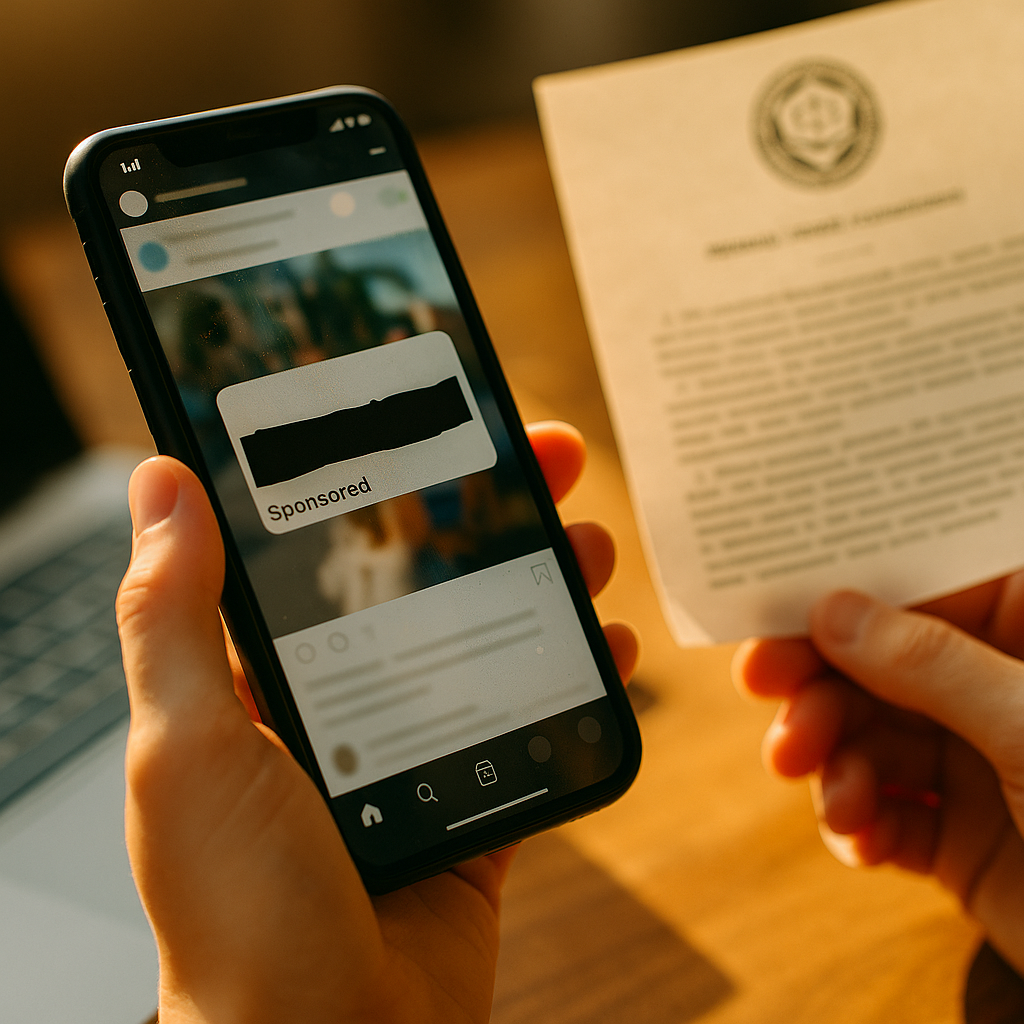
Here’s an uncomfortable number: most brands running “boosted” creator content have no documented process for verifying the disclosure label survives the boost. Zero. Dark posting, the practice of running creator content as a paid ad without it ever appearing on the creator’s public feed, has quietly become standard media buying practice. But dark posting and FTC disclosure requirements are on a collision course, and most legal teams haven’t caught up.
What Dark Posting Actually Is (and Why It’s Not Going Away)
Dark posts are unpublished content, typically a creator’s video or image, that runs exclusively as paid media. It never lives on the creator’s grid or feed. Nobody scrolling that creator’s profile will ever see it. Meta popularized the format years ago through what it now folds into Advantage+ campaign tools, and TikTok’s Spark Ads function on the same logic: take organic-feeling content, attach a media budget, and target it surgically.
The appeal is obvious. Dark posts let brands test dozens of creative variants without cluttering a creator’s feed or diluting their personal brand. Performance marketers love the format because it behaves like paid social but carries the credibility of organic content. That credibility, the sense that this is just a creator sharing their honest opinion, is precisely the problem.
The Disclosure Gap Nobody Budgeted For
When a creator posts a sponsored video organically, the disclosure label (#ad, “Paid partnership with,” a platform-native tag) is baked into the post. It travels with the content wherever it’s shared, embedded, or screenshotted. Dark posting breaks that chain. Because the content never publishes organically, brands sometimes strip out the creator’s original caption and disclosure language during the ad-build process, then rely on the ad platform’s own “Sponsored” tag to do the disclosure work.
That’s a gamble. A small gray “Sponsored” label sitting above a video thumbnail is not the same as a clear, conspicuous statement that the person on screen was paid to say what they’re saying. The FTC’s Endorsement Guides are explicit that disclosures must be unavoidable and understood in context, not buried in ad-platform metadata that a consumer might not even register as a disclosure at all.
A platform’s generic “Sponsored” tag tells consumers an ad was purchased. It does not tell them a specific person was paid to endorse a specific product, and that distinction is exactly what the FTC’s Endorsement Guides require.
We covered this exact blind spot in our earlier breakdown of dark posted ad disclosure gaps, and the pattern hasn’t improved much since. Agencies keep treating disclosure as a creative asset problem (does the caption say #ad?) rather than a media trafficking problem (does the label survive the version that actually reaches consumers?).
Does Paid Amplification of an Organic Post Need a New Label?
This is the question keeping compliance leads up at night. If a creator already disclosed a partnership organically, and a brand simply boosts that existing post using the platform’s native “boost” button, most legal teams assume the original disclosure carries through. That assumption is usually correct, since the post itself, caption and all, is what gets amplified.
Dark posting is different. It’s not boosting an existing post. It’s building a new ad unit from creator footage, often re-editing it, re-captioning it, or combining clips from multiple creators. Once you’ve altered the asset, you’ve arguably created a new piece of content that needs its own disclosure treatment, independent of whatever the creator originally posted (if they posted anything publicly at all).
Ask yourself three questions before greenlighting a dark post built from creator content:
- Does the final ad unit include the creator’s original disclosure language, visible and legible, not just referenced in the caption field?
- Would a reasonable consumer scrolling their feed understand this is a paid endorsement, not organic commentary?
- If this ad were screenshotted and shared outside the platform, would the disclosure travel with it?
If the answer to any of those is no, you have a labeling gap, regardless of what the ad platform’s default “Sponsored” tag says.
Why Platform Tags Aren’t a Legal Shield
Marketers frequently assume that because Meta, TikTok, and YouTube require advertisers to flag branded content through native tools, the platform’s tag alone satisfies FTC disclosure obligations. It doesn’t. Platform policies exist to protect the platform’s advertising business and user trust metrics, not to satisfy federal consumer protection law. They’re related, but they’re not the same compliance regime.
TikTok has actually built more robust tooling here than most brands realize. We broke down how those TikTok Shop disclosure tools can be configured to force disclosure persistence, but configuration is opt-in. Nobody flips that switch by default. Meanwhile YouTube has rolled out automated detection specifically because manual disclosure compliance kept failing at scale, a shift we detailed in our look at YouTube’s auto detection system for undisclosed brand deals.
The direction is clear: platforms are building automated guardrails because brands and agencies have proven, repeatedly, that they won’t self-police dark posting disclosure without a technical nudge.
Where This Gets Riskier: Live and Shoppable Formats
Dark posting a static video is one thing. Dark posting a clip pulled from a livestream shopping event is a different animal entirely, because the original context (a live host explaining a partnership in real time) gets stripped out when you extract a 15-second highlight for paid media. We’ve written before about why real-time disclosure labels beat bolted-on ones, and the same logic applies here in reverse. A label that worked fine in the live moment often disappears entirely once the clip is repackaged as an ad.
The same risk shows up in connected TV placements, where creator content gets reformatted for a completely different viewing environment. Our piece on connected TV disclosure requirements found brands frequently lose disclosure text entirely during the reformatting process, simply because nobody on the media team thought to check.
Building a Dark Posting Compliance Workflow That Actually Holds Up
Fixing this isn’t complicated, but it does require someone owning the handoff between creative and media buying. Here’s what a working process looks like:
- Lock disclosure language before editing begins. Whoever builds the ad unit should receive the required disclosure text as a non-negotiable creative element, not an afterthought added in review.
- Audit every dark post before launch, not after. A five-minute checklist beats a five-figure FTC inquiry. Confirm the label is visible for the full duration a typical viewer would watch, not just in the first frame.
- Document platform-native tags as a supplement, never a substitute. Screenshot the ad as it appears live, including any “Sponsored” labeling, and file it alongside your disclosure documentation.
- Apply the same standard across markets. If you’re running dark posts internationally, disclosure expectations vary, and we covered how to structure this in our guide to location-gated disclosure policy.
- Extend live shopping disclosure rules to clipped content. Our FTC placement playbook for live shopping is a useful template for treating extracted clips with the same rigor as the original broadcast.
None of this is glamorous work. But social media compliance research consistently shows that undisclosed paid partnerships erode consumer trust faster than almost any other brand safety issue, and regulators have taken notice of the volume of paid amplification running through platforms without adequate labeling.
If your dark posting workflow can’t answer “where did the disclosure go” for every ad unit built from creator content, you don’t have a compliance program. You have a liability waiting for an FTC complaint to surface it.
The broader trend, per eMarketer’s influencer marketing forecasts, is that paid amplification of creator content will keep growing as a share of total influencer spend. That means the disclosure gap in dark posting isn’t a niche edge case. It’s becoming the default way brands scale creator content, which makes fixing the labeling process a budget-line priority, not a legal afterthought.
The Takeaway
Treat every dark post built from creator content as a new ad requiring its own disclosure check, not an extension of whatever the creator originally posted. Build that checkpoint into your media trafficking process this quarter, before your next paid amplification push scales the gap along with it.
Frequently Asked Questions
What is dark posting in influencer marketing?
Dark posting is running creator content as a paid advertisement without publishing it on the creator’s public feed or profile. It exists only as an ad, targeted to specific audiences, and never appears organically.
Does the FTC require special disclosure for dark posts?
The FTC doesn’t have a rule specifically labeled “dark posting,” but its Endorsement Guides require that any material connection between a brand and an endorser be disclosed clearly and conspicuously in whatever format the content reaches consumers, including dark posts.
Is a platform’s “Sponsored” tag enough to satisfy disclosure rules?
Generally, no. A generic “Sponsored” label confirms an ad was purchased but doesn’t clearly convey that a specific creator was paid to endorse the product, which is what the FTC’s disclosure standard actually requires.
Do boosted organic posts need a different disclosure than dark posts?
If a brand boosts an existing organic post without altering it, the original disclosure typically carries through since the caption and content remain intact. Dark posts built from re-edited or re-captioned creator footage need independent disclosure review because the original context may not survive the edit.
Who is responsible for disclosure compliance on a dark post, the brand or the creator?
The FTC has pursued both brands and creators for inadequate disclosure, but brands typically carry greater exposure on dark posts since they control the final ad unit and the media spend behind it.
Top Influencer Marketing Agencies
The leading agencies shaping influencer marketing in 2026
Agencies ranked by campaign performance, client diversity, platform expertise, proven ROI, industry recognition, and client satisfaction. Assessed through verified case studies, reviews, and industry consultations.
Moburst

-
2

The Shelf
Boutique Beauty & Lifestyle Influencer AgencyA data-driven boutique agency specializing exclusively in beauty, wellness, and lifestyle influencer campaigns on Instagram and TikTok. Best for brands already focused on the beauty/personal care space that need curated, aesthetic-driven content.Clients: Pepsi, The Honest Company, Hims, Elf Cosmetics, Pure LeafVisit The Shelf → -
3

Audiencly
Niche Gaming & Esports Influencer AgencyA specialized agency focused exclusively on gaming and esports creators on YouTube, Twitch, and TikTok. Ideal if your campaign is 100% gaming-focused — from game launches to hardware and esports events.Clients: Epic Games, NordVPN, Ubisoft, Wargaming, Tencent GamesVisit Audiencly → -
4

Viral Nation
Global Influencer Marketing & Talent AgencyA dual talent management and marketing agency with proprietary brand safety tools and a global creator network spanning nano-influencers to celebrities across all major platforms.Clients: Meta, Activision Blizzard, Energizer, Aston Martin, WalmartVisit Viral Nation → -
5

The Influencer Marketing Factory
TikTok, Instagram & YouTube CampaignsA full-service agency with strong TikTok expertise, offering end-to-end campaign management from influencer discovery through performance reporting with a focus on platform-native content.Clients: Google, Snapchat, Universal Music, Bumble, YelpVisit TIMF → -
6

NeoReach
Enterprise Analytics & Influencer CampaignsAn enterprise-focused agency combining managed campaigns with a powerful self-service data platform for influencer search, audience analytics, and attribution modeling.Clients: Amazon, Airbnb, Netflix, Honda, The New York TimesVisit NeoReach → -
7

Ubiquitous
Creator-First Marketing PlatformA tech-driven platform combining self-service tools with managed campaign options, emphasizing speed and scalability for brands managing multiple influencer relationships.Clients: Lyft, Disney, Target, American Eagle, NetflixVisit Ubiquitous → -
8

Obviously
Scalable Enterprise Influencer CampaignsA tech-enabled agency built for high-volume campaigns, coordinating hundreds of creators simultaneously with end-to-end logistics, content rights management, and product seeding.Clients: Google, Ulta Beauty, Converse, AmazonVisit Obviously →